eBook - ePub
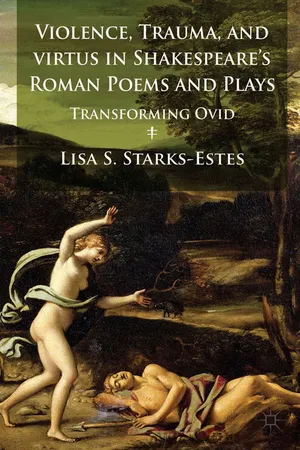
Violence, Trauma, and Virtus in Shakespeare's Roman Poems and Plays
Transforming Ovid
- English
- ePUB (mobile friendly)
- Available on iOS & Android
eBook - ePub
Violence, Trauma, and Virtus in Shakespeare's Roman Poems and Plays
Transforming Ovid
About this book
Employing psychoanalysis, trauma theory, and materialist perspectives, this book examines Shakespeare's appropriations of Ovid's poetry in his Roman poems and plays. It argues that Shakespeare uses Ovid to explore violence, trauma, and virtus - the traumatic effects of aggression, sadomasochism, and the shifting notions of selfhood and masculinity.
Information
Topic
LiteraturaSubtopic
Crítica literaria europeaLove’s Wound: Violence, Trauma, and Ovidian Transformation in Shakespeare’s Roman Poems and Plays
1
The Origin of Love: Ovidian Lovesickness and Trauma in Venus and Adonis
During the infamous War of the Theatres (or Poetomachia), Ben Jonson lampooned writers who had affiliated themselves with the Ovid movement of the 1590s in his satirical Poetaster (first performed in 1601). In this comedy, Jonson directly pokes fun at fellow dramatists John Marston and Thomas Dekker and indirectly criticizes Ovidian poet-playwrights Marlowe and Shakespeare by staging a showdown between Ovid and Virgil, moderated by Horace (most likely representing Jonson himself) and judged by the Emperor Augustus. In dramatizing his own biased view of these ancient writers and the traditions they represented in his time, Jonson portrays Ovid as a melancholy lover who recites from a marginally altered version of Marlowe’s translation of Ovid’s Amores, elegy 1.15 (Poet., 1.1.1–2)1 and swoons for love of Augustus’s married daughter Julia, and as a radical poet who pursues poetry against his father’s wishes for him to study law. Ovid, Julia, and his followers are banished from court, even though Horace defends their ‘pleasures’ as ‘harmless’ enough, just ‘innocent mirth’, in a transparently back-handed defense of Ovid and hence Ovidian poets (4.8.12–13).2
As Colin Burrow notes, Jonson’s play appears during a backlash against the Ovid craze of the 1590s, an attempt to eradicate the ‘dominant eroticized reading of Ovid’, which resulted not in the elimination of Ovid’s influence but in a shift toward a coupling of his subjects with an emphasis on the vitality of the Ovidian imagination.3 The primary message of Jonson’s play is clear: Ovid’s notorious (perhaps even dangerous) verses pale in comparison to the glorious poetry of the great Virgil. As Jonson dramatizes, writers of the English Renaissance swore allegiance to one side or the other – to Virgil, poet of chastity, epic legacy, reason, and constancy; or to Ovid, poet of eroticism, counter-tradition, imagination, and transformation. Jonson makes his allegiance to the former, and Shakespeare, following Marlowe, to the latter. Throughout his career, especially in his Roman poems and plays, Shakespeare offers a sustained defense of Ovid and his counter-Virgilian legacy, which he announces in the ‘first heir of ... [his] invention’, Venus and Adonis (1593).4
In his Venus and Adonis, Shakespeare challenges the myopic view of Ovid and his poetry that Jonson later depicted. Even as his poem luxuriates in sensuous Ovidian language, both in Latin and in Golding’s translation, it unearths the violence and vulnerability that lurk just beneath its tantalizing surface. In this poem, Shakespeare exhibits a playful eroticism in the full Ovidian sense, but with an edge. Rather than incorporating Ovid’s myths to teach moral lessons or to allegorize Neoplatonic virtues, he employs them to delve into the depths of melancholy and to engage fully with sadomasochism in its manifestation as early modern lovesickness, foregrounding the alignment of desire and death in conceptions of love. In so doing, Shakespeare, in Ovidian fashion, creates an etiological myth in his Venus and Adonis – one that explains the origin of love as suffering, a union of pleasure and pain.5
Shakespeare fashions his myth through the use of Ovidian poetics, transforming and combining multiple sources from Ovid’s Metamorphoses (Venus and Adonis and its contexts, as well as Echo and Narcissus, Salmacis and Hermaphroditus); the tradition of ‘mournful love’ from Ovid’s Amores and the Latin elegiac tradition; the conventions of Petrarchan love poetry; and, by extension, his own sonnets.6 By casting the story of Venus and Adonis in this Ovidian framework and drawing from Ovid’s fluid characterization of gender and transgressive sexuality that run throughout Ovid’s poetry, Shakespeare makes his poem more ‘Ovidian’ than Ovid’s own version of the tale in his Metamorphoses.7 Through a dynamic intertextual treatment of these sources, which is at times parodic, at other times full of erotic intensity and human pathos, Shakespeare provides multilayered variations on the theme of love as torment and ecstasy, involving homo- and heteroerotic desires as well as the pangs of unrequited love and loss. Shakespeare ventures into this dangerous territory equipped with characteristically Ovidian wit, allowing him to explore the erotics of cruelty and sorrow of loss while maintaining a comic sensibility. Through this full engagement with love-melancholy, Shakespeare traverses from comic eroticism into a full examination of the deepest emotional layers of Ovidian poetry, the effects of violence as trauma.
Even in this early poem, Shakespeare demonstrates what Augustus and even Horace (alias Jonson) in Poetaster simply do not comprehend about Ovidianism, especially Shakespeare’s take on it: that even if – or perhaps especially even when – Ovid’s poetry is divorced from the moralizing tradition, it is anything but a frivolous or empty appeal to sensory delights. Early in his career, in this poem and also in his comedy A Midsummer Night’s Dream (treated in the Coda of this study), Shakespeare announces his affiliation with this Ovid – his subject matter, poetic process, and radical experimentation with genre. In choosing the Latin epyllion (Ovid) over the Latin epic (Virgil) in his own poetic mythmaking, Shakespeare makes a deliberate statement about poetry and its investment in ideals of masculinity and authority.
As Shakespeare and his contemporaries well knew, the Latin epic – with Virgil’s Aeneid as its prototype – was deeply implicated in the service of dynastic power and imperial conquest, as the primary purpose of its narrative was to praise Augustus and to build poetic monuments of national history and identity from inherited stories, chronicles, legends, and myths. At least on the surface level, the epic supports the dominant order – even if on another it may seem to criticize that order by mourning the losses and futility of war.8 Despite the counter-discourses it may contain, the epic nevertheless aims at the glorification of martial victory and conquest as the fulfillment of imperial destiny.9 Consequently, the Latin epic necessarily valorizes the ideals and attempts to solidify the notions of national masculine identity under the rubric of virtus in its meaning as manly valor.10 In this sense, Alison Keith explains, the ‘classical epic was a privileged site for negotiating questions of masculine identity’11 – and the Roman epic more so than the Greek. Whereas the Greek epic centers on issues of masculine prerogative, codes of behavior, and skill on the battlefield, the Latin epic is built around ‘additional pressure on gender ..., given the centrality of uir-tus in all senses to the genre at Rome’.12 According to Alison Sharrock, the Roman epic explicitly endorses a ‘masculine order’ in the realms of ‘Augustus, arma (war and epic), and political life’.13 The dominance of this ‘masculine order’ is evident in the Latin epic – both what is included in and excluded from its narrative.
These boundaries of the Latin epic were made more visible when viewed in relief against its opposing poetic genre, the love elegy, a tradition that Ovid revived from earlier generations of Latin poets – Catullus, Gallus, Propertius, and Tibullus. These Latin poets, in turn, had drawn from an earlier tradition of erotic verse from the poetry of ancient Greece, namely that of Sappho.14 The Latin elegiac tradition generally involves a male speaker who, a self-proclaimed slave to love, devotes his life to everything except what the Roman ethic dictates in choosing to serve his cruel Dominae or ‘slave mistress’ rather than Augustus or Rome; and dedicating his life to the pursuit of passion and pleasure, rather than reason and military discipline.15
Like the earlier Catullus who raged against Julius Caesar’s political machine while perfecting a poetic form that played dangerously on the edges of Roman masculinity, Ovid wrote elegies in defiance of Augustus and all he represented, clearly pushing the edges of the elegy much further in his amatory verses. Even Ovid’s choice to write in this genre constituted an extreme break from poetry sanctioned by Augustus, for the love elegy valorizes everything that is shunned in the Roman masculine ideal, as Ovid’s speaker declares with playful wit in the opening lines of his Amores:
Arma gravi numero violentaque bella parabam
edere, materia conveniente modis.
par erat inferior versus – risisse Cupido
dicitur atque unum surripuisee pedem. (1.1.1–4)
I’d meant in solemn metre to rehearse
A tale of arms and war and violence,
Matching the weighty matter with my verse,
All lines alike in length – no difference;
But Cupid laughed (they say)
And filched one foot away. (1.1.1–6)16
Ovid’s lighthearted tone here and in his farewell to the epic (2.1) masks the truly profound goals of his poetic project. Ovid’s elegies challenge the Augustan order of things by questioning dominant notions of masculine identity, exposing the vulnerability that lurks just beneath the seemingly impermeable, rigid surface of Roman virtus.17 Although writing of love not war in his elegies, Ovid nevertheless grapples with the ideal of virtus and the imperative of war in Roman masculinity through his ironic use of martial metaphors in the rhetoric of his love poetry (militia amoris or ‘soldiery of love’ – especially in 1.9, 2.10, 2.12, 3.8) and also through his complex examination of erotic dynamics – domination and submission, violence and desire, impenetrability and vulnerability – in amatory relations. As Sharrock claims, ‘[Ovid’s] poetry is constantly showing us both the violence and the uis of love and also the vulnerability of violence’ (italics added).18
Ovid self-consciously writes from the inherited tradition of Latin amatory verse noted above, playing on the theme of dominance and submission in his love poetry, but in so doing unabashedly exposes its erotic dynamic, using the speaker’s perspective ironically to reveal the fragile façade of masculinity in all its guises. Ovid’s speaker – a persona that M.L. Stapleton calls the desultor Amoris (from a line in which he insists that he is the opposite, ‘non sum desultor Amoris’ [Amores, 1.3.15]) – reveals himself to be a narcissistic, insensitive, abusive lover and untrustworthy narrator of his disastrous, mostly failed amorous pursuits of the married ‘Corinna’ and another woman, the femina nova. In his selfish pursuits of women, the desultor Amoris ends up becoming everything he sought not to be: a fool who is a powerless, emotional slave to love. As Stapleton explains, through his unfeeling responses to his beloved – including a self-centered meditation on her abortion, his deception and lack of fidelity with her maid, and so on – the desultor Amoris ends up impotent and lonely, discarded by his femina nova for a rich soldier.19 Ovid, who employs irony to distance himself as poet from this persona, allows his readers to see through the desultor’s many guises, ultimately revealing his empty shallowness. Through the use of this ironic narrator, Ellen Greene notes, Ovid ‘reveals what he believes to be the hypocrisy in the elegiac pose’, thereby ‘attempt[ing] to destroy the myth of the elegiac lover as the upholder of an ideal’.20 In effect, even as Ovid writes love poetry to undercut the epic, he also exposes the underlying assumptions of its conventions as they had been developed by the Latin elegists who preceded him.
Ovid’s love elegies, in many ways, can be said to be the poetry that launched the later traditions of courtly love, Petrarchan poetry, and the subsequent variations on the love sonnet.21 The Renaissance lyric emerged from a medieval tradition that had infused the Ovidian legacy with Christian ideology, the Neoplatonic ideal of transcendent love, thereby producing a tension between the sexual and spiritual aspects inherent in its erotic dynamic. Petrarch refashioned the lyric tradition from this legacy, writing love poetry to his aloof mistress as Ovid and forerunners had done; he also appropriated Ovid’s mythological framework (Apollo and Daphne; Diana and Actaeon) and the dominant themes, conceits, or metaphors – such as the hunt – from Ovid’s Metamorphoses. However, Petrarch closed Ovid’s gap between the poet and persona, creating an ‘I’ that is complex but, at the same time, much more empathetic.
Petrarch’s poetry instigated and perpetuated generations of adaptations and revisions, so that by the time Sir Thomas Wyatt imported the Petrarchan sonnet to England following his diplomatic trips on the continent for Henry VIII, its conventions had already undergone multiple variations in Europe. The Elizabethans, who reshaped the Petrarchan sonnet in their own image, clearly understood the connections between the Latin elegiac tradition and the later Renaissance lyric, as they published their sonnets in the same collections as their Ovidian poems.22 Furthermore, Elizabethan poets like Marlowe and Shakespeare seem to have found in the earlier, pre-Christian poetry of Ovid a sophistication and skepticism that challenged and provided an attractive alternative to the later, Renaissance Italian tradition that had been passed down to the English sonneteers.
Inspired by this new Ovidian movement, Shakespeare and his contemporaries found an alternative genre drawn from Ovid’s Metamorphoses – now inflected with his elegiac verses and their inherited legacy of the Petrarchan sonnet – often termed the epyllion or the Ovidian narrative.23 This conflation of the anti-epic elegiac and the narrative modes allowed these poets to employ Ovidian poetics of transformation by intermixing e...
Table of contents
- Cover
- Title
- Copyright
- Acknowledgements
- Introduction
- Part I Love’s Wound: Violence, Trauma, and Ovidian Transformation in Shakespeare’s Roman Poems and Plays
- Part II Transforming Bodies: Trauma, Virtus, and the Limits of Neo-Stoicism in Shakespeare’s Roman Poems and Plays
- Notes
- Bibliography
- Index
Trusted by 375,005 students
Access to over 1.5 million titles for a fair monthly price.
Study more efficiently using our study tools.
Frequently asked questions
Yes, you can cancel anytime from the Subscription tab in your account settings on the Perlego website. Your subscription will stay active until the end of your current billing period. Learn how to cancel your subscription
No, books cannot be downloaded as external files, such as PDFs, for use outside of Perlego. However, you can download books within the Perlego app for offline reading on mobile or tablet. Learn how to download books offline
Perlego offers two plans: Essential and Complete
- Essential is ideal for learners and professionals who enjoy exploring a wide range of subjects. Access the Essential Library with 800,000+ trusted titles and best-sellers across business, personal growth, and the humanities. Includes unlimited reading time and Standard Read Aloud voice.
- Complete: Perfect for advanced learners and researchers needing full, unrestricted access. Unlock 1.5M+ books across hundreds of subjects, including academic and specialized titles. The Complete Plan also includes advanced features like Premium Read Aloud and Research Assistant.
We are an online textbook subscription service, where you can get access to an entire online library for less than the price of a single book per month. With over 1.5 million books across 990+ topics, we’ve got you covered! Learn about our mission
Look out for the read-aloud symbol on your next book to see if you can listen to it. The read-aloud tool reads text aloud for you, highlighting the text as it is being read. You can pause it, speed it up and slow it down. Learn more about Read Aloud
Yes! You can use the Perlego app on both iOS and Android devices to read anytime, anywhere — even offline. Perfect for commutes or when you’re on the go.
Please note we cannot support devices running on iOS 13 and Android 7 or earlier. Learn more about using the app
Please note we cannot support devices running on iOS 13 and Android 7 or earlier. Learn more about using the app
Yes, you can access Violence, Trauma, and Virtus in Shakespeare's Roman Poems and Plays by L. Starks-Estes in PDF and/or ePUB format, as well as other popular books in Literatura & Crítica literaria europea. We have over 1.5 million books available in our catalogue for you to explore.