- English
- ePUB (mobile friendly)
- Available on iOS & Android
eBook - ePub
About this book
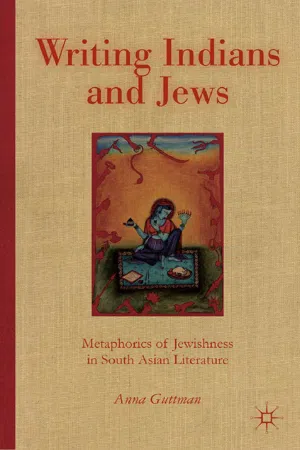
Writing Indians and Jews examines discursive practices surrounding the representation of Jews and Jewishness in Indian literature in English. These investigations make an important contribution to the study of contemporary South Asian and diasporic literature, and understandings of anti-Semitism, religious fundamentalism, and globalization.
Information
Topic
LiteraturaSubtopic
Literatura generalCHAPTER 1

JEWS AND INDIANS: IMAGINING MOBILE SUBJECTS
South Asian identity is coming to be understood in more globalized terms, as Judith Brown’s Global South Asians: Introducing the Modern Diaspora (2006), makes clear. The Indian state itself has also taken strategic steps to recognize and incorporate the identities of those of Indian descent living beyond the subcontinent through the creation of legal categories such as “non-resident Indian” (Brown 155) and “Person of Indian Origin” (Brown 159). The Indian nation-state has not only sought to legally include diasporic Indians for economic gain (both of those categories enable financial investment in India), but has increasingly empowered diasporic subjects to define India culturally, as is evidenced from the repatriation via translation into Hindi of Salman Rushdie’s national allegory, Midnight’s Children, commissioned in honor of the 50th anniversary of Indian independence in 1997 (H. Trivedi). Politically, too, Indians abroad have played an important role (see A. Gandhi). While South Asians are not necessarily the modern diaspora, as Brown’s title perhaps implies, people of South Asian descent are having an important impact on the critical and creative formation of nonlocal and transnational identities.
What happens when a concept, like diaspora, with a very specific cultural origin in Jewish history is applied to a new context? As Jonathan and Daniel Boyarin point out in Powers of Diaspora (2002), the results have been varied: Stuart Hall dismisses any connection between Black and Jewish experience, while Vijay Mishra sees Jewish diaspora as useful for “situat[ing] and critiqu[ing] the imaginary construction of a homeland” not just for Jews, but for South Asians as well (see Boyarin and Boyarin 13–15). Indeed, Boyarin and Boyarin see both Jewish and Indian diasporas as “privileged” (16) and suggest that “a sustained effort at dialogue and comparison between and among subcontinent and diaspora scholars would seem to be a richly promising project” (17). This chapter answers Boyarin and Boyarin’s challenge by analyzing South Asian diasporic writers, who, since the 1980s, have been engaged in imagining subcontinental transnationality in Jewish terms. I begin to approach these questions by tracing a figure that, since at least the early modern period, and thus since the birth of colonialism as we now understand it, has stood for nonlocal, non-national identity: the Wandering Jew. I am particularly interested in his appearance in Sarnath Banerjee’s graphic novel The Barn Owl’s Wondrous Capers (2007). Next, I trace the representation of the Jew as a contentious figure for diasporic and transnational identities in the fiction of Salman Rushdie. Though Rushdie’s work, unlike Banerjee’s, has received considerable critical attention, his persistent attention to Jewish characters has gone largely unnoticed. His interest in Jewish identity as a touchstone for the development of South Asian subjectivities is mirrored in the writing of other South Asian diasporic writers such as Hanif Kureishi, Manzu Islam, Hari Kunzru, Marina Tamar Budhos, Ved Mehta, and Sofiul Azam, whose work will also be discussed. Finally, I analyze Achmat Dangor’s novel Kafka’s Curse (1997), a novel that takes this process one step further by enabling its protagonist, a man of South Asian descent, to pass as Jewish (and therefore White) in apartheid era South Africa.
THE WANDERING JEW
Divergent passages in the gospels of John and Matthew allude to a figure (assumed to be Jewish) who either hastens or harasses Jesus on his way to the crucifixion (Anderson 11–15). He (and the figure is always male) is cursed with eternal life and destined to await the second coming. For the next millennia, this story remains well known in Christian theological circles but has little popularity or literary weight. This changes in 1602 with the publication of a pamphlet in Germany. In this new version of the story, the Jew who rejects Christ is cursed not only with eternal life, but also with wandering. As R. Edelmann points out, the pamphlet appears at a time when the issue of whether or not Jews should be allowed to settle in Germany was being widely debated (5–8). The pamphlet’s suggestion that the history of dispersion and expulsion of the Jewish community is divinely ordained and morally justified clearly indicates that Jews cannot and should not call Germany, or any other place, home. This version of the story spread rapidly throughout Germany and Europe, with the original pamphlet being reprinted 20 times in 1602 alone. In this schema, the Jew’s mobility is inescapably bad, with the state of being nonlocal positioned as fundamentally suspect. The sociological functions that the Wandering Jew performs—whether explaining the apparently inexplicable and suspect survival of Jewish communities in the face of minoritization and persecution, or providing a justification for that continued persecution—are oriented toward a dominant, Christian world view (Isaac-Edersheim 205).
Some facets of the Wandering Jew legend invite the situating of the tale with respect to a larger investigation of colonial discourse analysis. Albert Edmunds associates the figure of the Wandering Jew with Buddha, and, by extension, the mystic East (see Anderson 411–412). The French novelist Eugène Sue famously imagines the Wandering Jew as the protector of a French family’s inheritance in Le Juif errant (1844). Several of those in the novel who stake a questionable claim to that inheritance are of ‘Eastern’ origin, hailing from India and Siberia, while the rightful heir is a Jesuit missionary in America, whom the Jew is sworn to protect. The Wandering Jew of that novel is not only decidedly ‘Eastern’ himself (appearing repeatedly in India) but emblematic of a world defined by uneven economic development; he is “of the race of the labourers,” whose emancipation comes with the death of his (presumably Jewish) descendants (Sue 233). This trope anticipates that which Walter Rideout identifies in the radical American novel of the early twentieth century in which the plight of the Jew is meant “to symbolize by his fate the experience of all workers under capitalism,” thereby indicating the need for socialism (but not to reaffirm Jewishness) (160). In yet another version of the legend, Cain is the antecedent of the Wandering Jew, and Cain, supposedly, is the ancestral African, since the mark on the murderer is allegedly black. Indeed, in Sue’s novel the Wandering Jew is repeatedly identified by the black mark upon his face. During the British immigration debates of the late nineteenth century, as Lara Trubowitz elucidates, “the ‘Wandering Jew’ becomes ‘wandering Jewishness’” (7) and Jewishness itself was configured as “a form of contagion, a threat to the British political and social body” (6). While it is not possible to fully explore the provocative relationship between the Wandering Jew and the colonial project inhering in each of these versions of the story, even these brief outlines should make it clear that postcolonial critics ought to be suspicious of any reading of this troubled figure as evidence for either the fact, or the happiness, of diasporic mobility.
In this context, Sarnath Banerjee’s most recent graphic novel, The Barn Owl’s Wondrous Capers, presents something of a challenge. This text, narrated at the outset by an omniscient and unnamed third person, resurrects the figure of the Wandering Jew, and in the opening pages (a sort of prologue), takes care to situate this legend within its Christian and early modern origins. Next, the text jumps to eighteenth-century Calcutta, which is where the body of the text begins. Here the narrator remains unnamed, but it eventually becomes clear that this section is written from the perspective of a Wandering Jew, whose name we later discover is Abravanel (a name taken from one of the more famous Spanish Jewish families of the fifteenth century). He makes his living as a purveyor of fancy goods for the rich (Banerjee 21). He is also depicted as assisting in the acquisition of sexual, as well as material, fulfillment for Calcutta’s overindulged elite, and has written a book of scandals detailing their exploits. He has business connections that span the globe, as becomes apparent from his ability to supply a zebra, at short notice, to a vain client. His narrative alternates with that of Pablo Chatterjee, one of Calcutta’s contemporary young inhabitants, who is on a quest to recover the book Abravanel has written, which Pablo sees as belonging to him. In the last section, 13, Abravanel merges with Digital Dutta, a computer programmer and one of Pablo’s acquaintances, who directs Pablo’s search for the book.
Not only is this version of the figure cursed by Christ, but as the text progresses, the Wandering Jew’s character is positioned relative to a number of canonical visual, musical, and literary texts that have been pivotal in constructing not only the Wandering Jew as a cultural trope but Jews in general. Gustave Doré’s woodcut, “The Wandering Jew,” for instance, which appears directly behind Digital when he is inside his apartment (Banerjee, Barn Owl 95), immediately after Pablo recounts that Dutta creates a “strange sense of déjà vu,” his face reminiscent of “old typography” (94). As the only photo and the densest area of the page, it is the visual center of the frame. The image depicts a decrepit old man looking wistfully at Christ on the cross as he trudges through a gloomy landscape. The second frame on the same page is a close-up of the image’s title and attribution.
Similarly, Digital is depicted listening to Wagner’s “The Flying Dutchman” (Banerjee 151) in which a ship’s captain who is forced to sail forever due to blasphemy is reconfigured as a Wandering Jew (Anderson 8). The Barn Owl’s Wondrous Capers also revives many of the legends associated with this figure of the Jew, as well as revisiting impostor figures such as the Count of St. Germain, who some believed was the Wandering Jew (Anderson 119). The association of the Jew, Abravanel, with global capitalism and sexual licentiousness, are the stock in trade of European anti-Semitism and will be discussed at greater length in Chapter 3. Likewise, the text’s suggestion that Jews would introduce the concept of insurance to India (in fact brought by the British) alludes to well-known, anti-Semitic discourse in Britain associating Jews with insurance fraud; the association of Jews with insurance is part of a larger discourse in which the Jew is a “manipulator of malign power dangerous to everyone else” (Podhoretz 205).
Abravanel’s eighteenth-century book of scandals documenting life in Calcutta seems to parallel the well-known nineteenth-century Bengali novel by Kaliprasanna Sinha, The Observant Owl, from which Banerjee’s text derives its name. Like the imagined text of Banerjee’s graphic novel, it casts a satiric eye on Calcutta’s society. Banerjee has himself suggested in an interview that his graphic novel and its inspiration share little beyond the title (see Anon). Indeed, Jewishness hardly figures in Sinha’s text, nor is the narrator clearly identified, though he is usually read as a projection of the author. The narrator’s comment in that text that the statue of a goddess resembles a “pukka Jew” marks the Jew as an object of exotic authenticity, more foreign to Calcutta than the English (Sinha 44). What the narrators of these two texts do share, however, is a sense of cosmopolitan rootlessness and interest in urban life. That Banerjee reimagines these characteristics as specifically Jewish in the twenty-first century suggests more about contemporary global identity politics than it does about the actual makeup of Calcutta’s past or present. Dutta, too, is figured as a projection of the author, making Banerjee one of several South Asian writers discussed in this chapter who identify themselves with Jewishness.
Dutta himself is never directly identified as a narrator, but is depicted in an adjacent frame to Abravanel in the same pose, inviting the viewer to compare their features (Abravanel is shown a few frames earlier leaping into Dutta’s flat and looking at the Doré print). The next frame depicts Dutta gazing into the mirror; Abravanel’s hat sits by his side and Abravanel’s face is reflected back at him (Barn Owl 237). The top hat, and Abravanel’s attire more generally, are noteworthy for encoding Abravanel as decidedly European, despite his origins in Aleppo (located in modern Syria), where, in the typical local fashion, he is shown wearing a turban and a flowing robe (19, 21). Elsewhere, Abravanel is also depicted with a long beard and flowing sidelocks, an image that reinforces his association with an othered, and European, Jewishness. The remainder of the text’s final section is narrated by a gargoyle, who not only adds to the story of the Wandering Jew, but directs Dutta to return the book of scandals to “its true owner” or else he “may never escape this cycle of perpetual return” (252). Presumably, the gargoyle is promising Dutta, in his guise as the eternal Jew, death.
Digital Dutta first makes his appearance in Banerjee’s earlier graphic novel, Corridor (2004), where his story is woven into a number of other young adult lives in Delhi, all of which center around a used bookstore. Digital is given relatively little character development in this first text, and there, at least, does not seem to be a Wandering Jew. Indeed, Digital’s storyline revolves around the question of whether or not he will pursue an H1-B visa and emigrate to the United States, as his fiancé and her family suggest. Ultimately, he makes the decision to stay in India and, indeed, to return to his home city of Calcutta. As such, Digital’s exemplary characteristic is not his mobility but his stasis; he chooses a national identity over a diasporic one. Indeed, in the present of The Barn Owl’s Wondrous Capers this stasis takes on extreme proportions as Digital never wanders more than a 10-minute walk from his apartment. While Digital directs the main character, Pablo, as he journeys through Calcutta and its history, he is only once depicted outside his apartment, in a brief appearance lasting just six frames. Dutta, we are reassured, is one of those who “seldom travel in space and almost never in time” (83). In making Digital Dutta the text’s Wandering Jew, Banerjee radically settles and nationalizes an essentially unsettled and unsettling figure, stripping him of all Jewishness in the process.
An interest in anatomizing India’s heterogeneous religious, class, and cultural communities runs through Banerjee’s text, as it does in Sinha’s. Given India’s troubled recent history of religious discourse and the polarizing of religious identities, such an ethnographic eye can be, at best, double-edged. The Barn Owl’s Wondrous Capers opens with the following epigraph: “This book is inspired by history but not limited by it.” But which history inspires it? On the one hand, this story of the Wandering Jew seems to propose a reimagining of the past that transcends binaries and the narratives of conflict that they engender. When Abravanel states, “history will forget me because I am neither colonizer nor colonized” (229) the text all but declares its intent to reinsert into history this supposedly forgotten, liminal perspective. Certainly, some of the recasting of the legend in The Barn Owl’s Wondrous Capers does have subversive and comic potential. In this aspect, Banerjee’s imagining of the possibilities for South Asian diasporic identity is similar to that of Salman Rushdie and Hanif Kureishi, discussed later.
Yet there is also the possibility that Abravanel, as a mythic figure, is in fact being placed outside of history, and thus risks partaking in the notion that “continued Jewish presence” is “either an uncanny or a wonderful mystery” (Boyarin and Boyarin vii). At the end of The Barn Owl’s Wondrous Capers the Jew is obligated to ‘return’ the eponymous book to Pablo, who is now its rightful owner, a handover suggestive of the displacement and replacement of the Jew by the Indian. Indeed, Pablo’s grandfather had purchased the book from a Jewish shopkeeper in France years earlier who is oblivious to its true value, both financial and cultural (40). Elsewhere, The Barn Owl’s Wondrous Capers evokes Jewish history even as it blatantly overwrites it. The text concludes in London, where Pablo wanders and recalls the places he associates with his failed romantic relationship with Bipasha, one of which is “the Pakistani restaurant behind Whitechapel Mosque” (260). This text is part of a frame that accurately depicts a view of the East London Mosque (which is in Whitechapel) along with the Fieldgate Street Great Synagogue. These two edifices are in fact adjacent to each other quite as Banerjee has depicted them to be and the words “Fieldgate Synagogue” are clearly visible on the building in the foreground in his depiction (260). At the time of the text’s composition, this synagogue had an active congregation. Yet the synagogue remains unseen by Pablo who imagines only the mosque and the Pakistani restaurant, rendering East London a resolutely South Asian and Muslim space. The disjunction between text and image renders Jewishness both uncanny and unspoken. Sander Gilman’s comment on Vikram Seth’s Two Lives in Multiculturalism and the Jews would therefore seem to apply to Banerjee’s text as well: “Where Jew was, Indian is ... the Indian ... is the new hybrid, postmodern citizen of the world” (165). With Pablo’s culturally hybrid name, his involvement in cross-racial love affairs and apparent mobility, and use of concepts such as the “glocal” to frame his narrative (82) it is clearly he, not Digital Dutta, who is the postmodern citizen of the world in Banerjee’s text.
This is despite the fact that some Jewish theorists, notably Jonathan and Daniel Boyarin, contend that the diasporic condition is actually a positive and radicalizing aspect of Jewish identity; it is for them “that genius that consists in the exercise and preservation of cultural power separate from the coercive power of the state” and can “speak well ... to the dilemmas and possibilities of the ‘new diasporas’” (vii). Much postcolonial theory on diaspora echoes Boyarin and Boyarin without referencing Jewishness specifically. Edward Said, while recognizing “the miseries of the displaced person or refugee” (Culture and Imperialism 332) also sees in their condition, and that of other diasporic subjects, “a genuine potential for an emergent non-coercive culture” and the only real prospect for escaping the grip of colonialism and imperialism (334). In this view he expresses his agreement with Theodor Adorno, himself of Jewish descent. Yet Said also argues that
the “strong” or “perfect” person achieves independence and detachment by working through attachments, not by rejecting them. Exile is predicated on the existence of, love for, and a real bond, with one’s native place; the universal truth of exile is not that one has lost that love or home, but that inherent in each is an unexpected, unwelcome, loss.
(Culture and Imperialism 336; italics in original)
For Said, the “native place” and “the home” though inaccessible are not, in and of themselves, problematized as points of reference. Yet for both Jews and many of the other subjects discussed in this chapter—Indian Muslims in particular—twentieth-century history has rendered these very categories suspect. It should be clear that the pot...
Table of contents
- Cover
- Title Page
- Copyright
- Contents
- Acknowledgments
- Introduction
- 1. Jews and Indians: Imagining Mobile Subjects
- 2. Terror and the Archive: Textualizations of (Jewish?) History in Contemporary South Asian Literature
- 3. “I would always be the Asian, the Shylock”: Postcolonial Economies of Jewishness
- 4. Jewish and Indian: Narrating between Race, Faith, Ethnicity, and Nation
- Conclusion
- Notes
- Bibliography
- Index
Trusted by 375,005 students
Access to over 1.5 million titles for a fair monthly price.
Study more efficiently using our study tools.
Frequently asked questions
Yes, you can cancel anytime from the Subscription tab in your account settings on the Perlego website. Your subscription will stay active until the end of your current billing period. Learn how to cancel your subscription
No, books cannot be downloaded as external files, such as PDFs, for use outside of Perlego. However, you can download books within the Perlego app for offline reading on mobile or tablet. Learn how to download books offline
Perlego offers two plans: Essential and Complete
- Essential is ideal for learners and professionals who enjoy exploring a wide range of subjects. Access the Essential Library with 800,000+ trusted titles and best-sellers across business, personal growth, and the humanities. Includes unlimited reading time and Standard Read Aloud voice.
- Complete: Perfect for advanced learners and researchers needing full, unrestricted access. Unlock 1.5M+ books across hundreds of subjects, including academic and specialized titles. The Complete Plan also includes advanced features like Premium Read Aloud and Research Assistant.
We are an online textbook subscription service, where you can get access to an entire online library for less than the price of a single book per month. With over 1.5 million books across 990+ topics, we’ve got you covered! Learn about our mission
Look out for the read-aloud symbol on your next book to see if you can listen to it. The read-aloud tool reads text aloud for you, highlighting the text as it is being read. You can pause it, speed it up and slow it down. Learn more about Read Aloud
Yes! You can use the Perlego app on both iOS and Android devices to read anytime, anywhere — even offline. Perfect for commutes or when you’re on the go.
Please note we cannot support devices running on iOS 13 and Android 7 or earlier. Learn more about using the app
Please note we cannot support devices running on iOS 13 and Android 7 or earlier. Learn more about using the app
Yes, you can access Writing Indians and Jews by A. Guttman in PDF and/or ePUB format, as well as other popular books in Literatura & Literatura general. We have over 1.5 million books available in our catalogue for you to explore.