eBook - ePub
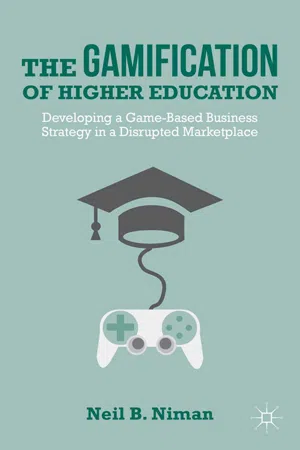
The Gamification of Higher Education
Developing a Game-Based Business Strategy in a Disrupted Marketplace
- English
- ePUB (mobile friendly)
- Available on iOS & Android
eBook - ePub
The Gamification of Higher Education
Developing a Game-Based Business Strategy in a Disrupted Marketplace
About this book
Instead of thinking about education as the mastery of a body of knowledge where the subject matter becomes the focus of our attention, The Gamification of Higher Education encourages us to think of it as a process that draws out the best in individuals and prepares them for happy, productive, and successful lives.
Information
Topic
EducationSubtopic
Business StrategyPART I
The Business of Higher Education
CHAPTER 1
The Coming “Perfect Storm” in Higher Education
Depending on one’s penchant for risk, change is either a breath of fresh air or a horrible nightmare. The hard part to managing change is when it comes time to evaluate whether it represents a short-term fad that may shake things up for a brief period and then go away, or if it represents something more fundamental that represents a true game changer. Many firms are no longer with us because they either thought a permanent change was only a temporary flirtation with a bad idea, or could not respond to a major shift in the marketplace. Realizing that the future is not going to follow the patterns of the past is only the first step that must be taken in response to change. Adapting your organization to meet the challenges of a new reality is something entirely different.
Many like to think (especially those in academia) that their institution of higher learning is immune to the vagaries of the world in which we live. They are in essence an “oasis” that breathes life into the surrounding desert. However, universities are no more immune to the laws of economics, the whims of politicians, or changing demographics than any other large organizations that are a part of modern society. It is perhaps easy to sit back and gaze upon those ivy halls that have been an essential part of university life for in some cases, hundreds of years, and think that those changes taking place today are no different from previous ones. To believe that those sturdy walls have seen it all and will be around long after the current changes have come and gone.
However, as technology continues to redefine the meaning of space and time from an educational perspective, it is not clear that institutions of higher education will be able to ignore the fundamental changes that are taking place. After all, the path to the future has been paved with the wreckage from many industries that were thought to be immune to the changes that were taking place around them. More importantly, those forces that are trying to change higher education can be found in a number of different industries who have encountered many of the same challenges. Hence it is rather naive to think that higher education is insulated from the problems facing other industries. In fact, there is much to be learned from the recent experiences that have transformed much of the economy as we know it.
The Higher Education Bubble
What does going to college and owning your own home have in common? For many, they are necessary stepping stones for reaching the American Dream.1 While it may make more sense in today’s economy to rent rather than own, there is something special about becoming a person of property. The freedom to do what you want, when you want, and where you want often trumps whatever savings you might achieve as the result of renting.
In the same way, going to college opens doors that would otherwise remain closed.2 At the most basic level, we see that the unemployment rate for college graduates is substantially lower than for those with just a high school education.3 But it is more than whether you have a job or not, it is the quality of work and the ability to have a career as opposed to just a job that makes the decision to go to college much more than a simple economic choice that balances the costs against tangible economic benefits.4
With so much to be gained, it should come as no surprise that our elective representatives who populate the halls of government (either at the federal or state level) would want to do their best to make the dream come true. If the government can open the door to home ownership or a lifelong career, what is wrong with that? Well, as we are about to see, it can have adverse consequences that, in the long run, does more harm than good.
Let’s begin by exploring the recent housing crisis that played a major role in throwing the world into a global recession. It is not a new policy on the part of the federal government to try and make home ownership economically viable for as many as possible. One can just look at the mortgage home deduction available to those who file US tax returns. It is perhaps the most visible sign of support for home ownership. What is less obvious are the set of forces that tried to make home ownership possible for those segments of the population who previously were denied the ability to borrow the funds needed to purchase a home.
The seeds of the crisis lay in a fundamental transformation that occurred in the market for mortgages. What had previously been a local affair became in the course of 20 some odd years a national and then an international market. With the rise to prominence of two quasi-government firms (Fannie Mae and Freddie Mac), a national market emerged where bundles of mortgages could be traded just like any other financial instrument.5 The creation of a national market enabled capital to flow where it could enjoy the highest rate of return and with improvements in the flow of capital, home ownership became possible for an ever expanding pool of buyers,
Of course, having worked at the national level, there was no reason to believe that it couldn’t be successful on an international scale. By bundling these mortgages together into what has become known as collateralized debt obligations, securities could be created that might be attractive to international investors. Using a process known as securitization, it became possible to open a door to an even bigger pool of funds that could finance home mortgages and hence made the dream come alive for even more Americans.6
Under increased government pressure to make loans to previously underserved segments of the population in combination with a pool of new potential purchasers of these securities, mortgage originators began to experiment with new products that could eliminate some of the traditional barriers that prevented some individuals from obtaining a mortgage.7 The creation of no income verification loans, interest only loans, mortgages that artificially lowered interest rates for the first few years of the loan, or loans that could be obtained with no money down are all examples of products that were designed to make home ownership affordable to entirely new segments of the population.
All of this was done with the best of intentions in order to enable as many as possible to obtain the American Dream. And it worked beautifully as long as interest rates remained low and housing prices continued to rise. The easy availability of cheap money drove up housing prices to the benefit of everyone. Whether you worked in the construction industry, the financial industry, or were a homeowner who could sit back and watch their investment appreciate on a monthly basis, the benefits spread throughout the entire economy. All was well and good until the supply of cheap money dried up seemingly overnight and the industry collapsed. The aftermath was a dramatic fall in housing prices, the collapse of many financial institutions, and the decimation of an entire industry (construction).8
By this time you are probably wondering what this has to do with higher education. After all, housing is not education and since they are unrelated, why should what happened in one industry be relevant for the other? While the two may be unrelated in many respects, they are similar in the sense that they have both been targeted by the federal government for support in an effort to make their product accessible to as many as possible.9 As a result, the question that comes (at least to my mind) is that if government policies based on the best of intentions created a bubble in the housing market, could similar policies be generating a nearly identical bubble in the market for higher education?
Before going any further, it is important to note that the decisions that ultimately create bubbles leading to one crisis or another defy the rational choices that well-trained economists believe that individuals make.10 For example, there was no reason to think that mortgage loans were being made to less than credit worthy borrowers. Furthermore, there would be no reason to assume that all of the smart individuals that were making lending decisions and purchased mortgage-backed securities did not know that at some point, the Fed would raise interest rates and borrowers would need to have the financial wherewithal to be able to continue to make their monthly payment at a higher interest rate.
Based on the best information that was publicly available, the smart decision was to purchase real estate. Of course, after the fact we realized that many of the loans were not very good and could not absorb higher interest rates.11 Therefore as the Fed raised rates, many could no longer afford their adjustable rate loans and what had been an imbalance created by too much demand and too little supply, reversed itself seemingly overnight. Hence it did not matter how well you considered your options with the information that was available, for many purchasers of mortgage-backed securities and investment properties, the decision that they ultimately made was the wrong one.
Thus, despite the best research by noted economists who write that students are not overburdened by debt, that the wage premium associated with a college degree is as strong as ever, and that college will enable you to start a career rather than just a job is still true, all of that may go out the window.12 If there is the perception that a college education prepares you for nothing more than living at home with mom and dad as you can’t find anything more financially rewarding than driving a taxicab while the bills pile up because you are mired in student loan debt, then why go to college?
The Anatomy of a Crisis
In drawing parallels between the financial crisis of 2008 and a potential one in higher education, we need to start with the two primary drivers that have changed the competitive landscape. The first can be found in the general support at both the state and the federal level for higher education.13 There has been strong recognition on the part of elected leaders that education can not only be a powerful driver for economic growth, but can also improve the quality of the society in which we all live.14 The impact has been to increase access to higher education by lessening the impact of rising tuition. However, just like any other industry chased by too many dollars, net revenues (profits) rise and with that, an incentive for others to enter the industry so that they can obtain their share of a growing market.15
The other driver stems from the new technologies that offer the potential to redefine the way that courses are delivered. Whether under the heading of distance learning, e-learning, massively open online courses (MOOCs), or something else, technology is lowering some of the barriers that have kept institutions of higher learning well protected from much if any competition.16 While students still exhibit a strong preference to attend schools that are located in relatively close proximity to where they grew up, there is little certainty (if any) that those preferences will not change especially if competitive offerings emerge at substantially lower prices.17
Let’s now work through the anatomy of a crisis.
1.The potential for greater net revenues (profits) along with easier entry resulting from changes in technology encourages new institutions to enter the industry.
2.As more institutions enter the market, it creates an increase in the supply of available seats that need to be filled by students.18
3.The excess capacity in the industry provides incentive for some institutions to lower their admissions standards in order to boost their head count.19
4.Increased numbers of students are recruited based on the relaxation of current admissions standards (lower SAT scores or the equivalent), less motivated individuals (reaching into the pool for those who are not really interested in advancing their education), or by making promises in terms of career or other opportunities that will never come true.20
5.Admitting students who otherwise would not enroll will reduce graduation rates (as long as academic standards are maintained).21
6.A decline in graduation rates will reduce the return on investment for those who are borrowing money to finance an education. It will also buttress stories about whether or not college is worth the price.22
7.As the number of stories increases calling into question the value of higher education, enrollment declines; thereby creating a crisis for many institutions.
Unlike the financial crisis, no massive debt defaults are required (though it would definitely exacerbate the problem).23 The important point is that it is not just one demand driver, but rather the totality, that could potentially lead to a serious problem. The list might include
•A structural change that alters the way that government subsidies are distributed in the form of student aid. This affords the potential of greatly reducing revenues for underperforming institutions.24
•A growing perception that the return on the investment in higher education no longer makes sound financial sense either in terms of the ability to get a job or the type of job that a recent graduate actually wants.25
•A growing gap between the ability to pay and what it costs to earn a degree. While the growth of financial aid seems to have kept pace with increases in tuition on a percentage basis, in dollar terms it has not.26
•A shift in governmen...
Table of contents
- Cover
- Title
- Introduction
- Part I The Business of Higher Education
- Part II Gaming Fundamentals
- Part III Transformation through Gamification
- Notes
- Bibliography
- Index
Trusted by 375,005 students
Access to over 1.5 million titles for a fair monthly price.
Study more efficiently using our study tools.
Frequently asked questions
Yes, you can cancel anytime from the Subscription tab in your account settings on the Perlego website. Your subscription will stay active until the end of your current billing period. Learn how to cancel your subscription
No, books cannot be downloaded as external files, such as PDFs, for use outside of Perlego. However, you can download books within the Perlego app for offline reading on mobile or tablet. Learn how to download books offline
Perlego offers two plans: Essential and Complete
- Essential is ideal for learners and professionals who enjoy exploring a wide range of subjects. Access the Essential Library with 800,000+ trusted titles and best-sellers across business, personal growth, and the humanities. Includes unlimited reading time and Standard Read Aloud voice.
- Complete: Perfect for advanced learners and researchers needing full, unrestricted access. Unlock 1.5M+ books across hundreds of subjects, including academic and specialized titles. The Complete Plan also includes advanced features like Premium Read Aloud and Research Assistant.
We are an online textbook subscription service, where you can get access to an entire online library for less than the price of a single book per month. With over 1.5 million books across 990+ topics, we’ve got you covered! Learn about our mission
Look out for the read-aloud symbol on your next book to see if you can listen to it. The read-aloud tool reads text aloud for you, highlighting the text as it is being read. You can pause it, speed it up and slow it down. Learn more about Read Aloud
Yes! You can use the Perlego app on both iOS and Android devices to read anytime, anywhere — even offline. Perfect for commutes or when you’re on the go.
Please note we cannot support devices running on iOS 13 and Android 7 or earlier. Learn more about using the app
Please note we cannot support devices running on iOS 13 and Android 7 or earlier. Learn more about using the app
Yes, you can access The Gamification of Higher Education by N. Niman in PDF and/or ePUB format, as well as other popular books in Education & Business Strategy. We have over 1.5 million books available in our catalogue for you to explore.