eBook - ePub
Employment Guarantee Schemes
Job Creation and Policy in Developing Countries and Emerging Markets
- English
- ePUB (mobile friendly)
- Available on iOS & Android
eBook - ePub
Employment Guarantee Schemes
Job Creation and Policy in Developing Countries and Emerging Markets
About this book
Employment Generation Schemes directs attention to challenges and opportunities of enacting direct job creation policies in developing countries and BRICS, including: China, Ghana, Argentina, and India. This exciting new volume investigates how the Job Guarantee might interface with other policy goals.
Information
CHAPTER 1

Green Jobs for Full Employment, a Stock Flow Consistent Analysis
Guaranteed Job and the Kyoto Protocol
Unemployment is a fact in present economies. Even without a crisis, unemployment exists and costs a lot to society. Reasons for unemployment are multiple and differ according to the theory at hand. Lack of effective demand, imperfect markets, and friction are examples of unemployment justifications. All sorts of policies based on these different theories have been implemented with varying results but none have proven effective in tackling unemployment. Full employment has never been achieved during the last 40 years. Often the problem is that these policies promote indirect jobs creation: public spending, wage subsidies, incentives, tax cuts, job training. Another issue is the change in the dimension of these policies; we now have microeconomic supply of labor policies instead of macroeconomic demand stimulation policies. Even if they meet some objectives, these policies do not provide an answer to unemployment.
It is the duty of the state, as Lerner expressed it, to provide jobs when the market fails to do so (Lerner, 1944, 1951). By guaranteeing a job to all that are willing and able to work, the state would remove all involuntary unemployment. Examples of such job guarantee schemes exist, even if they have never been developed on a full scale.1 Furthermore, in most economies the potential of energy saving via insulation and uses that are more efficient is important. In order to reach the Kyoto Protocol objectives, it is urgent to develop policies that reduce the production of carbon dioxide.
This chapter presents a stock flow consistent (SFC) model of a multisectorial economy with an Employer of Last Resort (ELR) scheme where ELR workers would work to transform the economy toward a greener one. We will focus on the impact of the green job ELR policy and compare these results with a standard Keynesian demand spur (KDS).
Overview of the Model
SFC models are based on the works of two schools of thoughts developed by Wynne Godley and James Tobin. Both these approaches are centered on the importance of consistency between and among stocks and flows: each flow in the model comes from a sector (or account) and goes to another account. In each period, the sum of flows has to be nil. Stocks are the sum of inflows and outflows. SFC models are thus evolutionary models (Godley and Lavoie, 2007).
The economy modeled in this chapter discusses two household sectors (wage earners and capitalists), three productive sectors (capital goods, energy, and widgets), a banking sector, and a public sector. Figure 1.1 represents the flow diagram of the model. Both household sectors and the public sector consume widgets and electricity (thin dashed lines on the diagram). Furthermore, all productive sectors consume energy to produce their own goods. All productive sectors use fixed capital (produced by the capital goods sector, thin dash-dotted line) and labor (thick solid line). In order to invest, firms borrow money from banks and pay interests (thick dotted line). Finally, industries pay wages to workers (thick solid line) and dividends to capitalists (thick dashed line). Household sectors save part of their wealth as cash on their current account (thin solid lines) and as bonds (thick dash-dotted lines) for which they receive interests. Banks balance their liabilities (current accounts) with loans to firms and by bond holding (thin dotted line) for which they receive interests. The government imposes a tax on wages and profits (thick dash-dotted lines), pays interests on bonds, and gives a dole to unemployed workers.
The chapter is structured as follows. The second section will analyze structural unemployment and the policies implemented in order to reduce it. The third and fourth sections will present the multisectorial model and its steady state. The ELR scheme and its impacts are studied in the fifth section. Finally, the sixth section provides the conclusion.
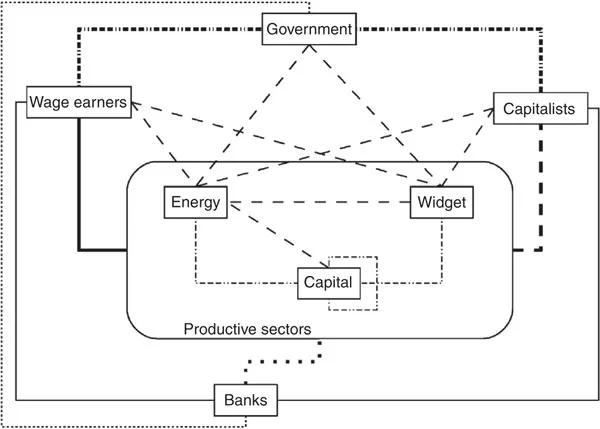
Figure 1.1 Flow diagram. Each line represents a group of flows between two sectors. Each group of flow might be bidirectional. For example, the line linking wage earners and government represents flows from wage earners to government (taxes, bond holding) and flows from government to wage earners (dole, interests on bonds)
Unemployment
Mainstream economics usually explains unemployment by market rigidities. Unemployment would disappear if wages were allowed to decline low enough. Labor market is like all other good markets with rigid price and should not be seen as anything else. However, unemployment is not often recognized for the function it has in a capitalist economy (Forstater, 1998, 2006). Most of the time, firms are working with excess capacity in order to be able to respond to sudden changes in demand. Unemployment thus allows the economy to be more flexible by permitting firms to hire workers out of the “reserve army of labor” when needed.
Following Schumpeterian creative destruction, the process of birth of new technologies creates unemployment in obsolete sectors while creating jobs in new sectors (Schumpeter, 1934/1912). Structural unemployment may also be explained as a mismatch between demand and supply. Pasinetti (1993) shows it is highly improbable that, in a multisectorial model, distribution of demand among different sectors is such that full employment prevails, even when aggregate demand is high enough to imply full employment.
Ros (2000) explains using various two-sector models that labor surplus economies arise for different reasons. He uses efficiency wages on top of a Lewis growth model to show how Kaldorian underemployment appears.2 In Chapter 11, he also shows how unemployment emerges out of constrained economies, using a Kaleckian dual economy model.
It is illusionary to assume that capitalist economies will ever attain full employment under a normal situation.3 The only period of time in the modern era where full employment was reached in the United States is during World War II (Kaboub, 2007). Kaboub further adds, “Full employment and price stability were achieved, but only during wartime with a considerable number of the male working-age adults being in the army and the rest of the working-age population employed to support the war effort. Therefore, the US full employment experiment must be taken with caution” (Kaboub, 2007, p. 4). In March 1999, US unemplo...
Table of contents
- Cover
- Title Page
- Copyright
- Contents
- List of Figures and Tables
- Acknowledgments
- Introduction: Employment Guarantee Schemes—Development, Environment, and Community
- 1. Green Jobs for Full Employment, a Stock Flow Consistent Analysis
- 2. Ningxia’s Ecological Immigration Program: An Embryonic Employer of Last Resort Program
- 3. Beyond Full Employment: What Argentina’s Plan Jefes Can Teach Us about the Employer of Last Resort
- 4. Employment Generation Schemes and Long-Term Development: A Case Study of the NREGA in India
- 5. The State, Employer of Last Resort, and Youth Employment: A Case Study of the National Youth Employment Program in Ghana
- 6. The Job Guarantee and Municipal Confederalism: Exploring the National and Local Levels of Program Operation
- 7. Bring Back the WPA: Lessons from the Job Creation Programs of the 1930s
- Notes on Contributors
- Index
Trusted by 375,005 students
Access to over 1.5 million titles for a fair monthly price.
Study more efficiently using our study tools.
Frequently asked questions
Yes, you can cancel anytime from the Subscription tab in your account settings on the Perlego website. Your subscription will stay active until the end of your current billing period. Learn how to cancel your subscription
No, books cannot be downloaded as external files, such as PDFs, for use outside of Perlego. However, you can download books within the Perlego app for offline reading on mobile or tablet. Learn how to download books offline
Perlego offers two plans: Essential and Complete
- Essential is ideal for learners and professionals who enjoy exploring a wide range of subjects. Access the Essential Library with 800,000+ trusted titles and best-sellers across business, personal growth, and the humanities. Includes unlimited reading time and Standard Read Aloud voice.
- Complete: Perfect for advanced learners and researchers needing full, unrestricted access. Unlock 1.5M+ books across hundreds of subjects, including academic and specialized titles. The Complete Plan also includes advanced features like Premium Read Aloud and Research Assistant.
We are an online textbook subscription service, where you can get access to an entire online library for less than the price of a single book per month. With over 1.5 million books across 990+ topics, we’ve got you covered! Learn about our mission
Look out for the read-aloud symbol on your next book to see if you can listen to it. The read-aloud tool reads text aloud for you, highlighting the text as it is being read. You can pause it, speed it up and slow it down. Learn more about Read Aloud
Yes! You can use the Perlego app on both iOS and Android devices to read anytime, anywhere — even offline. Perfect for commutes or when you’re on the go.
Please note we cannot support devices running on iOS 13 and Android 7 or earlier. Learn more about using the app
Please note we cannot support devices running on iOS 13 and Android 7 or earlier. Learn more about using the app
Yes, you can access Employment Guarantee Schemes by M. Murray, M. Forstater, M. Murray,M. Forstater in PDF and/or ePUB format, as well as other popular books in Economics & Econometrics. We have over 1.5 million books available in our catalogue for you to explore.