eBook - ePub
Victorians on Screen
The Nineteenth Century on British Television, 1994-2005
- English
- ePUB (mobile friendly)
- Available on iOS & Android
eBook - ePub
About this book
Victorians on Screen investigates the representation of the Victorian age on British television from the mid-1990s to the mid-2000s. Structured around key areas of enquiry specific to British television, it avoids a narrow focus on genre by instead taking a thematic approach and exploring notions of authenticity, realism and identity.
Information
Subtopic
Film & Video1
Period Representation in Context: The Forsyte Saga on BBC and ITV
On Sunday 7 April 2002, ITV showed the first episode of a new period drama production, The Forsyte Saga, an adaptation of John Galsworthy’s novels of the same name. The series, planned as six one-hour episodes, had been, in the months prior to being shown on television, subject to much speculation and criticism. The reasons for this controversy were located in the 1960s and with another Galsworthy adaptation. This BBC adaptation, the first long-running classic serial on British television, was first shown on BBC2 in 1967. Its success had been immediate; it attracted an average audience share of 6 million when the serial was transmitted, a figure which tripled to 18 million viewers when the drama was repeated on BBC1 the following autumn. Exported successfully all over the world, the adaptation has since been made available first on VHS and more recently on DVD.
The recent broadcast of the Granada adaptation of Galsworthy’s Saga once again brought the BBC series into the limelight. As the BBC drama is a product of the 1960s, so the Granada adaptation is part of the context of the late 1990s and early 2000s, but the shadow cast over the new adaptation by the status and fame of the BBC version also raises questions about influence and the construction of meaning in the new drama. Rupert Smith, in the booklet accompanying the ITV drama, addresses the series’ inevitable competition with the earlier BBC adaptation and attempts to emphasise the independence of the ITV Forsyte Saga from its perceived predecessor by insisting on the historical situatedness of both series:
There will, of course, be comparisons made between the 1967 production and the 2002 Granada version, which is unfair but inevitable. There would not have been the one without the other. But, just as Donald Wilson’s ambitious adaptation of 1967 said as much about the 1960s as it did about the 1980s, we must see the current Saga as an expression of where we are today. (Smith 2002a, p. 35)
Nonetheless, the media coverage of the second adaptation as well as the reactions of viewers to it, which showed a noticeable tendency to regard the newer drama as a remake of the BBC series, reveal the importance of this earlier television text and hint at the need to regard this new adaptation not merely as an adaptation of the Galsworthy text but also as part of a discursive relationship with its televisual context and history. It is widely acknowledged that representations of the past are as much about the past as they are about the present and, in particular, in relation to period drama, even in the case of attempted faithfulness to the literary source, adaptations are equally determined by other factors and contexts. After all, as Roland Barthes claimed in ‘Theory of the Text’, ‘any text is an intertext’ (1981, p. 39); traces of past and present cultures are always already present in any given text. This already suggests the impossibility of representing the past without simultaneously negotiating the present. However, these programmes are equally signs of the impact of more specific histories.
The presence of the BBC drama which dominated the media coverage of the production and reaction to the ITV series highlights the importance of institutional contexts and discourses of quality, which were particularly prevalent through the often suggested hierarchy between the two channels, which posited the BBC adaptation as the more ‘worthy’ text. In the context of the success of the 1967 dramatisation, the adaptation of The Forsyte Saga in 2002 raises questions about origin and cultural ‘worth’ that problematise the simple duality of novel and adaptation. Thus, the relative obscurity of Galsworthy’s novels today, and the fact that the ITV series is only the second adaptation of The Forsyte Saga on television, indicates a shift in the notion of the ‘classic’ from literary source to earlier television programme. Multiple adaptations of the same novel are of course a common occurrence and it is recognised that there is a limited corpus of what is termed ‘classic’ works of literature from which most adaptation draws. Moving from one medium to another and becoming subject to their particular set of social, political, cultural and institutional conventions and configurations while at the same time also remaining part of their earlier literary context, multiple adaptations of the same literary text, although on one level inviting a comparison, have also often posed a problem for analysis and can be read as a challenge and an illustration of intertextuality at work. Thus, Sanders, for example, discusses adaptation as an often deliberately rather than incidental intertextual endeavour in which ‘adaptations perform in dialogue with other adaptations as well as their informing source’ (2006, p. 24). Her reading highlights that these texts are born out of not only specific cultural and political contexts, but also medium and institutional contexts which need to be acknowledged and negotiated in turn; they are the successors of what came before them and simultaneously the predecessors of future representations; they are part of their time, reflecting the present but also responding to the past in specific intertextual ways.
The existence of several versions of the same text produced at different times and possibly in different media only underlines such interdependencies between films/programmes and serves to illustrate that representation is dependent on a complex set of social configurations and cultural and institutional backgrounds. Thus, despite the denial of producer Sita Williams (cited in Smith 2002b), who tries to emphasise that the serial is first and foremost a literary adaptation, media as well as viewer comments and reactions suggest that the ITV’s Forsyte Saga is generally considered a remake of the earlier BBC series. Moreover, rather than replace the earlier version, the new adaptation rejuvenated interest in the earlier series and co-exists side by side with it, suggesting at least a partial eclipse of the original source text in public memory and resulting in a direct competition of the ITV production with the earlier BBC drama.
The 1967 adaptation of The Forsyte Saga
In England today there is no more charming and instructive sight than an upper-middle-class family in full plumage. This particular family is called Forsyte and they live in Park Lane. (The Forsyte Saga 1967)
This is how the voice-over introduces the Forsyte family in the first episode of the 1967 BBC2 adaptation of the saga. A caption informs the viewer that this is London and that it is the year 1879. Birdsong is heard, while the camera takes in the location, presumably Hyde Park. The setting is generic and public; various people are seen strolling through the gardens. The opening places the programme historically and introduces the viewer to the Forsytes and, as in Galsworthy’s novel, the viewer is made aware not only of the identity of the group of people but of their class and social status. Moreover, in combination with the voice-over, the public location and initial anonymity of the people in the park suggest a critical distance and a sense of control. A family is picked out by the narrator and, by extension, the audience, to represent the prosperous middle class of Victorian England. Although the voice-over is present only at the start of the episode, this sense of detachment, of observation rather than involvement, will persist, distancing the audience and inviting critical viewing.
Cutting to an open carriage and capturing each of the four passengers individually, the voice-over continues introducing the family by linking their social status as a wealthy and business-minded middle-class family to property and location:
Indeed all the Forsytes live around the park. It’s fashionable and property value is rising steadily. Although each Forsyte is impressive enough singly, their true flavour can only be appreciated when they gather together at one or other of their well-appointed houses … Today the gathering is at my uncle Timothy’s in Bayswater Road – yes, my uncle, for I too am a Forsyte. They call me Young Jolyon because my father Old Jolyon is at present head of the family. (The Forsyte Saga, Episode 1, 1967)
Again, the voice-over creates detachment. The narrator, now identified as Young Jolyon, is on the inside, part of the family; we are not. He is introducing the audience to a lifestyle and a world different to their own. At this point the carriage has arrived at its destination and the passengers have entered a house. The camera cuts to a drawing room and Young Jolyon introduces each family member and their background, while the camera captures them one by one as they socialise. These first five minutes of the serial thus introduce the Forsyte family, their status and, perhaps most importantly, our position in relation to them; voice-over and visual representation here work together to form an image of the Victorian age as materialistic, traditionalist and status-conscious.
If the opening succeeds in introducing the central characters and dynamics of the Forsyte family, it also succeeds in situating this serial temporally and spatially. The voice-over situates the serial historically within a period in which television’s roots in radio drama and theatre were more pronounced and shows a strong reliance on literary techniques that reveals the origins of the classic serial in radio drama adaptation (Giddings and Selby 2001, pp. 1–31). Significant in this context is also the choice to use a character’s voice-over instead of the omniscient narrator who occupies this role in Galsworthy’s saga. The use of voice-over has been discussed by Colin McArthur in his monograph on television and history, where he notes that one of the most important functions of the device is ‘as organiser of the other discourses constituting the programme and as guarantor of its “truth”’ (McArthur 1978, p. 23). He highlights parallels between this use of voice-over narration in historical programming and the similar use of the device in the nineteenth-century novel, which is equally characterised by a hierarchy of discourses arranged according to their ‘truth-value’ and reliability. The choice of Young Jolyon as narrator is thus important, as it sets his character up as the ‘voice of reason’, a reliable and trustworthy narrator who guides the audience in their own observations and as a mediator who bridges the gap between ‘them’ and ‘us’. Young Jolyon’s narration also identifies the Forsytes as the Victorian middle class. Arguably, by implying that he is not a typical Forsyte, Young Jolyon constructs himself as non-Victorian and hence ‘modern’. His dislike of his cousin Soames is symbolic; Soames comes to represent the ‘old’, the past of Victorian England as a period that, so the viewer senses, needs to be overcome, as well as the wealthy middle classes and their values. Soames’s values, so the juxtaposition with Young Jolyon suggests, stand in direct conflict to Young Jolyon’s perhaps more bohemian desire for independence and freedom from outdated social norms and conformity. His point of view is emphasised by his control over the narrative at this point, which is signalled as the camera moves around the room, framing members of the family clan as Young Jolyon introduces them. The claustrophobic, cluttered feel of the room further enhances the sense of constraint and entrapment. After the open spaces of the park, the drawing room during the family gathering feels particularly dark and, through an excess of both people and elaborate ornament, stifling and overcrowded, creating a need to escape rather than linger.
In the light of present-day concerns with authenticity it would be easy to dismiss the BBC adaptation as depicting a Victorian age that is both dated and inauthentic in its fussy and cluttered studio spaces. Yet the BBC adaptation of The Forsyte Saga was acclaimed for its authentic period detail, and indeed, looking at the décor of Victorian middle-class interiors, the cluttered, claustrophobic interior spaces that dominate the 1967 adaptation seem very much in keeping with period décor, which was, after all, marked by an emphasis on the ornamental and decorative, and celebrated the drawing room of the home as the stage for the display of the public persona of its owners. As Bailin notes, in Victorian interior design ‘the prevailing taste was for an excess of ornamentation, dim lighting, dark colours, heavy draperies; size, opulence, and quantity were the order of the day’ (2002, p. 40). Quoting Vita Sackville-West, who comments on the Victorian style in her novel The Edwardians, she elaborates on the excessive and almost suffocating abundance that marked the Victorian interior: ‘There were too many chairs, too many hassocks, too many small tables, too much pampas grass in crane-necked vases, too many blinds and curtains looped and festooned about the window – the overmantel bore its load of ornaments on each bracket, the mantel-shelf itself was decked with a strip of damask heavily fringed’ (Sackville-West, in Bailin 2002, p. 39).
Rather than indicating a lack of authenticity due to the ‘dated’ studio space, the interior spaces are here historically accurate even though arguably simultaneously rooted in contemporary attitudes towards the Victorian age. Thus, while the static nature of the shots and the lack of editing are also rooted in technological limitations of the medium in the 1960s as well as television’s affinity with the theatre, the claustrophobic interiors also serve to underline the depiction of the Victorian age as oppressive – as a period that needs to be overcome – an attitude to the period that is also reflected in the narrative. Mise-en-scène, here, works on an emotional and symbolic level through the clash between Victorian aesthetic ideals and modern tastes, but the excessively cluttered and cramped spaces also come to signify oppression in other ways as signifiers of outdated class structures and identities. Thad Logan, in The Victorian Parlour, emphasises this link between interior space and the display of material wealth and class which makes the ‘ornamental exuberance’ of the Victorian household an integral part of middle-class social identity (Logan 2001, p. 205) and also notes the potentially claustrophobic effect of such commodity fetishism to modern eyes: ‘the characteristic interior becomes increasingly full of objects, cluttered – to modern eyes – with a profusion of things, things that are not primarily functional, that do not have obvious use-value, but rather participate in a decorative, semiotic economy’ (p. 26). As Baudrillard notes in The System of Objects, the nineteenth-century bourgeois interior is distinctive not only in its excess of accumulative material wealth, but also in the hierarchical arrangement of spaces and objects which suggests a link between material reality and symbolic order that binds the interior space of the house, the physical body of its inhabitants, and the social situatedness of both: ‘The primary function of furniture and objects here is to personify human relationships, to fill the space that they share between them, and to be inhabited by a soul. The real dimension they occupy is captive to the moral dimension which it is their job to signify’ (Baudrillard 2005, p. 16). The mise-en-scène here becomes a manifestation of Victorian social structures and conventions and at times can be seen as literally projecting itself between characters, crowding in on them and bearing over their relationships as if to separate, to remove privacy and prevent intimacy; mise-en-scène comes to signify the ‘clutter’ not only of the past but of material culture as also a signifier of an outdated and limiting social system (Figure 1.1).
What is before us is a tableau of a past way of life but also, significantly, not necessarily of an unrecognisable social reality, which is observed critically by Young Jolyon and by the viewer. It is only at the very end of the scene that the camera includes Young Jolyon, making him visually part of the narrative, just as he introduces himself as part of the family: ‘I too am a Forsyte.’
Young Jolyon here becomes more than just the narrator of the story of his family and a character that encourages identification. Rather, his personal attitude is emblematic of wider attitudes to the Victorian age and the present. Young Jolyon is a rebel, not accepting of the social confines of Victorian bourgeois society, and I want to argue that even though the biased representation of Young Jolyon as a progressive outsider of an outdated Victorian society is in keeping with what is known of Galsworthy’s own views on the period, this aspect was primarily elaborated because of its relevance to social changes in the 1960s. The drama appears drawn between tradition and change, between conservative and socially radical ideas. Audience identification and sympathies similarly oscillated between nostalgic attachment to the Victorian age and critical judgement of its social norms. Thus, despite the initial guiding of the viewer towards an identification with Young Jolyon, once his guiding voice-over ceases such single focus quickly makes way for a more ambiguous and conflicted viewer response. Thus, sympathies of the audience oscillate between Young Jolyon and Soames in a way that, as Tracey Hargreaves suggests, shows that Young Jolyon is not entirely the focus of the audience’s attention and sympathies: ‘the adaptation quickly establishes marriage as a crucial and consuming issue and, in particular, that of Soames and Irene’ (2009, p. 29). Moreover, while Young Jolyon’s voice-over encourages an identification with his social awareness and progressive attitude, Hargreaves emphasises that there is also a nostalgic dimension of the drama, and refers to an interview with Malcom Muggeridge for Talkback in which he declares: ‘The whole world is pining for a lost bourgeoisie. And there, on the screen, they can see an image of one provided by the BBC’ (cited in Hargreaves 2009, p. 36). What is established then is a juxtaposition of conservatism, Victorian values and tradition as symbolised in the institution of marriage, and a new, liberal worldview suggested by Young Jolyon’s perspective and his liberal attitudes towards marriage and other potentially stifling Victorian social norms and institutions. Young Jolyon’s attitude towards Victorian norms and social conventions and their juxtaposition with the pragmatic materialism and traditionalism of the rest of the Forsyte clan, as epitomised in the character of Soames, mirrors conflicts and debates of the time. The opening to the adaptation, although clearly an introduction to the characters and their relationships with each other, is thus historically situated as part of a time marked by its struggle with outdated social traditions and beliefs. This struggle also manifests itself in attitudes to the Victorian age as a moment in history which, although itself marked by social struggle and progress, is here also associated with traditions still recognisable as part of a 1960s reality.
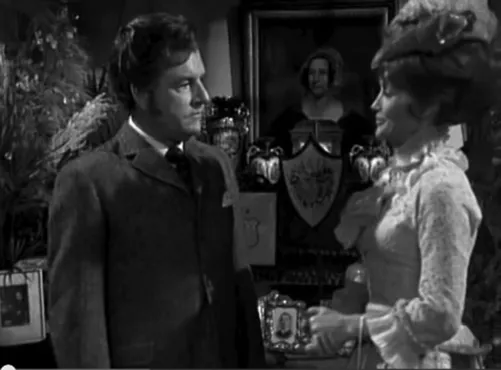
Figure 1.1 The Forsyte Saga (BBC2, 1967): Episode 1 – cluttered background separating Young Jolyon and his wife
At the same time, the drama’s visualisation of the period clearly reflects changes in technology available during production. The 1960s brought important technological developments – new possibilities of videotape, electronic editing and shooting on light 16 mm cameras, which allowed for a move away from ‘filmed theatre’. With the introduction of Ampex magnetic recording in 1959–60, which meant that television images could now be recorded onto videotape, there had been a decline in live studio drama. This new technology allowed for post-production and hence led to a change in style in televis...
Table of contents
- Cover
- Title
- Copyright
- Dedication
- Contents
- List of Figures
- Acknowledgements
- Introduction: Neo-Victorian Television: British Television Imagines the Nineteenth Century
- 1 Period Representation in Context: The Forsyte Saga on BBC and ITV
- 2 Victorian Fictions and Victorian Nightmares
- 3 Murder Rooms and Servants: Original Drama as Metadaptation 103
- 4 Real Victorians to Victorian Realities: Factual Television Programming and the Nineteenth Century 147
- Conclusion: Victorian Facts, Victorian Fictions
- Notes
- Bibliography
- Television Programmes and Films Cited
- Index
Trusted by 375,005 students
Access to over 1.5 million titles for a fair monthly price.
Study more efficiently using our study tools.
Frequently asked questions
Yes, you can cancel anytime from the Subscription tab in your account settings on the Perlego website. Your subscription will stay active until the end of your current billing period. Learn how to cancel your subscription
No, books cannot be downloaded as external files, such as PDFs, for use outside of Perlego. However, you can download books within the Perlego app for offline reading on mobile or tablet. Learn how to download books offline
Perlego offers two plans: Essential and Complete
- Essential is ideal for learners and professionals who enjoy exploring a wide range of subjects. Access the Essential Library with 800,000+ trusted titles and best-sellers across business, personal growth, and the humanities. Includes unlimited reading time and Standard Read Aloud voice.
- Complete: Perfect for advanced learners and researchers needing full, unrestricted access. Unlock 1.5M+ books across hundreds of subjects, including academic and specialized titles. The Complete Plan also includes advanced features like Premium Read Aloud and Research Assistant.
We are an online textbook subscription service, where you can get access to an entire online library for less than the price of a single book per month. With over 1.5 million books across 990+ topics, we’ve got you covered! Learn about our mission
Look out for the read-aloud symbol on your next book to see if you can listen to it. The read-aloud tool reads text aloud for you, highlighting the text as it is being read. You can pause it, speed it up and slow it down. Learn more about Read Aloud
Yes! You can use the Perlego app on both iOS and Android devices to read anytime, anywhere — even offline. Perfect for commutes or when you’re on the go.
Please note we cannot support devices running on iOS 13 and Android 7 or earlier. Learn more about using the app
Please note we cannot support devices running on iOS 13 and Android 7 or earlier. Learn more about using the app
Yes, you can access Victorians on Screen by Iris Kleinecke-Bates in PDF and/or ePUB format, as well as other popular books in Media & Performing Arts & Film & Video. We have over 1.5 million books available in our catalogue for you to explore.