eBook - ePub
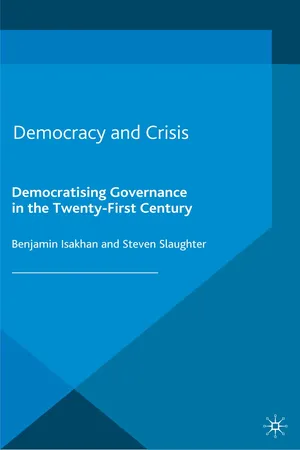
Democracy and Crisis
Democratising Governance in the Twenty-First Century
- English
- ePUB (mobile friendly)
- Available on iOS & Android
eBook - ePub
Democracy and Crisis
Democratising Governance in the Twenty-First Century
About this book
Recent years have seen constant reports on the failures of governance and the crisis of democracy. By examining cases like Global Financial Crisis, the Arab Revolutions and Wikileaks this volume highlights tensions between governance and democracy during times of crisis and examines the prospects of democratising governance in the 21st Century.
Information
Part I
Reconsidering Governance
1
Decentering Governance: A Democratic Turn?
Mark Bevir
Two narratives arguably dominate current accounts of the changing nature of state authority: those emphasising network governance and metagovernance. After examining these narratives, this chapter defends decentred theory, a narrative of the stateless state (Bevir and Rhodes, 2010) and the related possibility of a democratic turn in the governance literature.1 The general aim is to promote democratic innovations by challenging implicit reifications of the state and consequently the technocratic expertise that these reifications legitimate.
The narrative of network governance concentrates on the institutional legacy of neo-liberal reforms of the state. The neo-liberal reforms eroded the hierarchic bureaucracies that had flourished for much of the post-war era. They established a new politics of markets, quasi-markets and networks. Network governance describes a world in which state power is dispersed across various networks, each of which is composed of various public, voluntary and private organisations. A second narrative of the changing state accepts the idea that there has been a shift from bureaucracy to markets and networks but disputes the claim that this shift has resulted in a significant dispersal of state authority. This narrative focuses on metagovernance – an umbrella concept describing the role of the state and its characteristic policy instruments in network governance. From this perspective, the state returns as an important policymaker, albeit one that relies less on command than on indirect steering of relatively autonomous stakeholders.
Decentred theory challenges narratives of network governance and metagovernance. To decentre is to unpack a practice into the disparate and contingent beliefs and actions of individuals. Decentred theory focuses on the social construction of practices through the ability of individuals to create and act on meanings. It undermines the reified accounts of the state associated with narratives of network governance and metagovernance. It encourages analyses of the various traditions that have informed the diverse policies and practices by which elite and other actors have sought to remake the state. It implies the state is stateless. Further, as decentred theory challenges the craving for generality and modernist expertise that characterise much of the literature on governance, so it encourages a democratic turn, for as decentred theory rejects the craving for generality, it points to a pluralist approach, and as it rejects the fallacy of expertise, it points to a more dialogic approach.
Network governance
The first narrative of the changing state focuses on a network governance consisting of something akin to a differentiated polity characterised by a hollowed-out state, a core executive fumbling to pull rubber levers of control and a massive growth of networks (Rhodes, 1997a; Rhodes, 2000; Richards and Smith, 2002; Smith, 1999; Stoker, 1999 and 2000). Of course, social scientists define network governance in diverse ways. Nonetheless, many appeal to inexorable and impersonal forces to explain the shift from a hierarchically organised state to governance by markets and especially networks. They appeal, more particularly, to logics of modernisation, such as the functional differentiation of the modern state or the marketisation of the public sector. In their view, neo-liberal reforms led to the further differentiation of policy networks in an increasingly hollow state. Social scientists typically use a concept of differentiation here to evoke specialisation based on function. Their approach is modernist, treating institutions such as legislatures, constitutions and policy networks as discrete and atomised objects to be compared, measured and classified. They use comparisons across time and space to uncover regularities and to offer probabilistic explanations that can be tested against allegedly neutral evidence. In particular, these modernists treat the changing state as characterised by self-organising and inter-organisational networks, that is, as a complex set of institutions and institutional linkages defined by their social role or function. They thereby make any appeal to the contingent beliefs and preferences of the agents largely irrelevant.
In Britain this narrative of the changing state challenges a long-standing Westminster model. It claims in particular to capture recent changes in the British state in a way that the Westminster model does not. According to Rod Rhodes, for example, ‘the differentiated polity identifies key changes which reshape that political tradition’; it ‘focuses on interdependence, disaggregation, a segmented executive, policy networks, governance and hollowing out’ (Rhodes, 1997a: 199). The Anglo-governance school starts out from the notion of policy networks composed of groups clustered around a major state function or department (Marinetto, 2003). These groups commonly include the professions, trade unions and big business. The Anglo-governance school suggests that the state needs the cooperation of such groups to deliver public services. The state allegedly needs their cooperation because it rarely delivers services itself; it uses other bodies to do so. Also, there are supposed to be too many groups to consult, so the state must aggregate interests; it needs the legitimated spokespeople for that policy area. The groups in their turn need the money and legislative authority that only the state can provide.
Policy networks are a long-standing feature of the British state. They are its silos or velvet drainpipes. The Conservative government of Margaret Thatcher sought to reduce their power by using markets to deliver public services, bypassing existing networks and curtailing the ‘privileges’ of the professions, commonly by subjecting them to rigorous financial and management controls. However, these corporate management and marketisation reforms had unintended consequences: they fragmented the delivery of public services, creating pressures for organisations to cooperate with one another. In other words, marketisation multiplied the networks it aimed to replace. Commonly, diverse packages of organisations now deliver welfare state services. The first narrative of the changing state thus concentrates on the spread of networks in and around the state. It tells us not only that fragmentation created new networks but that it also increased the membership of existing networks, incorporating both the private and voluntary sectors. It also tells us that the state swapped direct for indirect controls; central departments are no longer either necessarily or invariably the fulcrum of a network. The state can set the limits to network actions – after all, it still funds the services – but it has increased its dependence on multifarious networks.
The Anglo-governance school conceives of networks as distinctive coordinating mechanisms, notably different from markets and hierarchies rather than just a hybrid of them. It associates networks with characteristics such as interdependence and trust. In its view, trust is essential because it is the basis of network coordination in the same way that commands and price competition are the key mechanisms respectively for bureaucracies and markets. Indeed, this view of networks is common beyond the Anglo-governance school (Frances et al., 1991; Powell, 1990). Shared values and norms are the glue that holds the complex set of relationships in a network together. Trust and reciprocity are essential for cooperative behaviour and therefore the existence of the network itself (Kramer and Tyler, 1996). With the spread of networks there has been a recurrent tension between, on the one hand, contracts (which stress competition to get the best price) and, on the other hand, networks (which stress cooperative behaviour). Trust and reciprocity are, it is said, essential to reduce this tension.
According to the Anglo-governance school, multiplying networks means that state (or core executive) coordination is modest in practice. Coordination is largely negative, based on persistent compartmentalisation, mutual avoidance and friction reduction among powerful bureaux or ministries. Even when coordination is cooperative, anchored at the lower levels of the state machine and organised by specific established networks, it is sustained by a culture of dialogue across vertical and horizontal relationships. The state only rarely achieves strategic coordination. Indeed, almost all state attempts to create proactive strategic capacity for long-term planning have failed (Wright and Hayward, 2000). The Anglo-governance school explains New Labour’s reforms as an attempt to promote coordination and strategic oversight and combat both Whitehall’s departmentalism and the unintended consequences of managerialism.
Consequently, the Anglo-governance school tells a story of fragmentation confounding centralisation as a segmented state seeks to improve horizontal coordination among departments and agencies and vertical coordination among departments and their networks of organisations. An unintended consequence of marketisation and of the later search for central control has been a hollowing out of the state. The state has been hollowed out from above by international interdependence, from below by marketisation and networks, and from sideways by agencies. The growth of markets and networks has further undermined the ability of the state to act effectively and made it increasingly reliant on diplomacy, that is, its negotiations with the other actors in markets and networks. The British state was already characterised by baronies, policy networks, and intermittent and selective coordination. It has been further hollowed out by the unintended consequences of marketisation, which fragmented service delivery, multiplied networks and diversified the membership of those networks by membership in the European Union and by other international commitments. As Rhodes explains, ‘central government is no longer supreme’; instead, there is a ‘polycentric state characterised by multiple centres’ (Rhodes, 1997a: 51).
Metagovernance
Critics of the first narrative of the changing state characteristically focus on the argument that the state has been hollowed out. For example, Jon Pierre and Guy Peters argue that the shift to network governance could ‘increase public control over society’ because governments ‘rethink the mix of policy instruments’. As a result, ‘coercive or regulatory instruments become less important and. … “softer” instruments gain importance’, one example being the growth of steering through brokerage (Pierre and Peters, 2000: 78, 104–105, 111). In short, they argue that the state has not been hollowed out. A second narrative of the changing state thus focuses on metagovernance, that is, the ways in which the state has reasserted its capacity to govern by regulating the mix of governing structures, such as markets and networks, and by deploying indirect instruments of control.
Metagovernance refers to the role of the state in securing coordination in governance and in particular to the state’s growing use of negotiation, diplomacy and informal modes of steering. As Eva Sørensen and Jacob Torfing suggest, ‘by understanding autonomy not as the absence of power but as a particular form of power-freedom relation, a space is cleared for analysing the diverse instruments of mobilising, forming and thereby governing the capacities of networks to undertake particular tasks, functions, and services “on their own”’ (Sørensen and Torfing, 2007: 190). Metagovernance suggests that the state now does less ‘rowing’ – the direct provision of services through bureaucratic organisations – and more ‘steering’ – the regulation of the networks of organisations that now provide services. Other organisations now undertake much of the actual work of governing; they implement policies, they provide public services and at times they even regulate themselves. The state now governs the organisations that govern civil society, the governance of governance. Further, the other organisations characteristically have a degree of autonomy from the state; perhaps they are voluntary or private sector groups or perhaps they are governmental agencies or tiers of government separate from the core executive. The state thus cannot govern them solely by the instruments that work in bureaucracies.
Nonetheless, there are several ways in which the state can steer the other actors involved in governance. First, the state can set the rules of the game for other actors and then leave them to do what they will within those rules; the other actors work in the shadow of hierarchy. So, for example, the state can redesign markets, reregulate policy sectors or introduce constitutional change. Second, the state can try to steer other actors using storytelling. The state can organise dialogues, foster meanings, beliefs and identities among the relevant actors, and influence what actors think and do. Third, the state can steer by the way in which it distributes resources such as money and authority. The state can play a boundary spanning role; it can alter the balance between actors in a network; it can act as a court of appeal when conflict arises; it can rebalance the mix of governing structures; and it can step in when network governance fails. Of course, the state need not adopt one uniform approach to metagovernance. It can use different approaches in different settings at different times, perhaps especially in the context of crises.
This summary implies much agreement about metagovernance. But social scientists are beginning to distinguish among approaches to metagovernance. Sørensen and Torfing identify four approaches: interdependence, governability, integration and governmentality (Sørensen and Torfing, 2007). Interdependence theory focuses on the state managing networks by means of a more indirect set of policy instruments (Rhodes, 1997b). Governability theory stresses that metagovernance and network management occur in the shadow of hierarchy (Scharpf, 1997). Integration theory stresses the formation and management of identities (March and Olsen, 1989). Governmentality theory focuses on the regulation of self-regulation and therefore on the norms, standards and targets that set the limits to networks (Barry, Osborne and Rose, 1996). This categorisation may seem odd given, for example, that proponents of integration theory and governmentality never talk of metagovernance. Nonetheless, distinguishing these approaches does help to identify different accounts of the extent and form of state intervention and control.
Proponents of interdependence theory would argue that manipulating the rules of the game allows the state to keep control over governing without having to bear the costs of direct interference. Proponents of governability theory stress the resources the state has at its disposal for metagovernance. They argue that the state can easily deploy these resources to manage other policymakers. Proponents of integration theory argue that the viewpoints and interests of different actors are so diverse that the core task is managing identities through, for example, storytelling about best practices and successful cooperation and coordination. Storytelling can create coherent social and political meanings and identities that soften the tensions among competing viewpoints and interests. Proponents of governmentality theory identify the complex of rules, norms, standards and regulatory practices that extend state rule more deeply into civil society by regulating the ways in which civil society self-regulates. In this view, accountancy, performance management and other management techniques are not just ways of achieving the 3Es – economy, efficiency and effectiveness – they are also ways of measuring, approving, appraising and regulating the beliefs and practices of network actors (McKinlay and Stakey, 1998). Of course, the approaches are not mutually exclusive; state actors deploy a different mix of approaches in different contexts.
Common ground
For all their different emphases and debate between the several proponents, the first two narratives of the changing state share much common ground. For a start, proponents of metagovernance take for granted the characteristics of network governance. They accept that states are becoming increasingly fragmented into networks based on several different stakeholders. Also, they accept that the dividing line between the state and civil society is becoming more blurred because the relevant stakeholders are private or voluntary sector organisations. So, for example, Bob Jessop concedes that ‘the state is no longer the sovereign authority’; it is ‘less hierarchical, less centralised, less dirigiste’ (Jessop, 2000: 24).
So, there is a shared modernist description of the characteristics of network governance. Narratives of metagovernance often recognise that non-state actors can have the power to self-regulate. They also have to distinguish these non-state actors from the state in order to make it possible to conceive of the state exerting a higher-level control over their self-regulation. The state governs the other actors involved in network governance. In other words, metagovernance heralds th...
Table of contents
- Cover
- Title
- Copyright
- Contents
- Acknowledgements
- Notes on Contributors
- Introduction: Crisis and Democracy in the Twenty-First Century
- Part I Reconsidering Governance
- Part II The Global Financial Crisis and Democracy
- Part III Transitional and Transnational Attempts to Democratise Governance
- Part IV Global Governance and Democratic Crises
- Index
Trusted by 375,005 students
Access to over 1.5 million titles for a fair monthly price.
Study more efficiently using our study tools.
Frequently asked questions
Yes, you can cancel anytime from the Subscription tab in your account settings on the Perlego website. Your subscription will stay active until the end of your current billing period. Learn how to cancel your subscription
No, books cannot be downloaded as external files, such as PDFs, for use outside of Perlego. However, you can download books within the Perlego app for offline reading on mobile or tablet. Learn how to download books offline
Perlego offers two plans: Essential and Complete
- Essential is ideal for learners and professionals who enjoy exploring a wide range of subjects. Access the Essential Library with 800,000+ trusted titles and best-sellers across business, personal growth, and the humanities. Includes unlimited reading time and Standard Read Aloud voice.
- Complete: Perfect for advanced learners and researchers needing full, unrestricted access. Unlock 1.5M+ books across hundreds of subjects, including academic and specialized titles. The Complete Plan also includes advanced features like Premium Read Aloud and Research Assistant.
We are an online textbook subscription service, where you can get access to an entire online library for less than the price of a single book per month. With over 1.5 million books across 990+ topics, we’ve got you covered! Learn about our mission
Look out for the read-aloud symbol on your next book to see if you can listen to it. The read-aloud tool reads text aloud for you, highlighting the text as it is being read. You can pause it, speed it up and slow it down. Learn more about Read Aloud
Yes! You can use the Perlego app on both iOS and Android devices to read anytime, anywhere — even offline. Perfect for commutes or when you’re on the go.
Please note we cannot support devices running on iOS 13 and Android 7 or earlier. Learn more about using the app
Please note we cannot support devices running on iOS 13 and Android 7 or earlier. Learn more about using the app
Yes, you can access Democracy and Crisis by B. Isakhan, S. Slaughter, B. Isakhan,S. Slaughter in PDF and/or ePUB format, as well as other popular books in Politics & International Relations & Political Philosophy. We have over 1.5 million books available in our catalogue for you to explore.