eBook - ePub
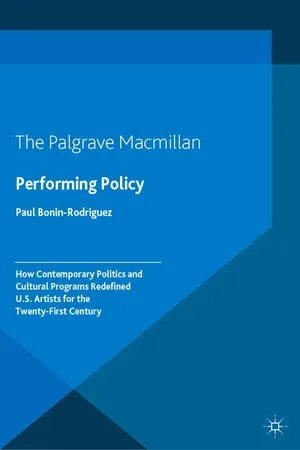
Performing Policy
How Contemporary Politics and Cultural Programs Redefined U.S. Artists for the Twenty-First Century
- English
- ePUB (mobile friendly)
- Available on iOS & Android
eBook - ePub
Performing Policy
How Contemporary Politics and Cultural Programs Redefined U.S. Artists for the Twenty-First Century
About this book
This book demonstrates how and why a majority of US artists must now function as producers of their original works, as well as creators. The author shows how, over the span of 20 years, the USA's cultural policy sector radically redefined US artists' practices without cohesively articulating the expectations of artists' new role.
Information
1
Introduction: Performing Policy
Performing Policy demonstrates how a movement in arts and cultural policy begun in the 1990s redefined US artists’ roles in American society and enhanced their prospects for the twenty-first century. What I am labeling a movement can be traced to a vast and still-growing archive of “gray literature,” the policy position papers (aka “white papers”) and scholarly monographs on arts and cultural policy and planning that began appearing in the late 1990s. These documents and the meetings from which they emerged countered the claims of a culture war that dominated the last decade of the twentieth century. Upon the publication of these reports, a number of arts initiatives soon followed. Artist-focused foundations and programs emerged to support artists’ capacity to contribute to vibrant cultural communities. Their progress was charted by their metrics, the “findings” that contributed to more innovations, additional studies, and programmatic evaluations.
The multiplying effect of policy to practice and back again continues even today, manifesting greater opportunities as well as deeper understandings about what the arts and artists bring to the nation and what they require to work well. Broadly, contemporary arts-focused studies tease out old dichotomies that once relegated “art” to the museum, the symphony hall, or the opera house and the artist to her studio. Observing that for too long the nation has focused on the European high arts, they call for cultural projects that engage the specifics of place. Acknowledging that twentieth-century arts policy relied too much on the nonprofit arts instrument and the leveraged grant model, they propose new models for arts support, greater recognition of the for-profit and community cultural sectors, and even time-based programs that maximize innovation in the short span of a decade, and then go away to make room for new ones.
As a set of “decisions (by both private and public entities) that either directly or indirectly shape the environment in which the arts are created, disseminated, and consumed,” today’s cultural policy efforts represent an admixture of ongoing political, social, and economic projects.1 Contemporary cultural policy theorists regard art and art making as critical “texts” of everyday life, practices that mark and mediate distinct cultural locations.2 For the first time in the history of US arts policy, a number of policy-informed initiatives also address the nation’s culturally and ethnically specific communities.3 As a result, today’s artists are often tasked to reframe their identities and articulate their practices to demonstrate how their skills and ways of thinking uniquely testify from and about a particular public, a municipality, and a nation. I am concerned with what these materials, as an archive that determines policy’s and philanthropy’s practices, have to offer artists directly. While a number of cultural policy scholars, economists, political scientists, and bloggers continue to follow new trends, gather data, and forge new policy directions, the sum of innovations has not been assessed in such a way that the implications translate readily to the artists. By reading contemporary cultural policy development, contextualizing those roles historically, and rehearsing their scenarios, I propose to bring cultural policy and artistic practice into a productive conversation—one that illustrates how artists can more effectively become the agents and cocreators of policy’s work.
Performing Policy proposes that the lens of performance analysis focusing on contemporary cultural policy development can effectively illuminate the players and their practices and offer a new way of thinking through the requirements of being an artist in the United States. I use performance both to describe an intentional practice—a “doing” to quote linguistic theorist J. L. Austin—and a type of optimization, as in “job performance.”4 Performance studies, as a “multivocalic,” intersectional discipline that emerged in the academy in the 1970s through the shared interests of anthropology, theatre studies, and the visual arts, offers a precise and multifaceted lens from which to read contemporary arts policy.5 The locus of performance studies’ analysis is embodiment, the ways in which performing subjects represent and also shape human relations through lived interactions. Embodiment cannot deny particular subjectivities at play—race, class, gender, sexuality, age, ability, and citizenship status among them—and so its presence is already in conversation with contemporary policy analyses.
The artist as producer, or the artist-producer
Since the late 1990s working US artists—writers, musicians, visual artists, and performing artists6—have been charged to function as producers of their creative works as well as the creative visionaries of their art. In addition to their art making, artists in the United States must regularly attend to concerns of financing, space, staffing, training, marketing, and contracts, among other concerns of production. As producers, or artist-producers, they now function as multidisciplinary professionals bridging the sectors of art, business, technology, policy, and education. Taking into account the benefits that artists bring to communities as “tradition bearers and cultural workers,”7 as well as acknowledging the actual costs and expertise required to make lasting cultural and social change, begs the question: how should today’s artists reward and promote their practices as well as themselves? While the notion of a struggling artist may still hold purchase in the national imaginary, how might an artist-based theory of contribution to society realize political, social, and economic effects for artists themselves?
By deploying the term “artist-producer,” I do not seek to change artists’ nomenclature, much less burden artists with cumbersome introductory banter. However, I do want to point directly to the hybrid lens through which contemporary arts and cultural policy literature and organizing increasingly portrays artists and structures their practices. The notion of a “hybrid” identity emerged in postcolonial studies, particularly in the writings of Homi K. Bhabha (1989) through his attempts to dissolve the oppressive division between “the master and the slave” by highlighting the ways that ethnic and cultural traditions can prevail against the totalizing—the homogenizing and hierarchically ordering—forces of global capitalism.8 Similarly, in my own study, hybridity offers a means to align artists’ practices with those of theorists and organizers who have been strategizing on their behalf. Drawing on Bhabha’s work, cultural theorists Michael Hardt and Antonio Negri (2000) refer to “hybridity” as a “realized politics of difference” and “liberation” that attenuates postmodernity’s presumptions of universality with postcolonial theory’s focus on place.9 Here I use a hybrid approach to offer an embodied agent for place-specific approaches, such as the work of the Pa’I Foundation in Honolulu, Hawaii. There, master teacher Vicky Holt Takamine sustains the tradition of Hawaiian hula through a teaching program and performance company and maintains a community arts space where artists may produce work and find entrepreneurial arts training.10 My thinking about hybridity is also informed by Mexican cultural theorist Hector Garcia Canclini. In Hybrid Cultures (1995), Garcia Canclini offers three key “levels” of hybrid organization and study. First, hybridity recognizes the necessity of a cross-disciplinary lens, or “nomad social sciences”; second, hybridity works across time, negotiating past tradition with present circumstance; and third, the study of hybrid cultures always takes the researcher beyond the specific “boundaries of cultural research,” taking into account “ethnic cultures and new technologies, and artisanal and industrial forms of production.”11 In the same vein, my study uses hybridity to distinguish how artists are also called to work across disciplines, to bridge times, traditions, and disciplines to define the role they play in communities. In a manner consistent with all of these cultural theorists, I deploy the term “artist-producer” for reasons both ontological and epistemological to illustrate the role artists play in communities and support how they think through their practices. Consequently, I use the term “artist-producer” to mark three distinct registers.
First and foremost, when creating work today, artists often function as the de facto producers of original work and of their own opportunities. Much of the contemporary cultural policy paradigm is predicated on studies developed since the late 1990s. At that time, economists, urban planners, and arts advocates recognized that the exponential growth of the nonprofit infrastructure between the 1970s and the 1990s wrought an unfeasible system.12 The 2001 and 2007 US recessions, fluctuations in the market, and even challenges to the nonprofit tax code have further panicked nonprofits and the philanthropies supporting them.13 The term “artist-producer” indexes the expressive and coproducing role anticipated by nonprofit organizations that require a type of artist who can bring audience-worthy works to the fore. As well-known choreographer Wally Cardona acknowledges, he must also act as an “administrator,” a grant writer, a fund-raiser, and a bookkeeper in “a project-to-project world” to produce his work.14 Contemporary granting programs like the Creative Capital Foundation, which I profile in Chapter 3, situate artists as the capable producers of their artistic vision who work alongside other professionals. At the same time, few artists work solely in the nonprofit sector; many ply their trade in commercial sector jobs, as well as community outlets.15 Artist entrepreneurship, with its dual focus on “venture creation” and “habits of mind,” also responds to this kind of artist-producer.16 In this study, I embrace artist entrepreneurs, but I do not ask artists as entrepreneurs to embrace uncritically the business entrepreneur’s ties to a world in which the rules of supply and demand are more evident and the incentives are primarily financial.17 The bottom line for the artist-producer may be more weighted by effectiveness of cultural expression than profit; however, the concerns of adequate resources to see that vision realized and artists rewarded remain of concern. In this capacity, I also share an alliance with “cultural entrepreneurship” and “artist entrepreneurship,” the two terms used to hail the creative organizational role artists play.18
Secondly, today many artists also work as producers of public good. Many contemporary studies of the arts and artists focus on the socially bonding elements of cultural expression—poetry, music, but also urban design, to name a few. Artists animate neighborhoods. Their works bring people into the close alliance of community, but also facilitate dialogue across distinct cultural histories and experiences. Building on the work of Edward Said, Columbia School of the Arts dean Carole Becker identifies artists as “public intellectuals” because they act “as spokespersons for multiple points of view and advocates for a critique of society.”19 Several arts policy theorists have begun to name this type of work in ways that resonate with the artist-producer. Urban policy expert Maria Rosario Jackson (2011) identifies US artists who work at the intersection of art and community development as having “hybrid careers.”20 Performance scholar Jan Cohen-Cruz (2010) uses the phrase “social call, cultural response” to describe contemporary performances that testify to, protest, and intervene on injustices such as anti-immigration movements or the Patriot Act. In doing so, these works pursue “cultural democracy—collective expression of the people, by the people, and for the people.”21 Choreographer Liz Lerman, whose works regularly engage distinct cultural groups, acknowledges: “One reason I have organized my life the way I have, with one foot in the art world and one foot in the community, is my realization that each of these shifts in my goals taught me something useful to take into the other realms of my work.”22 In The One and the Many (2011), art critic Grant Kester echoes Lerman’s assertion and historicizes the development of a collective ethos among many contemporary visual and installation artists working internationally. Unlike their modernist predecessors, who assumed a critical distance from their subjects, these artists work with communities over long periods of time, developing projects that address complex social concerns and contribute to public needs. Their installations include artistically transformed public parks and housing developments in blighted urban areas in Hamburg, Germany,23 and beautifully constructed water wells that acknowledge gendered labor divisions and local mores about women’s modesty in Kondagaon, Bastar District, Chhattisgarh, India.24 Kester theorizes that in response to neoliberalism’s dedication “to eliminating all forms of collective or public resistance . . . to the primacy of capital,” a number of today’s artists are also less concerned with proprietary interests than social benefits.25 Similarly, performance scholar Shannon Jackson uses the term “social works” to index politically engaged performances that maintain a materialist critique, but also work toward sustainability.26 All of these efforts point to Lewis Hyde’s assertion in The Gift (1979) that the arts exist in two simultaneous economies, “a market economy and a gift economy.”27 I share with him and with all of these scholars a sense that publically engaged artists “illuminate the human condition, contribute to the vitality of communities, and to the broader aesthetic landscape, as well as . . . promote social change and democratic dialogue.”28
Finally, rather than coining an ungainly portmanteau, “artistproducer,” I have loosely affixed the producer title to the artist with a hyphen and occasionally even say artist as producer, for good reasons. First, as cultural economists point out, artists generally make work with collaborators who have distinct skills that complement production. The choreographer working in concert dance often collaborates with a lighting designer, musicians and composers, costume designers, and stage managers. These...
Table of contents
- Cover
- Title
- 1 Introduction: Performing Policy
- 2 A Politic of Purpose: “The Arts and the Public Purpose” (1997)
- 3 New Work Now! The Austin New Works Theatre Community (2012)
- 4 Accounting for Capital: The Creative Capital Foundation (1999–Present)
- 5 A Survey Course: Teaching Artists and/as Producers (2013)
- 6 Linking Creative Investments: Investing in Creativity (2003) and LINC (2003–2013)
- 7 Proposing Place: Creative Placemaking (2010–Present)
- 8 Coda: Performing Policy
- Notes
- Bibliography
- Index
Trusted by 375,005 students
Access to over 1.5 million titles for a fair monthly price.
Study more efficiently using our study tools.
Frequently asked questions
Yes, you can cancel anytime from the Subscription tab in your account settings on the Perlego website. Your subscription will stay active until the end of your current billing period. Learn how to cancel your subscription
No, books cannot be downloaded as external files, such as PDFs, for use outside of Perlego. However, you can download books within the Perlego app for offline reading on mobile or tablet. Learn how to download books offline
Perlego offers two plans: Essential and Complete
- Essential is ideal for learners and professionals who enjoy exploring a wide range of subjects. Access the Essential Library with 800,000+ trusted titles and best-sellers across business, personal growth, and the humanities. Includes unlimited reading time and Standard Read Aloud voice.
- Complete: Perfect for advanced learners and researchers needing full, unrestricted access. Unlock 1.5M+ books across hundreds of subjects, including academic and specialized titles. The Complete Plan also includes advanced features like Premium Read Aloud and Research Assistant.
We are an online textbook subscription service, where you can get access to an entire online library for less than the price of a single book per month. With over 1.5 million books across 990+ topics, we’ve got you covered! Learn about our mission
Look out for the read-aloud symbol on your next book to see if you can listen to it. The read-aloud tool reads text aloud for you, highlighting the text as it is being read. You can pause it, speed it up and slow it down. Learn more about Read Aloud
Yes! You can use the Perlego app on both iOS and Android devices to read anytime, anywhere — even offline. Perfect for commutes or when you’re on the go.
Please note we cannot support devices running on iOS 13 and Android 7 or earlier. Learn more about using the app
Please note we cannot support devices running on iOS 13 and Android 7 or earlier. Learn more about using the app
Yes, you can access Performing Policy by P. Bonin-Rodriguez in PDF and/or ePUB format, as well as other popular books in Politics & International Relations & Art General. We have over 1.5 million books available in our catalogue for you to explore.