eBook - ePub
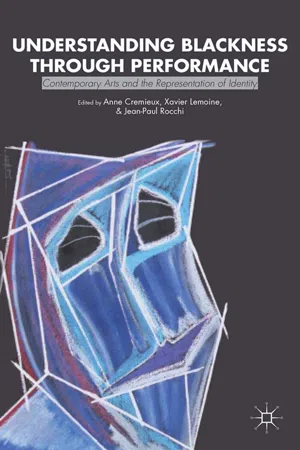
Understanding Blackness through Performance
Contemporary Arts and the Representation of Identity
- English
- ePUB (mobile friendly)
- Available on iOS & Android
eBook - ePub
Understanding Blackness through Performance
Contemporary Arts and the Representation of Identity
About this book
How does the performance of blackness reframe issues of race, class, gender, and sexuality? Here, the contributors look into representational practices in film, literature, fashion, and theatre and explore how they have fleshed out political struggles, while recognizing that they have sometimes maintained the mechanisms of violence against blacks.
Information
Subtopic
Art GeneralPart I
Black Being, Black Embodying: The Power of Auto-ethnography
1
Each Taking Risk, Performing Self: Theorizing (Dis)Narratives
Myron Beasley
I am overdetermined from outside . . . Already the white looks, the only true looks, are dissecting me. I am fixed.
—Frantz Fanon
I am an invisible man. No, I am not a spook like those who haunted Edgar Allan Poe; nor am I one of your Hollywood-movie ectoplasm. I am a man of substance, of flesh and bone, fiber and liquids—and I might even be said to posses a mind. I am invisible, understand, simply because people refuse to see me.
—Ralph Ellison
It was the silence. The absence of sound that prevailed in the space after I read the final words of my personal narrative before students and colleagues at the monthly Graduate colloquia continues to haunt me. Seemingly longer than a minute but less than a minute and a half—it could have been the looks, the glares, and those inaudible utterances from the audience. But it was an absence, an absence of sound, as I stood, offering my body, offering my narrative.
—My Journal
Always Situating
Langellier alerts, “when personal narrative performance materializes performativity—when narrator embodies identity, and experience—there is always danger and risks” (Langellier 1999: 129) and [It]participate[s] in the ongoing rhythm of people’s lives as a reflection of their social organization and cultural values” (Langellier 1989: 261). The risk is one of principle, an act of placing the “I” in the text and taking responsibility for ones’ own performances of self, ones’ actions, and ones’ words. In areas such as performance studies, communication studies, and even anthropology (not to mention other social science fields), scholars, in increasing numbers, are taking “risks” by engaging with their bodies and writing narrative as a way of presenting and representing their research. In so doing, they participate in the ongoing, and very much contested, terrain of the politics of academic writing and research. This corporeal move places the body at the center of the discourse, which for some is a critical act that liberates both the researcher and those who read their texts. Yet, for many academics, the domain of traditional academic writing is sacred, and the move toward viscerality is discombobulating.
Marcus along with Lincoln and Denzin articulated a shift in modes of inquiry that reflected the influence of postmodernism and critical theory, most notably the method of ethnography. Ethnography takes as its primary concern the exploration of cultural processes (broadly defined) in society and natural environments. In the last five decades, however, ethnographic approaches have expanded and are increasingly utilized by scholars in a variety of different fields. In addition, the methodology itself has come under scrutiny and has evolved from a position of distant observation to one of critical participatory observation where the scholar situates him/herself fully in the community where he/she works and is sensitive to and charts the power dynamic between the researcher and the community (Conquergood 1991). The ethnographer’s aim is to encourage a dialogue and coproduce a research project. Contemporary ethnographers are consumed with questions regarding voice (who has the right to speak for whom?), the power of text, and the multiple meanings of the word “culture” in this multinational and postmodern world. According to Dorst (1989), this postmodern world “abolishes a conceptual distinction traditional ethnography relies upon . . . the distinction between the set of ethnographic experience/observation and the site of ethnographic writing” (Dorst 2). This approach then moves beyond the basic, traditional role ascribed to an ethnographer by engaging also in a performance of critical ethnography. A critical ethnographer may encounter the same methodological struggles as a traditional ethnographer, but his/her aim is not just to present an “authentic” “representation” of the “Other.” Indeed, a critical ethnographer sets out to investigate the political implications of doing ethnographic research in the first place, and to unmask and detail how the culture being examined and the ethnographer together construct a “dialogic” performance in which the culture’s status as object is redefined as subject and the space in which the ethnographer and his/her co-participants create a performance anchored in the politics of “doing” the ethnography (Conquergood). The form that a critical ethnography takes depends on the specifics involved in the ethnography. Many critical ethnographers have “experimented” with various styles of presenting a culture in writing while simultaneously critiquing the act of representing another culture (Goodall 1991; McCall and Becker 1990; Ellis and Bochner 1996). Recently, many have embraced narrative and autoethnographic forms that are self-reflexive, evaluative, and have taken into account the researchers’ role in performing the writing of the ethnography. According to Dorst, such ethnographies occupy two positions:
A position of collector/transcriber/collageist, and a position of rhetorician/reader—in other words, the dual role of re-citer/re-siter, one who “tells over again” and thereby “relocates” the already inscribed citations by inserting them into a new context, in effect rewriting them (Dorst 206).
So the ethnographer should write in such a way that the “historicity or ‘writenness’ of the post-ethnographic text” (ibid. 207) is foregrounded, which requires that the fragments that comprise the texts are visibly and artificially displayed. Additionally, when fulfilling the role of critical reader, s/he should “unpack the rhetorical strategies, to read critically the auto-ethnographic souvenirs and identify the suppressed mechanisms through which they produce their effects” (207). Writing becomes more than just a form documenting and the reporting of an experience, this move is to consider writing as a happening, a meta performance, where the experience of doing and contemplating the text becomes just as important as the text itself. The process of writing then is a point of discovery that is included in the ethnographic text. A form that Norman Denzin describes as “messy text,” which he defines as “not only subjective accounts of [an] experience; scholars who operate from the messy text concept attempt reflexively to map multiple social discourses that occur in a given space,” which are grounded in “epiphanal moments” in people’s lives (Denzin 1997: 225). The writing represents both the narratives of the researcher with the narratives of the communities s/he engages, and, in many instances, reveals the complicated and difficult and often emotionally visceral pain (and pleasure) of doing the work. Hence the locus is on the narrative, the recounting of the stories people share with one another “as they attempt to make sense of the epiphanies or existential turning-point moments in their lives” (ibid. xvii). However, Langellier and Pollock advocate for a stronger reconsideration of the language of academic writing and build on the thoughts of noted linguist and philosopher, J. L. Austin, who suggested that we “do things with words.”
For example, in her seminal essay, “Performing Writing,” Pollock puts forth a compelling argument for performative academic writing:
At the brink of meaning, poised between abjection and regression, writing as doing displaces writing as meanings; writing becomes meaningful in the material, dis/continuous act of writing. (Pollock 1998: 75)
This approach forbids a Cartesian divide that separates the act of writing from the written text and the act of writing from audible speech and expression. Writing that performs is one challenge to the existing “standards” of academic research not only for its insistence of placing the body in the text but also because it calls for new forms, new ways in which the text is presented. Pollock suggests that performative writing is evocative, and fluid moving beyond the static meanings, a critical stance lingering and existing, neither masculine nor feminine, neither scholarly nor narrative, it just exists. It is metonymic, always unwriting itself. A metonymic text is “longing for a lost subject/object, for a subject/object that has disappeared” (Pollock 84). A performative text is subjective, nervous, citational, and consequential. Pollock’s argument (though not performatively written itself) is compelling and radical in what it asks scholars to consider. It is a process, performance of writing, and a written text that in its mere existence critiques the traditionalism and positivism that continues to dominate academic production. However, Langellier reminds us that narratives are performative utterances that, once again, reveal, “the ongoing rhythm of people’s lives as a reflection of their social organization and cultural values” (Langellier 1989: 261). Narratives are indeed powerful, but it’s the analytic scope of performance that provides a critical lens that disrupts the social space, challenges existing structures and cultural values.
Performance artist Guillermo Gomez-Peña suggests that performance is about “presence not representation; it is not . . . a mirror, but the actual moment in which the mirror is shattered” (Gomez-Peña 2000: 9). A disruptive moment, a seemingly chaotic instant when, according to Gomez-Peña, performance produces a “(dis)narrative . . . a complex multi-hued tapestry” of identities, cultures, and ideologies that challenge the dominant or master narrative about the performer and the audience (ibid. 9). His location of performance is situated here in performance of everyday life. Specifically, Gomez-Peña refers to performance identity, how we make sense of who we are in a given context. He is particularly interested in, like Langellier, the role narratives play in the construction and the performance of one’s identity.
This essay examines the complexities of race, particularly about the “risk” and shattered moments in which the racially marked body is made explicit in the performance of the personal narrative. I formulate an understanding of the (dis)narrative as one rooted in the lived experience of people of African descent. It is this narrative that hooks (she uses the term confessional writing) claims as the “beginning stage of a process of self-transformation” that enables one to find their voice (hooks 1999: 6). I conclude with my brief narrative performance “Taking Risks, Performing Self” as a way of theorizing of the (dis) narrative.
Situated in colonial discourse, Homi Bhabha contends that mediated images produce the social or master narratives of racially marked bodies. He asserts, “an important feature of colonial discourse is its dependence on the concept of ‘fixity’ in the ideological construction of ‘otherness’” (Bhabha 1986: xviii). Through this “fixity,” frozen images are produced and reproduced, inscribed and reinscribed on nonwhite bodies. Cultural studies theorist Stuart Hall suggests a yearning for fixity and subjugation is always present in colonial discourse as:
Both a nostalgia for an innocence lost forever to the civilized, and the threat of civilization being over-run or undermined by the recurrence of savagery, which is always lurking below the surface. (Hall 1982: 41)
Bhabha and Hall chart the limited and unyielding, yet pervasive, representations (narratives) of racially marked bodies, (dis)narratives then are a set of different readings charting the multifaceted complexities of identity and race.
The (dis)narrative is about the lived, everyday accounts of the multiple shades of identity formation. It is the embodied experiences as opposed to the monolithic set of readings. Race is significant in that the narrative of the marked body is prescribed, already written, and told by the dominant culture. The (dis)narrative then is a discourse that weaves in and out, alongside of, and often contradictory to, the colonial dominant reading of the physical body. It fleshes out the layers of identity and shatters the notion of the corporeal space while simultaneously theorizing the lived experience (Madison 1998). This critical performance produces the shattered moment where the audience/listener is confronted with an attempt to make sense of the racialized realities of the performer, the performance, and even the performers themselves. Hence the shattered moment illustrates the complexities and the fluidity of race. (Dis)narratives are the performed realities of the racialized body in performance.
This “radical” move by many contemporary scholars (including Conquergood, Denzin, Langellier, Pollock), many of whom are white, negates the history of such narrative performances that have always existed in scholarship produced by scholars of African descent. Actually, many were further marginalized within the academy because they wrote in such a reflexive, critical, and “personal” manner that was deemed “un-academic,” and they were labeled as “bad writers.” Until recently, some were excluded from academic studies (Sibley 1995). Consider Zora Neale Hurston, whose works have transformed both academic writing, the discipline of Anthropology, and in particular the methods of performance ethnography. The texts of Zora Neale Hurston solidified my own interests in ethnographic inquiry. Her work “struggled with the dangers of surveying the masses from the mountaintop, treating the folk material of the race as a landscape to be strip-mined in order to fuel the creative force” (Hemenway 1977: 154). Her work is testimony to that struggle, the challenges between armchair perspective and participatory observation, and writing her text in the language that captures the nuances and cadences of her coresearchers (never her informants or participants). Hurston’s work, particularly Mules and Men (1935) and Tell My Horse (1938), are subjective accounts that forecast contemporary dilemmas regarding self-reflexivity, creative modes of presentation and representation of research, and writing racialized bodies in the text. She adapted her field-notes to theatrical and musical performances; her writing took the form of narrative novels and captivating accounts of actually participating (I think particularly of her ritual accounts with the voodoo priest in Haiti) and engaging in communities, her communities. Using such tactics, Hurston unmasks the asymmetrical relationships that exist between the ethnographer and the communities they examine. The bulk of Hurston’s cultural contributions attest to this struggle. Hurston began with herself, her body, and her familiar space as fieldwork; her texts are (dis)narratives, complicating the performances of race, gender, and the role of the researcher in the ethnographic text. In Mules and Men, for example, Hurston returns to the familiar place of her hometown to collect folktales, “before everybody forgets all of ’em” (Hurston 1935: 8). However, ...
Table of contents
- Cover
- Title
- Introduction Black Beings, Black Embodyings: Notes on Contemporary Artistic Performances and Their Cultural Interpretations
- Part I Black Being, Black Embodying: The Power of Auto-ethnography
- Part II Shattered Frames and the Onlooker: Strategies and Significations
- Part III Through Performance: Desire and the Black Subject
- Part IV Shifting Paradigms of Identities
- Notes on Contributors
- Index
Trusted by 375,005 students
Access to over 1.5 million titles for a fair monthly price.
Study more efficiently using our study tools.
Frequently asked questions
Yes, you can cancel anytime from the Subscription tab in your account settings on the Perlego website. Your subscription will stay active until the end of your current billing period. Learn how to cancel your subscription
No, books cannot be downloaded as external files, such as PDFs, for use outside of Perlego. However, you can download books within the Perlego app for offline reading on mobile or tablet. Learn how to download books offline
Perlego offers two plans: Essential and Complete
- Essential is ideal for learners and professionals who enjoy exploring a wide range of subjects. Access the Essential Library with 800,000+ trusted titles and best-sellers across business, personal growth, and the humanities. Includes unlimited reading time and Standard Read Aloud voice.
- Complete: Perfect for advanced learners and researchers needing full, unrestricted access. Unlock 1.5M+ books across hundreds of subjects, including academic and specialized titles. The Complete Plan also includes advanced features like Premium Read Aloud and Research Assistant.
We are an online textbook subscription service, where you can get access to an entire online library for less than the price of a single book per month. With over 1.5 million books across 990+ topics, we’ve got you covered! Learn about our mission
Look out for the read-aloud symbol on your next book to see if you can listen to it. The read-aloud tool reads text aloud for you, highlighting the text as it is being read. You can pause it, speed it up and slow it down. Learn more about Read Aloud
Yes! You can use the Perlego app on both iOS and Android devices to read anytime, anywhere — even offline. Perfect for commutes or when you’re on the go.
Please note we cannot support devices running on iOS 13 and Android 7 or earlier. Learn more about using the app
Please note we cannot support devices running on iOS 13 and Android 7 or earlier. Learn more about using the app
Yes, you can access Understanding Blackness through Performance by Anne Cremieux, X. Lemoine,J. Rocchi in PDF and/or ePUB format, as well as other popular books in Media & Performing Arts & Art General. We have over 1.5 million books available in our catalogue for you to explore.