- English
- ePUB (mobile friendly)
- Available on iOS & Android
eBook - ePub
About this book
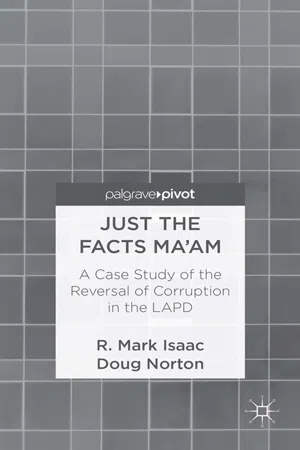
Just the Facts Ma'am is the only book written from an economics perspective that addresses one of the most remarkable cases of the reversal of corruption in the history of the United States - a case of corruption in the Los Angeles Police Department.
Information
1
Introduction
Abstract: Chapter 1 presents a brief introduction to the purpose of the monograph and lays out the road-map for the rest of the book. The theme so developed is the following: development economics research on corruption has surged in recent years, in part because there is a growing consensus that the efficacy of foreign aid hinges on the honest management of funds. The overall theme of the literature has been to demonstrate the corrosive effect corruption has on enterprise and the political process. We present here a case study of successful institutional change in the 1950s Los Angeles Police Department in which Police Chief William H. Parker produced a record of effective reforms. Finally, we introduce that we intend to apply this history to modern day development economics.
Isaac, R. Mark and Norton, Douglas A. Just the Facts Ma’am: A Case Study of the Reversal of Corruption in the Los Angeles Police Department. New York: Palgrave Macmillan, 2013. DOI: 10.1057/9781137354396.
Los Angeles “appears, in the light of recent developments, [to be] one of the most vice infested” cities in the nation.
—Los Angeles civic reformer Clifford Clinton, quoted in the Los Angeles Times, 1938
* * *
Philip Marlowe: “They say there’s a gambling house up the line.”
[Los Angeles] Policeman: “They say.”
Philip Marlowe: “You don’t believe them?”
Policeman: “I don’t even try buddy,” he said, and spat past my shoulder.
—Raymond Chandler, The Little Sister, 1949
* * *
Sgt. Joe Friday, LAPD Badge 714: “I live in this town. I work here, and I like it. There are 4,000 other men in the city who feel the same way…men who are trying to prove that the law is here to protect people, not cut ‘em down.”
—Dragnet, 1954
* * *
The Los Angeles Police Department “has become a model for police administrators throughout the world...”
—O.W. Wilson, Dean of the School of Criminology, University of California Berkeley, 1957
Development economics research on corruption has surged in recent years, in part, because there is a growing consensus that the efficacy of foreign aid hinges on the honest management of funds.1 The overall theme of the literature has been to demonstrate the corrosive effect corruption has on enterprise and the political process.2 We present here a case study of successful institutional change in the 1950s Los Angeles Police Department in which Police Chief William H. Parker produced a stunning record of effective reforms. Then, we apply this history to modern day development economics.
The study of institutions has recently received pride-of-place in mainstream development economics.3 Institutions are the social and legal rules of the game and they shape the costs and benefits of human action. But, while economists believe institutions matter, we have a thin knowledge about the emergence of institutions and the potentially fragile transitions toward better institutions. A seminal work on institutional formation from Lance E. Davis and Douglass C. North, “Institutional Change and American Economic Growth,” puts institutional change squarely in the domain of economic analysis. They write,
An institutional innovation will be innovated if the expected net gains exceed the expected net costs. Only when this condition is met would we expect to find attempts being made to alter the existing structure of institutions and property rights within a society. (Davis and North 1971, p. 10)
As will be seen below, the Davis and North paradigm—that institutions will be changed when there are perceived net gains from transformation—will play an important role in our analysis.
Chapter 2 of this volume provides social, economic, and political background for Los Angeles. The stories are rich with Midwestern immigrants, mobsters, corrupt city commissioners, crooked cops, concerned citizens, and the prospect of big military and business dollars.
In Chapter 3 we provide a model of equilibrium selection in the context of corruption. We flesh out that model with a review of Police Chief William H. Parker’s actual reforms. We tell a story about the courage and prudence Parker exhibited in the face of a corrupt status quo, but also present a number of critical preexisting institutions that were at his disposal. In addition to implementing a portfolio of incentive-related reforms, Parker believed strongly that cops should be honest, paid well, and that they should be viewed with esteem in the community. To this end Parker publicly communicated a campaign of restored values. One notable element of this campaign was the television show Dragnet.
In Chapter 4 we identify some key elements of the LAPD success story that ought to be transcendent with respect to time and location for reversing a culture of corruption: internal contestability of government power, external contestability of one government with another, the freedom of the media, and a memory of morality.
Finally, Chapter 5 concludes with a discussion about how the model we present might be applied out of sample to issues in contemporary economic development.
Before going further, we should say a few words about the research method we employ in this study. Our research may broadly be called a case study, a methodology that continues to have both supporters and detractors. Broadly speaking, there are two obvious approaches to the question of why Parker was so successful in his reforms. On the one hand, the existing, yet thin, historical literature emphasizes Parker’s personal values. On the other hand, a starting point for economists is likely to be an inquiry as to how Parker might have changed incentives (perhaps by changing institutions). Because we will be exploring the LAPD story through each of these two lenses, with specific reference to Davis and North’s model of institutional change, we believe that this research can be described as what Bates et al. (1998) have called an “analytic narrative” in which the data from a contextual history interact with one or more organizing models.
As we mentioned earlier there has been surprisingly little written about the Parker era. To our knowledge, none of that literature approaches the narrative from an economic analysis of values, institutions, and incentives. Nevertheless four sources have stood out as indispensable to our inquiry: John Buntin’s history of mid-century Los Angeles, L.A. Noir, which interplays the careers of Parker and gangster Mickey Cohen (Buntin 2009, hereafter “Buntin”); Alisa Sarah Kramer’s Ph.D. dissertation (Kramer 2007, hereafter “Kramer”), the archives of the Los Angeles Times (hereafter “LAT”), and Parker’s own words, Parker on Police, as collected by Wilson (1957).
Finally, it is important to emphasize at the outset that this is not a book designed to recommend Parker’s reforms per se as a model for developing countries. Instead, what we are examining are the conditions and methods that serve to support a reform program of this magnitude and effectiveness.
Notes
1Evidence about the importance of corruption in developing economies can be seen from the World Bank Anti-Corruption initiative in 1997. All aid strategies are required to assess “corruption risks” (World Bank 2000). A number of influential papers (see Chapter 5) and the popular book Economic Gangsters motivate the importance of studying corruption by linking it to a decline in foreign aid effectiveness (Fisman and Miguel 2008).
2There are a number of channels through which corruption might increase the costs of doing business. By decreasing the productivity of investment there will also be a decline in the rate of successful enterprise. Following failure would be an increase in the cost of capital. Corruption also has been shown to deteriorate checks and balances at various levels of accountability.
3Earlier work such as North and Thomas (1973) demonstrated the importance of institutions in economic growth. However, the fact that the handbook article presented in Acemoglu, Johnson, and Robinson (2005) argues that institutions are the fundamental cause of economic development is evidence of how the study of institutions is more mainline in development economics. Moreover, Boettke, Coyne and Leeson (2008) construct an account of the increased focus of development economists on institutions, which they call the “New Development Economics.”
2
A Brief History of Los Angeles: Conditions for Institutional Change
Abstract: In order to understand what William Parker accomplished and how he did it, it is necessary to lay some historical groundwork about the history of the settlement of Los Angeles, the parallel history of its neighbor to the South (San Diego), and, of course, a detailed discussion of the pattern of corruption in Los Angeles in general and in the Los Angeles Police Department in particular. This is the task of Chapter 2. In the first section, we look at the historical rivalries between Los Angeles and San Diego. As later developments made Los Angeles the more economically dominant of the two cities, it is important to recognize that, early on, San Diego was perceived to be the city best situated for growth in Southern California. In the second section, we look more closely at the growth of Los Angeles as a deliberately designed process of self-selection, appealing to Midwestern immigrants with a strong religious and ethical orientation. Finally, in the third section, we detail the specifics of Los Angeles police corruption during the 1920–1950 period, with particular emphasis on the years 1938–1949.
Isaac, R. Mark and Norton, Douglas A. Just the Facts Ma’am: A Case Study of the Reversal of Corruption in the Los Angeles Police Department. New York: Palgrave Macmillan, 2013. DOI: 10.1057/9781137354396.
The importance of reviewing the economic history of Los Angeles rests in its relationship to the Davis and North story of institutional change driven by perceived benefits and costs. A primary piece to this story of benefits and costs was the rivalry between Los Angeles and San Diego (outlined in Section 2.1). We argue that the threat that post–World War II economic development would flow away from corrupt Los Angeles to other locales (likely including San Diego just 100 miles to the south) gave William Parker support from the city leadership to execute a variety of institutional changes in the LAPD that improved police professionalism.
After the outline of the urban economic rivalry in Section 2.1, we will turn our attention in Section 2.2 to a history of values that typified the population of Los Angeles in the period of the 1920s through the 1950s. We will argue that the moral sensibility of many of the citizens of Los Angeles provided a “memory of morality” that supported Parker’s reforms. In addition, California was a center for Progressive Era institutions such as the initiative process, the recall, an independent grand jury, and strong civil service buffers for civic “experts and professionals” against partisan political influence. We will demonstrate that several of these Progressive institutions provided both the base upon which Parker could come to power and the levers that enabled Parker to stage a massive turnaround.1
Finally, in Section 2.3, we present a detailed history of municipal and police corruption in...
Table of contents
- Cover
- Title
- 1 Introduction
- 2 A Brief History of Los Angeles: Conditions for Institutional Change
- 3 Corruption Reform, Equilibrium Selection, and the Institutional Entrepreneur
- 4 Essential Components of the Success of Parkers Reforms
- 5 Application to Economic Development43
- Appendix
- Bibliography
- Index of Concepts and Events
Trusted by 375,005 students
Access to over 1.5 million titles for a fair monthly price.
Study more efficiently using our study tools.
Frequently asked questions
Yes, you can cancel anytime from the Subscription tab in your account settings on the Perlego website. Your subscription will stay active until the end of your current billing period. Learn how to cancel your subscription
No, books cannot be downloaded as external files, such as PDFs, for use outside of Perlego. However, you can download books within the Perlego app for offline reading on mobile or tablet. Learn how to download books offline
Perlego offers two plans: Essential and Complete
- Essential is ideal for learners and professionals who enjoy exploring a wide range of subjects. Access the Essential Library with 800,000+ trusted titles and best-sellers across business, personal growth, and the humanities. Includes unlimited reading time and Standard Read Aloud voice.
- Complete: Perfect for advanced learners and researchers needing full, unrestricted access. Unlock 1.5M+ books across hundreds of subjects, including academic and specialized titles. The Complete Plan also includes advanced features like Premium Read Aloud and Research Assistant.
We are an online textbook subscription service, where you can get access to an entire online library for less than the price of a single book per month. With over 1.5 million books across 990+ topics, we’ve got you covered! Learn about our mission
Look out for the read-aloud symbol on your next book to see if you can listen to it. The read-aloud tool reads text aloud for you, highlighting the text as it is being read. You can pause it, speed it up and slow it down. Learn more about Read Aloud
Yes! You can use the Perlego app on both iOS and Android devices to read anytime, anywhere — even offline. Perfect for commutes or when you’re on the go.
Please note we cannot support devices running on iOS 13 and Android 7 or earlier. Learn more about using the app
Please note we cannot support devices running on iOS 13 and Android 7 or earlier. Learn more about using the app
Yes, you can access Just the Facts Ma'am by R. Isaac,D. Norton in PDF and/or ePUB format, as well as other popular books in Economics & Econometrics. We have over 1.5 million books available in our catalogue for you to explore.