eBook - ePub
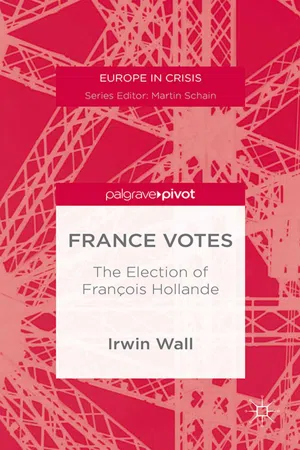
France Votes: The Election of François Hollande
The Election of François Hollande
- English
- ePUB (mobile friendly)
- Available on iOS & Android
eBook - ePub
About this book
France Votes analyzes the French elections of 2012 in the context of a France and Europe in crisis. With regard to the economy, Irwin Wall describes the ways in which the country's adherence to the common currency in the Eurozone has stripped France of its freedom of manouver. France Votes shows how a European-wide economic crisis was reflected in political crisis at home and the rise of new political extremism combined with mass disaffection from politics altogether. The result of all of this, posits Wall, is that France has become a no-choice democracy.
Information
1
The Innovations
Abstract: The 2012 election in France occurred under inauspicious circumstances: the Socialists were widely expected to win, but their front-runner, head of the International Monetary Fund, Dominique Strauss-Kahn, was eliminated from contention due to sexual indiscretions. The mantle of candidate fell to the unprepossessing François Hollande, who was aware of a growing crisis in the French political system, characterized by increasing alienation of the voters from the political class that governs them. Hollande rode to the top in the context of efforts by the Socialist party to address that crisis: on the one hand the Socialist party endorsed parity for women and greatly increased their participation in the party, and on the other hand it adopted and expanded the primary system, coming into vogue among many political parties in Europe and Israel. However, these were not sufficient to alleviate the political crisis which is rather driven by divisions in the electorate that transcend the parties, including European unity and globalization.
Wall, Irwin. France Votes: The Election of François Hollande. New York: Palgrave Macmillan, 2014. DOI: 10.1057/9781137356918.0004.
The French election campaign may be said to have begun curiously in a New York hotel room on May 24, 2011, where the leading potential candidate of the opposition Socialist party (PS), Dominique Strauss-Kahn, who was also serving as head of the International Monetary Fund, was accused of rape by a chambermaid named Nafissatou Diallo. Later that afternoon at JFK Airport, after having boarded his Air France flight to Paris, Strauss-Kahn was arrested by New York City police, held without bail, and subjected to the humiliating “perp walk,” a ritual for which New York’s finest are famous, before his eventual arraignment by a New York judge. Strauss-Kahn was eventually released on bail, and the case against him collapsed when the interrogation of Ms. Diallo revealed contradictions and possible untruths in her testimony. But his anticipated candidacy for the French presidency was fatally compromised.
Many in France believed that the Socialist leader had been entrapped by President Sarkozy’s intelligence services; the assault, if it was that, took place in a French hotel chain, Sofitel, and news of it swept through France immediately, perhaps because of leaks by upper-level hotel personnel, some of whom were seen to react in glee to the news. But even so, a fatal blow had been dealt to Mr. Strauss-Kahn’s presidential aspirations. His lame defense against the charges was that he had engaged in “consensual” sex; he could not deny that sex had taken place, however, since the police had discovered his semen strewn on the carpet. If indeed a trap, Strauss-Kahn had fallen into it, and informed circles in France smirked at this apparently most serious of sexual indiscretions for which he already had a reputation in France. The case led to rape charges being brought against him by a young journalist, Christine Banon, based on an incident that allegedly took place eight years earlier, in 2003. Banon accused Strauss-Kahn of attempted rape during an interview she had with him in her capacity as a journalist eight years earlier, explaining that she had been too intimidated to bring charges at the time. Banon’s charge was dismissed for lack of evidence and because the statute of limitations had expired, but then revelations emerged of Strauss-Kahn’s involvement in orgies and the procuring of prostitutes for a hotel-based sex-ring in the French city of Lille.1 These charges remained under investigation for the duration of the presidential campaign forcing Strauss-Kahn to withdraw his candidacy.
Diallo’s accusation was the first of a series of events that carried François Hollande, a Socialist, to the presidency of France. Hollande seemed an unlikely choice to many, who saw him as an uncharismatic career politician. His election still amounted to a minor revolution in French politics given the dimensions of his victory. His victory was unprecedented in its scale, giving him and his party control of the presidency, the National Assembly, the Senate, while it had dominance in the constitutional court; Socialist majorities also already existed in the vast majority of the regions and municipalities throughout France. Hollande appeared ready to use his exceptional mandate from the French people to modify profoundly, if not overturn, the existing relationships of states and power within the European Union. In fact, however, Hollande was perfectly aware, despite appearances, of the limitations on his power; the appearance of Socialist power in France by no means indicated a popular mandate but was rather a peculiar result of the electoral system. And however transformative his policy prescriptions seemed to be, they were limited by his personal timidity and the formidable array of power against them led by the Germans in the policy-making institutions of the European Union. There are several unprecedented aspects to Hollande’s victory and to the government he appointed in its wake, however, which are nevertheless transformative in the history of France.
At every French election the question of constitutional change is broached, and 2012 was no exception. Jean-Luc Mélenchon, the candidate of the extreme Left, openly called for a Sixth Republic; Hollande, however, observed that France had no less than 19 constitutions since the Great Revolution of 1789, and he thought that was enough. The Fifth Republic appeared to have become the consensual regime of the French, and Hollande wanted the Socialist party of France once and for all to accept its institutions. France had oscillated between monarchy, republic, and empire throughout its modern history; it seemed to have settled on the Third Republic in 1870, but that regime curiously lacked a constitution, and was rather established by a series of constitutional laws. The Third Republic endured from 1870 to 1940, its institutions gaining a kind of precarious stability and acceptance by the public. But if the institutions were stable the governments were not. The system of a weak president with power vested in a prime minister in need of a majority in the parliament led to chronic governmental instability that was held responsible for the collapse of 1940 and the national humiliation of dictatorship and collaboration under the regime of Marshal Pétain during the Second World War.
After the war, Charles de Gaulle, who was catapulted to the leadership of his country by his heroic leadership of the resistance, tried to establish a presidential republic which he proposed to head himself. He failed and went into exile while the Fourth Republic, as pundits pointed out, quickly transformed itself into another version of the Third. De Gaulle bided his time until the Algerian rebellion and the associated political crisis in France presented him with an opening in 1958; his return was regarded as essential to settling the crisis without civil war, but his price was a new constitution and the strong presidency that prevails today.
The system established under the Fifth Republic appeared to work well during de Gaulle’s presidency and that of his successors, Georges Pompidou and Valérie Giscard d’Estaing, but with the revival of a united Left during the 1970s threatening to win a majority in the National Assembly, it revealed itself to be less stable than it appeared. In fact the regime had what could have been a fatal flaw. The two-headed executive worked well so long as the president and prime minister were of the same party. But in the event that the Left won the legislative elections of 1978, which for the first time seemed a serious possibility, the president and prime minister would be of opposite parties, with no clear indication of who would actually control the government.
In the event the Socialist-Communist coalition did not win the elections in 1978; instead, François Mitterrand, the Socialist, won the presidency in 1981. The Socialist party, which had long criticized the system for its system of personal power, instead quickly adapted to it once it was able to win the presidency for itself in 1981. Indeed, François Mitterrand, who was the Left’s first president in 1981, was the author of a book describing the Fifth Republic as “Le Coup d’État permanent,” but as president from 1981 to 1995, through two seven-year terms, he accepted the institutions of the Fifth Republic after all; Mitterrand fitted admirably the role of republican monarch. But when he lost his majority in the National Assembly to the Gaullist Right in the March 1986 legislative elections, the basis of power in the regime again came into question. Mitterrand declined to provoke a constitutional crisis, however, and calmly appointed Jacques Chirac to lead a right-wing government that “cohabited” with the Socialist president from 1986 to 1988. The incipient crisis created by the two-headed executive power was resolved by a partial return to a parliamentary republic. When the Right won again in 1993, Edouard Balladur led a conservative government with Mitterrand as president again in what the French termed a government of “cohabitation.” Chirac succeeded Mitterrand as president in 1995 in a return of the conservative Gaullist party to power, but new legislative elections in 1997 were in turn won by the Left, and Chirac was forced to accept a Socialist-led government headed by Lionel Jospin that lasted for five years from 1997 to 2002. Cohabitation was turning from the exception into the rule as Chirac turned out to be a rather weak president, not at all what de Gaulle, the regime’s founder, had envisioned.
Neither of the government parties was satisfied with this situation, and as a consequence in 2002 the system was reformed yet again, this time so that presidential and legislative elections coincided. This reform greatly increased the importance of an already powerful presidency, although the term of sitting presidents was reduced from seven to five years. The 2002 elections were also a huge shock to the system, however: Jean-Marie Le Pen, head of the anti-system National Front party, emerged second to Chirac in the initial balloting for the presidency, nosing out the Socialist challenger, Lionel Jospin, by less than one point, but earning the right to challenge the incumbent president alone in the second round. In the event, Le Pen’s candidacy against Chirac in the second round revealed Le pen’s isolation as virtually all the other political forces in France rallied to the incumbent president, who received over 80% of the vote on the second ballot. Nevertheless the danger to the system not only from Le Pen but also from the massive disaffection of the voters from the political class in general was apparent for all to see. No single candidate, not even the incumbent President Chirac, could even get beyond 20% of the vote in the first round.
But in 2002 the legislative elections, now held one month after the conclusion of the presidential contest, became a kind of afterthought in which a part of the electorate returned to the polls to ratify its earlier choice and give the president his presidential majority in the National Assembly. After the chaos of the presidential ballot, the reorganized conservative party, the UMP (Union pour un Mouvement Populaire, Union for a Popular Movement), emerged from the legislative elections with a huge majority. Jacques Chirac, newly armed with an 80% majority of the popular vote on the second ballot and a large presidential majority in the National Assembly, in 2002, appeared to be the all-powerful president. But nobody was fooled; France’s underlying political crisis was evident as the National Front appeared to threaten the existence of democracy itself. The reform would seem to have minimized if not eliminated the possibility of president and prime minister of opposing parties, but it also diminished the importance of legislative elections in the eyes of French voters. The effect was still all too apparent ten years later in 2012: while the participation rate in the presidential balloting in 2012 was among the highest ever recorded in French elections, with over 81% of those registered turning out to vote, the abstention rate in the legislative elections little over a month later set a new record when only 56% of the electorate returned to the polls.2
France votes four times in order to accomplish what Americans do with a single day’s balloting. Since France has a multi-party system, a second ballot run-off is held to establish the winner following both the presidential and legislative elections. The presidential elections took place on April 22 and May 6, 2012, while the legislative elections were held on June 10 and June 17. There were no less than ten candidates for the French presidency on the first ballot in 2012, and multiple parties contested the first ballot of the legislative elections as well. Nevertheless, François Hollande was able to emerge with an overwhelming victory almost unprecedented in its scale. He won the presidency and an overwhelming majority in the National Assembly, all this despite the fact that the Left, even after one added together all its parts, was still a minority in the country. The fault here lay in the district system of voting as opposed to the more democratic system of proportional representation, which favors the two dominant parties and makes it very difficult for third parties to achieve representation in parliament. Routine in England and America, where two- or three-party systems in the case of England are the rule, this system has been less well digested in France, where strong politically independent forces of the extreme Right and Left, as well as the moderate center, find themselves almost entirely without national representation in parliament. Socialists already before the elections controlled the Senate and most of France’s regions and municipalities as well. Now they controlled the presidency and held a solid majority in the National Assembly. But the consequence of this situation was only to make it more difficult for the regime to address the growing sense of political crisis.
Nevertheless it appeared that one aspect of that crisis at least in part had been addressed. Women appeared in substantial numbers in the National Assembly, and Hollande’s government, formed immediately after the elections, reflected this: it was the first in French history to include an equal number of men and women as ministers, 17 each for a total of 34 ministers. In addition Hollande found himself dealing with a number of powerful women as he tried to implement his policies: in France, the leader of his own Socialist party, Martine Aubry, and the head of the threatening National Front party, Marine Le Pen; and in Europe, the dominant figure Chancellor Angela Merkel of Germany. The appearance of women in politics in a serious way in 2012 reflected years of struggle in France for the feminist demand of parity in political offices, a demand that successfully became enshrined in French law in 2000, if not yet in practice throughout the political system. But if parity was not achieved in the 2012 elections, women have nevertheless emerged as political players in the system to an unprecedented degree; they are today 155 of France’s 577 deputies in the French National Assembly.
Hollande’s campaign was also characterized by a surprising degree of American influence in the form of institutional borrowing and adaptation, in particular the use of the primary system. His victory occurred despite the fact that the Socialist party was and remains a minority party in France. The combined votes of the Left received a total of less than 45% on the first ballot of the presidential elections. Yet Hollande was able to gain a majority over Sarkozy on the second ballot, while his party achieved one of the most overwhelming political victories in French history in the legislative elections that followed. But despite the dimensions of Hollande’s victory, leading political scientists in France interpret his election as further evidence of a national political crisis, manifesting itself in a profound alienation of the population from the political class.3 The rise of the national-populist and racist National Front party under Marine Le Pen is but one aspect of that crisis. The growing rate of abstentions in French legislative elections is commonly held to be another. And finally, Hollande’s election reveals the biggest paradox of all. Despite his unprecedented degree of control over France, his power is severely limited by France’s position in the European system. His options as president proved surprisingly narrow, limited by France’s European partners, Germany in particular, his own limitations as a politician, and most of all the financial markets. His victory occurred amidst a crisis in the Eurozone, the grouping of 17 nations that since 1999 have adopted and used the euro as their common currency. Embedded economically in the EU and the Eurozone, France, like many of the smaller nations of Europe, has become in many respects a “no-choice” democracy.4
Who is François Hollande? Hollande was born into a middle class family of rather right-wing political views. He was educated in a Catholic boarding school, after which he took a degree at France’s elite business school, the Ecole des hautes études commerciales de Paris. From there he entered the École Nationale d’Administration, the training ground for the French political and administrative elite. Upon graduation Hollande went almost immediately into politics, slipping easily into the Socialist pa...
Table of contents
- Cover
- Title
- Introduction
- 1 The Innovations
- 2 The Contending Forces
- 3 The Campaign and the Elections
- 4 France and the Euro Crisis
- 5 The French Elections Decoded
- Conclusion
- Appendix
- Bibliography
- Index
Trusted by 375,005 students
Access to over 1.5 million titles for a fair monthly price.
Study more efficiently using our study tools.
Frequently asked questions
Yes, you can cancel anytime from the Subscription tab in your account settings on the Perlego website. Your subscription will stay active until the end of your current billing period. Learn how to cancel your subscription
No, books cannot be downloaded as external files, such as PDFs, for use outside of Perlego. However, you can download books within the Perlego app for offline reading on mobile or tablet. Learn how to download books offline
Perlego offers two plans: Essential and Complete
- Essential is ideal for learners and professionals who enjoy exploring a wide range of subjects. Access the Essential Library with 800,000+ trusted titles and best-sellers across business, personal growth, and the humanities. Includes unlimited reading time and Standard Read Aloud voice.
- Complete: Perfect for advanced learners and researchers needing full, unrestricted access. Unlock 1.5M+ books across hundreds of subjects, including academic and specialized titles. The Complete Plan also includes advanced features like Premium Read Aloud and Research Assistant.
We are an online textbook subscription service, where you can get access to an entire online library for less than the price of a single book per month. With over 1.5 million books across 990+ topics, we’ve got you covered! Learn about our mission
Look out for the read-aloud symbol on your next book to see if you can listen to it. The read-aloud tool reads text aloud for you, highlighting the text as it is being read. You can pause it, speed it up and slow it down. Learn more about Read Aloud
Yes! You can use the Perlego app on both iOS and Android devices to read anytime, anywhere — even offline. Perfect for commutes or when you’re on the go.
Please note we cannot support devices running on iOS 13 and Android 7 or earlier. Learn more about using the app
Please note we cannot support devices running on iOS 13 and Android 7 or earlier. Learn more about using the app
Yes, you can access France Votes: The Election of François Hollande by I. Wall in PDF and/or ePUB format, as well as other popular books in Politics & International Relations & European Politics. We have over 1.5 million books available in our catalogue for you to explore.