- English
- ePUB (mobile friendly)
- Available on iOS & Android
eBook - ePub
About this book
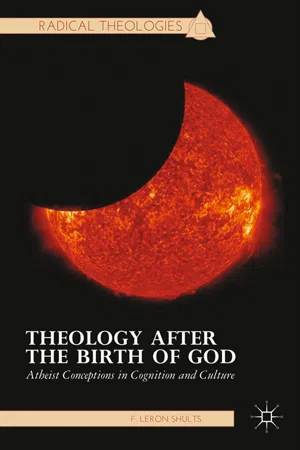
Engaging recent developments within the bio-cultural study of religion, Shults unveils the evolved cognitive and coalitional mechanisms by which god-conceptions are engendered in minds and nurtured in societies. He discovers and attempts to liberate a radically atheist trajectory that has long been suppressed within the discipline of theology.
Information
Topic
PhilosophySubtopic
Modern PhilosophyChapter 1
The gods Are Born—and We Have Borne Them
Crazy people are often difficult to ignore, especially when they are yelling provocative things like “God is dead” in the midst of a busy marketplace. The madman in Nietzsche’s famous aphorism, however, despite the intensity of his message and style of delivery, was met with relative indifference. When they heard him crying out that he was looking for God, some of the nonbelievers paused long enough to tease him: Has God lost his way like a child? Is he afraid of us? Has he emigrated? The madman jumped into their midst, piercing them with his eyes. “Where is God?” he cried; “I’ll tell you! God is dead! God remains dead! And we have killed him . . . We are all his murderers. But how did we do this? How were we able to drink up the sea? Who gave us the sponge to wipe away the entire horizon? . . . Are we not continually falling? And backwards, sidewards, forwards, in all directions? Is there still an up and a down? Aren’t we straying as though through an infinite nothing?” The crowd just looked at him—a bit disconcerted, but silent. Smashing his lantern on the ground, the madman sighed: “I come too early . . . my time is not yet.”1
No doubt many readers will have jumped past the quotations in the first paragraph, skipping ahead to this one to see if it offers anything more interesting. We’ve all heard this before. Claims about the death of God are deathly boring. Depending on whether or not one is an active participant within a religious in-group, such proclamations seem either obviously wrong or wrongly obvious. The message that “God is dead” gets surprisingly little traction in our mental and social worlds. It lacks sex appeal. For reasons we will explore in detail below, the idea of divine genitality is much more interesting—and disturbing—than the idea of divine mortality. Insights from a wide variety of scientific disciplines are converging to help explain how gods are conceived within human minds and nurtured within human groups as a result of naturally evolved, hypersensitive cognitive and coalitional tendencies that produce perceptual errors and cultivate out-group antagonism. The theoretical and practical relevance of this message will make it much more difficult to ignore.
Nietzsche also portrays the madman as bursting into churches and singing requiem aeternam deo (grant God eternal rest). Even there, among the believers, he is met relatively calmly and politely ushered out. Business—and church—carry on as usual. For the most part, the academic discipline of theology has also carried on as usual. Like many other modern masters of suspicion, as well as the “new atheists,” Nietzsche goes out of his way to criticize the problematic assumptions and deleterious consequences of monotheism, especially the slave morality of the Christian religion. Yet, theologians bound to such coalitions have found it surprisingly easy to immunize themselves from such challenges. Even within the academy and the public sphere, they go on appealing to the authoritative revelations of the supernatural agents putatively engaged in the religious rituals of their own groups. A growing number of scholars within other disciplines, as well as policy makers within pluralistic contexts, find this so annoying that they are tempted to ban theology from the marketplace of ideas.
This temptation is especially strong for atheists, and understandably so. However, I will argue for a different sort of atheistic strategy as well as a different atheistic message—both of which emerge out of philosophical reflection on empirical findings and theoretical developments within the biocultural study of religion. All of this will require a reconceptualization of religion, theology, and atheism. In the sense in which I will use the term, religion has characterized small-scale human groups for at least the past sixty thousand years. Theology, on the other hand, only emerged during the first millennium BCE within socioecological niches that required new ways of adapting to the increased psychological and political pressures of life in more heavily populated, complex literate states.
A specific conception of “God”—an infinite person with an eternal plan for human groups—has played a central role in the (re)production of the major religious traditions that trace their roots to the West Asian axial age. However, as many reflective individuals within and around those traditions have repeatedly pointed out, albeit for different reasons and with varying degrees of intensity, this idea is simply unbearable. Nevertheless, like the members of the religious coalitions they serve, most theologians, grinning or not, have continued trying to bear it.
Why Is Nietzsche’s Madman So Easy to Ignore?
God seems to have survived his death without much difficulty. Why do religious people find it so easy to dismiss the idea that “God is dead”? The problem was not that the madman had come too early. No, if his goal was to disrupt people’s reliance on supernatural agents to make sense of the world and act sensibly in society, as they stray “as though through an infinite nothing,” he had the wrong message. Had the madman read carefully through the last couple of decades of scientific literature in the biocultural study of religion, he would proclaim instead that the gods are born—and we have borne them! As we will see, this message opens up a new way of conceiving atheism as a positive force, rather than merely as a negative reaction to (mono)theism. In fact, one of the negative implications of the latter, often taken as “gospel” by members of religious coalitions, is that humans can not adequately interpret the natural world or appropriately inscribe the social world without help from imagined disembodied intentional forces. Atheism, on the other hand, is conceived as an affirmation: yes, we can. Or, at least, we can live trying.
But why is it so difficult to engender atheism? The reasons why most people seem impervious to objections to the notion of a personal God who cares for their own group can be clarified by a set of hypotheses that have emerged within and across disciplines such as evolutionary biology, cognitive science, neuropsychology, archaeology, cultural anthropology, behavioral ecology, political economics, and comparative religion. Theoretical insights from these (and many other) fields, which contribute to what I will call the biocultural study of religion, are converging to support the claim that supernatural agent conceptions are naturally reproduced in human thought as a result of evolved cognitive mechanisms that hyperactively detect agency when confronted with ambiguous phenomena and, once conceived, are culturally nurtured as a result of evolved coalitional mechanisms that hyperactively protect in-group cohesion. These tendencies are part of our phylogenetic and cultural heritage.
In other words, gods are easily “born” in human minds and “borne” in human cultures today because contemporary Homo sapiens share a suite of perceptual and affiliational dispositions that were naturally selected in early ancestral environments where the survival advantage went to hominids who were able to quickly detect relevant agents such as predators, prey, protectors, and partners in the natural milieu, and who lived in groups whose cohesion was adequately protected by attachment and surveillance systems that discouraged defecting, cheating, and freeloading in the social milieu. In chapter 2, I will return to these two sorts of theogonic (god-bearing) mechanisms, which I call anthropomorphic promiscuity and sociographic prudery, and outline the ways in which they reciprocally reinforce each other in the ongoing reproduction of gods in groups. As we will see, these evolved defaults aided human survival in a variety of ways, solidifying personal identity and enforcing social order. However, this is also true of other tendencies that seem to come to us “naturally,” such as racism, sexism, and classism. Such biases may have helped bind selves and societies together for millennia, but this does not mean that we have to hold onto these old habits as we continue adapting within (and altering) our rapidly changing late modern environments.
Of course, the original message of Nietzsche’s madman has not been completely ignored. Some conservative Christian theologians reacted by appealing to classical apologetic proofs (God cannot be dead because his existence must be thought) or to contemporary spiritual experiences (God cannot be dead because his presence is actually felt). Some liberal theologians tried to incorporate the madman’s proclamation directly into their doctrinal constructions: the death of God is thinkable, but only as a moment of divine “self-emptying” disclosed in the cross of (a now resurrected) Christ. Thomas Altizer, whose Apocalyptic Trinity was an earlier volume in the Radical Theologies series in which the present book appears, has been a central player in the “secular” theology movement since the 1960s. In The Gospel of Christian Atheism, he argued that it was through the “self-annihilation” of the “originally transcendent” God, who became “fully and totally” incarnate in Christ, that humans now “truly know this divine process of negativity.”2
Insights from the biocultural sciences of religion can help us understand why this “death of God” movement died out so quickly, leaving room for a whole host of “post-secular” proposals for faith in a “weak” biblical God who suffers with his people.3 For reasons we will examine in the following chapters, the latter sort of proposal is more easily embraced within local religious communities than the former. Assertions about the alleged moribundity of God are so maximally counterintuitive that they do not even distract people from their practical work in the marketplace, much less disrupt their ecclesiastical rituals. The role played by gods in the shared imagination of religious groups makes their death (nearly) unthinkable. The radical theology I advocate here is not another search for an “authentic” version of Christianity—or any other religious coalition whose cohesion depends on the revelation of (and ritual engagement with) supernatural agents. On the contrary, I will argue that after the discovery of the “birth of God,” theology can now follow a radically atheist trajectory that has long been suppressed within it.
For reasons I hope to make clear, the challenges and opportunities faced by postpartum theology will be very different than those of postmortem theology. The critiques of religion (and theology) that have emerged out of the biocultural sciences are significantly different than those leveled by Nietzsche, Feuerbach, Marx, Freud, and other twentieth-century skeptics. They are not simply newer versions of classical projection critiques, which have been surprisingly easy for religious people to dodge. The various scientific models we will explore in the following chapters could more properly be called detection/protection theories of religion. They unveil the very mechanisms that have enabled the religious evasion of complaints about anxiety-based projections.
Human beings evolved to detect other agents and to protect their own groups, but the integration and intensification of these hypersensitive tendencies led to the mistaken detection and violent protection of supernatural agent coalitions. The instincts behind these theories are not wholly new. At one point, Nietzsche himself suggested that what led to belief in “another world” among early humans “was not a drive or need, but an error in the interpretation of certain natural events, an embarrassing lapse of the intellect.”4 Decades earlier, Feuerbach had criticized the Christian religion not only for its anxious projection of a transcendent divine father figure, but also for its limitation of the allegedly universal love of God to a particular group.5 What the combined insights of the biocultural study of religion provide, however, are empirically based scientific theories that explain the actual mechanisms that lead to the generation of religious conceptions in human cognition and to their reproduction in human cultures.
Bearing gods in Cognition and Culture
It should be clear enough by now that my use of the term bearing is meant to do double duty, indicating the way in which gods are both born in human cognition (due to an overactive detection of agency) and borne in human cultures (due to an overactive protection of coalitions). The concept of gods, however, calls for further clarification. In common parlance, the term “god” usually evokes images of (male) Greek deities, Buddhist devas, or even the “God” of the Abrahamic monotheisms. Among scholars operating within the biocultural study of religion, however, it is a common practice to use the label “gods” as a shorthand way of referring to all kinds of culturally postulated discarnate entities, including animal spirits, ancestor ghosts, angels, bodhisattvas, and jinn, as well as more powerful divine beings like Zeus, Yahweh, or Vishnu. For the sake of this multidisciplinary dialogue, I will follow this practice, using the terms god and supernatural agent interchangeably as designations for any putative disembodied (or contingently embodied) force that is attributed intentionality (or related person-like qualities) and imaginatively engaged in ways that bear on the normative judgments of a human coalition.
Supernatural agents multiply like rabbits in the human Imaginarium, reproducing rapidly in fertile cognitive fields cultivated by participation in religious rituals. But only some of these god conceptions have been domesticated and bred across generations: those that are imaginatively engaged in ways that reinforce cooperation and commitment in human groups. For reasons we will explore in detail below, the reproductive success of this sort of supernatural agent within (some) Homo sapiens coalitions during the Upper Paleolithic provided a survival advantage to the individuals within them. Eventually some of these small, “god-bearing” groups moved out of Africa and into the Levant. Their genetic offspring outcompeted all other hominid species and spread across the continent into Asia and Europe, and eventually into Australia and the Americas. Their descendants—all living humans—share a phylogenetic inheritance, reinforced by millennia of social entrainment practices, that predisposes them to keep on bearing gods.
Making sense of these complex phenomena, which are shaped by the reciprocal interaction of cognitive and cultural dynamics, requires the integration of insights from a wide variety of perspectives. Some scholars within the social sciences and humanities looking over the disciplinary wall at scientists in fields like evolutionary psychology have worried about a rigid biological reductionism that would render their own fields irrelevant. Some cognitive scientists looking back over the wall have worried about a relativist social constructivism that does not take their own fields seriously. One still finds these extreme positions in some circles, but, as the suspicion on both sides has begun to subside, new conceptual space is being created and explored using new experimental methods that embrace explanatory pluralism.6 Biology and culture, genes and memes, brains and groups are so entangled in mutual resolving evolutionary processes that they can only be explained together.
My use of the phrase “biocultural study of religion” is not intended to blur the appropriate lines between distinct research communities, or to demarcate a new singular academic field or discipline. Given the astonishing fruitfulness of the open integration and overlapping application of these diverse theories and research methods to religious phenomena, trying to set such boundaries would be counterproductive. We might think of it as a “field,” but the metaphor should be construed not in geographical but in physical terms: a dynamic force field of interconnected and open explanatory events. If we think of it as a “discipline,” the focus should not be on deciding its departmental location but on disciplining ourselves to remain interconnected and open during every event of explanation. The theoretical and empirical literature that creates and fills this multidisciplinary conceptual space is rapidly expanding.7 In the following chapters, I will introduce and explicate a heuristic framework, based on a reconstruction and integration of some key concepts derived from this research, which I hope will help to unveil the mechanisms that continue to reproduce supernatural agents in contemporary minds and cultures.
Divine reproduction has always been a popular theme within religious mythology. When couched in the context of such world-founding narratives, the idea of the birth of gods (or the birthing of goddesses) has not been that difficult for most people to accept. Insofar as we conceive supernatural agents in our ow...
Table of contents
- Cover
- Title
- 1 The gods Are Born—and We Have Borne Them
- 2 Anthropomorphic Promiscuity and Sociographic Prudery
- 3 The Scientific Discipline of Theology
- 4 Arguing about Axiological Engagement
- 5 Religious Family Systems
- 6 Letting gods Go: Naturalism and Secularism
- 7 Postpartum Theology
- Notes
- Bibliography
- Index
Trusted by 375,005 students
Access to over 1.5 million titles for a fair monthly price.
Study more efficiently using our study tools.
Frequently asked questions
Yes, you can cancel anytime from the Subscription tab in your account settings on the Perlego website. Your subscription will stay active until the end of your current billing period. Learn how to cancel your subscription
No, books cannot be downloaded as external files, such as PDFs, for use outside of Perlego. However, you can download books within the Perlego app for offline reading on mobile or tablet. Learn how to download books offline
Perlego offers two plans: Essential and Complete
- Essential is ideal for learners and professionals who enjoy exploring a wide range of subjects. Access the Essential Library with 800,000+ trusted titles and best-sellers across business, personal growth, and the humanities. Includes unlimited reading time and Standard Read Aloud voice.
- Complete: Perfect for advanced learners and researchers needing full, unrestricted access. Unlock 1.5M+ books across hundreds of subjects, including academic and specialized titles. The Complete Plan also includes advanced features like Premium Read Aloud and Research Assistant.
We are an online textbook subscription service, where you can get access to an entire online library for less than the price of a single book per month. With over 1.5 million books across 990+ topics, we’ve got you covered! Learn about our mission
Look out for the read-aloud symbol on your next book to see if you can listen to it. The read-aloud tool reads text aloud for you, highlighting the text as it is being read. You can pause it, speed it up and slow it down. Learn more about Read Aloud
Yes! You can use the Perlego app on both iOS and Android devices to read anytime, anywhere — even offline. Perfect for commutes or when you’re on the go.
Please note we cannot support devices running on iOS 13 and Android 7 or earlier. Learn more about using the app
Please note we cannot support devices running on iOS 13 and Android 7 or earlier. Learn more about using the app
Yes, you can access Theology after the Birth of God by F. Shults in PDF and/or ePUB format, as well as other popular books in Philosophy & Modern Philosophy. We have over 1.5 million books available in our catalogue for you to explore.