- English
- ePUB (mobile friendly)
- Available on iOS & Android
eBook - ePub
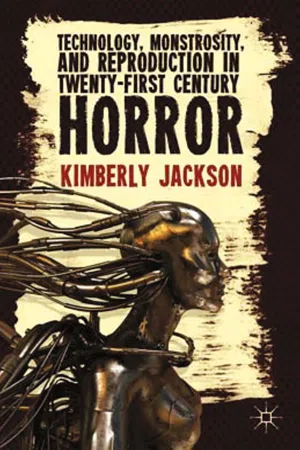
Technology, Monstrosity, and Reproduction in Twenty-first Century Horror
About this book
Through a wide spectrum of horror sub-genres, this book examines how the current state of horror reflects the anxieties in Western culture. Horror films bring them to a mass audience and offer new figures for the nameless faceless 'antagonist' that plagues us and provides material with which to build a different understanding of ourselves.
Information
1
Metahorror and Simulation in the Scream Series and The Cabin in the Woods
In this chapter I want to focus on several recent instances of metahorror: films overtly concerned with the horror genre and its conventions. As the films examined here were all released after the postmodern critique of metanarrative, the term metahorror in reference to them should receive the following qualification: while the films self-consciously refer to their own construction and the rules within which they operate, they do not therefore escape from that structure; their self-reflexivity is itself a part of their construction, and they do not in any real way break through the fourth wall. In this sense, these films are properly deconstructive; they expose the limits of the narrative structure in which they operate and thereby open up an internal space of play; they are at once definers of the genre and moments or examples of it.
While instances of metahorror date back at least to Michael Powell’s 1960 film Peeping Tom, this subgenre is generally associated with a sense of genre exhaustion that began in the 1980s. Philip Brophy, commenting in 1986, remarked that horror had begun to evince a “violent awareness of itself as a saturated genre” (5). Self-awareness or self-referentiality is only one quality by which a film might be characterized as “metahorror”; the other, as is the case in Peeping Tom, involves a self-conscious use of image technology such that the act of seeing or viewing, and the potential violence inherent in that act, comes to the fore. The former type of metahorror includes Thom Eberhardt’s Night of the Comet (1984) and Tom Holland’s Fright Night (1985), as well as the more recent I Know What You Did Last Summer series (Jim Gillespie, 1997; Danny Cannon, 1998; Sylvain White, 2006) and the Urban Legend films (Jamie Blanks, 1998; John Ottman, 2000). The most notable examples of the latter—including Wes Craven’s New Nightmare (1994), John Carpenter’s In the Mouth of Madness (1994), Craven’s Scream series (1996, 1997, 2000, 2011), Gore Verbinski’s The Ring (2002), William Malone’s Feardotcom (2002), and Drew Goddard’s The Cabin in the Woods (2012)—are those films that focus not only on the more anxious aspects of visual technologies but more specifically on their use in the production and reproduction of horror/the horror film.
The Scream series and The Cabin in the Woods are unique in that they combine these two aspects of metahorror, commenting both on genre conventions and on the role of media and communications technology in determining how horror is produced and received. Such themes have particular relevance in turn-of-the-century American culture, where “the large-scale dissemination of electronic images leads to a saturated state of hyperconsciousness in which real and simulated events are increasingly determined/defined in mimetic relation to each other” (Tietchen 102). This state of hyperconsciousness is accompanied by an ever greater fascination with and portrayal of violent crime; an overall desire to film, record, and publicize everything; a simultaneous paranoia that all of one’s actions are being watched and manipulated; a sense of uncertainty as to who is in control and/or where power lies; and a sense that old formulas and structures no longer hold, having become meaningless or exhausted. The Scream films and The Cabin in the Woods interrogate these tendencies by simultaneously asserting and denying genre structure and knowledge; producing layers of mediatization that make it difficult to locate the space of reality, truth, origin, or authenticity; and questioning the types of power and desire that operate in such a state of play. The films’ deconstructive potentials thus extend beyond the horror genre to society at large.
Genre Construction and Deconstruction in the Scream Series
The Scream series has not only been a box office success;1 the first film of the series, in particular, is often credited, along with Demme’s Silence of the Lambs (1991) and Myrick and Sánchez’s The Blair Witch Project (1999), with reviving the otherwise declining horror genre. In addition, Scream has enjoyed a prominent position in recent scholarly works on horror,2 though some earlier criticism of Scream’s postmodern tendencies was less than enthusiastic. As Matt Hills notes, “The problem for these critics appears to be that they read Scream as excessively playful in its postmodernism rather than as moralistically referential or indexical” (192). Such readings highlight the self-conscious aspects of the work over the critical, with many scholars either doubting that the latter exists or asserting that, if it does, it is ineffective. In contrast, Hills’s work is more generous, recognizing that the film’s intertextuality offers audiences significant “subcultural capital.” Beyond that, I would like to suggest that the series stages a crucial demonstration of the evolution of the reality-representation relation in an increasingly mediatized society, interrogating the ramifications of these trends for our understanding of originality and authenticity.3
In the beginning of Scream, a disembodied, electronically modified voice on the telephone asks, “What’s your favorite scary movie?” This killer, enhanced by communications technology and by his arsenal of genre knowledge, terrorizes a pretty, blond high-school student named Casey (Drew Barrymore) by quizzing her on her knowledge of horror movies. It seems as if being in the know will help her survive, but we quickly learn that is not the case. There is no way to win this game. Despite the film’s insistence that there are unbreakable rules in the slasher horror genre, the film also reveals time and again that those rules are arbitrary, that the genre is, as Andrew Tudor contends, “what we collectively believe it to be” (qtd. in Phillips, Projected Fears 5). It is therefore telling that the question Casey gets wrong—“Who was the killer in Friday the 13th?”—already breaks the rules. Casey answers correctly given the conventions of the genre: male psycho killers stalking scantily clad high schoolers. According to this logic, she says the killer was Jason. However, the killer in the first Friday the 13th film was not Jason but Jason’s mother. In true deconstructive fashion, difference lies at the origin. In fact, if we go back to the true origin of the slasher film, Hitchcock’s Psycho (1960),4 we see that the killer is both male and female; Norman Bates (Anthony Perkins) dresses like and takes on the identity of his mother when he kills.
Central to the deconstructive project in Scream is the determination of the rules of the system within which it sets to work. In this case, the system is slasher horror and the rules are those conventions that must be repeated in order to maintain the coherence of the genre. A tension develops between the similarity that must exist between iterations of the narrative and the differences that are inevitably introduced, a tension that serves horror quite well, as Phillips notes in Projected Fears, drawing on the work of Greenblatt: “The broad cultural success of a given work of fiction, then, can be said to rest, in part, upon the balance the work maintains between its resonance with familiar cultural elements and the unfamiliar elements that create in its audience a sense of wonder” (7). It is not new for horror films to reflect on or to be conscious of this tension in various ways, and this awareness, as Craven has demonstrated time and again throughout his career, far from rendering horror ineffective, can truly enhance it.
The final question the killer in Scream asks—“Which door am I at?”—is also a trick question, as we later learn that there are two killers. So he is at both doors at once. Again, there is no way for Casey, the helpless victim, to win this game. Interestingly, the killers in Scream gain a measure of power over their victims by sacrificing identity, self-presence, and coherence. As both cannot be the killer, the one must always cede control, either to the other or to anonymity. In addition to their duplicity, their power over their victims would be impossible without the use of cell phones, which allow them to be everywhere and anywhere at once. But not only do the phones distance them from the action (the one who is talking on the phone is not the one who is murdering the victim), their use of the electronic voice disguise furthers their anonymity. Moreover, they don mass-produced costumes derived from Edvard Munch’s series of The Scream of Nature paintings, which both disguise who they are and become an impressionistic reflection not of their power but of their victims’ helplessness. In this way, the killers are both victim and perpetrator at once, symbolically enacting their own deaths through various layers of absence even as they literally terrorize and dismember their victims. As Andrew Schopp contends, “In a fascinating way, the killers reflect a Gen X angst about lack of power coupled with a Gen X fantasy about acquiring power” (132).
The killers, Stu (Matthew Lillard) and Billy (Skeet Ulrich), do not view these layers of absence and mediation as a loss, however. They desire neither presence nor reality. Instead, their goal is to make their lives fiction. Their motive, as Tietchen points out, “is horror films themselves.” Tietchen continues, “The murders become secondary to the killer’s drive to participate in various modes of representation” (102). As Billy tells his girlfriend, Sidney (Neve Campbell), “It’s all one great big movie.” Emulating killers from horror films, their aim is to fuse reality and representation. “The flux between ‘the real’ and ‘the representation of the real’ is firmly fixed within Craven’s intentions” (Tietchen 103). Layers of mediation are produced in the process. Not only do we have diegetic-reality-as-movie, but further, there is the representation of this real fiction in the media. These layers are portrayed most clearly in one scene toward the end of the film, in which a bunch of high schoolers are viewing Halloween as one of the main characters, Randy (Jamie Kennedy), expounds on the rules of horror, while also commenting on the real string of murders that appears to be following these rules. At the same time, a hidden camera feeds the whole scene to a news van sitting outside the house. As Tietchen explains, “Again the flow of visual information is destabilized as Craven’s diegesis revolves around a horror movie viewed inside a horror movie and projected through a ‘news screen’” (103).
To add one more layer of confusion, it is not clear if the message of the film remains internal to the horror genre or extends to the real world outside. According to Hills, the latter occurs meaningfully only in the form of “populist, intertextual subcultural capital” (189). In other words, the film’s meaning has most to do with the community of viewers and the pleasure that comes from being in the know. Tietchen’s analysis is more open-ended:
Throughout, we are posed an interesting question: Is Craven confronting the emulation of horror films by real serial killers, or is he merely playing with a film killer’s influence on subsequent film killers? The Pavlovian response is that his film is reflexive—a mere inspection of the genre—but the deliberate ambiguity that shrouds the remainder of his diegesis, coupled by the visual reinforcement of designed confusion, leads one to wonder whether Craven is hinting at larger cultural pressures. (102)
As the Scream series continues into the second, third, and fourth films, Craven keeps this uncertainty alive, each film proclaiming, particularly through the struggles of the main character, Sidney Prescott, its own entrapment within the genre and its conventions while simultaneously highlighting the ever greater intimacy between fictional horror and true crime.
Genre conventions remain a major part of the way that characters speak about and attempt to deal with the murders in each film: Scream 2 is treated as a sequel, Scream 3 as the third installment of a trilogy, and Scream 4 as a “scream-make” (remake). However, as Valerie Wee notes, in response to Claudia Eller of the Los Angeles Times on the release of Scream 2, the Scream series is really closer to a serial, the difference being that a serial relies more on repetition, as opposed to a series, which involves some notion of progression or evolution. Wee’s interest in Scream’s serial qualities lies in the fact that it is the survivors who move on to the next film and not the killer(s). Beyond that, I would suggest that in many ways each film in the series is ultimately the same film; at the very least, all of them are about Scream. What is revealed in the fourth film, as a remake of the first, is that indeed all of the films have been remakes of the first. Scream is neither a series nor a trilogy but rather four films engaged in what Derrida refers to as “citational play,” each referring to the others in their separate but similar attempts to construct and deconstruct the genre and to comment on the status of reality in a media-saturated culture.5
In addition to the fact that the same main characters are present in each of the films—Sidney Prescott, our enduring Final Girl6; Dewey Riley (David Arquette), the delightfully dopey and ineffective policeman/detective; and Gale Weathers (Courteney Cox), aspiring Pulitzer winner—the sequel...
Table of contents
- Cover
- Title
- Copyright
- Contents
- List of Figures
- Permissions
- Acknowledgments
- Introduction: Imagining the Ends of Horror and of Humanity
- 1 Metahorror and Simulation in the Scream series and The Cabin in the Woods
- 2 The Image Goes Viral—Virtual Hauntings in The Ring and Feardotcom
- 3 The Image as Voracious Eye in The Blair Witch Project, Cloverfield, and the Paranormal Activity Series
- 4 Memory, Pregnancy, and Technological Archive in Dark Water and The Forgotten
- 5 The End of Patriarchy—Defining the Postmodern Prometheus in Splice and Prometheus
- Conclusion: A New Mythology for Techno-Humanity
- Notes
- Bibliography
- Index
Trusted by 375,005 students
Access to over 1.5 million titles for a fair monthly price.
Study more efficiently using our study tools.
Frequently asked questions
Yes, you can cancel anytime from the Subscription tab in your account settings on the Perlego website. Your subscription will stay active until the end of your current billing period. Learn how to cancel your subscription
No, books cannot be downloaded as external files, such as PDFs, for use outside of Perlego. However, you can download books within the Perlego app for offline reading on mobile or tablet. Learn how to download books offline
Perlego offers two plans: Essential and Complete
- Essential is ideal for learners and professionals who enjoy exploring a wide range of subjects. Access the Essential Library with 800,000+ trusted titles and best-sellers across business, personal growth, and the humanities. Includes unlimited reading time and Standard Read Aloud voice.
- Complete: Perfect for advanced learners and researchers needing full, unrestricted access. Unlock 1.5M+ books across hundreds of subjects, including academic and specialized titles. The Complete Plan also includes advanced features like Premium Read Aloud and Research Assistant.
We are an online textbook subscription service, where you can get access to an entire online library for less than the price of a single book per month. With over 1.5 million books across 990+ topics, we’ve got you covered! Learn about our mission
Look out for the read-aloud symbol on your next book to see if you can listen to it. The read-aloud tool reads text aloud for you, highlighting the text as it is being read. You can pause it, speed it up and slow it down. Learn more about Read Aloud
Yes! You can use the Perlego app on both iOS and Android devices to read anytime, anywhere — even offline. Perfect for commutes or when you’re on the go.
Please note we cannot support devices running on iOS 13 and Android 7 or earlier. Learn more about using the app
Please note we cannot support devices running on iOS 13 and Android 7 or earlier. Learn more about using the app
Yes, you can access Technology, Monstrosity, and Reproduction in Twenty-first Century Horror by K. Jackson in PDF and/or ePUB format, as well as other popular books in Social Sciences & Film & Video. We have over 1.5 million books available in our catalogue for you to explore.