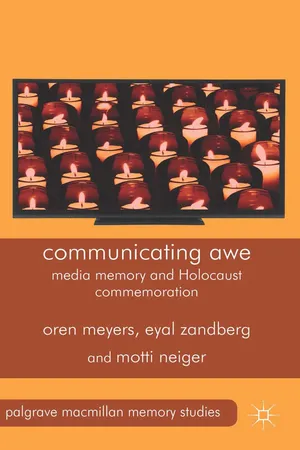
eBook - ePub
Communicating Awe
Media Memory and Holocaust Commemoration
- English
- ePUB (mobile friendly)
- Available on iOS & Android
eBook - ePub
About this book
Offering a cross-media exploration of Israeli media on Holocaust Remembrance Day, one of Israel's most sacred national rituals, over the past six decades, this fascinating book investigates the way in which variables such as medium, structure of ownership, genre and targeted audiences shape the collective recollection of traumatic memories.
Information
1
Mourning Newspapers
Holocaust Commemoration
and/as Nation-Building
and/as Nation-Building
The first chapter of the book provides a historical perspective to the study as it probes the shaping of Holocaust Remembrance Day media since the State of Israel’s formative era and up to the 1990s, via an analysis of the patterns of commemoration implemented by Israeli daily newspapers.1 The print press was the dominant medium during the first three decades of Israel’s existence and it is the only medium that offers consecutive archival material, covering the state’s first six decades.
In this chapter we look at the ways in which eight daily newspapers, each representing a distinct sociopolitical group or journalistic genre, covered Holocaust Remembrance Day through the years. This analysis enables us to explore the social–cultural–political struggle between these groups over hegemony through the processes of shaping Holocaust memory. In addition, this analysis illuminates the interrelations between the field of journalism and other social fields such as politics, economics and culture.
We investigate these interrelations through three complementary trajectories: the first trajectory focuses on the newspapers and the national ritual. To understand fully the historical perspective, we focus first on Israel’s formative era and more specifically on the establishment and the shaping of the mediated commemorative ritual as part of the national ritual. For example, the adoption of different commemorative dates by newspapers reveals their fundamental ideological disagreement. And so an analysis along the time axis reveals that almost a decade was needed for the Zionist centre to establish a single hegemonic commemorative date.
The second trajectory focuses on the people behind the texts – the journalists who wrote in the commemorative issues. In this section, we raise the question of cultural authority and explore what gave these writers the authority to take a major part in shaping Israeli society’s most traumatic memory. By focusing on the writers’ characteristics and by exposing their sources of authority, this part of the chapter illustrates the complex nature of cultural authority and highlights the interrelations between journalism and other social fields in the process of shaping collective memory.
The third trajectory of our exploration focuses on texts and meanings. In this section we analyze how each newspaper explained to its readers what the meanings of the Holocaust were. That is, not only what happened ‘there and then’, but what the meanings are of what happened to their readers ‘here and now’. The study shows how each of the newspapers transformed historical questions into ethical lessons, and transformed private testimonies into collective memory.
The exploration of the operation of the print press on Holocaust Remembrance Day via these three trajectories enables us to highlight the complex nature of both the process of establishing and shaping collective memory, and that of journalistic practice. It does so through the analysis of the interrelations taking part in both processes and through the examination of the role of Holocaust memory in the process of nation-building in Israel.
The development of the press in Israel
The print press in Israel, as in many other countries around the world, currently finds itself at a crossroads. It would appear that technological developments, together with cultural and economic changes, are threatening its future, as can be seen by the very many conferences and publications with phrases such as ‘the end of journalism’ in their title, followed by question marks or exclamation marks. In order to gain a deeper understanding of the texts that we shall analyze and focus on in the following chapter, we first need to familiarize ourselves with the political, social and cultural framework within which they were produced. To this end, we need to understand the characteristics of and developments in the field of journalism in Israel over the years.
The origins of the press in Israel date many years before the establishment of the state – from the religious sources of Jewish culture, where the written text is preferred over visual texts, through the early days of the Zionist movement, which was tightly related to the development of Hebrew newspapers. Indeed, it is symbolic that the visionary of the Jewish state, Benjamin Ze’ev Herzl was a journalist by profession (as were other leaders of the Zionist movement, such as Nachum Sokolov, Ze’ev Jabotinsky and Berl Katznelson). As Meyers has noted (2005a: 89), it is hard to distinguish or differentiate between the political activities of those people and their work as journalists. Thus, the development of the Hebrew press is inherently related to the emergence of the Zionist national movement. The founding and dissemination of Hebrew-language newspapers contributed to the distinctiveness of modern Jewish nationalism. Such newspapers functioned as a public sphere and reinforced the relationships between different communities that were geographically and even culturally remote from one another (Pansler, 2000). In this regard, the study of the Hebrew-language newspapers echoes Benedict Anderson’s (1983) arguments about the importance of the press in consolidating, shaping and disseminating a shared agenda and a pool of images that enabled the production of a shared consciousness and the cohesiveness of the nation. In the absence of a shared territory or leadership, and despite cultural and linguistic diversity, the press was a sphere where public opinion could develop (Soffer, 2011). The print press was thus an important foundation for the creation of a political and cultural centre for the modern Jewish nation. This was the case before the establishment of the state, during the era of the British Mandate in Palestine and in the first decades following the establishment of the State of Israel.
One of the more significant tools in consolidating a national consciousness, and indeed for the Jews’ ability to imagine themselves as a nation, was the use of the Hebrew language. During the nineteenth century, when the national movement and the Hebrew press both emerged, Hebrew was associated mainly with religious worship and study, and it was the newspapers that brought Hebrew into everyday life. The use of one language – Hebrew – enabled distinct communities (in Eastern Europe and North Africa) to imagine themselves as part of a single community, a Jewish national collective (Soffer, 2009). In fact, in the absence of any real shared land, the Hebrew press was a ‘shared linguistic territory’ for the various Jewish communities.
The most important feature of the Israeli press during the pre-state period and in the first decades of the country’s independence was diversity and variety. Because party-owned newspapers were dominant, a large number of newspapers were published, with each addressing a clearly defined sociopolitical group and mainly conversing with its own supporters (Meyers, 2005a). It is important to note that despite this diversity most of the newspapers saw themselves as taking a central part in the process of establishing a state and building the Hebrew nation. Accordingly, their allegiance to a central set of values and shared objectives usually trumped any ideological and social rifts. Indeed, Meyers (2005a: 91) has argued that one of the criteria by which journalists evaluated the quality of journalistic work was the extent to which it contributed to the advancement of Zionist causes. As a result, publications that did not identify wholeheartedly with the Zionist ideal (the Communist daily, Jewish ultra-Orthodox publications) were excluded from the main discourse.
It is especially interesting to note that the establishment of the State of Israel in 1948 had only a limited impact on the field of journalism. The strong sense of identification with Zionist ideology among most of the newspapers and their self-conception as emissaries of various specific world views meant that there was a complex relationship between the press and the political establishment, with permeable boundaries between the two. Tamar Liebes (1997) has argued that Israeli newspapers had internalized the hegemonic values and thus expressed very similar views to those of the political establishment, which they tended to cooperate with rather than confront, as expected of the press in a democratic country. The newspapers’ allegiance to the Zionist cause, along with dire security threats and anxieties about Israel’s continued existence, led the press to impose restrictions on itself, such as self-censorship.
As mentioned, during the 1950s and 1960s, the party newspapers were dominant in the public discourse and media market. This trend shifted as a result of various processes and important political events such as the Yom Kippur War of 1973 and the 1977 elections leading to the rise to power of the right wing Likud Party that alienated Israeli journalists from the political establishment. At the same time, fewer readers felt the need to consume ideologically identified newspapers, while more readers preferred newspapers that adhered to the rhetoric of objectivity that was advanced by the commercial newspapers. As the years passed, the rhetoric of journalistic writing developed, while the party newspapers – which were less comfortable with change and less attentive to public sentiment – increasingly came to be seen as archaic, as written in overly poetic language and as less reliable. As a result, the commercial newspapers were able to hire the more talented journalists and offer their readers a more sophisticated product. These processes took place in parallel with the decline of the power of the political parties among the Israeli public (Peri, 1999).
The newspapers in the study
This section of the book explores the Holocaust Remembrance Day issues published by eight daily newspapers since the establishment of the state of Israel in 1948 and through to 2000. As mentioned, this time frame was chosen in order to cover the era of dominance of the Israeli print press that was eroded through the years with the rise of electronic and online Israeli media. The newspapers that are analyzed are: Davar, Al HaMishmar, Herut, HaTzofeh, HaModia, Yedioth Aharonoth, Haaretz and Hadashot. Two main considerations guided this selection: first, a wish to cover the entire period – to this end, newspapers that were in operation when the state was established, or prior to that, were chosen; and, second, a desire to portray a reliable picture of the construction of Israeli collective memory while at the same time examining the memory of the Holocaust among distinct social sectors. Therefore, we chose newspapers from the political, cultural and social centre, as well as newspapers that represent the political periphery; we examined private commercial newspapers and party-run papers; and we looked at newspapers with a range of political stances, right wing and left wing, religious and secular and so on.
Haaretz (established in 1918) and Yedioth Aharonoth (established in 1939) represent the private commercial press. They were both established before the State of Israel and so they both offer a continuous picture of the development of the memory of the Holocaust through the years. Both instantiate two distinct journalistic schools: Haaretz is the most prestigious newspaper in Israel (Caspi and Limor, 1999) and is an example of a quality or elitist newspaper; Yedioth Aharonoth has had the highest circulation in Israel since the 1980s and throughout the period studied here and it represents the popular genre of journalism. Hadashot (1984–93) was also privately owned (by the Shocken family), although it was quite different from most conventional dailies of its time: it offered a ‘Tel Avivian’ oppositional voice that shaped its journalistic style and content.
The other newspapers are or were politically identified and in most cases party-owned. Davar (1925–96) provided the institutional perspective for many years. It was owned by the Histadrut workers’ union (the General Federation of Labour) and was closely identified with the centre-left Mapai Party that dominated Israeli politics until the late 1970s. Al HaMishmar (1943–95) was run by the Socialist Zionist United Workers Party (Mapam); it was founded in order to compete with Davar as part of the political struggle between the parties (Tsfati, 2000). The leadership of Mapam was deeply involved in the newspaper and even selected its editor. Until the early 1990s, all the kibbutzim that were affiliated with Mapam were required have their members subscribe to the newspaper. The end of forced subscription undermined the newspaper’s economic foundations and it closed down in 1995. Al HaMishmar is particularly significant as the representative of a social and political group that played a central part in shaping early Israeli Holocaust discourse. Herut (1948–65) represented the right-wing Herut Party, which positioned itself as a meaningful alternative to Mapai’s hegemony. HaTzofeh (1938–2008) represented the views and policies of the National Religious Party (Mafdal), and HaModia (established in 1950) is the representative of the Agudat Yisrael Party. Both newspapers offer a religious Jewish point of view, although HaTzofeh represented a Zionist perspective, while HaModia represents an ultra-Orthodox and non-Zionist ideology. They are both particularly interesting as reflections of the ways in which the Jewish religious sector of Israeli society has dealt with the memory of the Holocaust and with the national commemorative rituals initiated by the Israeli secular Zionist leadership.
Newspapers, rituals and nation-building: from days of memory to a Memorial Day
Newspapers contribute to the shaping of shared time. They can take shared dates and use them to formulate an appropriate agenda or to reject certain subjects. The analysis of the attitudes of the newspapers to the memorialization of the Holocaust enable us to investigate both the processes of shaping and consolidating collective memory, as well as the sociocultural and political processes within the emergent Israeli society. The adoption of the date for Holocaust Remembrance Day by the various newspapers is related to their different conceptualizations of time (as well as to the different ways in which they interpreted the various meanings of the Holocaust, which we shall elaborate on below).
During the first decade of Israel’s existence, three suggested dates for commemorating the Holocaust ‘competed’ with one another: the 10 of Tevet, a traditional Jewish fast day that commemorates the siege of Jerusalem that led to the destruction of the First Temple and that was set by the Israel’s Chief Rabbinate to commemorate along with this ancient event the current memory of the Jews who were annihilated in the Holocaust; 19 April 1943, the day of the start of the Warsaw Ghetto Uprising, and the date that the Kibbutz HaArtzi and HaShomer HaTzair movements, both affiliated with the left-wing Mapam Party, commemorated the Holocaust; and the 27 of Nisan, the official date to commemorate the Holocaust as declared by the Knesset. This state of competition between three suggested memorial days was indicative of the relative weakness of the central government in that early period and illuminates the centrality of the struggle over memory as part of the nation-building process and the struggle for hegemony in the emergent society.
The tradition of memorializing the Holocaust began immediately after the end of the Second World War in the displaced persons (DP) camps across Europe, as each community commemorated its victims. By and large, the dates of these memorial days were connected to events in the history of each community during the war. The only day with more general connotations was Liberation Day, which marked the defeat of the Nazis (Ofer, 1996a). The fact that the DPs marked Holocaust Remembrance Day on the date that the war had ended highlights their self-perception as Europeans, stressing that they perceived the Holocaust as an integral part of the war. The secular Zionist leadership sought to alter this European outlook: it wished to supersede European Jewry and create a New Hebrew identity in the Land of Israel. Indeed, this can be seen as a clash between two orientations: the past versus the present – the DPs looked back from the present into their difficult (European) past, while the Zionist movement, as a revolutionary movement, looked forward, into the (Israeli) future.
At the end of the 1940s, immediately after the declaration of Israel’s independence and following the War of Independence, the Zionist leadership was entirely preoccupied with current pressing issues and made no efforts at establishing a memorial day for the Holocaust. The Chief Rabbinate was the first body to move into this institutional vacuum and in 1949 it declared the 10 of Tevet as Holocaust Remembrance Day. A number of factors helped the Rabbinate to be the first to establish a day of commemoration for the event. The Rabbinate had an existing date that already functioned within the traditional Jewish yearly cycle; there was no need to create or invent a new date, but rather to align commemoration of the Holocaust with a pre-existing date and tradition. Additionally, the Chief Rabbinate was a hegemonic institution and was thus largely free of internal political struggles. Following that, the Chief Rabbinate authorized itself to define every aspect of th...
Table of contents
- Cover
- Title
- Copyright
- Dedication
- Contents
- List of Figures and Tables
- Acknowledgements
- Introduction
- 1 Mourning Newspapers: Holocaust Commemoration and/as Nation-Building
- 2 Sonic Sorrow: Radio Broadcasts and the Creation of the Soundtrack of Memory
- 3 Programming Commemoration: Holocaust Remembrance Day Television Broadcasts on Public and Commercial Television
- 4 ‘To Sell Holocaust Day to the Children’: Narrating Traumatic Memories as Media Work
- Conclusion: Communicating Awe between Traditional and New Media
- Notes
- References
- Index
Trusted by 375,005 students
Access to over 1.5 million titles for a fair monthly price.
Study more efficiently using our study tools.
Frequently asked questions
Yes, you can cancel anytime from the Subscription tab in your account settings on the Perlego website. Your subscription will stay active until the end of your current billing period. Learn how to cancel your subscription
No, books cannot be downloaded as external files, such as PDFs, for use outside of Perlego. However, you can download books within the Perlego app for offline reading on mobile or tablet. Learn how to download books offline
Perlego offers two plans: Essential and Complete
- Essential is ideal for learners and professionals who enjoy exploring a wide range of subjects. Access the Essential Library with 800,000+ trusted titles and best-sellers across business, personal growth, and the humanities. Includes unlimited reading time and Standard Read Aloud voice.
- Complete: Perfect for advanced learners and researchers needing full, unrestricted access. Unlock 1.5M+ books across hundreds of subjects, including academic and specialized titles. The Complete Plan also includes advanced features like Premium Read Aloud and Research Assistant.
We are an online textbook subscription service, where you can get access to an entire online library for less than the price of a single book per month. With over 1.5 million books across 990+ topics, we’ve got you covered! Learn about our mission
Look out for the read-aloud symbol on your next book to see if you can listen to it. The read-aloud tool reads text aloud for you, highlighting the text as it is being read. You can pause it, speed it up and slow it down. Learn more about Read Aloud
Yes! You can use the Perlego app on both iOS and Android devices to read anytime, anywhere — even offline. Perfect for commutes or when you’re on the go.
Please note we cannot support devices running on iOS 13 and Android 7 or earlier. Learn more about using the app
Please note we cannot support devices running on iOS 13 and Android 7 or earlier. Learn more about using the app
Yes, you can access Communicating Awe by O. Meyers,M. Neiger,E. Zandberg in PDF and/or ePUB format, as well as other popular books in History & Historiography. We have over 1.5 million books available in our catalogue for you to explore.