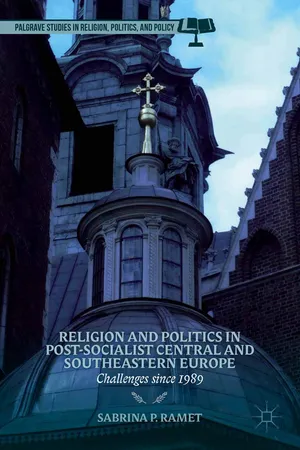
eBook - ePub
Religion and Politics in Post-Socialist Central and Southeastern Europe
Challenges since 1989
- English
- ePUB (mobile friendly)
- Available on iOS & Android
eBook - ePub
Religion and Politics in Post-Socialist Central and Southeastern Europe
Challenges since 1989
About this book
This volume examines the political engagement of religious associations in the post-socialist countries of Central and Southeastern Europe, with a focus on revelations about the collaboration of clergy with the communist-era secret police, intolerance, and controversies about the inclusion of religious instruction in the schools.
Information
1
Religious Organizations in Post-Communist Central and Southeastern Europe: An Introduction
Sabrina P. Ramet
I
The upsurge of popular resistance, defiance, and collective self-assertion which swept the communists out of power in Central and Southeastern Europe between 1989 and 1990 had its roots in the 1970s (just think of Charter 77) and the early 1980s. One may even trace the ultimate collapse of the communist organizational monopoly in the region back to its initial establishment in the latter half of the 1940s. Never accepted as legitimate by the local population, in spite of its genuine achievements in terms of assuring a measure of economic equality and partial, if qualified, progress in promoting gender equality, communism was doomed by its intolerance of free thought, free speech, free travel, and political competition, as well as by its recourse to violence and incarceration in dealing with perceived threats (as in the murder of Fr. Jerzy Popiełuszko by agents of the Polish secret police in 1984). Where free thought is concerned, freedom of religion was, as is well known, a central demand and the limitations on its exercise constituted only one of a number of fractures which ultimately brought the communist organizational monopoly to an end.
In the Central and Southeast European region, 1989/1990 marked a great historical watershed. Where political monopoly and a planned economy once prevailed, one now finds political pluralism and capitalist economics. Controlled and censored media have given way to a more diverse media market, albeit one in which there have been, nonetheless, tendencies toward concentration of ownership and not always subtle forms of political influence.1 And the Church–state formulae operative in communist times – which ranged from total suppression in Albania to tight control and monitoring in Bulgaria, Czechoslovakia, and Romania, to various and diverse forms of modus vivendi within fixed limits in the German Democratic Republic, Hungary, Poland, and Yugoslavia – have been replaced by a religious marketplace in which the larger, traditional Churches have tried to consolidate their positions and expand their influence,2 while newer entrants to the market, whether missionary Churches from the West (e.g., the Church of Jesus Christ of Latter-Day Saints) or local creations, have tried to carve out a space and establish toeholds in the region.3 But, as Lavinia Stan and Lucian Turcescu have noted, the post-communist governments in the region have tended to favor the dominant Church in both formal and informal ways, in spite of constitutional proclamations about the equality of (registered) religious associations.4 This volume examines some trends and tendencies in the public life of religious associations in Central and Southeastern Europe, identifying certain legacies and controversies arising from the pre-1989 Church–state condominium, and discussing some new challenges and opportunities for religious organizations in the region.
Leaving aside Albania and Kosovo, where statistics on religious affiliation are seriously unreliable, reported religious affiliation suggests that Catholicism is strongest in Poland (between 89% and 93% nominal Catholics,5 although only about 40% of Polish Catholics attended mass regularly in 2011)6 and Croatia (86.2%)7, see Table 1.1. Orthodox Christianity is recorded as strongest in Romania (86.8% reported Orthodox), Serbia (85%), and Bulgaria (82.6%). Muslims are the largest religious group in Bosnia-Herzegovina, where they constitute an estimated 40% of the population. Only in the Czech Republic are persons who are unaffiliated with any religion in a clear majority. In each of the remaining countries (Hungary, Macedonia, Montenegro, Slovakia, and Slovenia), one Church predominates, with reported membership in the largest Church ranging from a “low” of 51.9% Catholic in Hungary to a high of 74.2% Orthodox in Montenegro.
In only three countries in the region do Protestants account for more than 5% of the population: Romania (7.5%), Slovakia (10.8%), and Hungary (15.9% Calvinist and 3% Lutheran). In Albania, which at one time had a Muslim majority, there has been “a significant movement of Muslims towards Catholicism . . . [alongside] Protestant Christian proselytism.”8 This conclusion is borne out by Isa Blumi’s contribution (Chapter 12) on Albanians. As he writes, the communist regime of
Table 1.1 Religious affiliation in Central and Southeastern Europe (population figures from July 2011; percentages from censuses of 2001–2002)
POLAND total population = 38,441,588 | |
Roman Catholic | 89.8% |
Eastern Orthodox | 1.3% |
Protestant | 0.3% |
Other | 0.3% |
Unspecified | 8.3% |
CZECH REPUBLIC, total population = 10,190,213 | |
Roman Catholic | 26.8% |
Protestant | 2.1% |
Other | 3.3% |
Unspecified | 8.8% |
Unaffiliated | 59% |
SLOVAKIA, total population = 5,477,038 | |
Roman Catholic | 68.9% |
Protestant | 10.8% |
Eastern-Rite Catholic | 4.1% |
Other or unspecified | 3.2% |
None | 13% |
HUNGARY, total population = 9,976,062 | |
Roman Catholic | 51.9% |
Calvinist | 15.9% |
Lutheran | 3% |
Eastern-Rite Catholic | 2.6% |
Other Christian | 1% |
Other or unspecified | 11.1% |
Unaffiliated | 14.5% |
SLOVENIA, total population = 2,000,092 | |
Catholic | 57.8% |
Muslim | 2.4% |
Orthodox | 2.3% |
Other Christian | 0.9% |
Unaffiliated | 3.5% |
Other or unspecified | 23% |
None | 10.1% |
CROATIA, total population = 4,483,804 | |
Roman Catholic | 87.8% |
Orthodox | 4.4% |
Other Christian | 0.4% |
Muslim | 1.3% |
Other or unspecified | 0.9% |
None | 5.2% |
BOSNIA-HERZEGOVINA, total population = 4,622,163 | |
Muslim | 40% |
Orthodox | 31% |
Roman Catholic | 15% |
Other | 14% |
SERBIA, total population = 7,310,555 | |
Serbian Orthodox | 85% |
Catholic | 5.5% |
Muslim | 3.2% |
Protestant | 1.1% |
Unspecified | 2.6% |
Other, unknown, or atheist | 2.6% |
MACEDONIA, total population = 2,077,328 | |
Macedonian Orthodox | 64.7% |
Muslim | 33.3% |
Other Christian | 0.37% |
Other and unspecified | 1.63% |
MONTENEGRO, total population = 661,029 | |
Orthodox | 74.2% |
Muslim | 17.7% |
Catholic | 3.5% |
Other | 0.6% |
Unspecified | 3% |
Atheist | 1% |
ROMANIA, total population = 21,904,551 | |
Romanian Orthodox | 86.8% |
Protestants | 7.5% |
Roman Catholic | 4.7% |
Other (mostly Muslim) | 0.9% |
None | 0.1% |
BULGARIA, total population = 7,093,635 | |
Bulgarian Orthodox | 82.6% |
Muslim | 12.2% |
Other Christian | 1.2% |
Other | 4% |
Source: CIA Factbook, downloaded on 9 July 2011.
Enver Hoxha obliterated Islamic institutions and, since 1990, Christian Churches have made significant gains in Albania.
II
Although Pope John Paul II (1920–2005; reigned 1978–2005) responded to the collapse of communism by calling for a re-evangelization of Eastern Europe, this was not because religious affiliation as such had particularly declined in the region (outside the Czech Republic and Eastern Germany) but rather because changes in legislation had contributed to changes in behavior. Divorce and abortion, in particular, had come to be seen as normal in communist-era Eastern Europe, not to mention contraception, and, for that matter, the Orthodox Churches have also decried these practices.9 Thus, by re-evangelization, what Pope John Paul II had in mind above all was to suppress, as far as possible, abortion and divorce, while preventing the passage of legislation granting civil union status to gays and lesbians. And yet abortion has remained legal, under somewhat varying conditions, in most of the countries in the region. The major exceptions are Poland and Hungary – both predominantly Catholic countries. In Poland, under a law passed in 1993, abortion is permitted only when the woman’s life is in danger, when the pregnancy is the result of rape or incest, or when the fetus is determined to be seriously damaged.10 In Hungary, abortion had been legal until recently, but, under a new constitution passed in 2011, human life is declared to be protected from the moment of conception – effectively ruling abortion as unconstitutional. Moreover, although abortion is, at the time of writing, legal in Slovakia up to the tenth week and beyond that if the mother’s life is in danger, under legislation passed in 2009, women are required to accept advice on the risks of and alternatives to abortion before undergoing the procedure.11 Abortion has been legal in Croatia, but in June 2011 local Catholic bishops renewed their effort to obtain a total ban on it, alongside a ban on the adoption of children by same-sex couples.12
“Re-evangelization” of local behavior has had similarly limited success where same-sex relationships are concerned. In Romania, for example, the Orthodox Church fought hard to prevent the parliament from legalizing homosexuality, only to watch helplessly as the Chamber ...
Table of contents
- Cover
- Title Page
- Copyright
- Contents
- List of Tables
- Preface and Acknowledgments
- Notes on Contributors
- 1. Religious Organizations in Post-Communist Central and Southeastern Europe: An Introduction
- 2. The Catholic Church in Post-Communist Poland: Polarization, Privatization, and Decline in Influence
- 3. The Catholic Church in the Post-1989 Czech Republic and Slovakia
- 4. The Kádár Regime and the Subduing of the Roman Catholic Hierarchy
- 5. The Catholic Church and Politics in Slovenia
- 6. Church and State in Croatia: Legal Framework, Religious Instruction, and Social Expectations
- 7. The Cross, the Crescent, and the War in Bosnia: The Legacy of Religious Involvement
- 8. Religion and Democracy in Serbia since 1989: The Case of the Serbian Orthodox Church
- 9. Islam and Politics in the Serbian Sandžak: Institutionalization and Feuds
- 10. The Orthodox Churches of Macedonia and Montenegro: The Quest for Autocephaly
- 11. The Orthodox Churches and Democratization in Romania and Bulgaria
- 12. Religion and Politics among Albanians of Southeastern Europe
- Afterword
- Further Reading
- Name Index
- Subject Index
Trusted by 375,005 students
Access to over 1.5 million titles for a fair monthly price.
Study more efficiently using our study tools.
Frequently asked questions
Yes, you can cancel anytime from the Subscription tab in your account settings on the Perlego website. Your subscription will stay active until the end of your current billing period. Learn how to cancel your subscription
No, books cannot be downloaded as external files, such as PDFs, for use outside of Perlego. However, you can download books within the Perlego app for offline reading on mobile or tablet. Learn how to download books offline
Perlego offers two plans: Essential and Complete
- Essential is ideal for learners and professionals who enjoy exploring a wide range of subjects. Access the Essential Library with 800,000+ trusted titles and best-sellers across business, personal growth, and the humanities. Includes unlimited reading time and Standard Read Aloud voice.
- Complete: Perfect for advanced learners and researchers needing full, unrestricted access. Unlock 1.5M+ books across hundreds of subjects, including academic and specialized titles. The Complete Plan also includes advanced features like Premium Read Aloud and Research Assistant.
We are an online textbook subscription service, where you can get access to an entire online library for less than the price of a single book per month. With over 1.5 million books across 990+ topics, we’ve got you covered! Learn about our mission
Look out for the read-aloud symbol on your next book to see if you can listen to it. The read-aloud tool reads text aloud for you, highlighting the text as it is being read. You can pause it, speed it up and slow it down. Learn more about Read Aloud
Yes! You can use the Perlego app on both iOS and Android devices to read anytime, anywhere — even offline. Perfect for commutes or when you’re on the go.
Please note we cannot support devices running on iOS 13 and Android 7 or earlier. Learn more about using the app
Please note we cannot support devices running on iOS 13 and Android 7 or earlier. Learn more about using the app
Yes, you can access Religion and Politics in Post-Socialist Central and Southeastern Europe by S. Ramet in PDF and/or ePUB format, as well as other popular books in History & European History. We have over 1.5 million books available in our catalogue for you to explore.