eBook - ePub
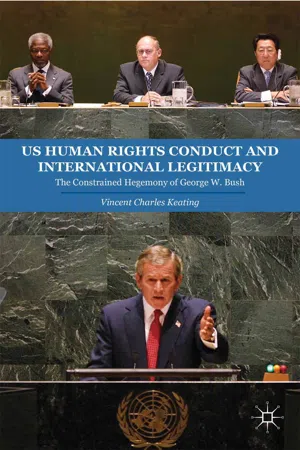
US Human Rights Conduct and International Legitimacy
The Constrained Hegemony of George W. Bush
- English
- ePUB (mobile friendly)
- Available on iOS & Android
eBook - ePub
US Human Rights Conduct and International Legitimacy
The Constrained Hegemony of George W. Bush
About this book
Information
Topic
DerechoCHAPTER 1

INTRODUCTION
There is little question that the terrorist attacks of 9/11 had profound effects on US foreign policy. There was almost immediate speculation after the attacks about whether they had “changed everything” within US foreign policy, and consequently in wider international relations. This speculation continues through a variety of introspective pieces to the present day.1 Among the effects of the attacks, of particular concern to both human rights practitioners and activists was the Bush administration’s propensity to prioritize national security over human rights—even rights that might be considered fundamental and non-derogable. The Bush administration opened prison camps at Guantanamo Bay to contain detainees who had neither access to the US judicial system nor status as prisoners of war under the Geneva Conventions.2 The Bush administration claimed that these detainees must be placed in a different category from other prisoners of war, labeling them “unlawful” or “enemy combatants.” As such, they did not have the same rights to judicial review of the lawfulness of their detention. US security agents and the military began to officially use “stress and duress” techniques in interrogations in Afghanistan, Iraq, and at Guantanamo Bay, techniques that increased in severity until the prisoner abuse scandals. The Central Intelligence Agency (CIA), in particular, used a highly controversial interrogation technique known as waterboarding against high-value al-Qaida operatives to elicit information from them. Finally, the United States rendered other suspected al-Qaida members to states such as Egypt, Jordan, and Syria for questioning, to let these states generate intelligence through means that would not be legal in the United States.
Though many types of alleged human rights abuses were perpetrated by the Bush administration in the name of national security, this book argues that the denial of habeas corpus, torture, and rendition for the purposes of torture were the most serious. The right of habeas corpus, or the right to appeal the legality of one’s detention before a judge, precedes all other institutions of judicial oversight, and its removal can aid states in committing further human rights abuses. When a state, either the United States or another state acting on behalf of the United States, inflicts grievous physical and psychological harm through torture, it is one of the most serious human rights violations that can be committed. The right not to be tortured is a fundamental right or a right with highly legalized norms in international society.3 The severity of torture is thoroughly recognized in international law; it is not only addressed by major human rights treaties as a right to which no exceptions can be made, but it also has an entire international convention devoted to its prohibition.4
This new focus on counterterrorism at the expense of human rights was not limited to the United States. These policies arising from the war on terror, which focused primarily on mitigating the threat of future terrorist attacks, were reflected in the conduct of other states, which began to curb civil liberties such as freedom from arbitrary arrest and freedom of movement.5 The focus on counterterrorism, particularly when it was accompanied by a reduction in human rights protections, was certainly worrying to Mlada Bukavansky, who in 2007 wrote,
The perceived shift in US hegemony from a multilateral to a unilateral and more muscular strategy in foreign policy has yielded further contestation and resistance [from both the left and the right], either to the liberal democratic values the US and its allies purport to uphold, or to the perceived hypocrisy and corruption of those values by such policies as the invasion of Iraq and the “war on terror.” Moreover, the manner in which a number of European governments have chosen to fight terrorism, by curtailing civil liberties and cracking down on immigration, further renders contestable liberal states’ normative superiority.6
This concern was echoed by Tim Dunne, who argued in the same year,
The post-9/11 period has prompted many to ask whether human rights values and policies were as deeply entrenched as supporters of the regime had hoped. What marks the contemporary challenge out as being of particular concern is that its centre of gravity is inside the liberal western zone. This time the assault on the foundations of the regime is not from communist states who regard individual liberty as a bourgeois sham, or southern African states who want to exclude peoples on grounds of race, or even Asian states who believe community must precede liberty: the post-9/11 challenge is being led by western governments who openly question whether fundamental human rights commitments need to be changed or abandoned in the name of national security.7
Given the well-documented actions of the Bush administration that made controversial trade-offs between counterterrorism and human rights, and some evidence that these trade-offs were echoed internationally, this book seeks to determine whether the Bush administration, through either its defection from old norms or its active promotion of new ones, fundamentally harmed the international human rights system by creating a norm cascade in favor of their preferences. Given that norm change occurs through the discursive interaction among agents in international society, the primary research question is, therefore, was the United States successful in legitimating its conduct for torture, rendition for the purposes of torture, and denial of habeas corpus within international society?
This analysis is necessary for two reasons. First, the defection of the United States from what is considered appropriate conduct within international society could lead to a change in international human rights norms, particularly if it openly advocated for such a change. Though many liberal democracies curtailed some rights in their counterterrorism efforts, the Bush administration enacted policies that blatantly ran counter to established human rights norms to a degree that was unprecedented for liberal democracies at this time. This change is particularly important because the United States has played an important role in determining the scope of international human rights from World War II to the present.8 Should it have equal influence in the opposite direction, then its defection from these norms could have serious consequences.
Some scholars have already voiced their concern that this might be the case with respect to torture. In 2007, Tim Dunne argued that American conduct could lead to a “norm cascade” where torture in the name of antiterrorism becomes acceptable practice.9 Other authors argued that the conduct of the United States could degrade the international human rights system in general. For instance, Joan Fitzpatrick argued in 2003,
The human rights regime is menaced by potentially dramatic alterations in ... the norms of humanitarian law. Human rights institutions have largely conducted business as usual in the aftermath of September 11, albeit with a sense of dread, defensiveness, and political polarization. For many years sceptical, stand-offish, and self-righteous, the United States now exercises its hegemony more corrosively than ever on the international human rights regime.10
In 2009, Sigrun Skogly argued that there had been a reduction in the willingness of states to remain bound by international human rights law with respect to their counterterrorism strategies, suggesting a diminution in their commitment to protect human rights both domestically and, more importantly for the purposes of this book, internationally.11 Similarly, Harrelson-Stephens and Callaway argued that since 9/11 the “US commitment to international norms has been undermined to the extent that it now openly violates certain international as well as domestic human rights.”12 Nevertheless, unlike the scholars cited earlier in the text, Harrelson-Stephens and Callaway contended that the effect of US conduct was not negative on the whole:
The September 11th attacks can be viewed as an exogenous shock that has had a serious but not necessarily terminal effect on international human rights. While this affected the domestic resolve of the United States in support of international human rights, it appears that the institutionalization of human rights norms in Europe, as well as widespread acceptance of human rights, thus far has been sufficient to uphold the regime absent the hegemon. Certainly, states that were repressing their citizens prior to 9/11 have used the war on terror and subsequent human rights violations by the United States as justification for continued repression. Nonetheless, other major powers remain strongly committed to human rights, and more importantly, continue to expand the regime today.13
Given this disagreement among scholars over the effects of US human rights conduct in the war on terror, this book aims to provide an empirical analysis of whether the Bush administration was successful in causing a norm cascade within international society that favored their preferences.
Second, most international action taken against serious human rights abuses has involved states that were materially weak in comparison to the states that supported the human rights system. This is clearly not the case with the United States. Their defection, therefore, provides a good case study to analyze the dynamics of norm reproduction when the materially preponderant state in the system faces opposition over serious human rights concerns. Some scholars such as Richard Falk argued that there is a “hegemonic logic” in the determination of international human rights, that the sole purpose of such norms is to advance the interests of the hegemon. Human rights regimes should therefore include only the rights preferred by the hegemon and its allies—any rights claims that would demand a change in domestic or foreign policy of the hegemon would not be accepted as legitimate.14 If this is the case, then the introduction of habeas corpus restrictions and the use of techniques that arguably constitute torture might have effects that radiate out to international society because of the sheer material capabilities of the United States. Overall, scholars dispute the effect of materiality on norms, with some arguing that materiality explains all norms and others arguing that materiality and norms are somewhat independent but related in particular ways.15 What seems to be more certain is that the United States, even independently of its economic and cultural influence, has a material advantage within international society that is unparalleled. As Kenneth Waltz noted, “Never since Rome has one country so nearly dominated its world.”16 Colin Gray agreed, going as far as stating that “when the United States wishes to act it is literally unstoppable by any combination of polities and institutions.”17 The question, therefore, is whether there is any evidence that the material position of the United States within international society helped it to either absorb the costs of defection or successfully promote a new standard of human rights in the face of the threat of terrorism.
This book will examine each of these issues in the three case studies through analyzing the interaction of legitimation strategies by the United States and other members of international society. If the legitimacy claims of the United States concerning their human rights conduct were accepted by most members of international society, then this would point much more strongly to the possibility of a norm cascade than if the majority of actors in the international system disputed their legitimation claims. Similarly, studying the way in which the United States attempted to legitimate its actions and probing the reactions of other members of the international community might provide some idea of the effects of materiality on this process, particularly if the United States fails to legitimate its position despite attempting to leverage its material advantage.
It must be noted at this juncture that this project excludes NGOs and other members, in English School terms, of “world society” from its analysis.18 Though it is true that these organizations provided a constant normative critique supporting the existing human rights norms throughout the Bush administration, the focus of this project is on the legitimation debates of other states and organizations created by states. This is delineated for a number of reasons. First, the claims by members of international society are likely to be more variable than those of human rights NGOs, many of which see their sole task as defending the international human rights system. International organizations and particularly states, on the other hand, have multiple and often contradictory goals that they must achieve to satisfy both their own internal political needs and those of international society. The likelihood of the United States being successful in legitimating its conduct with other members of international society is nontrivial, and therefore an interesting subject of study, whereas with NGOs the likelihood is close to nonexistent.
Second, though there is a great deal of literature surrounding the role of NGOs in the growth of international human rights, both international organizations and states are equal, if not more important, actors in some cases. According to Rosemary Foot, states have
played a vital role in carrying the [human rights] message forward. It is the body that signs the convention and then produces the requisite domestic legislation. Operating externally, the state may create new human rights norms, and then utilize the diplomatic tools at its disposal to promote adherence to international standards on the part of other states in the system.19
International organizations may be used by states who may not wish to become openly involved in an issue for political or economic reasons. Thus, these multilateral institutions have a useful function in that they can send a message about legitimate or illegitimate behavior while minimizing the direct costs of open criticism that states might otherwise face.20 Foot similarly argued that the UN human rights institutions have been “crucial to the elaboration and legitimation of human rights norms, and in providing a platform upon which governmental and NGO criticisms of abuse can be aired.”21 They are also actors unto themselves in the diffusion of norms through their promotion of gatherings between member states and subject experts, and in some cases through issuing reports that raise the profile of a subject of concern.22 Work by Terrence Chapman suggests that the activity of international organizations has the ability to influence public opinion in states, which can constrain or influence leaders.23 As such, members of international society are the more relevant actors given that the project seeks to address the effect that the United States had on international human rights norms, whose legal character can be influenced or even directly changed by their actions of members of international society.
The chapter structure of the book is as follows. Chapter 1 sets the theoretical stage for the analysis, justifying why we might use legitimacy to study this problem, reviewing the debates over the relationship between legitimacy and material ...
Table of contents
- Cover
- Title Page
- Copyright
- Contents
- Acknowledgments
- 1. Introduction
- 2. Norms and Legitimacy in International Society
- 3. Torture
- 4. Habeas corpus
- 5. Rendition
- 6. Conclusion
- Notes
- Bibliography
- Index
Trusted by 375,005 students
Access to over 1.5 million titles for a fair monthly price.
Study more efficiently using our study tools.
Frequently asked questions
Yes, you can cancel anytime from the Subscription tab in your account settings on the Perlego website. Your subscription will stay active until the end of your current billing period. Learn how to cancel your subscription
No, books cannot be downloaded as external files, such as PDFs, for use outside of Perlego. However, you can download books within the Perlego app for offline reading on mobile or tablet. Learn how to download books offline
Perlego offers two plans: Essential and Complete
- Essential is ideal for learners and professionals who enjoy exploring a wide range of subjects. Access the Essential Library with 800,000+ trusted titles and best-sellers across business, personal growth, and the humanities. Includes unlimited reading time and Standard Read Aloud voice.
- Complete: Perfect for advanced learners and researchers needing full, unrestricted access. Unlock 1.5M+ books across hundreds of subjects, including academic and specialized titles. The Complete Plan also includes advanced features like Premium Read Aloud and Research Assistant.
We are an online textbook subscription service, where you can get access to an entire online library for less than the price of a single book per month. With over 1.5 million books across 990+ topics, we’ve got you covered! Learn about our mission
Look out for the read-aloud symbol on your next book to see if you can listen to it. The read-aloud tool reads text aloud for you, highlighting the text as it is being read. You can pause it, speed it up and slow it down. Learn more about Read Aloud
Yes! You can use the Perlego app on both iOS and Android devices to read anytime, anywhere — even offline. Perfect for commutes or when you’re on the go.
Please note we cannot support devices running on iOS 13 and Android 7 or earlier. Learn more about using the app
Please note we cannot support devices running on iOS 13 and Android 7 or earlier. Learn more about using the app
Yes, you can access US Human Rights Conduct and International Legitimacy by V. Keating in PDF and/or ePUB format, as well as other popular books in Derecho & Derechos civiles en la legislación. We have over 1.5 million books available in our catalogue for you to explore.