- English
- ePUB (mobile friendly)
- Available on iOS & Android
eBook - ePub
About this book
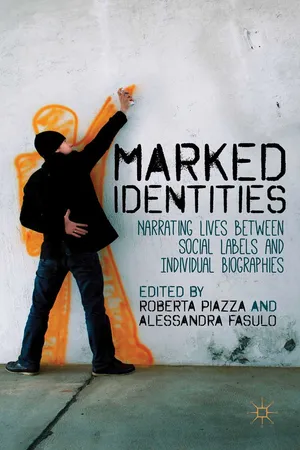
Western society has become increasingly diverse, but stereotypes still persist in the public discourse. This volume explores how people who have a marked status in society - among them Travellers, teenage mothers, homeless people - manage their identity in response to these stereotypes.
Information
1
‘Since Big Fat Gypsy Weddings [ . . . ] Now [People] . . . Understand More ‘Cos of That Programme’: Irish Travellers’ Identity Between Stigmatisation and Self-Image
Roberta Piazza
Introduction
Irish travellers are transient people like Scottish travellers, gypsy and Romany communities. As a consequence of their mobility, travellers’ relation with place poses a number of questions; in spite of their symbolic or nominal inscription in an original Irish motherland, they tend to develop an emotional attachment to other particular localities (Piazza, 2014). Many groups of Irish travellers today aspire to a settled life in their own caravans in serviced encampments. The loyalty to a nomadic lifestyle, mixed with need of services and a desire to be stationary while in mobile dwellings, has contributed to making Irish travellers the object of discrimination by settled residents who are suspicious of them, even though their knowledge of the travellers and their needs is severely limited. The police response to travellers’ unauthorised occasional settlements in parks outside cities tends to echo this suspicion with the positioning of a van with surveillance cameras to monitor their moves. Such charitable organisations as Friends, Family and Travellers, however, aim to ‘end racism and discrimination against Gypsies and travellers, whatever their ethnicity, culture or background, whether settled or mobile, and to protect the right to pursue a nomadic way of life’ (http://www.gypsy-traveller.org/).
Based on a series of semi-structured interviews with women travellers in the South of England, the present chapter is an attempt to contribute to an understanding of who Irish travellers are and how they live. The interviewed travellers were found to strongly identify with their role as providers of safe and decent living standards for their families, and to follow their travellers’ lifestyle, while also being critical of some of the principles at the basis of their culture. The interpretation of their answers to the questions during the interviews recognises the limited power these speakers as a group experience, especially in terms of their very restricted ability to make decisions about where to live their lives. In line with the thrust of the volume, these interviewees show a clear awareness of the heavy social connotation attached to the term ‘traveller’ and the scarce knowledge the outside community has of them. The chapter also takes into due consideration the power imbalance inherent in the interview itself as a particular speech event, a problem which will be addressed in the section on methodological issues. In general it may be said that the new regulations limiting permanence in travellers’ authorised sites to a three-month period and the threat of eviction make these subjects particularly powerless and vulnerable, a fact that is undoubtedly reflected in the identity the interviewed women claim in the interaction with the researchers. It is on these grounds that this chapter adopts an analytical framework used to investigate disenfranchised and socially disempowered groups and offering a way of categorising the individuals’ different responses to social marking (Goffman, 1963/1986; Waxman, 1983; Juhila, 2004).
The investigation adopts a view of identity as discourse-construed. Even when the women speak in the first person, they show what Coffey (2013) sees as a ‘group cohesion [that] emerges from a variable sense of independence and a feeling of being special because of group membership’. Being women in a precarious situation bestows on them the role of ensuring an acceptable living standard for their families and hence determines their shared aspirations and needs, identifiable through the recurring reference to a number of tropes (e.g. need of stability, safety and hygiene, education and health). It cannot be denied, of course, that for the purpose of the study in this chapter travellers were selected as representative of a specific category of people; in this light the interview, in which both interviewers and interviewees are ‘competent members [each of their own] culture’ with their own analytic resources, is seen as a situation allowing the negotiation of identity categories (Baker, 1997).
The present discussion is centred on the ways in which during the interviews these women ‘actively construct’ their social self instead of ‘passively living out some cultural prescription for social identity’ (Ochs, 1993, p.296). Previous models for the analysis of disenfranchised groups (mainly Goffman, 1963 and Waxman, 1983) are considered as a way of reflecting on the multiple identities the interviewees claim in the particular interview context. The use of some linguistic resources such as the pronouns ‘I’, ‘we’ and ‘you’, among other ‘constructions at all levels of grammar and discourse’ (Ochs, 1993, p.288) indexing these women’s subjective and choral experience respectively, and the identification of tropes emerging from the women’s talk, indicate their agentive role and how, in the exchange with the two researchers, they engage in a cross-cultural negotiation with the dominant culture.
Contextualising travelling communities
In England travellers are granted ethnic minority status and the official name of GRT (Gypsies, Romany and Travellers). Due to the prevalence of a sedentarist discourse that praises a life of stability and permanency, mobile GRTs have long been stigmatised (Powell, 2008) or exoticised, in both cases have been victims of an ‘othering’ or exclusion process (Sibley, 1981; Halfacree, 1996; Cresswell, 1999; Valentine, 2001 in Holloway, 2005, p.354). Recently non-essentialist, non-sedentarist approaches (Sheller and Urry, 2006) proposing a ‘mobile and deterritorialized’ notion of identity have prevailed in the academic debate. This is in opposition to the harsh way in which as Kabachnik (2009) highlights, these nomads have been dealt with in the British Isles (Hancock, 1987; Lucassen, Willems and Cottaar, 1998; Mayall, 1988) where since the 1960s these groups ‘have been under constant pressure to stop traveling and settle down’ (2009, p.461).
Nomadic people generally occupy ‘non-authorised’ or ‘authorised’ encampments; while the former are frequently parks or free open green spaces in or at the periphery of towns and cities, the latter are rent-based serviced spaces (providing electricity, water, gas, hygienic services and occasionally transport) contained within boundaries and guarded. This circumstance is key in analysing the situation of travellers, triggering a clash between opposing discourses. Irish travellers are mobile individuals, who don’t want to renounce their transient lifestyle, but at the same time aspire to settle in encampments. This leads to accusations of nonauthenticity vis-à-vis travellers who want to settle and novel forms of discrimination against these groups probably due, at least to an extent, to the fact that the permanent community can no longer pigeonhole them in the category of transient migrants. Kabachnik (2009) mentions a 2004 article by Jenkins entitled ‘The occupiers were the opposite of travellers: they were stayers’, in which this attitude is particularly visible. This author comments that ‘[t]he situation is paradoxical, since Gypsies and Travelers are being prevented from “settling down”, which has been the British state’s goal for nomads ever since they arrived. Nomadic groups are being prevented from staying in one place in part because of the dominant image of the universal nomad’ (2009, p.468).
While in the past they were allowed long stays in various places on the outskirts of towns, they are now subjected to frequent eviction from public spaces and only allowed short periods even in authorised sites. The women interviewed for the present study were living in a transit encampment in the South of England,1 and all expressed the wish to stay there permanently or as long as possible. However, scarcity of premises is a hard reality. The area of Brighton and Hove, for instance, offers only a ‘semi-permanent’ three-month site, while a project to build a permanent site has long been under discussion (Travellers Strategy: http://www.brighton-hove.gov.uk/downloads/bhcc/travellers/Traveller_Commissioning_
Strategy_2012.pd-accessed).
Strategy_2012.pd-accessed).
Many of the above considerations have a bearing on the women’s answers during the interviews. The tension between a desire to remain in the site and a persistent wish to be mobile and unattached is apparent, as is the contradictory relation with the outside world. These seemingly contrasting factors determine several interactional strategies in the women’s talk that index their position towards the outer permanent community.
The next section discusses the relevant research on the identity of travellers as marginalised people and how they deal with what they assume is their stigma in the interaction with the researchers.
The stigma of mobility
The theoretical premises of this study are that identity is intrinsically relational and shapes itself as ‘a discursive construct which continually shifts in the local contexts in which the social actors enter’ (Meinhof and Galasiński, 2005, p.7). Different degrees of intentionality, consciousness and habit influence the construction of identity, which in most cases is ‘an outcome of others’ perceptions and representations, and in part an effect of larger ideological processes and material structures that may become relevant to interaction. It is therefore constantly shifting both as interaction unfolds and across discourse contexts.’ (Bucholtz and Hall, 2005, p.606) It is within such an identity paradigm that the research on individuals who are socially strongly connoted or stigmatised and who are in an asymmetrical situation with majority groups is considered in this section.
Marginalised individuals are subject to the process of negative ‘othering’ (Riggins, 1997) and perceived as a ‘homogeneous category’ of outsiders and deviant people (ibid., p.5). Riggins (1997, p.6) points out that discourses of otherness can be produced by both dominant and majoritarian groups (see also Arteaga, 1994; Blundell, 1994; Diamond, 1993; Goodman and Miyazawa, 1995 among others) as well as minority groups (e.g. Ahmed, 1999; Basso, 1979; Saldívar, 1991); however, it is the discrimination by majority groups that is more extensively studied.
Goffman’s (1963/1986) is the earliest micro-anthropological study of social stigma and stigmatised individuals’ responses to it. Any kind of stigma, whether physical, mental or socio-cultural, which Goffman (1963/1986) terms ‘abominations of the body’, ‘blemishes of individual character’ or ‘tribal stigma’ (p.4) respectively, has a negative impact on an individual’s self-image and produces ‘decreased self-esteem and self-efficacy’ (Shih, 2004, p.182). Like individuals, groups can be stigmatised on the basis of a number of features; we will see, for instance, how in the travellers’ discourse the frequent mention of hygiene and cleanliness is possibly linked to the interviewees’ awareness of the stigma of dirtiness attached to their group.
Goffman (1963/1986) discusses how stigmatised individuals may form alliances with the other stigma bearers and dissociate themselves from ‘normals’. Alternatively, the stigmatised individuals can conceal their identity, for instance by focusing on some non-stigmatised aspects of their self; in this case, ‘a physically deformed person undergoes plastic surgery, a blind person eye treatment, an illiterate remedial education, a h...
Table of contents
- Cover
- Title Page
- Copyright
- Contents
- List of Tables
- Notes on Contributors
- Introduction
- 1. ‘Since Big Fat Gypsy Weddings [ . . . ] Now [People] . . . Understand More ‘Cos of That Programme’: Irish Travellers’ Identity Between Stigmatisation and Self-Image
- 2. The Nice Stasi Man Drove His Trabi to the Nudist Beach: Contesting East German Identity
- 3. ‘They Paint Everyone With the Same Brush but It Just Simply Isn’t the Case’: Reconstructing and Redefining Homeless Identities
- 4. On the Margins: Aboriginal Realities and ‘White Man’s Research’
- 5. ‘Racial Laws Turned Our Lives Positively’: Agentivity and Chorality in the Identity of a Group of Italian Jewish Witnesses
- 6. Young Motherhood: Is It Really a Case of ‘Shattered Lives and Blighted Futures’?
- 7. Reordered Narratives and the Changes in Self-Understanding From Addiction to Recovery
- 8. History in Waiting: Receiving a Diagnosis of Asperger in Midlife
- Afterword
- Index
Trusted by 375,005 students
Access to over 1.5 million titles for a fair monthly price.
Study more efficiently using our study tools.
Frequently asked questions
Yes, you can cancel anytime from the Subscription tab in your account settings on the Perlego website. Your subscription will stay active until the end of your current billing period. Learn how to cancel your subscription
No, books cannot be downloaded as external files, such as PDFs, for use outside of Perlego. However, you can download books within the Perlego app for offline reading on mobile or tablet. Learn how to download books offline
Perlego offers two plans: Essential and Complete
- Essential is ideal for learners and professionals who enjoy exploring a wide range of subjects. Access the Essential Library with 800,000+ trusted titles and best-sellers across business, personal growth, and the humanities. Includes unlimited reading time and Standard Read Aloud voice.
- Complete: Perfect for advanced learners and researchers needing full, unrestricted access. Unlock 1.5M+ books across hundreds of subjects, including academic and specialized titles. The Complete Plan also includes advanced features like Premium Read Aloud and Research Assistant.
We are an online textbook subscription service, where you can get access to an entire online library for less than the price of a single book per month. With over 1.5 million books across 990+ topics, we’ve got you covered! Learn about our mission
Look out for the read-aloud symbol on your next book to see if you can listen to it. The read-aloud tool reads text aloud for you, highlighting the text as it is being read. You can pause it, speed it up and slow it down. Learn more about Read Aloud
Yes! You can use the Perlego app on both iOS and Android devices to read anytime, anywhere — even offline. Perfect for commutes or when you’re on the go.
Please note we cannot support devices running on iOS 13 and Android 7 or earlier. Learn more about using the app
Please note we cannot support devices running on iOS 13 and Android 7 or earlier. Learn more about using the app
Yes, you can access Marked Identities by R. Piazza, A. Fasulo, R. Piazza,A. Fasulo in PDF and/or ePUB format, as well as other popular books in Languages & Linguistics & Sociolinguistics. We have over 1.5 million books available in our catalogue for you to explore.