- English
- ePUB (mobile friendly)
- Available on iOS & Android
eBook - ePub
About this book
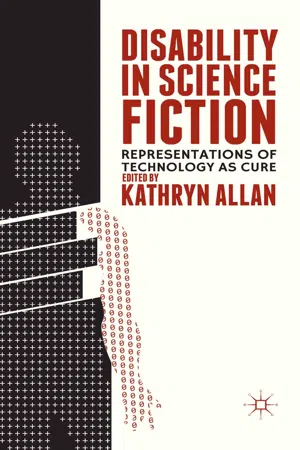
In this groundbreaking collection, twelve international scholars – with backgrounds in disability studies, English and world literature, classics, and history – discuss the representation of dis/ability, medical "cures," technology, and the body in science fiction.
Information
Cure Narratives for the (Post)human Future
CHAPTER 9
“Great Clumsy Dinosaurs”
The Disabled Body in the Posthuman World
Brent Walter Cline
If Mary Shelley’s Frankenstein can arguably be considered the first science fiction (SF) novel, then it is fair to say that SF has been interested in the practical and philosophical consequences of posthumanism since its inception. SF narratives have long explored the anxieties and promise of the posthuman, what Neil Badmington calls “an activation of the trace of the inhuman within the human” (171). For instance, in two influential texts in posthuman SF, Olaf Stapledon’s Star Maker and Greg Bear’s Blood Music, the next step in human evolution demands the divorce of consciousness from the physical body, so that the “inhuman” can help transcend the person into a higher plane of existence. In Star Maker, the nameless narrator becomes a disembodied person, able to span galaxies and unite with alien minds, which grant him expanded consciousness. In Blood Music, the entirety of humankind unites to an enormous organism that dispenses with the physical body but allows “participants” to retain their intellectual and emotional identities. The promise that such visions of posthumanism express toward the relationship of the inhuman and the human body is applauded by many critics within feminism and queer theory, perhaps most famously in Donna Haraway’s essay on the cyborg. The interaction between the inhuman and the body destabilizes the ability to enforce normalcy, so that “ambiguity and difference are redefined to become signifiers of an inclusive posthuman embodiment” (Wolmark 76). While this questioning of essence is often seen as beneficial by those who seek to destabilize the enforcement of cultural normatives, there are foundations to the idea of posthumanism that necessarily interrogate the role of the human body in the formation of personhood. The consequences of this interrogation are perhaps best illuminated when shown in contrast to theories of personhood as demonstrated in disability studies, which, like posthumanism, focuses on the issue of physical embodiment and identity. When visions of the future like Star Maker and Blood Music are examined through the lens of disability studies, the result of a posthuman evolution, rather than creating an inclusive environment of “ambiguity and difference,” devalues the reality of the body in creating human experience and defining personhood.
While disability theorists are not wholly united in their understanding of human identity, the body, abled or disabled, is universally understood to be an integral part of the definition of a human being. This is not to suggest biological determinism, however, so that a blind person would have a distinct, determinate experience due to blindness, or a mentally disabled person would have a distinct, determinate experience due to cognitive ability. Instead, it is to recognize the physical reality of the body, whether it results in discrimination, suffering, or even transcendence. To deny this reality is to “fail to account for the difficult physical realities faced by people with disabilities [ . . . ] [it] presents their body in ways that are conventional, conformist, and unrecognizable to them” (Siebers 57). The construction of the body is not an abstract, theoretical idea only, as recognized by those who live in chronic pain or are constantly reminded of the limitations of their impaired bodies. This recognition is crucial, as any understanding of the body must include a distinction between impairment and disability. Impairment is a real, physical fact. To deny so, as Tom Shakespeare writes, is to ignore that “even if social barriers are removed as far as practically possible, it will remain disadvantageous to have many forms of impairment” (202). Disability is the social problem that creates lack of access for those who have various impairments. Therefore the disabled body is an impaired body that does not have access to the privileges and freedoms of “normalized” bodies due to social construction.
To return then to posthuman texts such as Stapledon’s Star Maker and Bear’s Blood Music, the “unmodified” human body is understood as a primitive obstacle, as it prevents the seat of consciousness, the mind, from access to “the inhuman,” and therefore higher planes of existence. The normalized body is ironically the disabled body, which “pervades literary narrative, first, as a stock feature of characterization and, second, as an opportunistic metaphorical device” (Snyder and Mitchell 47). Personhood within both Star Maker and Blood Music becomes an idea contained completely within the consciousness of the individual, and the “unmodified,” disabled body becomes the metaphor of our struggles to emerge from an inadequate or compromised position. This rendering of the physical body as an anchor to evolution directly opposes ideas that the body, even in a disabled state (if not because of a disabled state), might be an avenue of transcendence itself, as when Susan Wendell writes, “The onset of illness, disability, or pain destroys the ‘absence’ of the body to consciousness [ . . . ] and forces us to find conscious response to new, often acute, awareness of our bodies. Thus, the body itself takes us into and then beyond its suffering and limitations” (178). The posthuman claims of Star Maker and Blood Music deny that the physical body—including the disabled body—help create and expand our consciousness. The body is only an obstacle, and when consciousness is separated from that obstacle, greater evolution of thought and development of identity can occur.
This embodiment-as-disabled idea is perhaps even better understood when considering Carl Malmgren’s ideas on how (especially posthuman) SF worlds establish the path toward a more enlightened existence. It is fair to read the rhetorically disabled body in Star Maker and Blood Music as the barrier in Malmgren’s writing: “A frequently noted characteristic of much alternate society SF is the presence of the barrier, the physical dividing line separating the estranged society from the originary society [ . . . ] or marking the boundary of that society and the adjoining natural world. Now the barrier clearly figures significantly in the story of the fiction; the narrative is necessarily generated by penetration of the barrier (an actant moves from one topological space to the other), and the outcome of the story frequently hinges on the possible elimination of the barrier” (79). The human body, here always cast as a disabled body, must be eliminated so that the outcome of the story—the progression of human evolution—can occur. It is hardly coincidental that neither Star Maker nor Blood Music contains a true enemy or villain; the only real impediments to characters’ growth are the limitations their bodies inherently create. These bodies-as-barriers in Star Maker and Blood Music serve as a metaphorical signifier for the denial of access to the next step in human evolution, which involves the only necessary component of personhood: consciousness.
Olaf Stapledon’s Star Maker
The unique place of Olaf Stapledon in the development of SF has been long documented. Vast in its scale and unprecedented in its depiction of the cosmos, Stapledon’s two major works, Last and First Men and Star Maker, are more likely to find their literary and philosophical influences from Dante and Milton than H. G. Wells and Jules Verne. Few writers seem to imitate Stapledon, but nearly all seem to be influenced by him. Both Last and First Men and Star Maker have been described as myths more than novels, including the positive connotations of immensity of vision, and the negative connotations of coldness and lack of regard for character development. In a 1947 lecture entitled “Science and Fiction,” Stapledon stated that the rules of the genre must have “psychological and spiritual relevance to human readers in the present through the construct of ‘Myths for a scientific age’” (Crossley 32). Works involving angels and gods belong to a medieval mind-set; for the modern mind where these things cannot be true, new myths need to be created in order to provide explorations of the human essence and its relationship with the cosmos. In his study of the recreation of mythologies in SF, Casey Fredericks writes about Last and First Men, “No one, not even Wells, thought out the problem of the end of man so thoroughly on so extended a temporal range as Stapledon” (77). It is as though Stapledon’s vision of the genre was developed from the template of his two greatest works.
If, as Fredericks suggests, Last and First Men follows the development and finality of mankind more thoroughly than any other SF text, then Star Maker follows in such a magnitude of scale that the evolution of Last and First Men becomes cosmically little more than a footnote. Beginning on the British heather, Star Maker follows the disembodied travel of the unnamed narrator as he ascends from his terrestrial home and travels through the cosmos, observing different planets and planes of existence. As he moves from one world to another, encountering sentient beings described as arachnids, nautiloids, and plant men, he becomes a single member of a “cosmical mind,” whose other members include beings from the diverse worlds he has observed. Eventually, the narrator and his community of “awakened spirits” come into contact with the Star Maker, the creator-being that has designed and destroyed every cosmos “with the aloof though passionate attention of an artist judging his finished work; calmly rejoicing in its achievement, but recognizing at last the irrevocable flaws in its initial conception, and already lusting for fresh creation” (224). Like so much in his travels, the narrator’s experience into the consciousness of the Star Maker is unable to be fully expressed in language; he returns to his wife and home unable to fully express his encounter with the cosmos and its creator, yet nevertheless filled with a new regard to the significance of his terrestrial existence.
The idea of the posthuman in Stapledon is admittedly more subtle than will be shown in Blood Music, if for no other reason than the narrator’s journey is posited as more philosophical idea rather than reimagining of what life on earth might mean in a posthuman reality. While the journey ultimately leads the narrator back to the place he began with no access to realizing the change of existence he temporarily experienced, the very nature of this journey speaks to both the conception of what the posthuman might be as well as what our current bodily state means. For Stapledon, as will be the case with Bear (and is generally the case within all posthuman imaginings), the human body will be meaningless within future evolutions, suggesting that the present human body is at the very least a rhetorical, if not literal, barrier to that evolution.
One of the defining features of the narrator’s journey into the cosmos is that it is a movement in disembodied consciousness. Still having recently left the earth, the narrator realizes, “I myself was seemingly disembodied, for I could neither see nor touch my own flesh. And when I willed to move my limbs, nothing happened. I had no limbs. The familiar inner perceptions of my body, and the headache which had oppressed me since morning, had given way to a vague lightness and exhilaration” (15). While he is still fully human, he has left any semblance of a physical existence. This physical existence, however, is how his prejourney existence is situated. The opening line of the book, in all its mythic power, is, “One night when I had tasted bitterness I went out to the hill” (9). Whether content in his physical embodiment or not, the narrator initially needs it for comfort. Still early in his travels, he wonders if he is dead or “doomed to hang thus for ever out in space, a bodiless view-point?” (20). His suggestion here while still within his own solar system is that such an existence would be a kind of limbo, if not outright hell. When he ultimately contemplates all he has been through, however, the physical world is shown to be a shadow of that which he experienced: “Now that I am once more on my native planet, and this [‘superhuman’] aid is no longer available, I cannot recapture even so much of the deeper insight as I formerly attained” (22–23). The physical then is associated with the inability to retain that which the disembodied self was able to experience. Certainly, the narrator seems to suggest that the inadequacy of human language is partially at work in being unable to express his experience. At the same time, however, the “insight” the trip affords him is rhetorically contrasted with his physical existence; the narrator’s journey may allow him to witness physical things, but it is nevertheless a journey of consciousness.
While the narrator’s journey allows him to experience entirely new and indescribable things, the philosophical importance of the journey is less in the variety of diverse worlds he finds than it is in the joining into the consciousness of fellow travelers like himself. The narrator’s first and most distinct traveling companion is Bvaltu of The Other Earth. It is through Bvaltu that the narrator is able to gain a greater insight into the Other Humans; their culture, their literature, their history, and ultimately their destruction comes not by means of external observation but by a mental coupling with Bvaltu. As they begin their interstellar travel together, the narrator writes,
Our recent experiences had quickened our mental life, still further organizing our two minds together. Each was still at most times conscious of the other and of himself as separate beings; but the pooling or integration of our memories and of our temperaments had now gone so far that our distinctness was often forgotten. Two disembodied minds, occupying the same visual position, possessing the same memories and desires, and often performing the same mental acts at the same time, can scarcely be conceived as distinct beings. Yet, strangely enough, this growing identity was complicated by an increasingly intense mutual realization and comradeship. (67–68)
The importance of this increase of consciousness and peaceful solidarity in the midst of an overtly disembodied state is perhaps best revealed when compared to the opening of the book, when the narrator describes his relationship with his wife: “There, under that roof, our own two lives, recalcitrant sometimes to one another, were all the while thankfully one, one larger, more conscious life than either alone. All this, surely, was good. Yet there was bitterness. And bitterness not only invaded us from the world; it welled up within our own magic circle. For horror at our futility, at our own unreality, and not only at the world’s delirium, had driven me out on to the hill” (8–9). On his terrestrial home there is an increase in “conscious life” and solidarity, just as there is with Bvaltu. Whereas coupling with Bvaltu leads to “intense mutual realization and comradeship,” with his wife it leads to a fainter triumph and a palpable negativity. Life on earth with his wife is a mere shadow of what he experiences with Bvaltu, and crucial to this shadowy existence is that the bitterness encroaches from within and without, like a vague sickness rather than the assault of a malicious foe. With Bvaltu, no such bitterness occurs; instead, it is the heightened state of existence that occurs when one disembodied mind joins with another.
While the most present as a character, Bvaltu is only the first of the narrator’s companions in interstellar travel, and with more participants comes an even greater heightened awareness and peaceful solidarity. Although the narrator does describe a single time when there was a feud, the group of different disembodied organisms works nearly flawlessly toward a single goal: greater consciousness. As Robert Branham states about Star Maker, “all sentient beings are devoted to the pursuit of spiritual development” (249). Toward the end of the book, the narrator’s group of pilgrims on their way to see the Star Maker adopt entire galaxies into their community. The aim of this group is “to create a real cosmical community, with a single mind, the communal spirit of its myriad and diverse worlds and individual intelligences. [ . . . ] With grave joy we, the cosmical explorers, who were already gathered up into the communal mind of our own galaxy, now found ourselves in intimate union with a score of other galactic minds. We, or rather I, now experienced the slow drift of the galaxies much as a man feels the swing of his own limbs” (204, 5). The body here is only a means of expressing the fuller representation of existence that comes in the disembodied consciousness of the group.
This connection to one another in perfect harmony of consciousness is eventually reflected in the union with the Star Maker, a wholly intellectualized being. When the narrator approaches the Star Maker, the center of all existence, he is not welcomed by love or joy. The narrator states that at the moment of approaching the creator “all the longing and hope of all finite spirits for union with the infinite spirit were strength to my wings” (223). This ultimately is fantasy, however, as he is turned away, for the Star Maker “had made me not to be his bride, nor yet his treasured child” (223). While Stapledon purposely uses Judeo-Christian language for the Star Maker’s existence (e.g., “Let there be light”), he is clear to show that this creator God is not interested in intimate relationships with its creations. The Star Maker is as horrifying as he is exquisite: he builds and destroys a cosmos with no regard for the individual consciousness of its participants. His only goal is to continue to learn, evolve, and become an even more “awakened mind” than he was during his early creations. We see then the goal of the community of interstellar travelers is reflected in the Star Maker himself; in this way, their mission is divine.
In no part of this text does Stapledon suggest that the body is evil. In fact, when the narrator sees the plant men, he witnesses a race that is destroyed by their inability to recognize the fact that they are both physical as well as spiritual beings, serving as a “warn[ing to] the future Galactic Utopia not to ignore details of its physical fleshly basis” (Waugh 215). Stapledon’s narrator eventually returns to the physical place of bitterness that he began his celestial journey. The body is reality, and even the mythic nature of a book like Star Maker does not deny this. What it does suggest, however, is that the mind, consciousness, spirit—these words are used interchangeably throughout the text—is the primary determination of a person’s identity. If the narrator’s entire journey of consciousness leads him to the Star Maker, then we can read this creator-destroyer god’s existence as a reification of the idea of personal identity. As the narrator travels, he increases awareness and heightened consciousness until he reaches his goal: the highest, most evolved being, which is pure consciousness with complete power over all that is physical.
As is the case in Greg Bear’s Blood Music, most posthuman SF will conclude with a vision of an actual posthuman existence. In Star Maker, however, the narrator has returned to his home. He is once again bonded to the barrier that is the human body. The entire book, however, is written as a philosophical myth, and this return of a terrestrial life speaks to Stapledon’s understanding of what the contemporary human body means to our identity. Within Star Maker, we...
Table of contents
- Title Page
- Copyright Page
- Contents
- Acknowledgments
- Introduction
- Theorizing Disability in Science Fiction
- Human Boundaries and Prosthetic Bodies
- Cure Narratives for the (Post)human Future
- Contributors
- Works Cited
Trusted by 375,005 students
Access to over 1.5 million titles for a fair monthly price.
Study more efficiently using our study tools.
Frequently asked questions
Yes, you can cancel anytime from the Subscription tab in your account settings on the Perlego website. Your subscription will stay active until the end of your current billing period. Learn how to cancel your subscription
No, books cannot be downloaded as external files, such as PDFs, for use outside of Perlego. However, you can download books within the Perlego app for offline reading on mobile or tablet. Learn how to download books offline
Perlego offers two plans: Essential and Complete
- Essential is ideal for learners and professionals who enjoy exploring a wide range of subjects. Access the Essential Library with 800,000+ trusted titles and best-sellers across business, personal growth, and the humanities. Includes unlimited reading time and Standard Read Aloud voice.
- Complete: Perfect for advanced learners and researchers needing full, unrestricted access. Unlock 1.5M+ books across hundreds of subjects, including academic and specialized titles. The Complete Plan also includes advanced features like Premium Read Aloud and Research Assistant.
We are an online textbook subscription service, where you can get access to an entire online library for less than the price of a single book per month. With over 1.5 million books across 990+ topics, we’ve got you covered! Learn about our mission
Look out for the read-aloud symbol on your next book to see if you can listen to it. The read-aloud tool reads text aloud for you, highlighting the text as it is being read. You can pause it, speed it up and slow it down. Learn more about Read Aloud
Yes! You can use the Perlego app on both iOS and Android devices to read anytime, anywhere — even offline. Perfect for commutes or when you’re on the go.
Please note we cannot support devices running on iOS 13 and Android 7 or earlier. Learn more about using the app
Please note we cannot support devices running on iOS 13 and Android 7 or earlier. Learn more about using the app
Yes, you can access Disability in Science Fiction by K. Allan in PDF and/or ePUB format, as well as other popular books in Literature & Literature General. We have over 1.5 million books available in our catalogue for you to explore.