- English
- ePUB (mobile friendly)
- Available on iOS & Android
eBook - ePub
About this book
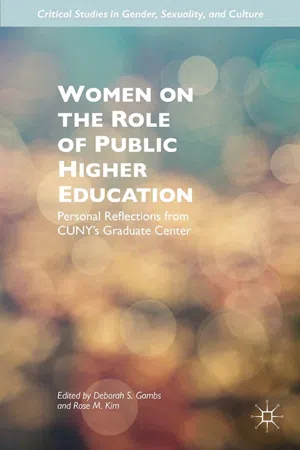
This edited collection presents a compilation of personal essays on the role of public higher education in the lives of fourteen social scientists who are graduates of the Graduate Center, the doctoral granting institution at the City University of New York, the nation's largest public urban university.
Information
Topic
EducationSubtopic
Education Theory & PracticeChapter 1
Introduction
Deborah S. Gambs and Rose M. Kim
An ever-present narrative surrounding public education today, and specifically public higher education, is that it is in crisis. This notion of crisis emanates from many sources—faculty, unions, the government, the private business sector, and the media—and is directed at all levels of education (primary, secondary, collegiate, and graduate), and not just in the United States, but globally. Different stakeholders identify various crises according to their standpoints. Faculties decry increasing standardization, stringent assessment procedures, and declining professional autonomy. Students complain about rising tuition and student debt; their parents bemoan the lack of employment in their children’s fields of study upon graduation. Faculties and students contest campus restrictions on assembly and free speech. Business leaders and elected officials complain about poorly trained graduates. Administrators struggle with budgetary constraints in the face of declining enrollment at many institutions, while depending increasingly on poorly paid contingent1 labor for teaching. Meanwhile, Boards of Trustees and Regents issue corporate-level salaries for top administrators. These “crises” are just some of the most prominently voiced. To further complicate matters, these crises overlap, are interrelated, and affect multiple stakeholders, and some crises have been chronic; so it is not always entirely clear who holds what position in the crisis, and in which crisis.
Critics of neoliberalism and privatization, such as Judith Butler, Michael Hardt and Antonio Negri, and David Harvey have attuned us to how the discourse of crisis can mystify the roles of law and capital, and be manipulated to enact major social changes, such as the privatization of state resources, the redistribution of wealth, and the dispossession of individuals and communities, so it is critical to be thoughtful in deploying the idea of an educational crisis. No doubt the problems facing public colleges and universities are intertwined with the Great Recession of 2008 and subsequent implementation of austerity budgets on the state and federal levels because of public higher education’s reliance on state funding.
In many public universities, recent budgetary cuts have been especially painful and controversial, due to the government’s steady decline in support for public education since the late 1970s. Heated confrontations have elicited attention in the national media. Most recently, in February 2014, the University of Illinois at Chicago’s faculty went on a historic strike, walking off their jobs in support of contingent faculty. In June 2012, after the University of Virginia’s Board of Visitors fired President Teresa A. Sullivan for moving too slowly on increasing online education that would cut operating costs, widespread opposition from students, faculty, alumni, and the national educational community roiled the university, resulting in Sullivan’s eventual rehiring. That same year, the University of California was rocked by student protests over tuition increases and the campus security’s heavy-handed response. In November 2013, the US House of Representatives’ Committee on Education and Workforce asked contingent faculty to share stories about work conditions for its report on quality of life and student learning;2 in response, more than 800 contingent lecturers from 40 states flooded the committee with stories of struggling to survive on near-poverty wages and with the help of food stamps.3 Technological changes, coupled with the desire of administrators to capitalize on their supposedly cost-cutting potential, add an additional layer of complexity to this mix.
Thus, decision-makers at colleges and universities today are awash with a range of questions related to the mission of higher education. Should colleges dedicate themselves to the traditional liberal arts curriculum of fostering a passion for the profound questions of what constitutes a just society and the development of citizenship skills? Or should they focus on training students for specialized occupations in an increasingly globalized economy? Questions of accountability are also prevalent. Are students learning? What are the learning goals of courses and how do you measure whether you have achieved them? Structural concerns also abound—should colleges expand to accommodate students’ needs or should they cap enrollment and raise tuition to deal with their budgetary constraints? Are corporate alliances the answer or the problem? And what is the impact of the online university, one of the fastest growing sectors of higher education? At the same time as public colleges and universities grapple with these major questions, they also are under attack for failing to produce marketable students with strong writing, mathematical and analytical skills, and for poor student graduation rates. All these internal questions occur amid continued defunding, criticism, and lack of support from state and federal governments, and problematic investment of finance and attention by powerful business leaders in the private sector.
Academics have been offering their insights. Thus, in the often-cited Academically Adrift: Limited Learning on College Campuses (2011), Richard Arum and Jsipa Roksa analyze a series of studies that attempts to assess whether students show evidence of developing critical thinking skills during their four (or more) years of college. Although they argue that a key reform in higher education should ideally be to focus on higher-order thinking and critical thinking, they also emphasize it is important for students to be prepared for the job market. Meanwhile, in The Knowledge Factory: Dismantling the Corporate University and Creating True Higher Learning (2000), Stanley Aronowitz condemns the present system for failing to produce critical, original thinkers, and decries higher education as a site of occupational training and socialization to the status quo, even deploying the term “post-secondary” to refer to the degraded state of higher education. Most recently Mark C. Taylor’s Crisis on Campus: A Bold Plan for Reforming Our Colleges and Universities (2010) argues for a radical reworking of higher education. Based on a 2008 Op-Ed piece Taylor wrote for the New York Times, and the overwhelming responses to the article on blogs and traditional media formats, the author claims that academia as we know it is fundamentally broken, yet necessary. In light of technological changes, and the unequal labor of community college faculty compared to those at top research institutions, Taylor suggests policy changes to reform the system of higher education. In Saving State U (2010), Nancy Folbre provides an invaluable history of the US public university, as well as the assault on higher education since the 1970s. In Cultivating Humanity: A Classical Defense of Reform in Liberal Education (1997), Martha Nussbaum has a more positive assessment of higher education and studies specific classroom curricula across the nation to illustrate how professors strive to inspire students “to think critically, to examine themselves, and to respect the humanity and diversity of others.” All these books apply a historical or pedagogical approach to consider the role of the public university and its evolution in the United States.
In general, however, there seems an utter lack of appreciation for the significant role that affordable public colleges and universities have played and continue to play in the lives of so many Americans, as well as international students. The continued focus on educational crisis(es), painted with such broad brushstrokes, obscures the learning and critical self-awareness that does flourish in higher education. Furthermore, the voices of students in public education are almost never heard, especially in the discourse of crisis. Typically the only feedback attributable to them is statistical, expressed numerically through graduation rates or standardized test scores. Although the writers in this collection are no longer students, their essays focus on a combination of their experiences in education, as children, as undergraduates, as graduate students, as doctoral candidates, and today, as faculty and scholars. Their reflections also reveal that learning is a life-long process, not simply measurable at the end of four years.
While this introduction reviews the macrohistorical developments in higher education, the collection of essays differs from previously referenced works because of its focus on specific individual lives, and especially those of gendered, racialized, and nationalized minorities. The book presents 14 autobiographical essays by women who received doctorates in the social sciences from the Graduate Center (GC), the doctoral granting institution of the City University of New York (CUNY), between 1995 and 2008. The essays provide a unique lens through which to address questions about the importance of public higher education by taking a close look at the role it has played in the writers’ lives. Their narratives offer a more nuanced portrayal of the importance of public higher education in people’s lives, and for society, as a whole. We wanted to focus on individual women because it was our experience as GC students, and now as CUNY faculty, that there were women within CUNY, the nation’s oldest public university system, who were engaged in important work and whose lives and vast range of experiences offered an important window into public higher education today, and higher education, in general. The rich diversity of backgrounds of women at the Graduate Center; their active involvement in the fight for racial, gender, and sexual justice, in politics, in advocacy, and in human rights; their critical perspectives on the academy; their development of new forms of research methods; their willingness to bring their whole life experience into their work; all should be seen as evidence for what can happen when education is public.
Obviously it is a complex task to assess the present state of doctoral public higher education. However, this book contributes to ongoing debates by providing insights into the positive contributions that higher education can make in people’s lives. As noted earlier, many critics of higher education have relied too heavily on historical surveys, and/or statistical measures and assessments to gauge the state of higher education. The narratives here, rich with critical insights and social awareness, counter and challenge the dominant narratives of crisis circulating in higher education—narratives of failing institutions, of incompetent students, and of lazy, self-serving educators. The narratives also make clear that it has not been “failing institutions” that have been the sole, real problem for students. Rather, the pursuit of an education is a complex endeavor, influenced by various social forces, such as budgetary constraints, economic inequality, racism, and nationalism in public and private K-12 and post-secondary schools, familial abuse, US militarism, and religious upbringing. Rightly Henry A. Giroux argues in Education and the Crisis of Public Values (2012) that
our current knowledge is contingent on particular historical contexts and political forces. Classrooms are shaped by a distinctive array of forces, ranging from the diverse histories and needs that students bring to them, to the scarcity or plenitude of resources available to teachers, to the relations of governance that bear down on teacher-student relations. (121)
With such an awareness of the broader social issues that shape education, this book delves into the experiences of 14 women who pursued and obtained PhDs in the social sciences at the Graduate Center.
As an affordable public institution in New York City, the GC doctoral programs draw students who have a strong commitment to politics, and to an open, accessible education. The essayists come from a broad range of social-class backgrounds, including the working poor, the working class, the lower middle class and the middle class, in addition to international students, and first- and second-generation immigrants. In the essays the contributors reflect on how the public university has shaped and influenced their lives, as well as their scholarly and pedagogical pursuits. Many, though not all, teach in public higher education, and reflect on those experiences, as well. They also pursue creative endeavors, and are activists, partners, and mothers. Four are natives of other countries (Ireland, Italy, Korea, and Turkey) and offer a transnational perspective; there is strong evidence that attacks on public education and students movements are not just in the United States, but occur globally, in Brazil, Chile, Canada, England, South Africa, and many other countries.
By focusing on the experiences of women in doctoral public higher education, the essays offer a unique counterpoint to the current body of work that largely focuses on undergraduate education to assess and critique student learning, and to make policy suggestions. The essays highlight the lived experiences of those who transitioned from student to scholar/educator. As graduate students, many worked as contingent lecturers, while also conducting their own research. While doctoral education is something in which only a very small percentage of people participate, doctoral students are a fundamental part of public higher education because they are deeply involved in research and go on to constitute the faculty of public and private colleges and universities.
Some social critics proclaim the end of the university, and others even call for it.4 However, this book—as reflected in the powerful voices of the essayists—despite agreeing with some of the specific criticisms and concerns, proposes that the university remains a powerful, vital social force in developing a critical awareness and in aiding self-discovery. In fact, the evidence is clear that higher education has always been, to some degree, in flux and often in crisis, often dating to the start of higher education itself. As early as 1918, social critic Thorstein Veblen decried the corporatization and vocationalization of higher education in The Higher Learning in America (1918): “The intrusion of business principles in the universities goes to weaken and retard the pursuit of learning, and therefore to defeat the ends for which a university is maintained” (224). For Veblen, the true function of post-secondary institutions was not job training, but “higher learning,” that is, critical research and scholarship: “The fact remains that the university is, in usage, precedent, and common sense preconception, an establishment for the conservation and advancement of higher learning, devoted to a disinterested pursuit of knowledge” (85).
So while some of the challenges facing higher education are long-standing, it is also true that we live in a particular moment in time and space in which vast social and technological changes are transforming the social world and intensifying the speed at which institutions change, interactions occur and processes unfold. The next section examines the current educational climate more closely.
Today’s Crisis: Neoliberalism, Corporatization, the Vanishing Public, and Rising Precarity
The constant drumbeat that higher education is in crisis—by failing to educate students, by not providing them with jobs, by failing to provide measurable returns, or whatever else—masks the real crisis that has b...
Table of contents
- Cover
- Title
- Chapter 1 Introduction
- Part I Learning to Be Critical
- Part II Building Caring Communities
- Part III Becoming and Staying Public
- Bibliography
- List of Contributors
- Index
Trusted by 375,005 students
Access to over 1.5 million titles for a fair monthly price.
Study more efficiently using our study tools.
Frequently asked questions
Yes, you can cancel anytime from the Subscription tab in your account settings on the Perlego website. Your subscription will stay active until the end of your current billing period. Learn how to cancel your subscription
No, books cannot be downloaded as external files, such as PDFs, for use outside of Perlego. However, you can download books within the Perlego app for offline reading on mobile or tablet. Learn how to download books offline
Perlego offers two plans: Essential and Complete
- Essential is ideal for learners and professionals who enjoy exploring a wide range of subjects. Access the Essential Library with 800,000+ trusted titles and best-sellers across business, personal growth, and the humanities. Includes unlimited reading time and Standard Read Aloud voice.
- Complete: Perfect for advanced learners and researchers needing full, unrestricted access. Unlock 1.5M+ books across hundreds of subjects, including academic and specialized titles. The Complete Plan also includes advanced features like Premium Read Aloud and Research Assistant.
We are an online textbook subscription service, where you can get access to an entire online library for less than the price of a single book per month. With over 1.5 million books across 990+ topics, we’ve got you covered! Learn about our mission
Look out for the read-aloud symbol on your next book to see if you can listen to it. The read-aloud tool reads text aloud for you, highlighting the text as it is being read. You can pause it, speed it up and slow it down. Learn more about Read Aloud
Yes! You can use the Perlego app on both iOS and Android devices to read anytime, anywhere — even offline. Perfect for commutes or when you’re on the go.
Please note we cannot support devices running on iOS 13 and Android 7 or earlier. Learn more about using the app
Please note we cannot support devices running on iOS 13 and Android 7 or earlier. Learn more about using the app
Yes, you can access Women on the Role of Public Higher Education by D. Gambs, R. Kim, D. Gambs,R. Kim in PDF and/or ePUB format, as well as other popular books in Education & Education Theory & Practice. We have over 1.5 million books available in our catalogue for you to explore.