- English
- ePUB (mobile friendly)
- Available on iOS & Android
eBook - ePub
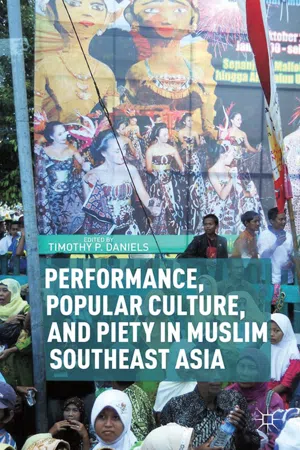
Performance, Popular Culture, and Piety in Muslim Southeast Asia
About this book
The Muslim-majority nations of Malaysia and Indonesia are known for their extraordinary arts and Islamic revival movements. This collection provides an extensive view of dance, music, television series, and film in rural, urban, and mass-mediated contexts and how pious Islamic discourses are encoded and embodied in these public cultural forms.
Information
1
PERFORMING PIETY FROM THE INSIDE OUT: FASHIONING GENDER AND PUBLIC SPACE IN A MASK “TRADITION” FROM JAVA’S NORTHWEST COAST
Laurie Margot Ross
INTRODUCTION
Cirebon, on Java’s northern littoral or pasisir, was an important port of transnational exchange in the Indian Ocean region, where Sufi artist guilds devoted to carving and textile industries flourished in the seventeenth century.1 The historic trade routes that we today call the “silk road” carried not only silk and other goods, but also cultural and religious ideas, of which many were linked to Sufism. In western Java, the two most important nodes of transnational exchange were Cirebon, on the cusp of Central Java, and Banten,2 just southeast of Sumatra and the Sunda Strait. Both Cirebon and Banten had mask theater traditions and were home to Java’s two oldest Muslim courts, of which only Cirebon’s remains now. Through these two portals Chinese, Arabs, Persians, Indians, Siamese, Central Asians, and Europeans gained access to the interior. In the early seventeenth century, Batavia (Jakarta) was built between them by the Dutch.3
Sufism appears to be immoderately male—both in terms of its practitioners and its lexicon4—yet, as Annemarie Schimmel elegantly argues in My Soul Is a Woman, women enjoy full equal rights in the mystical branch of Islam.5 Virtually all of the classical works on early Sufism position one woman as its early central figure: Rabi‘a al-‘Adawiyya. For Rabi‘a, who introduced the absolute love of God6 into Sufism in the eighth century, beauty was not of the lateral world; rather, it existed in the interior life of the heart. As Schimmel also notes, women are seldom referred to in the Quran, yet the important term nafs (“soul”) is a feminine noun used numerous times in the Quran. Although its meaning is often pejorative, it also refers to the mother of mankind.7
The gender equity that Sufism provides has afforded both female and male pedigreed mask dancers from Java’s rural northwest coast equally vibrant spiritual and artistic roles spanning multiple generations. These artists, called dalang topeng (dalang), trace their lineage to Sunan Kalijaga, one of the nine legendary Sufi saints (walisongo), who wandered the countryside performing with masks and puppets as instruments of dakwah (proselytization).
Topeng cirebon is different from the topeng malang described by Onghokham8 and Sunardi (chapter 5). While both are inherited forms that enjoyed great popularity before 1965, qualitative differences exist that are constellated around class, gender, and age: most dalang topeng are day laborers and predominantly female, while Malang troupes are comprised of men and children from well-heeled families. Furthermore, whereas the Cirebon practitioners trace their genealogy (keturunan) to a Sufi apostle, Malang artists view their art as a family business.9 Thus, the debate about displays of piety in topeng cirebon pertains chiefly to women, including the importance of concealing those parts of the body considered private, aurat.
Even with the thoughtful engagement about piety, the debate about doctrinal injunctions on figurative art hotly contested throughout much of the Islamicate remains off of most Cirebon citizens’ radar. This is likely due to the region’s idiosyncratic blend of Sunni and Shia mysticism.10 Shia Muslims have a long tradition of figurative art, including copious depictions of Prophet Muhammad. Moreover, one of Java’s most prominent and controversial Muslim figures, Shaykh Siti Jenar,11 is often compared to Junayd al-Baghdadi, both in terms of ideology and fate—both men were accused of extremist Shiism and executed for heresy. Siti Jenar, whose burial site resides on the outskirts of Cirebon, is considered the “eighth wali” by some adherents.12 While most dalang are Sunni and trace their lineage to Sunan Kalijaga, some recognize Siti Jenar’s disciple, Pangeran Panggung (Prince of the Stage), who met the same fate as his teacher, to be the founder of topeng. That those claiming this genealogy are often women signals a sharp contrast with other Islamic masking traditions, notably those of Sumatra and sub-Saharan Africa, where it is chiefly the domain of males.13
HISTORICAL CONTOURS
Masking was well established in the pre-Islamic Java,14 and at least as far back as the sixteenth century women are known to have performed with masks in popular entertainments.15 There is a lacuna in our knowledge of gendered mask dance in western Java until the mid-nineteenth century, when E. Hardouin’s 1855 illustration of a female dalang topeng/ronggeng16 and two clowns appeared in a chapter on itinerant mask performance, topeng babakan (mask acts) in Java Tooneelen uit het Leven Karakterschetsen en Kleederdragten van Java’s Bewoners in afbeeldingen naar de natuur geteekend.17
Three centuries of Dutch control came to a close when Japanese troops entered Java near Indramayu in 1942 and quickly gained control of the region. Following Japan’s defeat at the end of World War II, Dutch attempts to reclaim their hold of the Archipelago led to the Indonesian revolution and its eventual Independence in 1950.
It appears that the debate about visual representation in Islam first entered the topeng discourse during the last decade of Sukarno’s presidency, when three organizations were vying to succeed him in the late 1950s and early 1960s: Indonesia’s communist party, Partai Kommunis Indonesia (PKI); Indonesia’s nationalist party, Partai Nasional Indonesia, and; the separatist Darul Islam and Islamic Army of Indonesia (Darul Islam/Tentara Islam Indonesia, or DI/TII) movement, which aimed to establish an Islamic state governed by shari‘a. Although the peasant-based art form appealed to the PKI and its aligned socialist art organization, Lekra (Lembaga Kebudayaan Rakyat, or People’s Cultural League), suspicions ran high between the organization and artists. PKI was reportedly concerned about the artists’ potential link with members of DI/TII, who, likewise, were suspicious of the frequency of topeng performances at PKI events. According to the late dalang topeng, Sujana Arja (d. 2006), who frequently performed for both groups, DI/TII took issue with the mask itself, which they viewed as heresy.18 Yet, in DI/TII’s bid to dominate the region, topeng continued to be an important part of members’ hajatan (life cycle events). The critique of masks lay dormant with the execution of its leaders in west Java by the Sukarno administration in 1962.
Soon after the Suharto’s 1965 coup, referred to here as Gestok,19 when he had wrested control of the government from Sukarno and the furore over the massacres quieted, martial law silenced the itinerant dancers. This might have been a permanent state of affairs for topeng practitioners were it not for Suharto’s wife, Ibu Tien, who took up the mission of promoting Indonesia’s cultural diversity by creating the neocolonial theme park, Taman Mini Indonesia Indah (TMII, Beautiful Indonesia Miniature Garden), on the outskirts of east Jakarta in the mid-1970s. Her conception of TMII was based on both the colonial fairs and, more to the point, her personal observations at the New York World’s Fair in 1964.20 TMII showcased Indonesia’s rich visual and performing arts, including topeng cirebon. However, its once overt tasawwuf (Sufi) nuances were now muted with heavy restrictions placed on the use of public and private space. By removing topeng from its natural milieu, a secularized, stripped-down version was created. However, with the first overseas topeng tour that soon followed in 1977, topeng was back in circulation, albeit now under the watchful eye of the authoritarian Suharto regime.
By the late 1990s, nearly forty years after the Darul Islam movement was suppressed in west Java and with Suharto’s days numbered, piety in the public sphere was again ripe for debate and topeng involved in the conversation. This time, however, the debate was not merely externally driven, but was organically taking place within topeng circles. Perhaps not surprisingly, it is not female dalang with pedigree, but young mask dancers without it, who are the most conflicted and rigorous debaters. That the polemic reached rural artists before social media was entrenched at the village level was no doubt influenced by Suharto’s tacit (and not so tacit) support of DI/TII’s heirs. Its ripples are most clearly felt at the massive, reformist Pesantren Al-Zaytun in the village of Mekerjaya in Gantar, Indramayu, which will be exam...
Table of contents
- Cover
- Title Page
- Copyright
- Contents
- List of Figures and Table
- Acknowledgments
- Introduction: Performance, Popular Culture, and Piety in Malaysia and Indonesia
- 1 Performing Piety from the Inside Out: Fashioning Gender and Public Space in a Mask “Tradition” from Java’s Northwest Coast
- 2 Islamic Revivalism and Religious Piety in Indonesian Cinema
- 3 Embodying the Divine and the Body Politic: Mak Yong Performance in Rural Kelantan, Malaysia
- 4 “Islamic” TV Dramas, Malay Youth, and Pious Visions for Malaysia
- 5 Complicating Senses of Masculinity, Femininity, and Islam through the Performing Arts in Malang, East Java
- 6 Social Drama, Dangdut, and Popular Culture
- Afterword: Commentary
- References
- Notes on Contributors
- Index
Trusted by 375,005 students
Access to over 1.5 million titles for a fair monthly price.
Study more efficiently using our study tools.
Frequently asked questions
Yes, you can cancel anytime from the Subscription tab in your account settings on the Perlego website. Your subscription will stay active until the end of your current billing period. Learn how to cancel your subscription
No, books cannot be downloaded as external files, such as PDFs, for use outside of Perlego. However, you can download books within the Perlego app for offline reading on mobile or tablet. Learn how to download books offline
Perlego offers two plans: Essential and Complete
- Essential is ideal for learners and professionals who enjoy exploring a wide range of subjects. Access the Essential Library with 800,000+ trusted titles and best-sellers across business, personal growth, and the humanities. Includes unlimited reading time and Standard Read Aloud voice.
- Complete: Perfect for advanced learners and researchers needing full, unrestricted access. Unlock 1.5M+ books across hundreds of subjects, including academic and specialized titles. The Complete Plan also includes advanced features like Premium Read Aloud and Research Assistant.
We are an online textbook subscription service, where you can get access to an entire online library for less than the price of a single book per month. With over 1.5 million books across 990+ topics, we’ve got you covered! Learn about our mission
Look out for the read-aloud symbol on your next book to see if you can listen to it. The read-aloud tool reads text aloud for you, highlighting the text as it is being read. You can pause it, speed it up and slow it down. Learn more about Read Aloud
Yes! You can use the Perlego app on both iOS and Android devices to read anytime, anywhere — even offline. Perfect for commutes or when you’re on the go.
Please note we cannot support devices running on iOS 13 and Android 7 or earlier. Learn more about using the app
Please note we cannot support devices running on iOS 13 and Android 7 or earlier. Learn more about using the app
Yes, you can access Performance, Popular Culture, and Piety in Muslim Southeast Asia by T. Daniels in PDF and/or ePUB format, as well as other popular books in Social Sciences & Islamic Theology. We have over 1.5 million books available in our catalogue for you to explore.