eBook - ePub
The Discourses and Politics of Migration in Europe
- English
- ePUB (mobile friendly)
- Available on iOS & Android
eBook - ePub
The Discourses and Politics of Migration in Europe
About this book
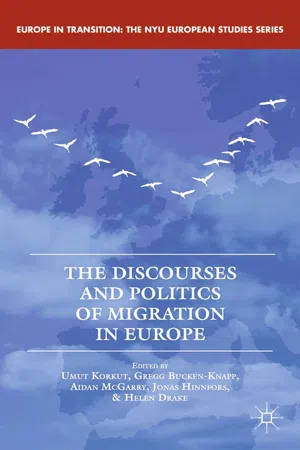
This book engages with politics and political discourse that relate to and qualify immigration in Europe. It brings together empirical analysis of immigration both topically and contextually, and interprets such empirical evidence with the use of policy and discursive analyses as methodological tools. Thematically, this volume focuses on how discourse and politics operate in issue areas as varied as immigrant integration and multilevel governance, Roma immigration and their respective securitization, the uses of language in determination of asylum applications, gendered immigrants in informal economy, perceptions of integration by the migrants, economic interests and economic nationalism stimulating immigration choices, ideology and entry policies, and asylum processes and the institutional evolution of immigration systems. These issues are analyzed with empirical evidence investigating the discursive formulation of immigration systems in political contexts such as the Netherlands, France, United Kingdom, Turkey, Switzerland, Scandinavian states, and Finland.
Information
PART I
Construction of the Foreigner
CHAPTER 1
Whose Interests Do Radical Right Parties Really Represent? The Migration Policy Agenda of the Swiss People’s Party between Nativism and Neoliberalism
Introduction
Since the late 1980s, right-wing populist parties—parties that combine authoritarianism (law and order and traditional values), nativism (the protection of the interests of the native-born over those of immigrants), and populism (a critique of the political and economic establishment) at the core of their ideology—have emerged as a significant electoral and parliamentary force in Western Europe (Mudde 2007). In a number of countries, the electoral success of these parties has relied on an “unholy alliance” between blue-collar workers who traditionally voted for the left, and small business owners who traditionally voted for the right (Kitschelt and McGann 1995: 10–11; Ivarsflaten 2005a: 465; Oesch 2008a). Though the reasons leading voters with apparently contradictory economic interests to vote for the same political parties have received extensive attention in the literature, little research has been devoted to the way party elites articulate these interests within their policy agenda. In this chapter, I explore the socioeconomic interests that characterize the electoral constituency of one of the strongest radical right parties in Western Europe, the Schweizerische Volkspartei (Swiss People’s Party [SVP]), and the way its party elites seek to reconcile these interests in their immigration policy agenda. Immigration policy is considered here as a policy with different distributive consequences across socioeconomic groups, and not only as a policy guided by values and identity concerns.
Questioning the idea that the policy agenda of this party is geared only toward migration control, I argue that it seeks to reconcile a nativist rhetoric catering to its working-class clientele, on the one hand, and neoliberal policies that cater to its business clientele, on the other. Hence, while the SVP has claimed to champion immigration control to protect native workers, it has also advocated measures to maintain or open entry channels for low-wage migrant employment and cater to its clientele of small business owners who have been historically dependent on low-skilled migration. As will be shown in the light of a number of policy reforms since the 1990s, the articulation of these interests has been characterized by many paradoxes and internal conflicts between different factions within the party, and between its electoral base and its elected representatives. My analysis emphasizes the role of political salience in influencing the strategies of party elites: while issues with a low political salience allow the neoliberal strand to prevail, high salience tends to drive back the party agenda toward stricter immigration control.
The chapter is structured as follows. In the first section, I outline the challenges radical right parties face when articulating the interests of different social classes in their policy agendas. In the second section, I outline how these diverging economic interests play out in the field of immigration policy, and present a typology of immigration policy agendas taking into account these distributive dilemmas. Then, I explore these elements in the Swiss case in light of recent immigration policy reforms, namely the free movement of workers with the European Union (EU), the regulation of undeclared work, and revision of the Aliens law. In these different cases, I emphasize the conflicts within different strands in the party regarding immigration policy reform, and the strategies deployed by party elites to reconcile them.
Cross-Class Alliances and Radical Right Party Agendas
In general, it seems fairly reasonable to assume that the policies advocated by parties are closely connected to the interests of their core constituencies, because party leaders are dependent on votes to stay in office. Anthony Downs was among the first to argue “parties formulate policies in order to win elections, rather than win elections in order to formulate policies” (1957: 28). Even if this assumption is certainly too one-dimensional because party elites may pursue different, and sometimes contradictory, objectives (Strom 1990: 566–570), it nevertheless points out that public policies cannot be analyzed in isolation from the electoral interests of the parties that enforce them. In this chapter, I am interested in how right-wing populist parties articulate the sometimes contradictory interests of their electorate. Interests are analyzed here essentially as economic preferences determined by the position of socioeconomic groups in the political economy and labor market (Gourevitch 1986; Swenson 2002). I draw on the assumption that party policies are essentially the reflection of the power balance between different electoral interests within a party. If this somewhat materialist focus may be too simplistic, as it relegates questions of identity and culture to the background, it nevertheless highlights the specific problems of reconciling the divergent economic interests characterizing the clientele of national populist parties, as well as the redistributive implications of immigration policy.
In many ways, the articulation of these heterogeneous economic interests in unified party policy agendas is an exercise in contortionism for political parties. If party platforms have to display a certain degree of internal coherence, the interests of voters are much more heterogeneous because the electoral base of political parties is also heterogeneous; different social groups may vote for the same parties for different reasons, and socioeconomic groups with similar standards of living may have radically opposed preferences. For instance, some relatively privileged segments of new middle classes vote for left parties, while substantial segments of the working-class vote for the national conservative right (Oesch 2008a, 2008b). As their social base becomes more heterogeneous, political parties have to represent possibly contradicting interests, thereby making it more difficult to formulate policy agendas without alienating part of the electorate. Moreover, this heterogeneous electoral base may also translate into different factions within party elites, generating potential conflicts between them.
Party leaderships can be assumed to be aware of these divergent interests and use different strategies to solve them. For instance, they may seek to stay ambiguous or “blur” their agenda on certain issues to maximize their vote share and avoid the issues on which different sections of their voters disagree, or on which the party elites differ from their voters. Rovny (2012: 1) argues that “parties emphasize their stance on some issue dimensions, while strategically evading positioning on others, in order to mask the distance between themselves and their voters.” Hence, a party may want to adopt clear ideological positions on an aspect that federates different segments of the electorate, and stay vague or conceal its positions on aspects susceptible to create disagreements. However, if “blurring” strategies are common in electoral politics, they may be more problematic when it comes to actual policymaking. The ability of parties to blur or conceal their position is more difficult once they are elected in parliament, and even more so when they hold office, when concrete policy choices have to be made. In these contexts, the contradictions and problems of reconciling the interests of different social classes in a common policy agenda may become more visible and potentially damaging electorally, depending on the salience of these issues with voters.
Radical right parties are particularly exposed to these kinds of dilemmas because of the cross-class composition of their electorate (Ivarsflaten 2005a; Oesch 2008a; Rovny 2012). In general, radical right parties have made substantial electoral advances in countries in which they managed to source votes from two specific socioeconomic groups, namely—and primarily—the blue-collar working class who traditionally voted for the left and—to a lesser extent—the petite bourgeoisie (shopkeepers, artisans, and independents) who traditionally voted for the right, even if the respective balance of these two groups varies across countries. Hence, production workers, service workers, and clerks taken together represented 68 percent of the electorate of the Austrian FPÖ in 2002, and 67 percent of the Flemish Vlaams Blok in 2002, while they only represented 39 percent of SVP voters in Switzerland (Oesch 2008a: 358). In Switzerland, salaried middle classes, big employers, and small business holders still constituted the largest part of the electorate of the populist right. What is particularly interesting is that these two groups have historically advocated different agendas in terms of economic policy, the former championing redistribution and the expansion of the welfare state, and the latter opposing state interventionism and taxation. The objective alliance of these socioeconomic groups with a priori contradictory interests has been observed in a number of national populist parties in Europe (Ivarsflaten 2005a: 465–466), and has been analyzed by a now relatively vast literature (ibid.; Kitschelt and McGann 1995; Lubbers et al. 2002; Mayer 2002; McGann and Kitschelt 2005).
There have been different approaches to explain the emergence of this cross-class alliance. The first approach, initially formulated by Kitschelt and McGann, assumed that socioeconomic change had induced a realignment of preferences of previously opposed social groups, thereby allowing radical right parties to use a “winning formula” combining authoritarianism and neoliberalism (1995). This combination allegedly allowed radical right parties to appeal to the antistatist petite bourgeoisie, whereas the anti-immigration agenda appealed to a growing fringe of the working class that felt threatened by immigration and globalization. The second approach argues that neoliberalism does not play such a prominent role in the first place in the success of populist radical right parties. De Lange (2007) and Mudde (2007) notably showed that populist radical right parties do not advocate similar economic policies everywhere, and populist parties in France, Belgium, and the Netherlands have adopted more centrist positions in economic terms.
While earlier analyses emphasized the neoliberal ideology of radical right parties in the 1980s, this picture no longer seems accurate to describe a large part of these parties today. Based on data on party placement in 17 countries, Rovny shows that radical right parties “emphasize and take clear ideological stances on the authoritarian fringe of the non-economic dimension, while deliberately avoiding precise economic placement” (2012: 19). In short, they are particularly prone to use the “blurring” strategy outlined above to please their electorate with different economic preferences. However, once again, this strategy is more difficult to pursue when radical right parties are engaged in actual policymaking, and even more so when they take part in government. The blurring strategy is less of an option, and their actual economic policy agenda becomes more salient for voters.
If these parties have to vote on legislative proposals in which the interests of their different constituencies cannot be reconciled, a central question is whose interests they will ultimately support, and when they will favor one specific segment of the electorate over another. Indeed, even if economic issues have been said not to be a central element for the working-class electorate of the radical right (Ivarsflaten 2005b; Oesch 2008a), supporting economic policies that are perceived to go against the interests of their voters can still be risky for the elites. Parties can appear as “betraying” part of their constituency, as shown by the electoral misfortunes of some parties after they accessed public office. The Austrian Freedom Party, for instance, implemented a series of neoliberal policies in alliance with the conservative ÖVP (Österreichische Volkspartei) that proved highly unpopular with its electorate, and underwent an electoral collapse just after it assumed office (Heinisch 2003). In the 2012 Dutch general election, Geert Wilders’s PVV (Partij voor de Vrijheid) similarly underwent a major electoral setback after it had committed itself to support a right-wing government determined to implement tough austerity measures.
As a working hypothesis, one can assume that the political salience of issues plays a prominent role because salience has asymmetric consequences for the influence of different socioeconomic groups in politics. As Culpepper convincingly shows in the case of corporate governance reforms, business interests tend to prevail when issues have low salience or highly technical (2010: 5ff.). When issues become politically salient, however, policymakers are spurred to pay more attention to the preferences of the median voter, and they may be less willing to favor business interests if chances of reelection are at stake. Transposing this logic to radical right parties, one can assume that party elites will support the interests of the business segments when issues are weakly salient. By contrast, when issues are very salient, party elites will avoid advocating policies that are perceived to go against the interests of their working-class voters, because this constituency is more interesting in terms of votes. Small businessmen will be more aware of issues that relate to their special preferences even if they are not much debated, while the blue-collar electorate has more diffuse interests and will pay attention only when issues become prominent in the media. While the blue-collar electorate is much bigger—the one with the biggest growth potential—the “business” faction can entail other benefits, such as funding or other forms of financial support. In short, “betraying” the working-class electorate is easier when issues keep a low profile. This proposition will be explored in the case of immigration policy, which can also be considered as a policy with redistributive implications for different constituencies, and across cases displaying different degrees of salience as measured by their coverage in the media.
Migration Policy and Socioeconomic Interests
In this section, I argue that migration policy can be understood as a policy with different distributional consequences across different socioeconomic groups, which makes it difficult for radical right parties to advocate policies that satisfy both their working class and their small business clientele. My approach draws on two assumptions. The first is that immigration policy is a policy guided not only by values or identities but also by economic interests, entails different socioeconomic implications for different economic groups, and is influenced by the power balance between different socioeconomic interests (Freeman 1995; Tichenor 2002: 23–26). The second is that populist radical right parties do not only make a rhetoric use of anti-immigration sentiments for electoral purposes, but also pursue political-economic objectives in their immigration policy agenda, reflecting the interests of the social constituencies they represent. In order to explore the economic objectives that can be pursued through immigration policy, I draw upon a typology of immigration policy agendas differentiating positions over the admission of immigrants and immigrant rights.
In his analysis of immigration policy in the United States, Tichenor outlines a two-dimensional typology of immigration preferences that he applies to US interest groups and political parties (2002: 50). Immigration policy preferences can be classified along two dimensions, namely the admission of immigrants (the restrictiveness of conditions regarding access to a country and its labor market) and the rights granted to them once in the country (the requirements regarding permanent stay, access to social security, mobility on the labor market, access to citizenship) (Ruhs and Martin 2008). First, classic exclusionists advocate both tight immigration control and restrictive immigrant rights. Immigration should be tightly restricted and rights for foreigners should be limited to reduce incentives for immigrants to enter the country. This is the archetypal stance assumed to be endorsed by populist radical right parties. Second, national egalitarians advocate tight immigration control and tend to oppose temporary migrant worker programs, but support equal rights for immigrants once they have been admitted in the country and tight control of labor standards. The leading idea of this stance is to defend the interests of national workers and, therefore, not to allow the creation of a secondary labor market of immigrants paid at lower rates. Within the category of immigrant rights, one could also classify measures of labor market regulation such as labor inspection or fight against illegal employment, drawing on the idea that these measures—at least in principle—prevent the exploitation of migrant workers. Third, free-market expansionists advocate rather open immigration policies but oppose the expansion of immigrant rights to maintain a source of cheap foreign labor for businesses. Groups within this category would favor temporary worker programs but would oppose sanctions against employers employing illegal immigrants, which de facto fosters the creation of dual labor markets, or an “industrial reserve army” (Castles and Kosack 1972; Piore 1979). Finally, cosmopolitans advocate both open door policies and expansive immigrant rights.
In light of the cross-class socioeconomic base of populist radical right parties, this typology can help outline the conflicts faced by these parties in articulating immigration policy agendas that can rally both working-class voters and small business owners. Hence, whereas native working-class voters may favor either a “classic exclusionist” or an “egalitarian nationalist” stance either to keep immigrants out or at least prevent them from undercutting wages by granting them the same rights as indigenous workers, small business owners may rather favor a free-market expansionist stance to access a pool of low-wage workers with limited rights. This is, for instance, particularly important in the hospitality sector, which is dependent to a large extent on migrant workers. Small business owners and smallholders have an interest in the availability of cheap immigrant labor, contrary to native blue-collar workers. If they want to reconcile the two social groups that they claim to represent, national populist parties face a dilemma between different agendas, notably between a classic exclusionist, national-egalitarian, and free-market expansionist stance. In connection with the role of political salience outlined in the previous section, one can assume that radical right parties will be more prone to advocate a free-market expansionist position in line with the preferences of their business clientele on issues that are weakly salient, while they may adopt a national-egalitarian or classic exclusionist position, believed to be more in line with the preferences of their working-class voters, on issues that are highly salient. This idea will be explored in the case of the SVP in the next section.
The SVP and Immigration Policy in Switzerland
Switzerland is an interesting case for the exploration of the immigration policy agenda of radical right parties. On the one hand, it hou...
Table of contents
- Cover
- Title
- Part I Construction of the Foreigner
- Part II Host Nations
- Part III Law and Order
- The Discourses and Politics of Migration: Policy, Methodology, and Theory
- Bibliography
- Contributors
- Index
Trusted by 375,005 students
Access to over 1.5 million titles for a fair monthly price.
Study more efficiently using our study tools.
Frequently asked questions
Yes, you can cancel anytime from the Subscription tab in your account settings on the Perlego website. Your subscription will stay active until the end of your current billing period. Learn how to cancel your subscription
No, books cannot be downloaded as external files, such as PDFs, for use outside of Perlego. However, you can download books within the Perlego app for offline reading on mobile or tablet. Learn how to download books offline
Perlego offers two plans: Essential and Complete
- Essential is ideal for learners and professionals who enjoy exploring a wide range of subjects. Access the Essential Library with 800,000+ trusted titles and best-sellers across business, personal growth, and the humanities. Includes unlimited reading time and Standard Read Aloud voice.
- Complete: Perfect for advanced learners and researchers needing full, unrestricted access. Unlock 1.5M+ books across hundreds of subjects, including academic and specialized titles. The Complete Plan also includes advanced features like Premium Read Aloud and Research Assistant.
We are an online textbook subscription service, where you can get access to an entire online library for less than the price of a single book per month. With over 1.5 million books across 990+ topics, we’ve got you covered! Learn about our mission
Look out for the read-aloud symbol on your next book to see if you can listen to it. The read-aloud tool reads text aloud for you, highlighting the text as it is being read. You can pause it, speed it up and slow it down. Learn more about Read Aloud
Yes! You can use the Perlego app on both iOS and Android devices to read anytime, anywhere — even offline. Perfect for commutes or when you’re on the go.
Please note we cannot support devices running on iOS 13 and Android 7 or earlier. Learn more about using the app
Please note we cannot support devices running on iOS 13 and Android 7 or earlier. Learn more about using the app
Yes, you can access The Discourses and Politics of Migration in Europe by U. Korkut, G. Bucken-Knapp, A. McGarry, J. Hinnfors, H. Drake, U. Korkut,G. Bucken-Knapp,A. McGarry,J. Hinnfors,H. Drake in PDF and/or ePUB format, as well as other popular books in Politics & International Relations & European Politics. We have over 1.5 million books available in our catalogue for you to explore.