- English
- ePUB (mobile friendly)
- Available on iOS & Android
eBook - ePub
About this book
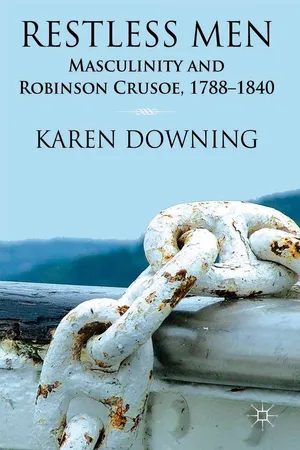
Robinson Crusoe's call to adventure and do-it-yourself settlement resonated with British explorers. In tracing the links in a discursive chain through which a particular male subjectivity was forged, Karen Downing reveals how such men took their tensions with them to Australia, so that the colonies never were a solution to restless men's anxieties.
Information
1
Confined by the Gout – Perceptions of Men’s Physical Health
One morning Robinson Crusoe’s father called him into his chamber to expostulate warmly on the subject of Crusoe’s ‘rambling thoughts’. The elder Crusoe had made a comfortable estate as a merchant and was now retired from trade. He had also developed gout, that familiar companion to men’s material good fortune. Gout is rarely commented on in the vast body of literature on Defoe’s novel, yet the elder Crusoe’s incapacitation undermined his remonstrance that the life he had chosen – one of temperance, industry and modest ambition – was the basis of happiness. His physical discomfort that morning had confined him to his bedroom and perhaps even added to the tetchiness of his tone to his son. For readers of Robinson Crusoe at the end of the eighteenth century, gout was a visible, pervasive and painful symbol of the consequences of a an industrializing and commercializing world which seemed to prove that ‘man was never intended to be idle’. This was the claim of physician William Buchan in his popular Domestic Medicine in 1769. ‘Inactivity frustrates the very design of his creation,’ he explained, ‘whereas an active life is the best guardian of virtue, and the greatest preservative of health’.1
Buchan was repeating a received wisdom, but as the eighteenth century drew to a close his claim signalled an intensifying struggle for British men. The nexus of luxury, effeminacy and the nation that had preoccupied men at the beginning of the century was ramped up in public rhetoric in the face of ongoing military action with France and in other outposts of the emerging empire. Buchan posed a significant problem for men and civilization in the late eighteenth century: how were men to be men, to fulfill the potential of their design morally and physically, if they succumbed to the idle life offered by civilization? The paradox that Buchan’s rhetoric did not expose was that while the middling classes aspired to the various luxuries of a civilizing life and paid for it with sedentary occupations in urbanized environments, the labouring classes were arguably working harder and longer than ever before in the manufacturing works that supplied the material trappings of that civilized life. By the 1830s, however, commentaries in medical literature, parliamentary reports and newspapers were as strident about the emaciated and enfeebled bodies of the unemployed and working poor as they had been about the inactive and effete bodies of sedentary workers at the turn of the century. Men were seemingly disadvantaged by all facets of an emerging industrial, consumer world.
Men’s own writings illustrated the far-reaching influence of these discussions surrounding men’s constitutions. From politician William Windham, whose diaries revealed his disposition to melancholy and preoccupation with his health, to political author William Cobbett, who through his writings attempted to project a robust and healthy self-image, men’s journals and letters referred to their health almost as often as they referred to the weather.2 These personal writings repeated the themes of public commentaries which are examined in this chapter. The common tropes were: firstly, man’s essential nature was to be active and that a civilized life threatened this nature; secondly, ‘balance’ in health, work and leisure was necessary for well-being and that consumption and city life made balance difficult to achieve; thirdly, working on the land, preferably one’s own land, was the most beneficial means of achieving good health; fourthly, adventure in, or emigration to, Britain’s colonies offered a solution to all these concerns about men’s health; and, lastly, that both physical and moral health were visible on the surface of the body.
While the physiological effects of coffee, tea, tobacco, opium and spices (some of the luxuries against which medical writers and moralists railed) and of inadequate sanitation in cities, poor ventilation in factories and grinding work (the topic of a wave of parliamentary reports after 1830) were unarguably real, this chapter is concerned with how these problems were represented in public writings and how men responded to them in their personal writings. The dissonance between men’s acknowledged desire to fulfil prescriptions for physical health and their inability to do so is expressed in these writings with unease and agitation.
Such anxiety seemed to be put to rest in the early Australian colonies – initially. The self-doubt and ill-health found in the writings of British men at home is almost absent from those of British men travelling or residing in the Australian colonies. Their initial encounters with ‘manly’ Indigenous inhabitants was taken as evidence of the value of an uncivilized life.3 Even more significantly, the superior health benefits of the colonies seemed proven in the first generation of native-born, white Australian men, who were described in contemporary accounts as tall, strong and physically robust. These ‘currency lads’, as they were called, appeared to have overcome all the perceived threats to men’s constitutions. As one British-born man, released from the anxieties of civilization in the new Australian colonies, proclaimed: ‘In England we exist – here we feel we are alive.’4 Robinson Crusoe’s ‘rambling thoughts’ may not have seemed as ill-advised as his father argued.
Every man his own physician
The problems facing men’s constitutions and advice on solutions were expansively articulated by physicians working on physiological research, religious spokesmen caring for the souls of their congregations, philosophers pondering concepts such as free will and responsibility, and doctors who specifically treated the mentally disturbed – who all participated in debates about the nature of man. Distilled in, and sometimes distorted by, travelling medical shows, public lectures, pamphlets and the products of quacks, these concerns reached a broad audience.5 Chief among the popular medical literature was physician William Buchan’s Domestic Medicine which Charles E. Rosenberg says was found everywhere in not only British but also American homes before the Civil War. The majority of general guides to health and healing – and there were many of them – were modelled in some specific or general way on Buchan’s book. These publications ran to many editions and were available through subscription libraries to people who could not afford their own copies. Increasing specialization of publications in the early nineteenth century did not diminish the pervasiveness of medical information; rather it increased the variety of forms, from very detailed anatomical drawings to ‘penny journals’ such as The Oracle of Health.6 The two most common features of this literature were injunctions to maintain ‘balance’ and repeated claims that every man was his own physician.7 It was the difficulty of maintaining the first and the changing meaning of the second that caused consumers of this literature so much unease.
Buchan made the specific connection between civilization – wealth, idleness, city-living and over-consumption – and its physical and moral consequences for men, undermining ‘the very design of his creation’.8 His book, like its many companions and emulators, was explicitly aimed at a general audience: from John Theobald’s adoption of a plainness of ‘stile’ to Thomas John Graham’s book for ‘the unprofessional reader’ that would be particularly useful to ‘clergymen, the heads of families, travellers, and persons proceeding to a foreign climate’. In the 1830s, when publications began to specialize, they still often claimed to be for ‘domestic’ use.9 Some, such as William Pinnock’s A Catechism of Medicine, employed the question-and-answer format that was often used in religious instruction, indicating that the book could be read by parents to children, and perhaps by masters to servants, as well as for personal use. This Catechism was representative of the gamut of concerns in these texts. Its appendix covered treatment of diseases but its emphasis was on the preservation of health and extension of life. A weak constitution was caused by intemperance in eating or drinking, unwholesome food or air, lack of cleanliness, excessive labour or sloth, the sudden transition from heat to cold, and indulgence of the passions. A man’s constitution could, therefore, be strengthened by ‘balance’, which for Pinnock meant a temperate climate, moderate exercise and strict temperance in food and drink, ‘together with a prudent regulation of the passions’: ‘all extremes,’ he wrote, ‘are unfriendly to health and longevity.’10
In his discussion of popular medical texts, Steve Shapin talks about ‘the golden mean’, the balance, discussed in so much of the advice and remarks on how stable that advice was over time.11 This emphasis and stability may reflect the continued underpinning of this medical literature by humoral theory – even in the face of newer understandings of physiology. Humoral theory saw bodily fluids – phlegm, yellow bile, black bile and blood – as central to the functioning of the human body. Because heat, cold, dryness and moisture affected the course of the humors from the stomach, through the bloodstream to the brain, there was a direct connection between passions and cognition, physiology and psychology, individual and environment. By the seventeenth century the circulation of the blood was properly understood and humors began to lose theoretical credibility but in practice the theory continued to sustain medicine well into the nineteenth century. Even new explications of the nervous system presumed a necessary balance for which temperance and moderation were required and many disorders of madness and insanity were thought to respond to fresh air, exercise and diet and other remedies recommended for general health. W. Andre Pearkes’ aim of a ‘state of perfect equilibrium’ was, therefore, part of a broader theoretical merging of humoral doctrines with modern assumptions about nerves that still sought humoral balance.12
The changes in popular medical literature – from pocket-sized such as Nicholas Culpepper’s, The English Physician Enlarged, to shelf-sized like Southwood Smith’s The Philosophy of Health, from herbal treatment of disease such as Theobald’s to regimens for long life like Pinnock’s, from purely textual descriptions such as Buchan’s to highly illustrated works like Southwood’s – tell us about changes in understandings of the body, the professionalization of medicine and the aspirations of the literate classes.13 But there is continuity as well as change in this literature. Authors continued to cite previous medical writers in each subsequent publication and a humoral Galenic view of the body and injunctions to balance persisted. The Oracle of Health, published weekly, showed very clearly how change and continuity existed together. Alongside articles on cancer of the lip caused by smoking of pipes, microscopic observations of skin pores and spinal deformities in children were ones on the devil as the cause of apparitions and a caution to parents that a sickening child was found to have a black cat sucking its breath during the night.14
Writers for The Oracle of Health showed an awareness of this unevenness of change and persistence of older ideas: of particular interest is the enduring notion that every man be his own physician. The phrase drew on ideas of self-management in Greco-Roman tradition and captured early modern men’s role as household heads wherein maintaining order and ensuring the welfare of the family included making medical decisions and carrying out medical treatment.15 While the phrase maintained currency, giving a strong impression of continuity, the substance of the idea changed as the eighteenth century turned into the nineteenth. Whereas in the 1760s the phrase was used to describe a practical solution for a still predominantly rural society, by the end of the century it implied a man’s responsibility for his own body, a rhetoric of responsibility that could be harnessed to the nation-building and empire-expanding aspirations of the state. In the 1830s The Oracle of Health still proclaimed that medicine should form part of ‘every man’s’ education.16 But many men found being responsible for the balance in their own bodies a cause of consternation and restlessness – as we shall shortly see.
The natural result of wealth, luxury and indulgence
Among the many problems that Buchan felt undermined the very nature of men was the inclination of so many to ‘crowd into great towns’. His anxieties ranged from unwholesome air to lack of exercise in the sedentary occupations of trade, professions and manufacturing jobs. Cities were also the source of those luxuries and temptations that led so often to maladies such as gout. ‘[W]hen I behold a fashionable table set out in all its magnificence,’ said an ‘elegant writer’ in The Oracle of Health, ‘I fancy that I see gouts and dropsies, fevers and lethargies, with other innumerable distempers, lying in ambuscade among the dishes.’ A simple, healthier diet became harder to achieve, however, in the presence of tea, coffee, chocolate, sugar and tobacco, which were both physically addictive and consumed in new culturally significant, usually urban, sites; they were part of the ‘revolution of sociability’ which accompanied the ‘industrious revolution’.17 Yet men’s ill-health and unhappiness was widely understood to be the ‘natural result of wealth, luxury, and indulgence’ and a removal from temptation the only solution.18
Indulgence caused inactivity and Buchan was blunt about men who neglected exercise: ‘Weak and effeminate, they languish for a few years, and soon drop into an untimely grave.’ At particular risk were ‘studious’ men who not only ignored exercise but allowed an excess of ‘intense thinking’ to become a ‘vice’. Such men were prone to gout, stone and gravel, cirrhosis of the liver, consumption, headaches, sore eyes, dropsy, fevers and, ‘the most afflicting of all’, hypochondria. The Oracle of Health agreed and for ‘Desk Diseases’ it recommended sea bathing and healthy bowels.19
But, as the Oracle told its readers, it was not only ‘desk’ jobs that threatened men’s physical constitution: most of the occupations to be found in the towns of the early nineteenth century came with specific health consequences. Importantly, these were the occupations of the lower classes for whom indulgence and indolence were never going to be a problem. Tailors suffered indigestion, afflictions of the bowels and curvature of the spine; bakers were prone to stomach disorders, coughs and rheumatism; chimney sweepers were subject to skin cancer, eye inflammations and lung damage; house painters experienced colic, palsy, headache and bowel complaints; house servants were affected by disorders of the digestive system and head; plumbers were short-lived because of lead poisoning; cotton and silk spinners experienced lung disease and indigestion; cooks and confectioners endured disordered digestion, headache and irritable temper; and footmen on their feet all day collected water in their scrotum. These ‘adverse circumstances’ not only made men ‘short-lived’, it also made them, according to Edwin Chadwick, ‘improvident, reckless, and intemperate’ – cities destroyed men’s morality as well as their health.20
Evidence collected in Chadwick’s ‘inquiry into the sanitary condition of the labouring population of Great Britain’ was unequivocal about the ultimate consequence of unhealthy men – the degeneration of the British race. Second-generation labourers ‘employed in the most important manufactories’ were ‘generally inferior in stature to their parents’. Weavers, ‘though not originally a large race’, had ‘become still more diminutive under the noxious influences to which they are subject’. ‘They are decayed in their bodies,’ said a Dr Mitchell, ‘the whole race...
Table of contents
- Cover
- Title Page
- Copyright
- Contents
- Acknowledgements
- Introduction: Crusoe’s Chains
- 1. Confined by the Gout – Perceptions of Men’s Physical Health
- 2. The Ecstasies and Transports of the Soul – Emotional Journeys of Self-discovery
- 3. My Head Filled Early with Rambling Thoughts – Raising Boys and Making Men
- 4. Satisfied with Nothing but Going to Sea – Seafaring Lives and Island Hopes
- 5. To Think that This Was All My Own – Land, Independence and Emigration
- 6. The Middle Station of Life – The Anxieties of Social Mobility
- 7. A Surprising Change of Circumstances – Men’s Ambivalent Relationship with Authority
- 8. The Centre of all My Enterprises – The Paradox of Families
- Conclusion: ‘Robinson Crusoe Untravelled …’
- Notes
- A Select Crusoe Bibliography
- Index
Trusted by 375,005 students
Access to over 1.5 million titles for a fair monthly price.
Study more efficiently using our study tools.
Frequently asked questions
Yes, you can cancel anytime from the Subscription tab in your account settings on the Perlego website. Your subscription will stay active until the end of your current billing period. Learn how to cancel your subscription
No, books cannot be downloaded as external files, such as PDFs, for use outside of Perlego. However, you can download books within the Perlego app for offline reading on mobile or tablet. Learn how to download books offline
Perlego offers two plans: Essential and Complete
- Essential is ideal for learners and professionals who enjoy exploring a wide range of subjects. Access the Essential Library with 800,000+ trusted titles and best-sellers across business, personal growth, and the humanities. Includes unlimited reading time and Standard Read Aloud voice.
- Complete: Perfect for advanced learners and researchers needing full, unrestricted access. Unlock 1.5M+ books across hundreds of subjects, including academic and specialized titles. The Complete Plan also includes advanced features like Premium Read Aloud and Research Assistant.
We are an online textbook subscription service, where you can get access to an entire online library for less than the price of a single book per month. With over 1.5 million books across 990+ topics, we’ve got you covered! Learn about our mission
Look out for the read-aloud symbol on your next book to see if you can listen to it. The read-aloud tool reads text aloud for you, highlighting the text as it is being read. You can pause it, speed it up and slow it down. Learn more about Read Aloud
Yes! You can use the Perlego app on both iOS and Android devices to read anytime, anywhere — even offline. Perfect for commutes or when you’re on the go.
Please note we cannot support devices running on iOS 13 and Android 7 or earlier. Learn more about using the app
Please note we cannot support devices running on iOS 13 and Android 7 or earlier. Learn more about using the app
Yes, you can access Restless Men by K. Downing in PDF and/or ePUB format, as well as other popular books in History & Australian & Oceanian History. We have over 1.5 million books available in our catalogue for you to explore.