- English
- ePUB (mobile friendly)
- Available on iOS & Android
eBook - ePub
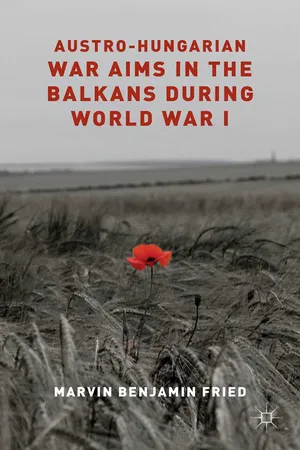
Austro-Hungarian War Aims in the Balkans during World War I
About this book
The conquest of Serbia was only one of the goals of the Austro-Hungarian Empire in the First World War; beyond this lay the desire to control much of South-East Europe. Employing previously unseen sources, Marvin Fried provides the first complete analysis of the Monarchy's war aims in the Balkans and tells the story of its imperialist ambitions.
Information
1
Introduction
In the minds of many historians, students, and the general public, Austria-Hungary’s role in World War I has been relegated to that of a mere ‘corpse,’ shackled to its powerful German ally and entirely dependent on it for survival. True, the Great War ended the Dual Monarchy’s existence, but only after more than four years of war, a front line stretching over two-thirds of its borders, and conflict with five of its seven neighbors. Moreover, Austria-Hungary was the second strongest member of the Quadruple Alliance, the vital land link to Germany’s oriental allies Turkey and Bulgaria, and the only reason why Germany did not face the combined might of the three Entente powers entirely alone, against which she would have succumbed much sooner.
Military historians can argue about the Monarchy’s failings on the battlefield, or whether it was indeed as useless as many Germans considered it. What this book concerns itself with is why, if the war was going so poorly, did Austria-Hungary not sign a separate peace, lose some territory, but survive the war essentially intact? Its officials later claimed not exiting the war was due to the unacceptable terms offered by the Entente, or the threat of a German invasion if the Monarchy abandoned its treaty obligations. In the interwar years these arguments appealed to many who sought to punish those leaders who had started the devastating war, and those who had let it continue until ten million lay dead and much of Europe was impoverished and in ruins. But to post-World War II generations, a more disturbing explanation for Austria-Hungary’s continued involvement seems more plausible. Using previously unseen sources, this book argues that the Monarchy fought on during the Great War right up to its dissolution because it weighed its options and chose to fight on.
This is a point seldom appreciated regarding Austria-Hungary, whose continued involvement in the Great War is rarely questioned. Why did the country fight on in what even its civilian leaders realized after the first few months was a near-hopeless battle against overwhelming odds? In part it was for the same reasons that had led some people in Vienna to advocate war in the first place: to achieve political, territorial, and economic dominance in the Balkans. Initially, Austria-Hungary’s goals – termed war aims – were limited to just its original opponent Serbia, but when the localized conflict became a world conflagration, so too the stakes rose. Austria-Hungary had to justify its losses just like the other belligerents. Thus, the Monarchy embarked on a policy of expansion against its adversaries which was greater during victorious phases and lesser after battlefield setbacks.
At the center of this policy stood the Austro-Hungarian Foreign Minister, charged with the task of coordinating the Monarchy’s complex domestic decision-making structure and formulating a coherent policy with its allies. He wrestled on the one hand with the Army, which sought near-boundless annexations against the Monarchy’s adversaries, and on the other hand against the Hungarians, who sought either no annexations or changes favoring only themselves. Eventually it fell to the Foreign Minister to take charge of the process, overrule the other decision-making factors, and propel forward a policy that ultimately failed to satisfy any individual party but which was made in the interest of the Monarchy as a whole. This policy, however, brought the Monarchy into direct conflict with its allies, Germany and Bulgaria.
These internal debates about the Balkans were not trivial. Discussions of whether to annex all or just parts of Albania, Montenegro, Serbia, Rumania, and Italy went to the core of how Austria-Hungary perceived its future role and what it hoped to achieve in this war. The book argues that it was in these regions that the policy-makers sought restitution for a war that risked its very existence and had cost so much. While control of Poland caused an ongoing debate between Vienna and Berlin, for Austria-Hungary the Balkans were non-negotiable. Only when the military and domestic food situation became truly disastrous were the officials prepared to abandon some (though not all) of their territorial goals there.
This book analyzes the development of Austro-Hungarian war aims and peace conditions in the Balkans during World War I. Though millions marched in 1914 across national frontiers, one of the heaviest burdens was borne by Austria-Hungary, which faced the crushing might of the Russian army in Galicia. It is not surprising that the majority of Austria-Hungary’s casualties during the war were sustained in its northern campaigns, and it is furthermore logical that significant Austro-Hungarian diplomatic and military efforts should have been focused on diminishing the existential threat to the Monarchy emanating from Russia. Yet, it is the first argument of this book that Austria-Hungary’s northern campaign (1914–17), followed by its south-western campaign against Italy (1915–18), were essentially distractions from Austria-Hungary’s principal military, political, and economic objectives, which lay in the Balkans and were fueled by hope for a victorious peace. The ultimately successful campaigns of the Central Powers against Serbia and Montenegro (1914–16) and against Rumania (1916), by contrast, brought the Austro-Hungarians closer than they had ever been to their dream of Balkan domination.
Decision-making and elaboration of war aims were split between a variety of forces within Austria-Hungary, namely the Emperor, his Foreign Minister, his Common Ministerial Council (and with it the Austrian and Hungarian national government leaders), and his Military High Command (Armeeoberkommando or AOK). Each had an important role to play in wartime. The military decisions were reached exclusively by the General Staff. The Foreign Ministry (Ministerium des Äussern, abbreviated MdÄ), on the other hand, had to compete with additional interests when formulating its foreign political and economic policy. Focusing on the struggle between the AOK and the MdÄ, the second argument of this book is that the Foreign Ministry generally retained control of Imperial foreign policy and overall managed to implement its conception of Austro-Hungarian aims in the Balkans. Although it is argued that the AOK had a serious and radicalizing effect on the MdÄ, especially in times of military success, its role never matched that of the German High Command (Oberste Heeresleitung or OHL), which managed to usurp control over foreign policy decision-making in Germany and forced draconian peace treaties against the defeated adversaries. The third argument of this book is that the MdÄ’s foreign policy remained surprisingly consistent across foreign ministers and military events, fluctuating only in degree and not undergoing wholesale alteration and expansion as was the case in Germany. While some historians have argued that the Austro-Hungarian moderate line, especially when compared with the AOK and OHL positions, was the result of confusion and the lack of clear goals, it is argued here that the MdÄ’s core war aims, as elucidated by the Foreign Minister, were on the whole both coherent and consistent.
This consistency and the difference between the OHL and the AOK notwithstanding, Austro-Hungarian war aims were not as limited as some have thought, and it was in fact only military defeats and, in the latter half of the war, hunger that forced the Foreign Ministry to adopt a more conciliatory line in its conception of the Monarchy’s vital interests and war aims. Even so, the more conciliatory line it adopted in 1917 was not enough to make peace possible, due to its consistently offensive war aims in the Balkans, the pursuit of which helped lead to the eventual destruction of the Empire. It is therefore the fourth argument of this book that the Great War was prolonged as a direct result of Austria-Hungary’s aims in the Balkans and its unwillingness to conclude anything but a general peace that would have maintained its staunch alliance with Germany. Thus, if Austria-Hungary’s willingness to stand by its German ally until the end kept Germany in the war by allowing it to fight on without encirclement, Vienna’s Balkan aspirations had kept Austria-Hungary in the war in the first place.
The purpose of this book is to ask the most fundamental of all questions when a country goes to war, which is, What are they fighting for? To answer this question, the book looks at elite decision-making within Austria-Hungary on matters of desired post-war territorial, economic, or political adjustments. It is, at its core, an analysis of the intense debate that arose between the different institutions and leaders of the Monarchy on the vital question of why continued conflict was necessary. For this reason, the book analyzes first and foremost the perspective of the Austro-Hungarian Monarchy. Recognizing that other factors played a role in influencing this decision, the book also includes the role of foreign allies on the domestic war-aims debate and setting.
War aims are the desired territorial, economic, military, or other benefits expected following successful conclusion of a war. Intangibles, such as prestige or power, can also represent war aims, though often (albeit not always) their achievement is framed within a more tangible context (e.g. conquest restores prestige, annexation increases power, etc.). War aims can be short-term and subject to change, and usually exist along a spectrum between maximum and minimum extremes. At times, war aims were explicitly stated internally or externally in a policy decision, while at other times (as was mainly the case in Austria-Hungary), the war aims were merely discussed but not published, remaining instead in the form of memoranda or instructions. Given their dependence on the military situation, war aims were usually fluid concepts and difficult to define, even for the highest government officials. Hence, this book looks at which war aims were considered among the diplomats and generals, what consensus was reached (or why none was reached), which figures retained most authority during this process, how foreign policy was shaped by war aims, and how events on the ground (usually controlled by the military) differed from the policy decisions of the diplomats and politicians.
Among the Viennese diplomatic elite, ‘positive war aims’ was a phrase referring to tangible outcomes. The fact that this German term exists implies the presence of ‘negative war aims.’ This book differs in an important respect from most previous works on war aims by expanding the traditionally limited definition to include these ‘negative war aims,’ which are defined as the prevention of undesired outcomes. This policy of limiting or eliminating the war aims of another state is included only insofar as it is relevant to achieving other, positive war aims. To demonstrate this distinction, we draw on an example supplied by Holger Afflerbach, who argued that before the war Austria-Hungary was concerned to uphold the status quo in the Balkans, and had a ‘negative interest’ in not allowing Serbia to expand further.1
The third category of wartime foreign policy goals discussed in this book is that of peace conditions. Peace conditions can be thought of as minimal war aims. If war aims are desired beneficial outcomes, peace conditions are the minimum outcomes, sine quibus non a belligerent state will not conclude peace. An example of such a peace condition is Austria-Hungary’s territorial integrity, which it declared to be non-negotiable. In World War I, there existed a nexus between war aims and peace conditions, in that maximum peace conditions can be thought of as the minimal war aims. After the terrible losses experienced by the belligerent powers, governments felt unable to make peace without tangible benefits to show for such sacrifices, which is why a ‘peace without victory’ as advocated by Woodrow Wilson never materialized. Because peace conditions were easier for the policy-makers to define, they often fluctuated less than war aims and were therefore usually longer-term. Nevertheless, there existed both maximum and minimum peace conditions.
Finally, it is important to state what this book is not trying to do. The book does not concern itself with the Balkan states themselves during World War I, or with the war aims developed by those Balkan states against Austria-Hungary. Nor is it a study of the military history of Balkan operations or occupation regimes, but rather an international history of diplomatic and political decision-making influenced by military developments on the ground.2 Although the conflicting Central Power war aims play an important role in the setting of Austro-Hungarian ones, both Entente and other Central Power war aims are taken as givens, and only their influence on Austria-Hungary’s goals is analyzed. Nor does the book attempt to address the influence of public opinion on war-aims formation.
This book fills a void in our understanding of Austro-Hungarian war aims in the Balkans during World War I. While both Entente and German war aims have been extensively researched, the literature often limits Austro-Hungarian involvement to the outbreak of the war and a losing battle to maintain national integrity. The Balkans, which is where the Monarchy’s interests initiated a global conflict, is relegated to a secondary front compared to the enormous major fronts in east and west. What historians have tended to forget is that the continued efforts to resist the enormous onslaught of the Russian army in the north, or defend Austro-Hungarian territory against Italian and Rumanian intervention, had as much to do with the need to maintain the Monarchy’s independence and sovereignty as it had to do with political, territorial, and economic ambitions in the Balkans. The scholarship has so far all but ignored the independent Austro-Hungarian goals, and generally subsumed them within German ones. For this reason, Poland takes an important place in the traditional account of the Monarchy’s ambitions, but does so by obscuring the role of the Balkans (beyond simply Serbia) in the thinking of the Austro-Hungarian policy-makers. A gap therefore exists in our understanding of the reasons why the war needed to be continued beyond simply survival, which could have been secured through a separate peace. This results partly from the types of sources consulted; this book is distinctive in that it consults an unusually broad array of sources in German, Hungarian, and English. Both diplomatic and military sources have been extensively consulted, lending strong support to the arguments made about the Foreign Ministry and AOK’s concern (some would say obsession) with the Balkans in the face of other, seemingly more pressing issues. These findings, which build on the state of research outlined in Chapter 2, compel a reconsideration of the Monarchy’s war aims and its corresponding foreign and security policy during World War I.
2
War Aims and Decision-Making in Austria-Hungary
Decision-Making in Austria-Hungary
War-aims formation in Austria-Hungary is closely tied to the intricacies of its internal decision-making structure. Although all states have complex civil–military relations and political hierarchies, Austria-Hungary’s decision-making structure stands apart. This is due to the fact that Austria-Hungary, as its name suggests, was not a unitary nation-state. Rather, it was a multi-ethnic monarchy of 53 million people speaking twelve official languages, the second largest country in Europe by territory and third by population, and united only by the scepter of a Habsburg emperor. The Monarchy was a set of contradictions and tensions as this ancient and deeply conservative royal institution entered into the modern world. The most obvious division was between Austria and Hungary. Following the ‘Compromise’ or more accurately Equalization (Ausgleich-Kiegyezés) in 1867, the Austrian Empire was reorganized into two halves, the self-governing Austrian and Hungarian portions. Until 1918, the state lived two separate political lives based in Vienna and Budapest, with two entirely separate governments, parliaments, prime ministers, and civilian bureaucracies controlling all domestic matters in the two halves of the Monarchy. Some areas, however, remained under the direct control of the Emperor. The Common Ministries of Foreign Affairs, War, and Finance, as well as the Austro-Hungarian Army and Navy, taken together constituted the core of the central government and in this deeply conservative state were directly appointed by the Emperor.
Foreign policy was directed by the common minister closest to the Emperor, traditionally labeled the Foreign Minister. However, his full title was Minister des k.u.k. Hauses und des Äußern, meaning he was firstly the Minister of the House of Habsburg but also implemented (the Emperor’s) foreign policy, making him the most powerful civilian government official. In the absence of a Prime Minister or Chancellor, the Foreign Minister was the Emperor’s ‘First Minister’ and wielded extraordinary influence. Although as an official who sat above the everyday politics of the Austrian parliament (Reichsrat) or Hungarian parliament (Országgyűlés) the Foreign Minister ‘did not have the duty or the right to take part in their deliberations,’1 he wielded enough power to retain control of the development of Austro-Hungarian war aims.
The Armee Oberkommando, or AOK, under the operational direction of the Chief of the General Staff and a nominal Habsburg Commander in Chief, was the body directing military operations. Given that it answered only to the Emperor and not to either of the two governments or the common ministers, it also had tre...
Table of contents
- Cover
- Title
- Copyright
- Contents
- List of Illustrations
- Preface
- Acknowledgements
- List of Principal Characters
- Glossary and Abbreviations
- Map of the Balkans, 1914
- 1 Introduction
- 2 War Aims and Decision-Making in Austria-Hungary
- 3 July 1914–December 1914
- 4 January 1915–September 1915
- 5 October 1915–June 1916
- 6 June 1916–May 1917
- 7 May 1917–November 1918
- 8 Conclusion
- Notes
- Bibliography
- Index
Trusted by 375,005 students
Access to over 1.5 million titles for a fair monthly price.
Study more efficiently using our study tools.
Frequently asked questions
Yes, you can cancel anytime from the Subscription tab in your account settings on the Perlego website. Your subscription will stay active until the end of your current billing period. Learn how to cancel your subscription
No, books cannot be downloaded as external files, such as PDFs, for use outside of Perlego. However, you can download books within the Perlego app for offline reading on mobile or tablet. Learn how to download books offline
We are an online textbook subscription service, where you can get access to an entire online library for less than the price of a single book per month. With over 1.5 million books across 990+ topics, we’ve got you covered! Learn about our mission
Look out for the read-aloud symbol on your next book to see if you can listen to it. The read-aloud tool reads text aloud for you, highlighting the text as it is being read. You can pause it, speed it up and slow it down. Learn more about Read Aloud
Yes! You can use the Perlego app on both iOS and Android devices to read anytime, anywhere — even offline. Perfect for commutes or when you’re on the go.
Please note we cannot support devices running on iOS 13 and Android 7 or earlier. Learn more about using the app
Please note we cannot support devices running on iOS 13 and Android 7 or earlier. Learn more about using the app
Yes, you can access Austro-Hungarian War Aims in the Balkans during World War I by M. Fried in PDF and/or ePUB format, as well as other popular books in History & European History. We have over 1.5 million books available in our catalogue for you to explore.