NESsT is an organization that develops sustainable social enterprises to solve critical social problems in emerging market economies. NESsT believes that social enterprise is a powerful tool that provides marginalized communities the skills, accessibility and technology needed to overcome social barriers and break the cycle of poverty.
Drawing on NESsT's unique methodology for identifying and building the capacity of early-stage social enterprises, as well as on surveys of relevant stakeholders, Social Enterprise in Emerging Market Countries provides a clear picture of where social enterprises are and where they need to go, and identifies key players in the social enterprise field and how they can take the bold steps needed to facilitate the growth and impact of these models. Etchart and Camolli focus on NESsT's research in Latin America and Central Europe, the two regions where it has operated for over 15 years, particularly in Argentina, Brazil, Chile, Ecuador, andPeru, with some cases from other countries in Latin America. For the purpose of illustrating important models and innovative programs and policies, this book also highlights cases and experiences from Central Europe.
- English
- ePUB (mobile friendly)
- Available on iOS & Android
eBook - ePub
About this book
Information
1
THE OPPORTUNITY FOR SOCIAL ENTERPRISE IN EMERGING MARKET COUNTRIES*
Social Enterprise in Emerging Market Countries: No Free Ride comprehensively maps and assesses the existing landscape and enabling environment for social enterprise development in emerging market countries, as well as the support mechanisms and best practices needed for social enterprises to overcome barriers to development. The book particularly focuses on the case of Latin America and Central Europe, but is relevant to emerging markets overall, since the enabling environment is nowhere fully developed and social enterprises face similar challenges in other countries.1 It is based on decades of experience, extensive research of hundreds of organizations and donors, and detailed case studies from many countries (see Appendix 1 for research methodology and scope). It provides a clear picture of the social enterprise ecosystem in emerging market countries today, where it needs to go, and how the players in the social enterprise field can get it there.
The book is organized into three parts: “Regulation and Policy” (chaps. 2 and 3); “Capacity-Support Structures and Scaling Best Practices” (chaps. 4 and 5); and “Capital for Growing Social Enterprises” (chaps. 6, 7, 8, and 9). Chapter 1 provides an overview of the social enterprise economy and summarizes the challenges and opportunities the sector faces in emerging markets. Chapter 10 concludes with highlights of the book’s findings on the most urgent collective actions stakeholders must take to catalyze the impact of the social enterprise sector in emerging economy countries.
WHY SOCIAL ENTERPRISES?
Social enterprises are businesses that solve critical social problems in a sustainable manner.2 Distinct from both traditional charities and most for-profit businesses, social enterprises create and sell products or services that improve the quality of life for low-income or disadvantaged people, while also earning financial revenues for the enterprise to sustain and grow its activities. Profits are for the most part reinvested (all profits must be reinvested when referring to nonprofit social enterprises) to grow and strengthen the enterprise for further impact. These enterprises engage in a broad spectrum of activities including community development, employment, education, conservation and environmental protection, financial services, health, sustainable income, and universal rights. They target a wide range of marginalized or excluded communities including at-risk youth and mothers, ethnic communities, people with disabilities, small producers and artisans, and low-income communities, overall.
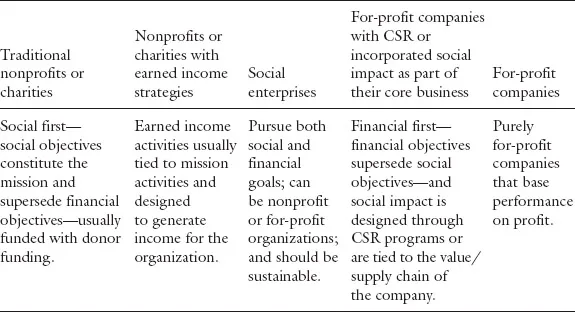
The growth of the social enterprise economy in the past two decades is due to its success in addressing entrenched social and economic problems. The persistent problems of unemployment, poverty, social exclusion, poor social services, and environmental degradation—even in fast-growing emerging market economies—call for new, innovative solutions. Neither pure market-based nor pure public-sector approaches have effectively confronted these problems. The former has tended to approach them as a side activity usually addressed through corporate social responsibility (CSR) programs, whereas the latter has tended to create programs with an overemphasis on subsidizing services for a set number of beneficiaries rather than improving the root causes of poverty and exclusion. Table 1.1 demonstrates where social enterprises fall in the spectrum related to social and financial objectives. Social enterprises are at the center of this spectrum, where social objectives supersede financial objectives, but where financial objectives are key for long-term sustainability and growth.
Social enterprises offer a hybrid response to complex social problems. Social enterprises address the social and economic barriers that face marginalized or disadvantage communities, and attempt to tackle them using a market-based approach. They are often best positioned to respond to critical social problems, as most often they originate as community-based initiatives, close to the problems and with a stake in the outcome. They frequently introduce new products and services to the market, and build market demand by raising awareness around the issues that these are addressing. They also take these products and services to new sectors that adopt them, and in many respects, become engaged in also solving these problems. There are very solid examples of how social enterprises have provided concrete ways for marginalized communities to access the formal economy and a better quality of life. Boxes 1.1, 1.2, and 1.3 provide some of these examples.
Table 1.1 Social enterprise spectrum
Box 1.1 Kék Madár
In Hungary 90 percent of people with disabilities are unemployed, and many are socially excluded.
Kék Madár is a foundation in Hungary established to create economic and educational opportunities for people with intellectual and physical disabilities (http://www.kek-madar.hu/). In 2007, Kék Madár entered the NESsT incubation portfolio and received a start-up grant to equip a restaurant and assist with marketing and communications, pricing structure, and customer service. Kék Madár offers a restaurant skills training program, and with the exception of the chef, all of the employees at the restaurant have a disability. The social enterprise also prepares a number of trained employees for the labor force each year. In 2013, the social enterprise expanded its seating capacity from 25 to 100 (40 for a catering service) allowing Kék Madár to train and employ additional beneficiaries. Kék Madár has become a model social enterprise for other entrepreneurs that want to offer employment to marginalized communities. It plans to launch five similar restaurants in Hungary in the next five years.
Box 1.2 Ingenimed
One in three newborn babies in Peru is born with jaundice, which occurs when there are high levels of bilirubin in the blood that can become toxic and lead to other complications if left untreated or treated poorly. Because imported phototherapy equipment is expensive, many clinics in Peru opt for improvised, ineffective treatment.
In a rural clinic in southern Peru, a newborn is being treated with locally designed and manufactured Neoled phototherapy and will be home safely within 24 hours. In the coming years, this affordable Neoled technology will be sold to clinics throughout Peru by Ingenimed, an invention-based social enterprise created in Cusco by a group of engineering students and a member of the NESsT incubation portfolio (http://www.ingenimed.net/). After an initial pilot, the social enterprise is in the process of developing a laboratory that will mass-produce the equipment. It plans to manufacture three different models of the technology, including a portable version, which is more accessible, and to reach over 70,000 newborns in the next four years.
Box 1.3 Interrupcion
Creating “a system of global commerce that yields fantastic-tasting, superior-quality products; prosperous producing communities; a healthier earth; and opportunities for consumers to do good things through the purchases they choose to make.” http://interrupcionfairtrade.com/site/social.php
Interrupcion is a fair-trade Argentinean social enterprise that uses social responsibility practices and citizen participation at every stage (www.interrupcionfairtrade.com). Started in 2001, today it partners with 11,000 small- and medium-sized fruit and vegetable producers in Latin America to provide premium, certified organic, and fair-trade products to North American markets. Interrupcion offers a guaranteed fair price in advance of the harvest, and if the market price is higher, the producer receives 90 percent of the higher price. In each producer community, the workers decide how to invest the “social premium”—approximately 2 percent of the sales volume, and by 2012 Interrupcion had allocated about USD 400,000 to communities. Workers have invested in community centers, computers, healthcare, recycling, and a range of other beneficial programs. Consumers benefit too—they receive healthy, high-quality fruits and vegetables that are grown by farmers practicing sustainable agriculture and receiving a fair price.
THE OPPORTUNITY FOR EMERGING MARKET COUNTRIES
Over the past two decades, the social enterprise sector has grown in more developed countries and is gaining traction in emerging economies. The social enterprise “ecosystem” in each country comprises individual enterprises and networks of enterprises, a range of intermediary or support organizations providing capacity-building and financial assistance, research and advocacy services (often civil society organizations [CSOs],3 but can include university and government programs), philanthropists, foundations, and impact investors, and the public policies that encompass all of these entities.
The social enterprise sector is very advanced in Western Europe, particularly in the United Kingdom, and has been catalyzed for the most part by relatively strong government policy. The entire European social economy has been estimated to employ more than 11 million people, about 6 percent of the active workforce.4 The EU views social enterprise as a model with high potential to respond to the challenges—in particular high unemployment rates—and make Europe more competitive in the world markets, as well as socially inclusive and environmentally sustainable.
The social enterprise sector is also relatively advanced in the United States. In addition to regulations designed to foster social enterprise,5 there are numerous social enterprises and social enterprise support organizations dedicated to foster their growth. According to the results of the first Great Social Enterprise Census, an important new initiative that maps the social enterprise landscape, Ben Thornley, director of Pacific Community Ventures and co-convenor of the Impact Investing Policy Collaborative, estimates that “this is an economic sector employing over 10 million people, with revenues of $500 billion; about 3.5 percent of total US GDP.”6 The Social Enterprise Alliance, established in 1998 and focused mostly on social enterprise practitioners, has 13 chapters in 11 states and convenes its members annually to build their capacity and advocate for a stronger, enabling environment for social enterprise at a national level. Net Impact was founded over a decade ago to inspire the next generation of leaders to use their careers to tackle the world’s most urgent problems. The organization has over 40,000 members and 300 volunteer led chapters, the majority based at US colleges and universities. And according to a Bridgespan Group study,7 across all of the top MBA programs, there has been soaring interest in social enterprise in recent years and schools have expanded their offerings to meet the demand.
Since the world recession of 2008, Central and Eastern European emerging economies have struggled with high levels of unemployment, political unrest, exclusion of minorities, and decreasing levels of public financing to address these and other problems. In Latin America, many countries have fared better than Europe during the recession, and their economies have expanded overall. However, the historic inequality within these countries has continued (and in some cases increased), and the economic growth has been concentrated in the highest income sectors. Large segments of the population remain outside the formal economy.
In Chile, for example, economic growth (in constant terms) has averaged 6 percent since 2008. Per capita income is about USD 16,330 (adjusted for purchasing power parity), but more than 40 percent of all income goes to the wealthiest 10 percent of the population (the poorest 10% receive less than 2% of all income). Chile’s Gini index in 2009 was the fifth worst in the world of data reported for that year.8 The situation is similar in many countries, where despite growth there are persistently very high youth unemployment rates and poverty levels, and ethnic minorities and the disabled face discrimination and isolation.
The growth of many emerging market countries in the past two decades provides a unique opportunity to catalyze the positive impact that the social enterprise sector can have on current social and economic problems. The opportunity builds on the efforts of a group of pioneering organizations that recognized the potential of social enterprise 10–15 years ago and began to support them in these countries. Today, with this experience as a base, alongside the growth of the sector in North America and Western Europe and the inability of emerging countries to address s...
Table of contents
- Cover
- Title
- 1 The Opportunity for Social Enterprise in Emerging Market Countries
- Part I Regulation and Policy
- Part II Capacity-Support Structures and Scaling Best Practices
- Part III Capital for Growing Social Enterprises
- Appendix 1: Research Approach and Methodology
- Notes
- NESsT Glossary of Terms
- Bibliography
- Index
Trusted by 375,005 students
Access to over 1.5 million titles for a fair monthly price.
Study more efficiently using our study tools.
Frequently asked questions
Yes, you can cancel anytime from the Subscription tab in your account settings on the Perlego website. Your subscription will stay active until the end of your current billing period. Learn how to cancel your subscription
No, books cannot be downloaded as external files, such as PDFs, for use outside of Perlego. However, you can download books within the Perlego app for offline reading on mobile or tablet. Learn how to download books offline
Perlego offers two plans: Essential and Complete
- Essential is ideal for learners and professionals who enjoy exploring a wide range of subjects. Access the Essential Library with 800,000+ trusted titles and best-sellers across business, personal growth, and the humanities. Includes unlimited reading time and Standard Read Aloud voice.
- Complete: Perfect for advanced learners and researchers needing full, unrestricted access. Unlock 1.5M+ books across hundreds of subjects, including academic and specialized titles. The Complete Plan also includes advanced features like Premium Read Aloud and Research Assistant.
We are an online textbook subscription service, where you can get access to an entire online library for less than the price of a single book per month. With over 1.5 million books across 990+ topics, we’ve got you covered! Learn about our mission
Look out for the read-aloud symbol on your next book to see if you can listen to it. The read-aloud tool reads text aloud for you, highlighting the text as it is being read. You can pause it, speed it up and slow it down. Learn more about Read Aloud
Yes! You can use the Perlego app on both iOS and Android devices to read anytime, anywhere — even offline. Perfect for commutes or when you’re on the go.
Please note we cannot support devices running on iOS 13 and Android 7 or earlier. Learn more about using the app
Please note we cannot support devices running on iOS 13 and Android 7 or earlier. Learn more about using the app
Yes, you can access Social Enterprise in Emerging Market Countries by N. Etchart,L. Comolli in PDF and/or ePUB format, as well as other popular books in Business & Entrepreneurship. We have over 1.5 million books available in our catalogue for you to explore.