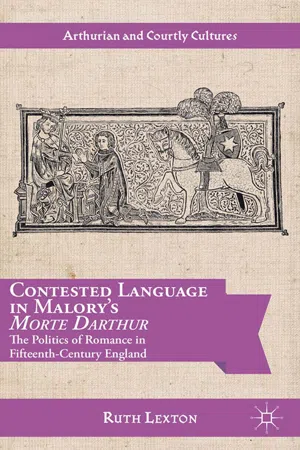
eBook - ePub
Contested Language in Malory's Morte Darthur
The Politics of Romance in Fifteenth-Century England
- English
- ePUB (mobile friendly)
- Available on iOS & Android
eBook - ePub
Contested Language in Malory's Morte Darthur
The Politics of Romance in Fifteenth-Century England
About this book
Examining Malory's political language, this study offers a revisionary view of Arthur's kingship in the Morte Darthur and the role of the Round Table fellowship. Considering a range of historical and political sources, Lexton suggests that Malory used a specific lexicon to engage with contemporary problems of kingship and rule.
Information
CHAPTER 1
KINGSHIP, JUSTICE, AND THE “COMYNS” IN THE TALE OF KING ARTHUR
Printing Sir Thomas Malory’s Morte Darthur in 1485, William Caxton made a deliberate decision to sell it to his public as “the noble and joyous hystorye of the grete conquerour and excellent kyng, kyng Arthur.” (Caxton’s Preface, cxlvi.21–22). In Caxton’s preface, Arthur’s greatness and excellence as a king are linked to proofs of his historicity, giving his achievements the status of fact: readers are urged to see Arthur as a hero-monarch and ideal national ruler. The success of Caxton’s strategy for Malory’s text, whether it is understood as a marketing ploy or a political program,1 is exemplified by continued use of the printer’s title, the Morte Darthur, which has stubbornly resisted attempts to abandon it in favor of a more neutral label that does not focus exclusively on Arthur’s death.2 Vinaver’s Works of Sir Thomas Malory, based on the Winchester Manuscript, a text that predates Caxton’s version and escaped his editorial hand, has become the edition of critical choice, but even this preference has done little to shift the attachment to Caxton’s title.3
I am not proposing to alter the title of the Morte, but I suggest we need to be more aware of how far our responses to the “hoole book” are still directed by the astute intelligence and business practices of its printer. Recent criticism has offered some important reevaluations of Caxton’s framing of the Morte that emphasize the cultural capital he exploits in Arthur’s interest.4 The Morte, which even in Vinaver’s paperback contains Caxton’s preface, is still sold to us as a book of the acts of Arthur, “a noble kyng . . . and reputed one of the nine worthy, and fyrst and chyef of the Cristen men” (Caxton’s Preface, Works, cxlv.15–17).5 The heightened picture of Arthur in Caxton’s preface has colored our judgment of his kingship in Malory’s first tale, the Tale of Arthur. Instead of using Caxton to situate our interpretation of Arthur, we must place Malory’s rendering of kingship in the Morte in the contemporary discourse within which it was written. I suggest that the prominence of laudatory vocabulary that surrounds Arthur in Caxton’s Preface and trails in his wake through the Morte, obscures another interpretative vocabulary that not only overlaps but also conflicts with it, that of political common terms. This political lexicon gives us the opportunity to reevaluate Arthur’s kingship in the light of the meaning and deployment of kingship in contemporary texts.
The Morte Darthur coincided in England with the culmination of almost a century of contested kingship, usurpation, civil ruin, and loss. Malory finished his book in 1469/70 just as Warwick ‘the Kingmaker’ ensured Edward IV was supplanted by his rival Henry VI. Caxton completed the printed Morte Darthur on 31 July 1485, but the book may not have been ready for sale until the following month.6 On 22 August, Richard III was defeated and killed on the field at Bosworth by Henry Tudor, the third usurper king in a generation and the one with the slightest claim to the throne. Eighteen months before, Richard III’s only parliament had enrolled and confirmed the petition in which he was asked to take the throne, partly on the grounds that
ye be born withyn this lande, by reason wherof, as we deme in oure myndes, ye be more naturall enclyned to the prosperite and comen wele of the same.7
The petitioners were engaged in an attempt to formulate kingship not on the usual basis of inheritance and divine right but on a “naturall” attachment to native land, invoking national feeling in a desperate effort to cover for Richard’s unnatural disinheritance of his nephew. Henry’s apologists had no such excuse: born in Wales and brought up mainly in Brittany, he lacked native attachment as well as lineage and won the throne by conquest alone.8 Caxton’s determination to hold Arthur up as an ideal, historical, and heroic king, like Richard III “a man borne wythin this royaume” and by this alone a national icon,9 cut compellingly against the radical transformations of and disillusionment in English kingship (Caxton’s Preface, cxliv.7).
Caxton, of course, is not solely responsible for the critical approach that takes Arthur’s greatness for granted. Part of the reason that Arthur’s problematic kingship has gone largely unnoticed in the Morte is because it is deeply entangled with a knightly behavior that receives repeated positive confirmation. Malory imbues his text with what Mark Lambert has described as the “solemn vocabulary of knightliness”: terms like noble, knightly, and courteous resonate strongly through the narrative.10 While this seemingly categorical and positive vocabulary has provided critics and readers with a navigating pattern when footholds of character and plot may fail, when applied to the king it can have the effect of an evaluative smokescreen. While Arthur is referred to as “noble kynge” or “moste noble kynge” by the narrator and other characters throughout the rest of the Morte, in the Tale of Arthur, he is called “noble kynge” only once, by his enemy Lot, suggesting the ambivalent connections between his positive qualities of knighthood and his more dubious ones as king.11 In the Tale of Arthur, Malory’s descriptions of Arthur frequently share in the vocabulary that lauds knightly actions, thus surrounding Arthur with narrative approbation and sidestepping the areas where the ideals of kingship and chivalric knighthood are in tension. For example, in his combat against the traitor Accolon, Arthur is closely aligned to the values of worthy knights, so much so that Nenyve is moved to help him precisely because of his knightly behavior: “She had grete peté that so good a knyght and such a man of worship sholde so be destroyed” (144.21–23). Accolon confirms her view, calling Arthur “the beste knyght that ever I founde” (145.10). Even Arthur frames himself more as a knight than as a king here: when he reveals his identity, the people around him fall to their knees before their king, but Arthur sees himself as a knight: “Here may ye se what soddeyn adventures befallys ouftyn of arraunte knyghtes” (147.6–8). The prominent place given to the “vocabulary of knightliness” in Arthur’s combat against Accolon suggests that he is being assessed by other characters (and even by himself) as a knight. As Lambert, Mann, and Lynch suggest, such vocabulary has the power to establish the tangible values of knighthood and forge a strong emotional connection with the reader who then accepts these values as the primary meaning of the book.12 Nenyve supports Arthur because of his demonstration of knighthood in this episode; Morgan hates him for much the same reasons: “because he is moste of worship and of prouesse of ony of hir bloode” (Works, 145.34–35). While Arthur’s “prouesse” and “worship” in combat makes him (at least temporarily) the best knight, it is important to understand that this language does not directly transfer into terms of good kingship. In fact, as I discuss in more detail below, overreliance on knightly action was discouraged in kings in contemporary advice literature. The king had to walk a fine line between embodying a military leader committed to the ideals of chivalry and demonstrating the temperate and restrained behavior appropriate to his office. The tension between kingliness and knightliness is especially evident in The Tale of King Arthur; although Arthur as knight succeeds in defeating Accolon, he is not able to destroy the underlying threat to his kingship, Morgan Le Fay.
At his coronation, Arthur swears “unto his lordes and the comyns for to be a true kyng, to stand with true justyce” (Works, 16.21–22). The “comyns,” “justyce,” and “true” are political terms that occur and recur across a variety of contemporary texts, implying a commonly held “mix of ideas, ideals, prejudices, and assumptions,” which were constantly tested as Malory’s contemporaries tried to comprehend the upheavals that formed their political lives. Malory’s Arthurian story, however much of it is a rendition of familiar tales set in a remote place and time, bears the indelible stamp of fifteenth-century English modes of thought. Freed from Caxton’s identifying generalizations and returned to the context of fifteenth-century political language, the Morte mounts a tacit but persistent critique of Arthurian kingship.
Arthur is the narrative center of the first tale: he becomes the head of the body politic and his kingship is formulated and consolidated, setting the tone for the remainder of his rule. Arthur’s kingship, like the chivalry of his knights, tends to be evaluated in light of the provisions laid out by the Pentecostal Oath.13 Here I focus on the first two sections of The Tale of King Arthur (Caxton’s Books I and II), prior to the formation of the Round Table and the establishment of the Oath in order to understand the basis of Arthur’s kingship. Arthur’s accession, coronation, and performance of kingship can be scrutinized in the light of contemporary practice and expectations. Is he the Christian conqueror, emperor, and Worthy of Caxton’s preface or a “berdles boye” despised by other kings (Works, 17.23), or something else entirely? At Arthur’s accession, the sword in the stone that indicates Arthur is chosen by God and is Uther’s rightful heir does not make Arthur king. His accession is more like a contemporary usurpation and sets a shaky foundation for Arthurian rule. Malory combines this election by the commons with a coronation oath that by contemporary standards was brief and inadequate, omitting the usual commitment of the king to defend the realm. The problematic coronation oath is fulfilled in the initial phases of Arthurian governance, giving rise to a polity that suffers from violent war and vicious feuding. Despite being the rightful claimant and having the reputation of an ideal king in the source material, in Malory’s version, Arthur looks like a usurper and proves to be a tyrant.
Arthur and the “Comyns”
In the Morte Darthur, Arthur’s accession is dominated by the actions of the commons:
And at the feste of Pentecost alle maner of men assayed to pulle at the swerde that wold assay, but none myghte prevaille but Arthur, and pulled it oute afore all the lordes and comyns that were there. Wherefore alle the comyns cryed at ones,
“We wille have Arthur unto our kyng! We wille put hym no more in delay, for we all see that it is Goddes wille that he shalle be oure kynge, and who that holdeth ageynst it, we wille slee hym.” . . . And so anon was coronacyon made.
(Works, 16.7–21)14
The “comyns” appear insistently in this passage: the word “comyns” is repeated three times here and once additionally in this context (Works, 13.15). It is otherwise used rarely in the Morte and only in this passage do the commons take political action.15 Despite Malory’s alteration of his source, his incorporation of the commons at this moment has been understood as a sign that Arthur is supported by all estates, and it has been argued that his accession would therefore have been viewed as typical by a fifteenth-century audience.16 Malory’s changes to his sources here, however, particularly his inclusion of the “comyns,” are extremely significant for the nature of Arthur’s kingship in the Morte. In Malory’s source, the French Prose Lestoire de Merlin, the “communs pueples” weep for joy at the election of Arthur by the sword in the stone and ask if anyone will oppose it.17 Their intervention, however, is not decisive. It is the barons who, having tested Arthur extensively, ensure that he becomes king; the accession itself occurs without reference to the commons.18 In Merlin, the cry of the commons comes before the barons delay the coronation and test Arthur’s fitness to be king. In Malory’s version, the scene is compressed and the commons’ intervention occurs after the barons’ delay; it becomes a moment of outcry against the barons, the sign of a separate political force in the realm. The commons’ involvement in the political process dramatically alters Arthur’s accession.
Malory evidently made a deliberate decision to specify that the “comyns” were the channel through which Arthur becomes king. Why might he have done this and how does it square with the contemporary understanding of the “comyns” and their relationship to the king? What was their usual role in royal “election” and what might this suggest to a fifteenth-century readership about Arthur’s accession? The use of the “comyns” here recalls two related traditions prevalent in fifteenth-century thought both broadly based on the notion of vox populi vox dei: the official role of the people in acclaiming the king at his coronation and the responsibility of sub...
Table of contents
- Cover
- Title
- Introduction Arthurian Romance and Political Language in Fifteenth-Century England
- 1. Kingship, Justice, and the “Comyns” in The Tale of King Arthur
- 2. Counsel and Rule in The Tale of King Arthur and Arthur and Lucius
- 3. Malory’s Lancelot and the Politics of Worship
- 4. Courtesy and Service in The Tale of Sir Gareth
- 5. Fellowship and Treason
- Conclusion Malory’s Contested Language
- Notes
- Bibliography
- Index
Trusted by 375,005 students
Access to over 1.5 million titles for a fair monthly price.
Study more efficiently using our study tools.
Frequently asked questions
Yes, you can cancel anytime from the Subscription tab in your account settings on the Perlego website. Your subscription will stay active until the end of your current billing period. Learn how to cancel your subscription
No, books cannot be downloaded as external files, such as PDFs, for use outside of Perlego. However, you can download books within the Perlego app for offline reading on mobile or tablet. Learn how to download books offline
Perlego offers two plans: Essential and Complete
- Essential is ideal for learners and professionals who enjoy exploring a wide range of subjects. Access the Essential Library with 800,000+ trusted titles and best-sellers across business, personal growth, and the humanities. Includes unlimited reading time and Standard Read Aloud voice.
- Complete: Perfect for advanced learners and researchers needing full, unrestricted access. Unlock 1.5M+ books across hundreds of subjects, including academic and specialized titles. The Complete Plan also includes advanced features like Premium Read Aloud and Research Assistant.
We are an online textbook subscription service, where you can get access to an entire online library for less than the price of a single book per month. With over 1.5 million books across 990+ topics, we’ve got you covered! Learn about our mission
Look out for the read-aloud symbol on your next book to see if you can listen to it. The read-aloud tool reads text aloud for you, highlighting the text as it is being read. You can pause it, speed it up and slow it down. Learn more about Read Aloud
Yes! You can use the Perlego app on both iOS and Android devices to read anytime, anywhere — even offline. Perfect for commutes or when you’re on the go.
Please note we cannot support devices running on iOS 13 and Android 7 or earlier. Learn more about using the app
Please note we cannot support devices running on iOS 13 and Android 7 or earlier. Learn more about using the app
Yes, you can access Contested Language in Malory's Morte Darthur by R. Lexton in PDF and/or ePUB format, as well as other popular books in Política y relaciones internacionales & Historia británica. We have over 1.5 million books available in our catalogue for you to explore.