- English
- ePUB (mobile friendly)
- Available on iOS & Android
eBook - ePub
About this book
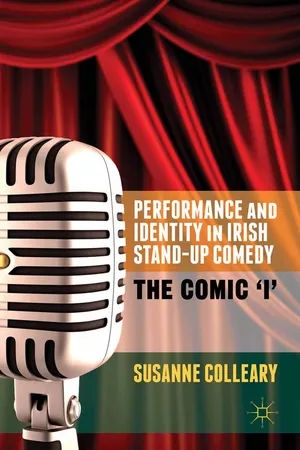
One of the cultural phenomena to occur in Ireland in the last two decades has been the highly successful growth of stand-up comedy as a popular entertainment genre. This book examines stand-up comedy from the perspective of the narrated self, through the prism of the fabricated comedy persona, including Tommy Tiernan, Dylan Moran and Maeve Higgins.
Information
Subtopic
Art General1
The Trailblazers: Vaudeville, Music Hall and Hibernian Varieties
1.1 A brief history: vaudeville to stand-up
It is a widely accepted fact that stand-up comedy as we understand it today has its roots in the vaudeville tradition of America and in the music hall tradition of the UK and Ireland. In America, by the 1850s, popular entertainments included the attractions of concert saloons, ‘free-and-easies’ and music halls.1 These places offered such varieties as “minstrelsy, burlesque, music, dance and sexual play in a confusion of combinations.”2 With that, different establishments often catered to different sections of the community, with high-end concert saloons catering for wealthier men, while ‘lesser’ music halls catered for both the working class and those of lower stations in life. However, by the beginning of the 1860s these entertainment houses were to undergo significant changes in how they conducted their business. Those moral ‘reformers’ (alongside others) of popular entertainments were on the move. Their objective was to take both music hall and variety from notorious respectable venues, to sanitise “the environment by removing prostitutes and liquor and ensuring ‘chaste’ performance, and to invite women and children by offering matinees and reduced admission.”3 Tony Pastor is chiefly recognised as the man who managed the transformation to new-found respectability.4 Initially, he created entertainments for “working-class Irish and German families.” His attractions included matinees with half price for children and free admission for ladies on Fridays if accompanied by a man. Pastor also removed alcohol from the refreshment saloon, and as reported, “excluding the rowdyish and troublesome elements,” from the audience.5 By 1875, Pastor was seeking to attract a middle-class audience by moving his theatre from the Bowery to Broadway, and again a few short years later to Union Square, on Fourteenth Street, known for being the heart of New York entertainments. Others inevitably followed suit. B.F. Keith and Edward Franklin Albee built upon Pastor’s successes,6 operating a variety show out of Boston. They too ensured that all acts were more than suitable for a typical family audience. The entrepreneurs were the first to label this type of family-oriented entertainment as “vaudeville.” Interestingly, the term vaudeville itself is thought to derive from the French Vau de Vive, a valley in Normandy that inspired drinking songs and eventually metamorphosed into “voix de ville,” or “street voices.”7 That said, and in parallel with others, including Fredrick Freeman Procter, Keith and Albee continued to develop their theatres, along with a national booking agency in the East. Their endeavours became big business, as well as being widely known as the ‘“Sunday school circuit’ because of their squeaky clean image of family entertainment.”8
The running format of a typical evening’s vaudeville included an opening show of five or six different acts, followed by a somewhat longer show of two hours, which would consist of perhaps eight or nine acts. The first act would typically include a “dumb show,” which may have included acrobats, jugglers or trick animals. The purpose of such a show was for latecomers and as entertainment for those in the audience who did not speak English.9 The main performance included dancing numbers, comedy acts and various entertainers, but the next to last spot in the second half was the crucial spot because “vaudevillian audiences loved comedians, [and] a comic often occupied that spot.”10 Among the many performance conventions that constituted vaudeville, chief among them was the interaction between performer and audience. Some theatre managers frowned on audience participation, for fear that it might offend the more ‘refined’ clientele. Despite that sensibility, the audience–performer relationship in vaudeville continued to be vital and robust – for example, the vaudevillian Nora Bayes considered the relationship as “an intimate chat with one or two friends.” In addition, perceived (or real) transgression(s) of the theatre managers’ rules created a ‘conspiracy’ of sorts between performer and audience, which allowed the performer a degreee of control and licence over the crowd. Performers considered such command and manipulation to be vital to the success of their acts: “they prided themselves on their ability to read the audience and considered themselves “mechanics of emotion.”11 At amateur nights, vaudevillian performers who did not make the grade ‘suffered’ at the hands of their audiences. Management often encouraged their clientele to shout for the ‘hook’ so as to remove below-par performers from the stage. They held up signs saying “‘Beat It,’ squirted the performers from a seltzer bottle, chased them off the stage with an inflated bladder and often closed the curtain.”12 The ghosts of these performance conventions still to a certain degree remain with the form, and I will return to this subject somewhat later on in the work. That said, among the comic greats produced by vaudeville were the legendary George Burns, Jack Benny, Milton Berle and the Marx Brothers.13 According to Lawrence J. Epstein, these comedians shied away from doing Jewish ‘bits’ to provide a more universal model of humour. Indeed Double’s list of vaudevillian comics overlaps that provided by Epstein; he includes “Buster Keaton, Charlie Chaplin, the Marx Brothers, Mae West, W.C. Fields, Eddie Cantor, Fred Allen, Bob Hope, Jack Benny and Milton Berle.”14 Some of these comedians performed something akin to what would be understood as a stand-up routine today. Interestingly, Milton Berle rejected the use of the term stand-up comedy to define his comic style of performance (one which he shared with others, including Jack Benny and Bob Hope). He stated, “We were monologists. Not stand-up comedians. That’s a new term. You know why? Because all they do is stand there and take the microphone off the stand.”15 Berle believed that monologists’ acts were concerned with more than just telling jokes, the ‘patter’ informed only part of the overall act, which might also include songs, dance numbers and impersonations. That being said, the monologists are recognised as the precursors to stand-up for a number of reasons; the style of performance was similar, the monologists addressed the audience directly and, toward the end of the vaudeville era, these performers began to emphasise the telling of jokes over other aspects of the performance.16
Over time, vaudeville began to decline following the rise of the film industry in America. Silent movies and, later, sound cinema in the late 1920s, dealt it damaging blows. Broadly speaking, the cost of movie tickets was cheaper than even the cheapest vaudeville seat, causing Lippincott’s magazine to state that “the movies caused decreases in box office at legitimate and vaudeville theaters and disbanding of theater companies… ‘it is a common occurrence to enjoy amusement by machinery in what was a regulation playhouse.’”17 As the stock market crash brought the 1920s to a close ‘the whole of American life was about to change. The economic collapse, the technology that led to radio and sound films, the emergence of a new generation and the rising horror in Europe all combined to make the 1930s and 1940s an entirely new world.18 So, the bell was tolling for live popular formats, meaning that by the 1930s vaudeville was on its knees. Of course, some of its major stars, including Jack Benny, Fred Allen and Bert Lahr, did manage to make successful transitions to the ‘talkies,’ as well as being absorbed into the exciting new medium of radio broadcasting at that time.19 By 1935 vaudeville was in sharp decline and what little remained acted as entertainments while the projectionist changed the reels in theatres and cinemas around the country.20 Although vaudeville was now disappearing, variety performance and comedians did have a number of alternative performance options open to them. One such alternative was the so-called ‘Borscht Belt,’ an umbrella term for a series of over 500 hotels which catered to New York Jews in the Catskill Mountains, one hundred miles north-west of New York City. The ‘Borscht Belt’ became increasingly popular after the First World War as a vacation spot for middle-class and wealthy American Jews. While the movie industry was becoming an increasingly popular leisuretime activity across the country and changing audience behaviour so that “the talking audience for silent pictures became a silent audience for talking pictures”,21 live performance was continuing hail and hearty in the mountains. Comedians including Milton Berle, Fanny Brice, Mel Brooks, Lenny Bruce, George Burns, Danny Kaye, Judy Holliday, Jackie Mason, Joan Rivers and Jerry Lewis were among the many who performed at the resort in the Catskills.22 The resorts were very popular and many holidayed there for a variety of reasons. As Epstein notes, in the Borscht Belt, “Jews were in the majority, and there was no external pressure to conform to American values… the resorts were the Jewish way station between immigrant life and comfortable assimilation.”23 Many also went to the mountains to escape the growing anti-Semitic sentiment in the USA during the years leading up to the Second World War. However, in the post-war years, with their increasing acceptance in broader society, American Jews began going to the same resorts as their fellow countrymen. These shifting cultural forces, along with the invention of television, and the unlikely influence of the air-conditioner all contributed to the decline of the popularity of the ‘Borscht Belt.’24 The Catskills suffered a slow demise and although it would remain a training ground for later comedians such as Lenny Bruce and Woody Allen (who played there in 1956); like many other performers, they had their hearts set on the wider American audience. Entertainment routes other than the ‘Borscht Belt’ saw comedians migrating into what was then known as the ‘Chitlin Circuit.’ This was the name given to a variety of venues that provided entertainment for black audiences in the larger American cities, including Chicago, Detroit, Cincinnati, Baltimore, Washington DC and Philadelphia. The jewel in the crown of this group was Harlem’s Apollo Theatre, still in operation today. The ‘Chitlin Circuit’ has a long and rich history, which is far beyond the scope of these pages. That said, the circuit became very organised from the 1930s onwards, playing host to comedians including “Pigmeat Markham, Moms Mabley and Redd Foxx [who] appeared alongside jazz bands, bluesmen, tap dancers and doo-wop groups.”25 In addition, during these years, places like Las Vegas increasingly paid headlining comedians large sums of money to perform there. So too, the country music scene produced white comedians like Minnie Pearl among others and beyond these more mainstream opportunities, stand-up comedians continued in an ad hoc fashion in bars, restaurants and cafés.
From ‘sick’ comedy to cultural icon
From the 1950s onwards stand-up comedy in America began to resemble more modern conceptions. Venues such as the ‘hungry i’ (intellectual) in San Francisco, which catered for a clientele made up largely of beat-niks and folk singers, hosted comics which ran counter to the style and format of more traditional forms. Mort Sahl epitomised this shift with material that was informal and conversational in style. Sahl was also unafraid of controversy and made an art form of “socio-political material… always with the cynic’s eye, Korea, Khrushchev, Eisenhower – all [became] grist for Sahl’s highbrow mill.”26 Sahl impacted the style of comedic performance by speaking his mind, by making intelligent socio-political material, and by resisting the more familiar ‘patter and razzmatazz’ of ‘vaudevillian’-style comics. Sahl and a little later Shelley Berman (described as an Everymanic-depressive) were comics who became known for their conversational non gag-premise style of comedy.27 These comics were hugely influential, and they, and others like them, broke the ground for what is considered stand-up comedy today. They were being inventive, innovative and even unafraid of contentious material or conservative backlash. Sahl, Berman and others came to be known as the ‘sick comics’28 for their fearlessness, their controversial style and their subject matter. A slew of talent followed including, “Lenny Bruce… Dick Gregory, Mike Nichols and Elaine May, Jonathan Winters, Phyllis Diller, Bob Newhart, and Woody Allen.”29 In many eyes, the most accomplished exponent of the ‘sick comics’ was the infamous Lenny Bruce. As Berger noted, “the relevance Mort Sahl initiated, Lenny jazzed up.”30 He did not ‘tiptoe about,’ either in his early career or later, when he became increasingly well known. His risky, and at times dangerous, approach to the material became the stuff of comic legend, and Bruce, along with his contemporaries, “massively expanded the possibilities of stand-up, in terms of both presentation and subject matter.”31 These, and those that would follow them, lit the torch for a new comic style – informal and conversational, with a relaxed and natural delivery. The work consisted of intelligent and sophisticated thematic routines where comics expressed their opinions and people listened up. These ‘sick comics’ were unafraid to take the audience into more uncomfortable areas of discomfort and unease, stepping away from the style of older comics and shaping the stand-up form as it is recognised today.
The very first dedicated stand-up comedy club opened in Sheepshead Bay, New York, in 1962. It was here that George Schultz hoped to profit from how cool and hip stand-up comedy had become due in large part to the efforts of (among others) Sahl, Bruce and Gregory. And it was here that stand-up comics could perform without having to share the stage with poets, exotic dancers or performing animals. Schultz named the club Pips, which still survives today. By the mid-1970s other New York clubs were popular, including the renowned club the Improv (Improvisation Café), along with the Comic Strip and Catch a Rising Star. Last, but by no means least came the Comedy Store. This was the brainchild of one Sammy Shore, an entertainer/comedy promoter, and was situated on Sunset Boulevard in Los Angeles. It opened its doors in 1972 and the earliest comedians to appear there were not actually paid at the Store; the thinking behind this was that the club gave budding comedians a chance to hone their skills, and the hope that talent scouts might pluck them from obscurity.32 In the 1970s American stand-up was again transformed following the growth of cable TV. Stand-up ‘comedy concert films’ were proving increasingly popular with cable companies as they were cheap to produce and achieved good ratings. Even today, a Home Box Office (HBO) ‘special’ can catapult a comic’s career into the big leagues.33 By the dawn of the 1980s stand-up comedy was about to explode, with a proliferation of clubs popping up all around the country. Franchises of the most successful clubs such as Catch a Rising Star and the Improv also began to appear across the country. By the 1990s, stand-up was being hailed as ‘the new rock and roll.’ The proliferation of films, books and plays on or about stand-up comedians as well as the birth of comedy cable channels point, in Philip Auslander’s view, to the “current power of the stand-up comic as a cultural icon.”34 That said, over time business did slow to a more realistic rate, with some clubs inevitably closing down as the market attained a steadier pace.35 Currently, the American stand-up comedy scene, both from a live and mediatised perspective remains (at the time of writing) in very rude health.
1.2 A brief history: music hall to stand-up
It ...
Table of contents
- Cover
- Title
- Copyright
- Contents
- Acknowledgements
- Introduction
- 1 The Trailblazers: Vaudeville, Music Hall and Hibernian Varieties
- 2 The Comic ‘i’
- 3 Messages
- 4 Everybody Knows That The Dice Are Loaded
- 5 Revenge of the Buckteeth Girl
- Final Remarks
- Appendix: Biographies
- Notes
- Bibliography
- Index
Trusted by 375,005 students
Access to over 1.5 million titles for a fair monthly price.
Study more efficiently using our study tools.
Frequently asked questions
Yes, you can cancel anytime from the Subscription tab in your account settings on the Perlego website. Your subscription will stay active until the end of your current billing period. Learn how to cancel your subscription
No, books cannot be downloaded as external files, such as PDFs, for use outside of Perlego. However, you can download books within the Perlego app for offline reading on mobile or tablet. Learn how to download books offline
Perlego offers two plans: Essential and Complete
- Essential is ideal for learners and professionals who enjoy exploring a wide range of subjects. Access the Essential Library with 800,000+ trusted titles and best-sellers across business, personal growth, and the humanities. Includes unlimited reading time and Standard Read Aloud voice.
- Complete: Perfect for advanced learners and researchers needing full, unrestricted access. Unlock 1.5M+ books across hundreds of subjects, including academic and specialized titles. The Complete Plan also includes advanced features like Premium Read Aloud and Research Assistant.
We are an online textbook subscription service, where you can get access to an entire online library for less than the price of a single book per month. With over 1.5 million books across 990+ topics, we’ve got you covered! Learn about our mission
Look out for the read-aloud symbol on your next book to see if you can listen to it. The read-aloud tool reads text aloud for you, highlighting the text as it is being read. You can pause it, speed it up and slow it down. Learn more about Read Aloud
Yes! You can use the Perlego app on both iOS and Android devices to read anytime, anywhere — even offline. Perfect for commutes or when you’re on the go.
Please note we cannot support devices running on iOS 13 and Android 7 or earlier. Learn more about using the app
Please note we cannot support devices running on iOS 13 and Android 7 or earlier. Learn more about using the app
Yes, you can access Performance and Identity in Irish Stand-Up Comedy by S. Colleary in PDF and/or ePUB format, as well as other popular books in Media & Performing Arts & Art General. We have over 1.5 million books available in our catalogue for you to explore.