- English
- ePUB (mobile friendly)
- Available on iOS & Android
eBook - ePub
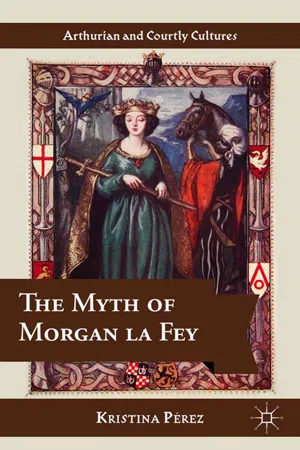
The Myth of Morgan la Fey
About this book
The sister of King Arthur goes by many names: sorceress, kingmaker, death-wielder, mother, lover, goddess. The Myth of Morgan la Fey reveals her true identity through a comprehensive investigation of the famed enchantress' evolution - or devolution - over the past millennium and its implications for gender relations today.
Information
CHAPTER 1
HOW TO HANDLE A WOMAN: PERVERSION OR PSYCHOSIS?
Halfway through the 1960 musical Camelot, King Arthur finds himself perplexed by the behavior of Queen Guinevere and wonders, “How to Handle A Woman?” This question has been vexing Arthurian heroes since the twelfth century. His solution—to “love” her—begs the question, just how is a man meant to love a Woman?
Given that the seed of Arthur’s own downfall is his love for his older sister, who plays a maternal role toward him, this quandary becomes even more pertinent. It would seem, therefore, that Arthur is wondering how to handle both a Mother and a Lover. For Arthur and the other heroes in his eponymous literature, this solution of loving takes two primary forms: perversion or psychosis.
If Morgan la Fey is the Mother of Arthurian myth, it becomes necessary to examine how children—especially male children—develop in relation to their Mothers. Could it be that she is actually the ultimate sex symbol? Essentially, to borrow a term from psychoanalyst Melanie Klein, we must scrutinize the symbolic rôle that Morgan (or an equivalent female personage) plays in the internal development of various masculine heroes.1
The vilification of Morgan as Arthurian literature matures can be read as the disdain of the boy-child and the renouncement of his sexual desire for the Mother as he gets older. In order to understand this eternal dichotomy—and its effect on the portrayal of Morgan in Arthurian legend—it is necessary to look backward past the Oedipus Complex to what we will term the Oresteian Position: a position characterized by the primacy of the Law of the Mother over the Law of the Father. Consequently, Morgan becomes the Oresteian Mother of Arthurian myth.
This reconsideration derives its impetus from Irigaray’s criticism of Freud for forgetting the ancient murder of the Woman-Mother that precedes the death of the Father.2 She has suggested that in the Oedipus Complex the murder of the Father is not motivated by a desire to take his place, but rather to get rid of the one who severed his bond with the Mother.3 Klein has also argued that in the early stages of the Oedipus Complex jealousy is based on the child’s suspicion toward the Father, who is accused of having taken away the Mother’s breast and the Mother. The Law of the Mother is established before that of the Father and it is this initial stage of development—the Oresteian Position—that provides the key to understanding all later psychological complexes.
In Kleinian theory, it is the Mother who is the prototype of God and even a child who has a loving relationship with his Mother also has the unconscious terror of being devoured by her. From birth, the infant has a persecutory anxiety resulting from the loss of the intrauterine situation. Since Morgan originated in Celtic Sovereignty Goddesses this schematization fits rather nicely.
Throughout Klein’s 1963 essay, “Some Reflections on The Oresteia” it becomes clear that she sees both the persecuting superego and the idealized parents as symbolic rôles. We will therefore juxtapose the accepted applications of the Oedipus myth (a son’s murder of his Father and marriage of his Mother) with that of Orestes (a son’s murder of his Mother to avenge his Father) to demonstrate how Morgan and her avatars perform both these roles. Klein asserted that “position” is a more accurate term than “mechanism” or “phase” because of the rapidity with which children’s developmental psychotic anxieties change to normal attitudes—in contrast with the psychoses of adults—and we will use it accordingly.4
Attempts by our heroes to contain their Oresteian Mothers result in either perversion (a defense against her), or psychosis (the full negative impact of the Oresteian Position). The perverse solution undertaken by various Celtic and Breton heroes, as we will see, is to enter into a masochistic relationship with her. Even then, however, it’s the Sovereignty Goddess or Fairy Mistress who ultimately triumphs. The Oresteian Mother becomes the Phallic Signifier because it is she who imposes the Law—as we witnessed in Echtrae Chonnlai—therefore seeming omnipotent (in other words possessing the Phallus that the hero-child desires).
The myth of Orestes is presented in a trilogy of Greek tragedies by Aeschylus (c. 525–456 BC) known as the Oresteia. Karen Horney—a younger contemporary of Freud—cites Sophocles’s treatment of the myth as an example of a time when matricide was the most unforgivable crime in a society in which the Woman held a more central role.5 However, Aeschylus’s villainess Clytemnestra, like Morgan, is punished for being both a Mother and a fervent Lover.
The play opens with the homecoming of King Agamemnon from the Trojan War. His wife, Clytemnestra, is planning to murder him. Partly because she’s involved in an extramarital affair with his enemy and partly to avenge her daughter, Iphigenia (whom Agamemnon sacrificed to the gods before heading into battle).
Agamemnon arrives with Cassandra—the prophetess and enslaved daughter of the Trojan king—in tow as his concubine, further enraging his wife. Foreshadowing Mélusine, the Breton Fairy Mistresses and Morgan herself, Cassandra describes Clytemnestra as a “monster,” a “viper coiling back and forth,” a “sea witch . . . Scylla crouched in her rocky nest—nightmare of sailors,” and the “raging mother of death.”6
Although Cassandra’s prediction of her and Agamemnon’s deaths at the hands of Clytemnestra is believed, she and the rest of Greece accept this fate. In her prophecy, Cassandra cries, “Keep the bull from his mate!”7 It’s significant that Cassandra prophesies Clytemnestra will “gore” her husband with her “black horn” even though she actually kills Agamemnon with an axe,8 emphasizing the penetrative qualities of her deed even more strenuously.
The next play in the trilogy, The Libation Bearers, begins with Elektra—Clytemnestra’s other daughter—pouring libations over her father Agamemnon’s grave, swearing vengeance against her Mother and appealing to the gods for the appearance of her long-lost brother, Orestes. It’s evident that Elektra’s hatred for her Mother stems as much from the usurpation of her Mother’s affections by her lover (and her subsequent feelings of abandonment) as from the death of her Father. In other words, Clytemnestra has put her own sexual and emotional needs before her maternal duties.
In dramatic fashion, Orestes appears at this precise moment and tells Elektra that he is on instructions from Apollo to murder his Mother or lose his own life. The sexual elements of this mission are clearly discernible, his sword an attempt to reclaim the Phallus lost by his Father in death. Not unlike Morgan’s repeated seizing of Arthur’s sword, Excalibur.
Orestes slips into the palace incognito, murders his Mother’s lover, and turns to Clytemnestra saying, “It’s you I want.”9 Clytemnestra asks him if he has no respect for the “breast you held, drowsing away the hours,/soft gums tugging the milk that made you grow?”10 After a brief hesitation, he slays her and madness immediately overcomes him.
According to Klein, the idea that the Mother is omnipotent and therefore able to prevent all internal and external pain is commonly retained into adulthood and the bliss in suckling is the prototype of sexual gratification. In the Oresteia, it is stated that Orestes was not primarily suckled by Clytemnestra but by his nurse (The Libation Bearers, v. 750). His guilt upon killing his Mother therefore suggests that his motivation was not primarily revenging his Father but his own feelings of abandonment. Irigaray sees the child’s phantasy of a devouring Mother-figure as the inverse of the blind consumption to which she is forced to submit. She argues that what psychoanalysis calls “orality”—the desire for the Mother to fill us to the brim, the characterization of the infant’s mouth or the vagina as a bottomless pit—is actually a phantasy derived from Oedipal hatred.11
Indubitably, the apple that Connlae receives from his Otherworld Woman (an unending supply of nourishment that precludes the consumption of any other food and from which he can’t bear to be weaned) might be interpreted in this manner. And, plainly, the Irish hero desires the Otherworld Woman sexually, totally disconsolate in her absence. Likewise, the baby reacts to the frustration of this pleasure with hate and aggression, feelings that are directed toward the same objects that provide gratification: the breasts of the Mother.12
The Mother is consequently seen as both the “good” breast and the “bad” breast, and early emotional life becomes dominated by a sense of losing and regaining the “good” object.13 The stage of mental development that has been designated as the Oresteian Position occurs toward the end of the second quarter of the first year of life when the paranoid-schizoid position, which is characterized by destructive impulses, projections, and splitting, is at its height.14 Klein also claims that it is during the middle of the first year that the depressive position begins to develop in tandem with the early stages of the Oedipus conflict, which comes to a head at weaning.15
The “good” breast becomes the prototype for what is experienced as loving and nurturing, while the “bad” breast represents all that is menacing and persecuting. For Klein, unlike Freud, the superego results from the internalization of both the satisfying “good” breast and the dreaded “bad” breast.16 Hence the superego is a maternal presence and the enforcer of the Law of the Mother rather than a paternal enforcer of the Law of the Father. In Arthurian literature, the symbolic rôles of “good” and “bad” breast become divided between Morgan la Fey as the “bad” breast and the Dame du Lac as the “good” breast.
The child turns all of his hatred against this “bad” denying breast, attributing to it all of his own active aggression: a process that psychoanalysis terms “projection.”17 The child is also, concurrently, performing the mental activity of “introjection:” that is, in his phantasy he is taking into himself everything he perceives in the outside world.18 In early child development, it is the Mother—especially the breast—who is the primal object of both the infant’s introjected and projected processes.
Since the breast/Mother represents not only food but also freedom from persecutory anxiety to the child, he lives in constant fear of her loss and this in turn underlies his fear of being punished for hubris,19 presumably by the superego. Klein has written that, in her experience, the fear of both the internalized and external loss of the “good” object is inextricably linked with feelings of guilt at having destroyed the Mother/breast and that her loss is a punishment for his dreadful deed. Matricide becomes the organizing principle of the subject’s symbolic capacity.
Indeed, for both Klein and psychoanalyst Karl Abraham, oral envy is the primary envy and penis envy only secondary; under the dominance of oral desires the penis is strongly equated with the breast.20 The gratification experienced at the Mother’s breasts allows the baby to turn his desire to the Father’s penis, although the conflicting feelings toward the Mother’s breasts are also transferred to it.21 The boy phantasizes that the Mother incorporates his Father’s penis inside herself and wants to forcefully recapture the penis that he imagines as being inside his Mother and to hurt her in the process.
When Arthur tries to recapture Excalibur from his older sister, he expresses a desire to hurt her in the process although he never truly acts on this wish nor does he recuperate his sword. Further, the imagos of both the breasts and the penis are planted within the child’s ego and form the nucleus of the superego.22 This shift in libidinal drive illuminates the close connection between the Oedipus Complex and the develo...
Table of contents
- Cover
- Title
- Introduction Final Girl: The Once and Future Goddess
- 1. How to Handle a Woman: Perversion or Psychosis?
- 2. Courtly Masochism
- 3. Monstrous Mothers: Morgan la Fey and Mélusine
- 4. Divine Mothers: Morgan, the Dame du Lac, and the Virgin Mary
- 5. What Do Women Want? Gawain and Freud
- 6. Fals lustes: Malory’s Mistresses
- 7. Follow Me: Beguiling the Victorians
- 8. If Ever I Would Leave You: Morgan in the Modern Era
- Notes
- Index
Trusted by 375,005 students
Access to over 1.5 million titles for a fair monthly price.
Study more efficiently using our study tools.
Frequently asked questions
Yes, you can cancel anytime from the Subscription tab in your account settings on the Perlego website. Your subscription will stay active until the end of your current billing period. Learn how to cancel your subscription
No, books cannot be downloaded as external files, such as PDFs, for use outside of Perlego. However, you can download books within the Perlego app for offline reading on mobile or tablet. Learn how to download books offline
Perlego offers two plans: Essential and Complete
- Essential is ideal for learners and professionals who enjoy exploring a wide range of subjects. Access the Essential Library with 800,000+ trusted titles and best-sellers across business, personal growth, and the humanities. Includes unlimited reading time and Standard Read Aloud voice.
- Complete: Perfect for advanced learners and researchers needing full, unrestricted access. Unlock 1.5M+ books across hundreds of subjects, including academic and specialized titles. The Complete Plan also includes advanced features like Premium Read Aloud and Research Assistant.
We are an online textbook subscription service, where you can get access to an entire online library for less than the price of a single book per month. With over 1.5 million books across 990+ topics, we’ve got you covered! Learn about our mission
Look out for the read-aloud symbol on your next book to see if you can listen to it. The read-aloud tool reads text aloud for you, highlighting the text as it is being read. You can pause it, speed it up and slow it down. Learn more about Read Aloud
Yes! You can use the Perlego app on both iOS and Android devices to read anytime, anywhere — even offline. Perfect for commutes or when you’re on the go.
Please note we cannot support devices running on iOS 13 and Android 7 or earlier. Learn more about using the app
Please note we cannot support devices running on iOS 13 and Android 7 or earlier. Learn more about using the app
Yes, you can access The Myth of Morgan la Fey by K. Pérez in PDF and/or ePUB format, as well as other popular books in Literature & Literary Criticism Theory. We have over 1.5 million books available in our catalogue for you to explore.