eBook - ePub
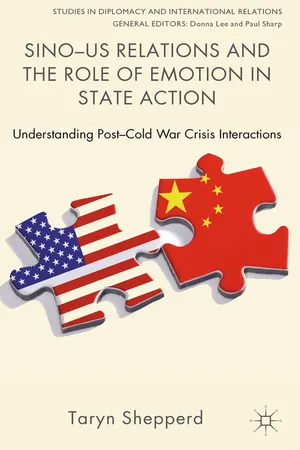
Sino-US Relations and the Role of Emotion in State Action
Understanding Post-Cold War Crisis Interactions
- English
- ePUB (mobile friendly)
- Available on iOS & Android
eBook - ePub
Sino-US Relations and the Role of Emotion in State Action
Understanding Post-Cold War Crisis Interactions
About this book
Examining twenty-first century relations between the US and China, Shepperd investigates three well publicised crises between these states, highlighting how social interests relating to identity and emotional needs were key dynamics driving these interactions and their transformation.
Information
1
Introductory Discussion
Introduction
The US–Chinese relationship is often referred to as the most important bilateral relationship for the near future. Whilst somewhat simplistic in reference and resting on materialistic assumptions, it is nonetheless an undeniable fact that with the US as the lone superpower, and the PRC as the most likely challenger to US hegemony in the world, this is a relationship that is gaining in prominence and influence. Consequently, the US–China relationship is one of the fastest growing and most popular topics of debate in both popular and academic circles. This book was borne out of an interest in the growth and development of China over the past two decades and a long-standing interest in US foreign policy. The nature of the enquiry has changed as time has passed. Initially the focus was on the ‘rise of China’ on the international scene and what this would mean for its relationship with the US, given US pre-eminence. However, the more I read, the more I became interested in the intricacies of the relationship itself, particularly in the pivotal period following the end of the Cold War when the overall relationship was plunged into crisis on three separate occasions, over what appeared to be three totally different incidents, two of which appeared accidental in nature. This dynamic, and the inherent complexity of the relationship itself, raised a number of issues that were either glazed over, or ignored in the majority of literature surrounding the topic, leaving a number of unanswered questions both theoretically and empirically. It was the awareness of these ‘gaps’ that led to the following research agenda, and what represents a concerted effort to seek greater knowledge and develop understanding of the intricacies of what is clearly a complex and nuanced bilateral relationship. This book seeks to add to a growing body of literature on the relationship both theoretically and empirically. In order to demonstrate the relevance of the research and its contribution to the literature, it is necessary to set out that which is to be analysed, before embarking upon a discussion aimed at setting out the conceptual focus.
Introducing the puzzle
China and the US have enjoyed a special, albeit uneasy relationship for some time now. Over 30 years after the normalisation of relations the two actors have managed to successfully negotiate a set of rules for co-operation and co-existence. They have set up a number of mechanisms for interaction and communication in such fields as trade, the economy, and culture, which has further developed following the events of 9/11, the War on Terror, and the development of a more strategic dialogue. Whilst both states have, since the normalisation of relations, continued to verbally reinforce the underlying principles of the relationship, and prioritise the focus on increased co-operation and engagement, my book demonstrates that this has not always been the case.
The period following the end of the Cold War was a pivotal time for the world and represented something of a watershed in the relationship between the US and China. Not only was this something of a transitional period at the international level, but also in terms of the US–China relationship which no longer had the ‘need’ to combine their efforts against the common threat of the Soviet Union. The period itself did not get off to a good start with the events in Tiananmen in the summer of 1989 and their repercussions for perceptions of China internationally. However, whilst the events of that summer led to a definite cooling of relations between the two governments, this ‘punishment period’ did not sway the leadership in either country from their desire to build and maintain peaceful and co-operative relations so as to enable mutual economic benefit, a goal that has been in the declared interests of each governments foreign policy since the normalisation of the relationship (as shall be investigated in Chapter 3). Whilst co-operation was the impetus for the relationship and was a course of action declared to be in the best interests of both states, this did not stop the development of the following three well publicised crises between the two states which brought about the potential for conflict: the Taiwan Strait Crisis (1995–96), the bombing of the Chinese embassy in Belgrade (1999), and the Spy Plane Incident (2001).1 My particular interest lies with these three interactions, and a number of puzzles arising from them.
For the purposes of clarifying the subsequent agenda and the originality of this piece of work I have identified the following four puzzles as representative of a new area of inquiry. These puzzles are both theoretical and empirical in nature and therefore pave the way for the need to establish a new mode of enquiry – an agenda that shall be set forth over the course of this chapter and the next. The main puzzles are as follows:
- How, on these three separate occasions, did the relationship turn confrontational despite material interests that dictated the need for co-operation?
- What were the processes involved in transforming the logic from one of co-operation to confrontation?
- How was it possible, given this confrontational logic, to transform the interactional framework back to the co-operative logic?
- What were the underlying processes that allowed for such transformations to take place?
As is apparent, the first and fourth questions are primarily agent-based puzzles. They seek to address the lack of attention and/or insight offered by purely rational and neo-utilitarian approaches to state action that focus upon the exogenously given nature of state interests and their exclusive focus on the material dynamics of those interests. The term neo-utilitarian is borrowed from Ruggie (1998). As we shall see in the literature review and the theoretical discussion of the next chapter, such accounts, with their focus on static material interests offer little insight into the changing nature of state interests and their construction and relation to identity and context. Furthermore, those arguments that have sought to analyse the role of non-material dynamics in the relationship such as the role of image (see for example Chen, 2003; Gries, 2005a/b; Scott, 2007) and misperception (see for example Shambaugh, 2003; Blum, 2003; Lubman, 2004) have not offered any insight into the processes of change within the dynamics of the relationship itself with the notable exceptions of Goh (2004) and Duffy and Goh (2008) who wrote two very informative and methodologically innovative accounts of the processes of change leading up to and including the period of rapprochement. However, these two accounts clearly deal with a different timeframe than the one under analysis here, and employ different methodological and theoretical assumptions than are proposed through the course of this investigation. The second and third puzzles deal more directly with structurally-based arguments in that they are concerned with processes of change within the interaction itself, which are largely unaccounted for in other analyses of these cases, which either focus on the co-operational logic of agent interaction, or the confrontational logic of the security dilemma. Again as such accounts tend to assume the static nature of international politics they ignore the dynamic nature of interactions which are of distinct importance to this particular investigation with its focus on the potential for change and the dangers of applying static assumptions and making grand predictions based upon these assumptions.
My central concern lies with seeking to understand, and where possible explain, the processes of change during these timeframes and how such processes were made possible. I argue that a focus on purely material interests has insufficient explanatory power. As such one of the claims of the book is that in order to gain a more nuanced understanding of agent interactions, at any level, it is necessary to consider the role of interests that lie outside of the material categorisation of rationalist approaches. This is where the concepts of identity and emotion come to be of particular importance.
Many scholars of IR assume that strategic and economic issues are central to understanding state interactions, whether confrontational or co-operative, while emotional and relational issues are deemed subsidiary. However, it seems clear that most interactions between political agents arise both from material and non-material concerns. In addition to economic and strategic interests (material) there are identity-based interests (social) such as the desire for status, recognition, pride, dignity and legitimacy. These non-material interests are inherently social in nature, that is, they are non-tangible and dependent upon interactional and relational processes. These interests are of particular importance in the face of uncertainty and fear and are therefore, not surprisingly, evident in cases involving confrontation. The analysis therefore differentiates between what can be called material/strategic interests and identity-based, principled interests (also called social interests). In many ways these can be distinguished by reference to the debate over the logic of consequence and the logic of appropriateness (March and Olsen, 1989; Muller, 2004). Neo-utilitarian approaches, with their focus on material factors tend to focus almost absolutely on the first seeing behaviour as driven by the logic of consequences reliant upon means-ends calculations. Constructivists, on the other hand, focus on the logic of appropriateness whereby behaviour is seen to be rule governed (see Checkel, 1997; Risse, 2000; Fierke, 2007a). The subsequent chapters will demonstrate that such a narrow focus is misleading by demonstrating that once one party has broken the rules of engagement the other state’s behaviour is both constituted and constrained by social interests. These social interests, that appear more consistent with a logic of appropriateness, dictate that some form of reparation is needed in order to move forward and place a priority on that which is deemed appropriate behaviour rather than utility maximising behaviour.
With this in mind, rather than looking at the overall relationship and attempting to make grand predictions as to its future direction, my book focuses upon three well publicised diplomatic crises and identifies the processes by which the relationship went from one of co-operation (or co-existence depending upon one’s interpretation) to confrontation and back to co-operation again within what were relatively short timeframes. The focus is on the themes and concepts that have emerged out of the public transactions, and the justification and implementation of policies. The analysis of the official US–China discourses across these three interactions is a significant departure from other accounts, both of the relationship as a whole, and into these specific interactions, not least because it represents an attempt to trace the processes of change from within both actors’ discourses. Such an approach may lend itself to criticism, firstly with regards to linguistic challenge and second with regards to claims of ethnocentrism. The linguistic challenge was a particular concern, however given the nature of these being public interactions conducted through both national and international media outlets necessitated that much of the discourse was readily available in English (either by being spoken and transcribed in English, or by virtue of being officially translated for an English speaking audience). On the rare occasions where the information has not been readily available in English, they have been translated by native speakers for the purposes of authenticity. The reason for wishing to approach the material from both perspectives is twofold. Firstly it relates to the desire to provide a more complete ‘picture’ of the interaction and deeper investigation into the processes involved from a multitude of perspectives, and secondly, the theoretical assumptions underpinning my subsequent analysis seemed to dictate the need to look at both parties involved in any interaction. It is therefore hoped that greater depth and understanding is offered by way of this being more than a one-dimensional approach to foreign policy analysis.
The focus on these three interactions was not a means to facilitate some a priori hypothesis. The purpose is instead to address the absence in the relevant literature of attention to the question of how the relationship was, within a short temporal frame, constituted along both confrontational and co-operative logics. To borrow a quote from Ruggie (1998: 855), ‘where is the transformative logic?’ This puzzle dictated the approach that was developed and its largely conceptual focus. My approach has therefore taken on board Wendt’s (1992: 423) suggestion that ‘the framing of problems and research strategies should be question-driven rather than method-driven’. Whilst the timeframe under investigation may be considered fairly short (comprising of less than a decade) the title and design of the book is geared towards looking at ‘crisis points’ – the fact that these three points occurred within a relatively short temporal window is not, I think, of great concern. The main concern is rather that there were these three crises in the first place (with the potential for conflict between the world’s superpower and the next ‘rising power’). In my opinion, the fact that the three occurred within a relatively short temporal frame only makes their eventual resolution all the more intriguing as it would suggest that there were serious underlying issues at play in the relationship, issues that were largely unaccounted for in analyses and which have an important impact upon the successful design of policy.
Answering a question about processes of transformation requires a framework of analysis that enables investigation into the inter-subjective and constitutive nature of interactions, identities and interests. My focus is on changing discursive representations of both the context and the actors involved. In seeking to fulfil this requirement, I have drawn upon a number of insightful pieces of literature which have, in many ways, served as departure points in the construction of my own framework. Each of these shall be discussed in the relevant sections over this chapter and the next. In what follows I introduce the analytical framework and discuss each of the central concepts and justify their inclusion before moving the discussion on to the theoretical and methodological issues and their relationship to the conceptual dynamics.
The pieces of the puzzle
‘The constructivist turn’ within IR (a phrase coined by Checkel, 1998), has begun to transform the traditional agenda of the discipline with much greater attention now being paid to non-material dynamics in international relations, irrespective of the level of analysis. Constructivism is an approach that has allowed for an increased focus on the role of ideas, identity, norms, culture, and more recently emotion. Whilst many constructivists have sought to critique the assumptions of neo-utilitarian approaches, others have sought to focus upon paving a way for new modes of thinking within the discipline. My own work falls into the latter category: I approach the US–China relationship from a different angle, asking different questions and focusing upon different dynamics. In line with this thinking I have sought to draw inspiration from the following analogy and draw upon its logic:
Whereas conventional IR lenses show us an iceberg as it emerges from the sea, constructivist and other post-modern accounts can take us below the surface to see the issues that shape what is going on at the surface (Peterson and Runyan, 1999: 236).
Constructivism was an approach that rose to prominence following the end of the Cold War and in response to the apparent inability of the mainstream structural theories to account for the processes of change that had led to the end of the Cold War. Its suitability for the analysis of the processes of change distinguishes it from more traditional theories of international relations (Koslowski and Kratochwil, 1994; Fierke, 1998; Finnemore and Sikkink, 1998; Fierke and Wiener, 1999; Goh, 2004; Duffy and Frederking, 2009).
The argument put forward in this book is thus structured around a range of concepts that distinguish it from more conventional accounts by those employing neo-utilitarian research agendas, or those who are primarily concerned with focusing upon the general and overarching dynamics of the relationship. It has a largely conceptual focus that operates on two levels; the first deals with three concepts around which the investigation is based, and the second deals with the role of language in terms of gaining insight into the construction of meaning. Essentially we have three concepts that structure the analysis of language use. Whilst the next chapter is committed to a theoretical discussion of the assumptions I shall be applying the methodological approach to my analysis, it is important at this introductory stage to discuss the conceptual focus of the research and give due consideration to how such an approach shapes the theoretical and methodological approach that will be employed in the analysis of each case study.
An underlying reason for the application of such an approach to this bilateral relationship was dissatisfaction with the accounts of these three important interactions in the existing literature. Conventional approaches to IR (which still can be seen to largely dominate the discussion on this relationship – particularly when applied to the policy realm) continue to categorise this relationship as either conflictual, or co-operative. Such a one-dimensional, deterministic approach tends to oversimplify what is a complex, nuanced and fluid relationship. Furthermore, a growing body of literature has sought to address the obvious gaps in such research by examining the role of image and misperception in this relationship and thereby move the debate away from the purely material accounts. These analyses however, have also tended to provide overarching and generalised claims regarding the nature of the relationship as opposed to in-depth empirical analyses of specific interactions. As a result, this very useful and insightful look into the dynamics of the relationship has tended to be either one-dimensional, or all encompassing. Undoubtedly such analyses prove very useful, particularly to those interested in applying academic research to the policy realm, however, in seeking knowledge of the future direction of the relationship, or in seeking to uncover general dynamics, they have largely served to focus on the bigger picture to the neglect of the actual intricacies of day to day political practice. Those who have provided largely structural arguments have, in particular, ignored the role of agency in this relationship. Clearly there is the potential for this relationship (and any other relationship between two or more political agents) to become either conflictual, or co-operational. However, it cannot be said, and I believe should not be said, that the relationship is always going to be defined as either one, or the other. Such a complex and nuanced relationship cannot be defined in such black and white terms as there are clear dangers in doing so for policy-makers. Within the remit of my own book, I would argue that whilst such analyses provide interesting and useful insight they offer no account into the nature of these interactions. Furthermore, the very existence of these three crises would seem indicative of interplay between conflict and co-operation between the US and China, again a dynamic that either tends to be overlooked, or inadequately discussed oftentimes proving inconvenient to general analyses of the relationship and its future directions. This interplay, or fluidity you may say, suggests that not only are there processes to be explored, but that material dynamics alone prove unsatisfactory as explanatory tools for the processes of interaction. It is therefore necessary to develop an approach that allows for the analysis of process as well as one that is able to incorporate the consideration of non-material dynamics.
The following section outlines and discusses the four concepts which will constitute the analytical framework of the book: lang...
Table of contents
- Cover
- Title
- Copyright
- Contents
- List of Figures and Tables
- Acknowledgements
- List of Abbreviations
- Chapter 1 Introductory Discussion
- Chapter 2 Theoretical Underpinning and Methodological Tools
- Chapter 3 1995–96: The Taiwan Strait Crisis
- Chapter 4 1999: The Bombing of the Chinese Embassy in Belgrade
- Chapter 5 2001: The ‘Spy Plane Incident’
- Chapter 6 Concluding Discussion
- Notes
- Bibliography
- Primary Source Material for Empirical Chapters
- Index
Trusted by 375,005 students
Access to over 1.5 million titles for a fair monthly price.
Study more efficiently using our study tools.
Frequently asked questions
Yes, you can cancel anytime from the Subscription tab in your account settings on the Perlego website. Your subscription will stay active until the end of your current billing period. Learn how to cancel your subscription
No, books cannot be downloaded as external files, such as PDFs, for use outside of Perlego. However, you can download books within the Perlego app for offline reading on mobile or tablet. Learn how to download books offline
Perlego offers two plans: Essential and Complete
- Essential is ideal for learners and professionals who enjoy exploring a wide range of subjects. Access the Essential Library with 800,000+ trusted titles and best-sellers across business, personal growth, and the humanities. Includes unlimited reading time and Standard Read Aloud voice.
- Complete: Perfect for advanced learners and researchers needing full, unrestricted access. Unlock 1.5M+ books across hundreds of subjects, including academic and specialized titles. The Complete Plan also includes advanced features like Premium Read Aloud and Research Assistant.
We are an online textbook subscription service, where you can get access to an entire online library for less than the price of a single book per month. With over 1.5 million books across 990+ topics, we’ve got you covered! Learn about our mission
Look out for the read-aloud symbol on your next book to see if you can listen to it. The read-aloud tool reads text aloud for you, highlighting the text as it is being read. You can pause it, speed it up and slow it down. Learn more about Read Aloud
Yes! You can use the Perlego app on both iOS and Android devices to read anytime, anywhere — even offline. Perfect for commutes or when you’re on the go.
Please note we cannot support devices running on iOS 13 and Android 7 or earlier. Learn more about using the app
Please note we cannot support devices running on iOS 13 and Android 7 or earlier. Learn more about using the app
Yes, you can access Sino-US Relations and the Role of Emotion in State Action by T. Shepperd in PDF and/or ePUB format, as well as other popular books in Politics & International Relations & Chinese History. We have over 1.5 million books available in our catalogue for you to explore.