- English
- ePUB (mobile friendly)
- Available on iOS & Android
eBook - ePub
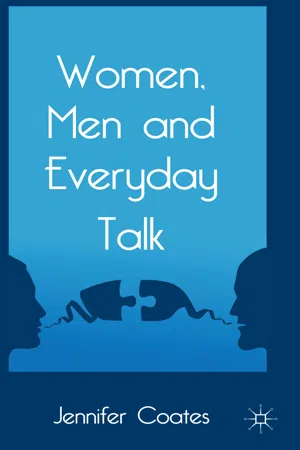
Women, Men and Everyday Talk
About this book
Bringing together a selection of some of the author's key papers on language and gender, this book provides an overview of the development of language and gender studies over the last 30 years, with particular emphasis on conversational data and on single sex friendship groups.
Information
Part I
Language in All-Female Groups
1
Women’s Stories: The Role of Narrative in Friendly Talk [1996]
In this chapter, I shall look in some detail at eight stories1 told in conversation by women friends to each other. My aim is to show what women’s stories are like in terms of structure and content and to tease out the role of narrative in friendly conversation. In a book on Women’s Folklore, the authors commented that researchers have concentrated on male public performance and have ignored ‘folklore that is more collaborative and enacted in the privacy of the domestic sphere or as part of ordinary conversation’ (Jordan and Kalcik 1985: ix). Ordinary conversation is what I am interested in – the spontaneous conversation of people who know each other well – and in this chapter I shall focus on the stories women friends tell each other ‘in the privacy of the domestic sphere’, as part of their everyday talk.
Story-telling plays a central role in friendly conversation between women, as it does for most people, whatever their background. The writer Ursula Le Guin (1992: 39) argues that ‘Narrative is a central function of language’. She also claims that narrative is ‘an immensely flexible technology, or life-strategy, which if used with skill and resourcefulness presents each of us with that most fascinating of all serials, The Story of My Life’ (1992: 42). Her account rings very true for me. My oldest friend and I always begin our weekends together (we live 60 miles apart and meet once every two or three months) by asking ‘Who’s going to tell their story first?’ By ‘story’ we mean an autobiographical account of everything that has happened to us in the weeks or months since we last saw each other. The fact that we have spoken on the phone in between is ignored. What counts is the face-to-face, blow-by-blow account. In other words, we tell each other the latest episode of the Story of My Life. The reason this friend is precious to me is that she actually wants to hear my story, just as I genuinely want to hear hers. Through the exchange of stories, we share in the construction and reconstruction of our personal identities, our ‘selves’. Doing this is part of what being friends entails.
In terms of their structure, stories differ significantly from the surrounding conversation in which they are embedded. When someone starts to tell a story, we listen to them in a way that is quite different from normal. Think of the quiet that descends on an infant school classroom when the teacher says ‘Once upon a time...’. William Labov, who studied the language practices of Black adolescent males in New York City, was struck by the power of narrative to compel attention: ‘they [narratives] will command the total attention of an audience in a remarkable way, creating a deep and attentive silence that is never found in academic or political discussion’ (Labov 1972a: 396). A keyword here is ‘audience’. In friendly conversation, the idea of participants functioning as an audience while someone speaks is nonsensical most of the time. In the conversations I’ve recorded, what is most noticeable is the noisy all-in-together quality of the talk. Story-telling is the exception. When someone starts to tell a story, the other conversational participants withdraw temporarily from active participation and give the story-teller privileged access to the floor.
A typical story
The stories women friends tell each other are about personal experience, their own or that of someone close to them. The following is a typical story told by a woman to her friend about buying a dress. Pat (all names have been changed) tells this story at a point in the conversation where she and Karen have started talking about their new dresses. (See pp. xiii–xv for transcription conventions.)
Sundresses | |
Well I saw those [dresses] um on Wednesday when I was up there, | |
and then my mother phoned me up and said, | |
“Oh I want to get a couple of these lengths which I’ve seen in Watford”, | |
’cos she’s going to America in a couple of weeks’ time, | |
[...] | |
5 | and she said “I want a couple of sundresses |
and can you just run them up for me”. | |
So I said, “Yeah, I saw them myself”, | |
and I said, “Before you go and get them in John Lewis | |
go in St Albans market, | |
10 ’cos I’ve seen dress lengths ready cut, | |
the lot . for four ninety nine”. | |
And she said, “Oh I haven’t got time to go in St Albans. | |
I’ve seen the ones I want anyway in John Lewis’s | |
and I don’t think there were much difference in price”. | |
15 | So I- and she was talking to me about them |
and saying how nice they were, | |
and I said, “Yeah well I nearly bought myself one”. | |
And then my Dad phoned up last night, | |
and he said, “Go and get yourself one, | |
20 | we’ll give you the money”. |
[...] | |
Didn’t need asking twice. | |
But when I went up there | |
I was glad really, | |
’cos in- where they had the finished lengths they only had the prints | |
25 | and I was going to get one of those. |
[...] | |
God I’ve wanted a plain black sundress for twenty years. | |
Now I’ve got one. |
At the heart of any story is a series of narrative clauses, that is, clauses containing a verb in the simple past. This story starts with the verbs saw and phoned, but the key verb is said: she said ... so I said ... and he said. The narrative core of this story is a dialogue between the narrator and first her mother, then her father. This dialogue is framed by the opening event, the narrator seeing the dress lengths in the market, and by the final triumphant Now I’ve got one. Notice that the narrator omits the key clause and then I bought a sundress – we are left to infer from the information given in lines 22–25 that this is what she did. The structure of this story is typical of oral narrative: clauses are organised in a temporal sequence which corresponds to the actual sequence of events. In other words, the basic structure is A and then B and then C ... . At the beginning of the story, the action is suspended from time to time to provide background information. Pat tells Karen when the story began – on Wednesday – and where – up there (line 1). She introduces the key players – herself and her mother – and explains why her mother wanted to buy the dress lengths – ’cos she’s going to America (line 4). Labov (1972b) calls this part of a story orientation, by which he means those parts of the narrative which answer the questions who? where? when? Comments which evaluate the events described, such as didn’t need asking twice (line 21), tell the audience how the narrator intends the events to be interpreted. (Here, Pat lets Karen know that she was very happy with her father’s offer.) The last two lines operate as a sort of coda: they bring the story to the end and re-orient us in the present.2
The language of oral narrative is much simpler than the conversation in which it is embedded. Most lines consist of one simple clause (e.g. and then my Dad phoned up last night) or of a simple clause with a chunk of direct speech as its direct object (e.g. and he said, “Go and get yourself one”). Clauses are linked by the simple coordinators and and so, with an occasional subordinating conjunction such as when or because introducing a subordinate clause. Women’s stories are full of detail – the names of people and places are given (e.g. Watford, St Albans, John Lewis [a department store]). Women also fill their stories with people’s voices: in Pat’s story we hear the voices of Pat herself, her mother and her fathe...
Table of contents
- Cover
- Title
- Introduction
- Part I Language in All-Female Groups
- Part II Language in All-Male Groups
- Part III Gendered Talk in Other Contexts
- Part IV Language and Gender – Changing Theoretical Frameworks
- References
- Index
Trusted by 375,005 students
Access to over 1.5 million titles for a fair monthly price.
Study more efficiently using our study tools.
Frequently asked questions
Yes, you can cancel anytime from the Subscription tab in your account settings on the Perlego website. Your subscription will stay active until the end of your current billing period. Learn how to cancel your subscription
No, books cannot be downloaded as external files, such as PDFs, for use outside of Perlego. However, you can download books within the Perlego app for offline reading on mobile or tablet. Learn how to download books offline
Perlego offers two plans: Essential and Complete
- Essential is ideal for learners and professionals who enjoy exploring a wide range of subjects. Access the Essential Library with 800,000+ trusted titles and best-sellers across business, personal growth, and the humanities. Includes unlimited reading time and Standard Read Aloud voice.
- Complete: Perfect for advanced learners and researchers needing full, unrestricted access. Unlock 1.5M+ books across hundreds of subjects, including academic and specialized titles. The Complete Plan also includes advanced features like Premium Read Aloud and Research Assistant.
We are an online textbook subscription service, where you can get access to an entire online library for less than the price of a single book per month. With over 1.5 million books across 990+ topics, we’ve got you covered! Learn about our mission
Look out for the read-aloud symbol on your next book to see if you can listen to it. The read-aloud tool reads text aloud for you, highlighting the text as it is being read. You can pause it, speed it up and slow it down. Learn more about Read Aloud
Yes! You can use the Perlego app on both iOS and Android devices to read anytime, anywhere — even offline. Perfect for commutes or when you’re on the go.
Please note we cannot support devices running on iOS 13 and Android 7 or earlier. Learn more about using the app
Please note we cannot support devices running on iOS 13 and Android 7 or earlier. Learn more about using the app
Yes, you can access Women, Men and Everyday Talk by J. Coates in PDF and/or ePUB format, as well as other popular books in Languages & Linguistics & Linguistics. We have over 1.5 million books available in our catalogue for you to explore.