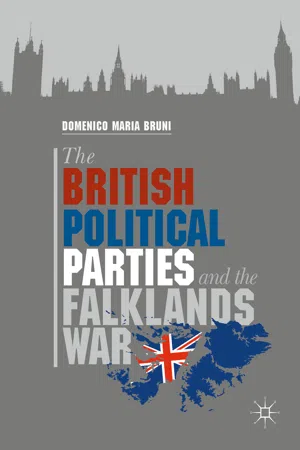
This book explores and reconstructs how the principal parliamentary parties in Britain confronted and responded to events that unfolded during the Falklands War in the spring of 1982. The author begins by situating the Falklands Crisis within the wider context of the breakup of the British Empire and discusses the fluid political situation in Parliament at the time. Following this, the book examines in detail each of the parties – the Conservative Party, the Labour Party and the SDP-Liberal Alliance – and their actions during the crisis. The chapters focus on each party in turn and follow a chronological narrative to reconcile the evolution of the diplomatic and military picture with the internal political one.
- English
- ePUB (mobile friendly)
- Available on iOS & Android
eBook - ePub
The British Political Parties and the Falklands War
About this book
Information
© The Author(s) 2018
Domenico Maria BruniThe British Political Parties and the Falklands Warhttps://doi.org/10.1057/978-1-137-31471-0_4The Labour Party
Domenico Maria Bruni1
(1)
Department of Political Science, Luiss Guido Carli, Rome, Italy
According to Tam Dalyell, two contingent and fortuitous occurrences strongly conditioned the Labour Party’s response to the Argentine attack on the Falkland Islands. Firstly the fact that neither Michael Foot nor Denis Healey were in London on Friday 2 April. As a consequence, on that day, the acting leader of the PLP was John Silkin, Shadow Defence Secretary and Shadow Leader of the House of Commons. When at 11 a.m. the Lord Privy Seal announced as imminent an Argentine attack, Silkin committed the Party to the ‘full support for the right of the people of the Falkland Islands to stay British’ and branded Galtieri and his fellows a ‘tinpot Fascist junta’.1 The second occurrence was the interview given by Silkin himself on the BBC’s World at One later that day. When asked whether the UK should have committed to supporting the Falklanders up to the point of taking up arms against the Argentines, Silkin answered without hesitation: ‘certainly!’. The media exposure was crucial: ‘from that moment the PLP leadership was on a motorway which perhaps it never really intended to travel, but from which there was no obvious exit’. In Dalyell’s opinion, had Denis Healey been in London on 2 April, he would have displayed a more cautious approach.2 In fact, in his memoirs, Healey considered to have been an error the bellicose attitude of the Labour Party in the first stage of the crisis. However, Healey related such an assessment to the speech of Michael Foot on 3 April: that was the defining moment in the shaping of the Labour Party’s attitude at the outbreak of the crisis.3 Foot fully agreed with what Silkin had said both in the House and to the BBC and there is no reason to believe that without the Shadow Defence Secretary’s statements he would have set out his speech in the emergency debate on 3 April differently.4
Actually many Labour MPs looked at the crisis in the South Atlantic with the memories of the European crisis of the 1930s in their minds. The need not to accept a fait accompli and not to give in to the temptation of ‘appeasement’ went far beyond John Silkin’s personal belief.5
One more factor helped to shape the attitude of many Labour MPs in the crisis. During the 1970s the Labour movement had repeatedly raised the issue of the defence of human rights under the dictatorial regimes in Latin America, particularly in Chile and Argentina. The greater the weight of the Left within the National Executive Committee of the Party, the more the commitment on these issues increased. The draft manifesto approved at the Labour Annual Conference in 1980 affirmed the party’s commitment to avoiding a situation where the Falklanders would ‘be handed over to any Argentinian regime which violates human and civil rights’.6 When Argentina invaded the Falklands, the NEC was discussing the Labour Programme draft to submit to the Annual Conference the next autumn. The chapter on ‘Latin America and the Caribbean’ worked out by the Latin American sub-committee of the International Committee included a paragraph on the Falkland Islands, which stated:
We believe that the rights of the Falkland Islanders to self-determination should be upheld; in no circumstances should they be put at the mercy of a regime which violates human and civil rights. It is unlikely that fruitful tripartite discussion on the question can begin until there has been a change of regime in Argentina.7
The debate on this section of the programme was suspended precisely because of the outbreak of the crisis.8 When the discussion was resumed in June, the paragraph on the Falklands was completely erased.9 However, at the beginning of April the one cited was the position regarding the Falklands worked out by the competent body of the Labour Party, and it was in line with what had been approved by the whole party two years earlier.
Random and subjective factors certainly played a role in defining the Labour leadership’s first reaction. However, this latter must be included within a broader context that helps to explain its rationale.
1 First Reactions
Since the morning of 2 April John Silkin had been providing an interpretation of the events on the basis of the interwar period model. His most important contribution on that day, however, was to get the House to hold an emergency debate the following day, winning the Government’s attempts at resistance.10
Five Labour MPs took to the floor in the debate on Saturday 3 April. Michael Foot’s speech played a major role in shaping the mood of the House during the emergency debate. The extent of its impact can be appreciated by the approval expressed by the chairman of the 1922 Committee, Edward Du Cann: ‘the Leader of the Opposition spoke for all of us’.11 These words of course stemmed from the anger of Conservative MPs towards the Government, but they also revealed Foot’s ability to touch sensitive keys for the Tories on that specific situation. First of all, the Labour leader made clear that the situation of the Falkland Islands did not relate to colonialism. The goals to be pursued had to be identified in the light of other premises. Actually, what were at stake were the wishes of the Falklanders and the safeguard of the international rule of law. As a consequence it was required, on the one hand, to protect the islanders and to defend their rights; on the other hand, it was ‘to ensure that foul and brutal aggression does not succeed in our world’.12 The first, more specific purpose was closely connected with the second, more general one. The latter evoked a traditional self-representation of the British elites, that is the idea of being the ‘defender of people’s freedom throughout the world’.13 Both factors were also present in Margaret Thatcher’s speech. The Prime Minister, however, greatly emphasised the principle of sovereignty and the UK’s right to self-defence, whilst the Leader of the Opposition gave much more importance to the right to self-determination of the Falklanders and the defence of the rule of law. The result was a highly effective speech. Moreover, its impact was further strengthened by the speaker’s curriculum vitae. Foot’s anti-appeaser reputation, established by his public behaviour in the 1930s, allowed the automatic reference to the events of fifty years earlier, increasing, if possible, the pathos of his words. Douglas Jay and John Silkin spoke in similar terms. Jay accused the FCO of being ‘too much saturated with the spirit of appeasement’ and the MoD of having carried on a ‘policy of unilateral disarmament of the Royal Navy’, which ‘had invited aggression’.14 Silkin was even more explicit: he branded the Argentine government ‘fascist’ and Galtieri as a ‘bargain basement Mussolini’.15
A second recurring element in the Labour MPs’ speeches was the will to underline the gap between the ineptitude of the incumbent government and the effectiveness of the previous Labour Cabinet. Michael Foot dealt with this issue, but it was fully exploited by Edward Rowlands.16 Having handled the Falklands problem as Minister of State at the FCO under Jim Callaghan’s premiership, Rowlands was enabled to stigmatise the Government’s faults and mistakes. In 1977, the Labour Government had shown its ability to read as well as to react to the situation, in such a way as to enable effective playing of the deterrence card. In contrast, the errors and the incompetence of the Thatcher Government had opened the way for action by the troops of Buenos Aires. Political evaluation reached a conclusion that could only call for the resignations of the principal responsible figures: Carrington and Nott. A strong request was put forward by John Silkin, who also linked Margaret Thatcher with the responsibility of the two ministers.17
A third distinguishing element of the Labour MPs’ speeches concerned the first steps taken by the Government immediately after the news of the attack on the Falklands. On the one hand there was the approval of the recourse to the United Nations. On the other, more cautious assent to the sending of a task force was expressed. Silkin was explicit in distinguishing the substantial homogeneity between Government and Opposition in the reading of events from true, actual, political action. If from one standpoint it was necessary to respond to an unprovoked aggression, from another standpoint—if the Government failed to clarify its responsibilities, and how it intended to use the fleet—it could not rely on the unconditional support of the Opposition.
George Foulkes was the only Labour backbencher who had the possibility of openly expressing, in Parliament, any dissent vis-à-vis the bellicose mood that seemed to pervade the entire House of Comm...
Table of contents
- Cover
- Front Matter
- Introduction
- The Falklands Issue Before the War
- The Conservative Party
- The Labour Party
- The SDP-Liberal Alliance
- Conclusions
- Back Matter
Trusted by 375,005 students
Access to over 1.5 million titles for a fair monthly price.
Study more efficiently using our study tools.
Frequently asked questions
Yes, you can cancel anytime from the Subscription tab in your account settings on the Perlego website. Your subscription will stay active until the end of your current billing period. Learn how to cancel your subscription
No, books cannot be downloaded as external files, such as PDFs, for use outside of Perlego. However, you can download books within the Perlego app for offline reading on mobile or tablet. Learn how to download books offline
Perlego offers two plans: Essential and Complete
- Essential is ideal for learners and professionals who enjoy exploring a wide range of subjects. Access the Essential Library with 800,000+ trusted titles and best-sellers across business, personal growth, and the humanities. Includes unlimited reading time and Standard Read Aloud voice.
- Complete: Perfect for advanced learners and researchers needing full, unrestricted access. Unlock 1.5M+ books across hundreds of subjects, including academic and specialized titles. The Complete Plan also includes advanced features like Premium Read Aloud and Research Assistant.
We are an online textbook subscription service, where you can get access to an entire online library for less than the price of a single book per month. With over 1.5 million books across 990+ topics, we’ve got you covered! Learn about our mission
Look out for the read-aloud symbol on your next book to see if you can listen to it. The read-aloud tool reads text aloud for you, highlighting the text as it is being read. You can pause it, speed it up and slow it down. Learn more about Read Aloud
Yes! You can use the Perlego app on both iOS and Android devices to read anytime, anywhere — even offline. Perfect for commutes or when you’re on the go.
Please note we cannot support devices running on iOS 13 and Android 7 or earlier. Learn more about using the app
Please note we cannot support devices running on iOS 13 and Android 7 or earlier. Learn more about using the app
Yes, you can access The British Political Parties and the Falklands War by Domenico Maria Bruni in PDF and/or ePUB format, as well as other popular books in History & British History. We have over 1.5 million books available in our catalogue for you to explore.