- English
- ePUB (mobile friendly)
- Available on iOS & Android
eBook - ePub
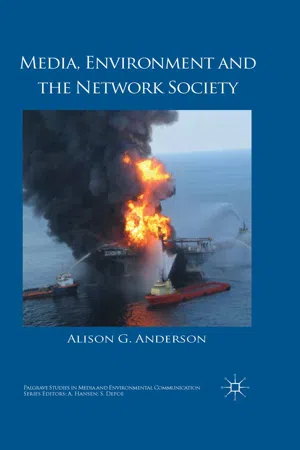
Media, Environment and the Network Society
About this book
The news media has become a key arena for staging environmental conflicts. Through a range of illuminating examples ranging from climate change to oil spills, Media, Environment and the Network Society provides a timely and far-reaching analysis of the media politics of contemporary environmental debates.
Information
1
Introduction
As I write this book Super Typhoon Haiyan, thought to be the strongest storm ever recorded, has devastated large areas of the Philippines and is thought to have killed over 10,000 people. Yet the science linking tropical storms and climate change is unclear. The most recent Intergovernmental Panel on Climate Change (IPCC) report, released in September 2013, found that:
Globally, there is low confidence in attribution of changes in tropical cyclone activity to human influence. This is due to insufficient observational evidence, lack of physical understanding of the links between anthropogenic drivers of climate and tropical cyclone activity, and the low level of agreement between studies as to the relative importance of internal variability, and anthropogenic and natural forcings.
(IPCC, 2013, original emphasis)
With the exception of the North Atlantic region (where it is thought to have contributed, at least in part, to increased tropical cyclone activity there since the 1970s) there is simply not enough scientific evidence to support a link. But that does not necessarily rule out a connection; it is extremely difficult to attribute specific extreme weather events to climate change. The IPCC report concludes that the weight of evidence for anthropogenic (human-caused) climate change is mounting:
The evidence is stronger that observed changes in the climate system can now be attributed to human activities on global and regional scales in many components . . . Taken together, the combined evidence increases the overall level of confidence in the attribution of observed climate change, and reduces the uncertainties associated with assessment based on a single climate variable. From this combined evidence it is virtually certain that human influence has warmed the global climate system.
(IPCC, 2013, original emphasis)
The report also notes that the heavy rainfalls associated with tropical cyclones and average tropical cyclone maximum wind speed are both likely to increase in the future with the continued warming of the oceans.
While the seriousness of the threat, the rate of change and the links to the frequency and intensity of extreme weather events are the subject of much debate, there is a clear scientific consensus that the mean global temperature has grown significantly since pre-industrial times and human activity is the principal cause (see Brulle et al., 2012). Yet climate change has become a highly politicised issue and the media have played a central role in shaping public perceptions and policy agendas. This book argues that analysis of media representations of environmental issues, including climate change, must be placed in the wider context of the increasing concentration and globalisation of news media ownership, and an increasingly ‘promotional culture’, highlighted by the rapid rise of the public relations industry in recent years and claims-makers who employ increasingly sophisticated media strategies.
One of the greatest challenges of our time concerns our relationship with nature and the environment. The choices we make now will affect generations to come. No longer conceived of as purely scientific issues, problems such as climate change, energy depletion, species extinction, deforestation, population growth, water scarcity and air pollution have permeated into public discourse and popular media over the last couple of decades. Media coverage has tended to focus more on the problems than the solutions. Many environmental issues are complex, uncertain and involve long time spans. These sit uneasily in news media schedules that favour certainty, immediacy and simplicity. Emerging technologies such as nanotechnologies and synthetic biology herald a new world that proponents argue potentially offer a means of solving some environmental problems, but at the same time some environmentalists argue they may unleash harmful effects on nature. Given so many uncertainties some social actors advocate a ‘wait and see’ approach while other claims-makers recommend the precautionary ‘better safe than sorry’ principle.
As important as studying the role of the media is examining the struggle among news sources to define issues and control agendas. Various social actors including scientists, industry, policymakers and non-governmental organisations (NGOs) battle to influence public perceptions. How the problems and solutions are framed has the potential to critically shape political and public responses. Environmental issues are often deeply contested. Media representations do not mirror objective indicators of environmental damage but offer a highly socially constructed version of reality. Also, in tracking their prominence, this book suggests we need a longitudinal, multi-issue approach given that environmental issues may compete against one another for news attention as well as competing with other non-environmental issues. For example, US news media attention was focused for much of 2010 on the Deepwater Horizon crisis, but a study just focusing on climate change coverage during that period might have concluded that environmental issues were very low down the agenda.
This book is about power – the power to influence news media agendas and propel issues onto the agenda. But there is also a less visible side to power that is about silencing issues and the ability to keep them off the radar. Among the key questions it seeks to address are: What factors trigger particular environmental stories to make their way into the headlines and others to be ignored? How do issue-attention cycles operate? Whose voices tend to have the greatest prominence in media coverage? How do actors seek to keep issues off the agenda? Why do some claims-makers choose not to be visible in mainstream media? And has the digital revolution fundamentally altered the balance of power? To what extent are new social media simply acting as echo chambers? How influential are global news agencies/wire services in the recycling of news agendas? And how does this vary across different issue domains and in different cultural contexts?
Since I wrote Media, Culture and the Environment (published in 1997) the media landscape has considerably changed and trends such as the reliance of environmental journalists on a show business type of approach to covering the environment have intensified. The field itself has considerably grown, so much so that environmental communication has become an area of multidisciplinary study in its own right (see Cox, 2013). There is now greater recognition of how values, ideology, discourse and the symbolic realm influence how we perceive nature. This book examines the influential theory of the ‘network society’ and discusses its significance for understanding the nature of contemporary environmental activism and mediation of the environment.
With the growing fragmentation of the media, digitalisation and a proliferation of outlets, it is hard to identify distinct boundaries between online and offline media. Web 2.0, the so-called second generation of web-based technologies, has enhanced the interactive and participatory features of the internet through blogs, wikis, video sharing, social networking and podcasting. More recently Web 3.0 (sometimes referred to as the semantic web) enables the integration of data from diverse sources through, for example, the smart tagging of documents, images, events and locations, making internet searches more precise and tailored to individuals. The widespread use of inexpensive but reasonably high quality mobile phone and digital cameras has led ‘publics’ to take a greater role in newsgathering through ‘citizen journalism’, playing a more active role in processes of news production. Increasing numbers of people are uploading their video clips of news events to media outlets (Allan, 2006; Anderson, 2006). Round the clock 24/7 reporting increases the immediacy of breaking news, accelerating the speed at which politics is conducted. RSS (Really Simple Syndication) enables users to filter news headlines according to their own personal interests. By the end of 2014 it is estimated that there will be almost 3 billion internet users worldwide (Voice of America, 2014). And advances in technology now mean that many mobile phone users can access news updates directly via their phone. Blogging has taken off to such an extent that it is estimated that there are over 175,000 new blogs posted each day (Technorati, 2008). The total number of smartphones is estimated to reach over three billion by 2017, with particularly rapid increases predicted to occur in Africa and the Middle East.
The internet itself is far from new; the technology dates back to 1969, when the first message was sent over ARPANET, and in 1971 the first network email system was created. British software engineer, Tim Berners-Lee, invented the World Wide Web (WWW) in 1989 and by the summer of 1991 his browser became available on the internet and the first web page was published. From the very beginning the environmental movement has been at the forefront of developments in new media. One of the first internet-based media projects was GreenNet in the UK (see http://www.gn.apc.org/). This, together with PeaceNet in the US, was established in the mid 1980s (Atton, 2007). In the early days pressure groups such as Greenpeace were reliant upon the use of telex and fax. Greenpeace’s first email connection was made in the United States in 1983, and by the late 1980s many environmental groups were using email and newsgroups (see Greenpeace International Archives; Pickerill, 2006).
During the early 1990s activist mailing lists began to emerge and one of the first alternative media sites to utilise the benefits of the World Wide Web was the centre for environmental information, EnviroWeb. Greenpeace launched its first website in 1994 (Greenpeace International Archives). In the same year UK Friends of the Earth (FoE) established its email system and website. The website was developed by a couple of individuals in their free time, bypassing formal approvals. Later, when funding was needed, this development was stalled for a time by bureaucracy and organisational policy constraints (Pickerill, 2004). To begin with many FoE staff did not have individual access to computers and few of the regional groups actively used emails to connect with each other. The computers were slow and mainly used by FoE for membership database support, and network facilities were often unreliable (Washbourne, 2001). However, by 1996 there was one computer to each full-time member of staff based at the national headquarters and seven regional offices. The computers provided employees with a variety of facilities including email and internet access, and the group purchased a number of notebook computers to enable campaigners to keep in contact while mobile (Washbourne, 2001). In 1995 FoE launched its Chemical Release Inventory (CRI) which enabled the public to perform user-friendly postcode searches on the website for details of polluting factories in their local area, using previously incomprehensible data provided by the Environment Agency (see Pickerill, 2003).
By 1998 the website was getting more than 20,000 hits a week (FoE Annual Review 1998, cited by Pickerill, 2001: 150). The success of the CRI led to the Factory Watch campaign, established in 1999. In November 2000 Greenpeace International launched its own Cyberactivist Community, an action and discussion forum (see http://activism.greenpeace.org/cybercentre/ and http://forum.greenpeace.org/int/). Its developers describe it as providing a ‘cyberactivist community where people representing over 170 countries and territories can share ideas and participate in environmental actions . . . ’ (Greenpeace, 2006). Greenpeace also facilitated cyberactivism in countries with very limited access to computers or telephone lines. In 1999 it established a cybercafé at the site of the Union Carbide Factory in Bhopal, India, where a gas leak in 1984 killed large numbers of people and left many with permanent injuries. This enabled residents to send thousands of electronic messages to Union Carbide and the Indian Government, insisting action should be taken over the continued leaking of toxic chemicals into the local groundwater (Greenpeace, 2006). As Pickerill notes, ‘Their use of the technologies has evolved from a few basic websites to an international network of email lists, contacts and the use of online tactics such as hactivism’ (2006: 267). More recently, blogs, wikis and mobile phones have been increasingly utilised in environmental actions. A Canadian study investigating environmental NGO’s use of virtual and physical means of influencing climate policy found that the vast majority of the 100 groups interviewed (sample drawn from environmental NGOs attending the UN Framework on Climate Change, Montreal, December 2005) used websites, email and listservs in their organisation, and over a third used blogs and online petitions (Sieber et al., 2006).
The ability to connect online and through mobile devices radically changes the physical space of social action and potentially allows it to become increasingly interactive. We are able to both receive and create media content. New connections can be formed and link to action elsewhere in a series of infinite expansions. As Nick Couldry (2012) points out, the new digital revolution is comparable to the print revolution even though the speed with which it has occurred has been infinitely faster. However, as we shall see, there are still considerable uncertainties about its effects. In the rich West we are ‘supersaturated with media’ that are converging at greater and greater speeds (Couldry, 2012). For example, radio and newspapers are increasingly moving online, cable and satellite channels continue to multiply, television programmes invite us to comment via Twitter and social networking sites enable us to link to other media. However, there are multiple digital divides (influenced by age, ethnicity, gender and socio-economic factors) and huge variations across the globe in terms of who has access and the ability to make their voice heard. For example, in large areas of Africa, South Asia and Latin America smart phones are rare and signals are weak. Rural, uneducated women in developing countries tend to be excluded from such forms of networking. In countries such as Niger less than one per cent of people have broadband subscriptions or mobile broadband (see Broadband Commission, 2012).
Inequalities of visibility (of issues and actors) become fundamental to understanding the operation of power in the network society. The approach this book takes is to avoid the ‘media centrism’ that has so often characterised research in this area. It is only through widening the lens to examine processes of news production and consumption that we develop a more complete understanding of how environmental issues are mediated.
Outline of chapters
This book is divided into the following chapters.
Chapter 2, ‘Environmental Risks, Protest and the Network Society’, places the media politics of the environment within the wider context of debates concerning the role of contemporary media in communicating risk. In recent years a number of scholars have highlighted the lack of sustained, rigorous analysis of the role of the media in reporting risk. This chapter provides a critical survey of the literature in the field and teases out key conceptual and methodological issues. It offers an in-depth examination of Beck’s influential theory of the ‘risk society’ and Castells’ theory of the ‘network society’. It argues that analysis of media reporting of environmental risks must be placed within the broader context of the growing concentration and globalisation of news media ownership, the convergence between old and new media, and the rapid rise of the PR industry.
Chapter 3, ‘News Agendas, Framing Contests and Power’, begins by examining the concepts of ‘framing’ and ‘agenda-building’ in order to explore the selective nature of environmental coverage. Environmental issues may be framed in a number of different ways, depending upon the influence placed on such factors as economic development or biodiversity. Different stakeholders have varying degrees of power in commanding news media attention and being treated as credible news sources. The chapter examines whose views tend to gain visibility and considers the changing strategies of NGOs in relation to traditional news media and online news.
Chapter 4, ‘The Climate Change Controversy’, surveys research conducted in a range of international contexts on the role of the news media in covering climate change. This chapter explores how climate change has been framed over time and which voices have been treated as legitimate and authoritative sources. It examines the reasons why these developments have occurred and considers the impact of political agendas, public pressure and the activity of NGOs. Important questions are raised concerning objectivity and trust in the communication of controversial science.
Chapter 5, ‘Oil Spills and Crisis Communication’, examines the news media representation of oil spills through focusing in particular on the BP Deepwater Horizon disaster in 2010. Oils spills are often considered to be particularly newsworthy by the news media. Images of visually appealing animals such as seals make for emotive coverage that is seen as engaging the audience. However, not all major oil spills receive great publicity and media coverage is often not in proportion to the total amount of damage incurred. Today the media politics of oil spills has to be considered in the context of a rapidly changing global communications environment where many news sources have developed increasingly sophisticated strategies for targeting media and shaping news agendas. The internet, particularly for activists, is increasingly providing a key source of alternative first-hand images and narratives that challenge official accounts.
Chapter 6, ‘Emerging Technologies’, discusses emerging environmental issues linked to nanotechnology and biotechnology, and considers the lessons that have been learnt from the reporting of previous controversies, such as genetically modified organisms. It explains the nature of debates concerning these issues and discusses the potential role of the media in representing potential benefits and risks. This discussion draws upon the sociology of expectations, stigma, attention cycles and framing theory. While there are serious concerns over the environmental effects of such technologies, they are seen to form an integral part of the solution to many environmental problems.
Finally Chapter 7, ‘Future Directions’, brings together the main arguments of the book and offers some wider reflections on the field before highlighting future avenues for research. I suggest that we need to develop a more nuanced account of the role of the media in communicating environmental issues that takes into account the complex interplay of actors and issues competing across a range of arenas including: the media, parliament, regulatory institutions, interest and pressure groups, scientific communities, and industry. Such an approach needs to be able to account for shifting dynamics and a myriad of socio-cultural factors that may shape the problematisation of an issue in different ways. The influence of actors and arenas shifts over time, and regulatory institutions play a key role in early screening and determining which interests get represented through established policy-making channels and which may be allowed to get back-door access. This directs attention to the less visible aspects of news production processes and the hidden faces of power, given that control over the media is as much to keep certain issues marginalised or hidden as it is to publicise them. How far is the internet providing a means to bypass traditional gatekeepers and who is listening anyway? What lessons can we learn from past controversies that can inform a better understanding of the media politics of the environment?
2
Environmental Risks, Protest and the Network Society
. . . thanks to the effective merging of the on and offline, massive gatherings of people attempting to change the order of the world around them is now the new normal.
Jurgenson (2012)
It’s clearer than ever: climate change is real, humans are the cause, and we have to act. Sometimes the riskiest decision you can make is to do nothing.
Richard Branson (2013)
Heralded as Greenpeace’s largest campaign yet, ‘Save the Arctic’, which was launched in June 2012, employed a combination of strategies designed to skilfully attract online and offline attention to the global oil giant Shell’s exploitation of Antarctica. Visual stunts are by no means new, but the combination of theatricality, drama, high profile celebrities, parody and satire communicated to global audiences via the web together with mainstream media, illustrates a new spectacularisation of the environment characteristic of power politics in late modern society. The contest for power is more visibly played out on the media stage than at any time before.
Tactic one: Use visual symbols with high emotional resonance
Activists dressed up as homeless ‘polar bears’ wander lost in major cities around the globe. They provide a photogenic opportunity for television news film crews and press photographers and are well attuned to news values. Team this up with videos posted on YouTube involving well known actors and music stars. The video Vicious Circle is narrated by actor John Hurt with music from Ic...
Table of contents
- Cover
- Title Page
- Copyright
- Contents
- List of Figures and Tables
- Acknowledgements
- 1. Introduction
- 2. Environmental Risks, Protest and the Network Society
- 3. News Agendas, Framing Contests and Power
- 4. The Climate Change Controversy
- 5. Oil Spills and Crisis Communication
- 6. Emerging Technologies
- 7. Future Directions
- Bibliography
- Index
Trusted by 375,005 students
Access to over 1.5 million titles for a fair monthly price.
Study more efficiently using our study tools.
Frequently asked questions
Yes, you can cancel anytime from the Subscription tab in your account settings on the Perlego website. Your subscription will stay active until the end of your current billing period. Learn how to cancel your subscription
No, books cannot be downloaded as external files, such as PDFs, for use outside of Perlego. However, you can download books within the Perlego app for offline reading on mobile or tablet. Learn how to download books offline
Perlego offers two plans: Essential and Complete
- Essential is ideal for learners and professionals who enjoy exploring a wide range of subjects. Access the Essential Library with 800,000+ trusted titles and best-sellers across business, personal growth, and the humanities. Includes unlimited reading time and Standard Read Aloud voice.
- Complete: Perfect for advanced learners and researchers needing full, unrestricted access. Unlock 1.5M+ books across hundreds of subjects, including academic and specialized titles. The Complete Plan also includes advanced features like Premium Read Aloud and Research Assistant.
We are an online textbook subscription service, where you can get access to an entire online library for less than the price of a single book per month. With over 1.5 million books across 990+ topics, we’ve got you covered! Learn about our mission
Look out for the read-aloud symbol on your next book to see if you can listen to it. The read-aloud tool reads text aloud for you, highlighting the text as it is being read. You can pause it, speed it up and slow it down. Learn more about Read Aloud
Yes! You can use the Perlego app on both iOS and Android devices to read anytime, anywhere — even offline. Perfect for commutes or when you’re on the go.
Please note we cannot support devices running on iOS 13 and Android 7 or earlier. Learn more about using the app
Please note we cannot support devices running on iOS 13 and Android 7 or earlier. Learn more about using the app
Yes, you can access Media, Environment and the Network Society by A. Anderson in PDF and/or ePUB format, as well as other popular books in Social Sciences & Environmental Science. We have over 1.5 million books available in our catalogue for you to explore.