- English
- ePUB (mobile friendly)
- Available on iOS & Android
eBook - ePub
About this book
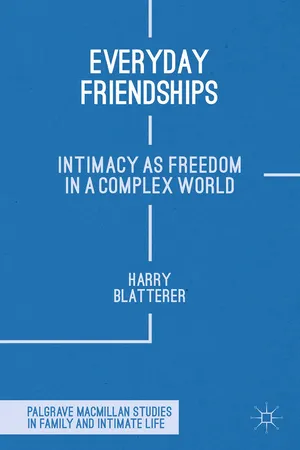
This book conceptualises the lived experience of intimacy in a world in which the terms and conditions of love and friendship are increasingly unclear. It shows that the analysis of the 'small world' of dyads can give important clues about society and its gendered makeup.
Information
1
Modernity, Intimacy, and Friendship
They who would confine friendship to two persons, seem to confound the wise security of friendship with the jealousy and folly of love.
Adam Smith
Intimacy is a fundamental human need. But the modalities of its enactment and experience, its possibilities and constraints, depend on context and on place, as well as time. In this chapter I will address intimacy as part of Western developments without which the contemporary meanings attributed to friendship are unthinkable. I have chosen to sketch some key structural and cultural transformations in private life. The autonomy promised by intimate relationships takes on particular significance with the rise of industrial capitalism. But already in the commercial society described by the thinkers of the Scottish Enlightenment these personal bonds are discussed. In the literature on the history of friendship, works by Adam Ferguson and David Hume, but above all by Adam Smith, are almost always held up as the first modern documents lauding the intimacy of friendship. That thesis bears rethinking. Scholars have argued that this commonly reiterated interpretation misses the highly instrumental approach to intimacy taken by the Scots, and especially by Smith. I argue instead that early Romanticism is key to the meaning of intimacy in the modern sense; that the Romantics’ often exaggerated outpourings of sentiment prefigure a cultural valorization of intimacy in terms of mutual disclosure, something that gains particular traction with the diffusion of therapy culture in the 20th century. A century before, however, it is Hegel who conceptualizes intimacy as offering the kind of modern freedoms we take for granted today. Via Honneth’s reworking of Hegel’s approach we will be able to address the central promise of intimacy – to find freedom in another – as central also to friendship.
The modern experience, public and private
When Siegfried Kracauer (1990, p. 54) writes about friendship as an ‘ideal community of free, independent persons’, he presupposes a modern society inhabited, made, and constantly remade by modern individuals. But what’s modernity and what do we mean by modern individuals? The various prefixes attached to describe its present qualities – post, late, second, reflexive – are testimony to different approaches. But there are some aspects that many perspectives on modernity share and that I will now draw in broad brush strokes.
It is a sociological commonplace that from about the 17th century, in European societies and then in societies that drew on European models of social and political organization, the arenas of human activity multiplied and became more differentiated, in the sense of both a pluralization of ways of life and internal fragmentation. The development of modern subjectivities is intertwined with the displacement of religious authority through science, the challenge to absolutism, and the struggle for a representative politics. Connected to these changes was the formation of a social imaginary that views individuals as closed units of cognition, a view that was systematized by the rationalist philosophers of the Renaissance (Burkitt, 1991; Elias, 2011). In the European imagination the birth of the individual is traced to the Reformation and the Renaissance, when individual identity is said to have replaced collective identity as the center of subjectivity.1 Its 18th century emergence in the modern sense presupposes structural changes that spell a thorough differentiation and pluralization of social subsystems: economy, politics, science, religion, art, law, and a distinct private realm gradually decoupled from one another and developed their own inner logics and mutual tensions.2 Science and art, for example, exit their service to religious and feudal authority, become relatively autonomous, and develop their own internal norms. Scientific refutations of religious dogma, but also scientists’ attempts to reintegrate science and religion, and the 19th century bohemian creed ‘art for art’s sake’ illustrate the changes.
Especially from the 19th century – earlier or later, even much later, depending on place – European populations were caught up in ‘the maelstrom of modern life’, well depicted by Marshall Berman:
the industrialization of production, which transforms scientific knowledge into technology, creates new human environments and destroys old ones, speeds up the whole tempo of life, generates new forms of corporate power and class struggle; immense demographic upheavals, severing millions of people from their ancestral habitats, hurtling them half-way across the world into new lives; rapid and often cataclysmic urban growth; systems of mass communication, dynamic in their development, enveloping and binding together the most diverse people and societies; increasingly powerful national states, bureaucratically structured and operated, constantly striving to expand their powers; mass social movements of people, and peoples, challenging their political and economic rulers, striving to gain some control over their lives; finally, bearing and driving all these people and institutions along, an ever-expanding, drastically fluctuating capitalist world market. (1983, p. 16)
With these structural and cultural changes heterogeneity becomes the normal ‘order’ of things and an internalized fact of life. But ‘differentiation’, the sociological keyword describing this heterogeneity, does not merely describe the fragmentation and pluralization of the tangible infrastructure of modernity, but draws into its semantics the intangibles of existential uncertainties. ‘The more nuanced become religious ideas and practices, concepts and language, family structures and parenting practices, professions and positions, feelings and principles, concerns and joys, and thus the richer for each individual becomes the cosmos of possibilities’, writes Friedrich Tenbruck (1989, p. 235, my translation), ‘the greater the risk that everybody falls into hopeless uncertainty and disorganization, because in all social connections the characteristics of the one must inevitably influence the other’.
In Luhmann’s language (2010, 4), these processes render life both complex and contingent: complex, because life’s possibilities outnumber what can be done and experienced in a life-time, and contingent, because things could always be otherwise. Contemporary processes of globalization, precipitating a disconnection of time and space and a constant ‘intrusion of distant events into everyday consciousness’, raise complexity and contingency to unprecedented levels (Giddens, 1991a, p. 27) and move the comprehensibility of an already fragmented social environment out of reach. That this is not merely an abstract development, but impacts lived experience is well put by Zygmunt Bauman, who articulates contemporary, ultimately modern, longings:
The anxiety would be lessened, tensions allayed, the total situation made more comfortable were the stunning profusion of possibilities somewhat reduced; were the world a bit more regular, its occurrences more repetitive, its parts better marked and separated; in other words – were the events of the world more predictable, and the utility or uselessness of things more immediately evident. (1995, p. 145)
That need for clarity, for a simpler life, for greater order, and for more straightforwardly articulable meanings also keeps alive tradition, which seems to offer existential anchorage, provides the illusion of permanence, and becomes all the more important the more acute the uncertainties, the less adequate collective identifications, the less appropriate recipes for living, the less self-evident the cues to a life worth living become. Rather than simply being overcome or constantly replaced by the new, tradition persists and even thrives precisely because it calls on modernity to justify itself against enduring significances. As we shall see, intimate relationships are not exempt from these dynamics. Thus, we moderns are torn between the meaning-giving calls of tradition and life-orienting convention on the one hand, and the call of innovation and self-created freedom on the other.
The processes of differentiation are implicated in new possibilities for social mobility, the formation of political collectivities and new freedoms, but they also presage the specters of atomization, anonymity, and alienation, leitmotifs of early sociology. Time and again, sociologists attend to private life as a refuge from the shadow side of modern life, as that realm of interaction where the warm light of intimacy glows charged with the promise of authentic life. Because ‘the ultimate and most sublime values have retreated from public life into the transcendental realm of mystic life or into the brotherliness of direct and personal human relations’, wrote Weber, ‘[i]t is not accidental … that today only within the smallest and intimate circles, in personal human situations, in pianissimo, that something is pulsating that corresponds to the prophetic pneuma, which in former times swept through the great communities like a firebrand, welding them together’ (Weber, 1977, p. 156). The hope with which private life is invested – that in its shelter we can nourish the soul and actualize our real selves, authentically, in harmony with cherished others – does not do justice to its often less than ideal realities. But those realities have done little to undermine the expectations with which private life and intimate connections are imbued.
Privacy, private life, and intimacy
The social history of private life cannot be recounted in a linear fashion. We need to be sensitive to the reality that the social processes and sensibilities that give meaning to privacy, private life, and intimacy ‘include, on the one hand, the “deprivatization” and “depersonalization” of certain aspects of life and, on the other hand, the “privatization” and “intimization” of others’ (Markus, 2010b, p. 8). In his On the Process of Civilisation (2012a [1939]), Norbert Elias has shown how from about the 16th century, first among the medieval nobility and then also the peasantry, all sorts of once-acceptable behaviors were pushed from public view; they were deleted from the social repertoire by an advancing ‘shame threshold’, ‘civilized’ in the sense that they came under increasing pressure to conform to emerging standards of etiquette and manners: from blowing noses into fingers to the use of handkerchiefs; from eating with hands to the use of cutlery; from the constant presence and normality of nudity to modesty, embarrassment, and eventually the sexualization of the body. Today, we can observe trends in the opposite direction, a kind of ‘decivilization’. Consider the increasing preparedness of people to disclose what once would have been considered private information in public forums, in a range of media, during ‘private’ cell phone conversations in public spaces (remember the phone booth?), or the cultural imperative of extroversion, assertiveness, and expressive optimism (Ehrenreich, 2009; Blatterer et al., 2010).
The meanings of privacy and publicness in premodern Europe were different from today’s variants in fundamental ways because they played out in a context of a hierarchical social organization. The lives of the nobility were wholly lived in the service of public functions, and were subordinate to the reputation of ‘the house’ (Elias, 2006). It is only with the emergence of a bourgeoisie that, under fast-changing structural conditions, begins to divide work from family life that an inward looking and increasingly autonomous intimacy emerges. From a perspective that emphasizes the links between private life and ‘civil society’, the lines between the bourgeois public and private spheres ran, by the 18th century, between public authority (state, court, police) and the world of private commerce, of literary, political, and cultural discourse (private salons, coffee houses) and the central nub of bourgeois life, the conjugal family with its own internal norms of intimacy. Both civil society and family came to share a private realm where private property ownership and patriarchal authority meant both freedom from public powers and the freedom to cultivate a new bourgeois subjectivity (Habermas, 1991, pp. 27–56). That subjectivity included reflection on the place of the self in a rapidly changing world, and the stabilizing effects that interpersonal relationships may offer.
In the course of that development privacy takes on its specifically modern value: it is anchored in a liberal notion of freedom whose normative core is individual autonomy. At base, writes Rössler, a ‘person is autonomous if she can ask herself the question what sort of person she wants to be, how she wants to live and if she can then live in this way’ (2005, p. 17). From this it follows that privacy is worth protecting because it permits personal control over our lives, something that has been shown to be fundamental to our sense of wellbeing (Mirowsky & Ross, 2003). This normative conception of privacy goes beyond the traditional spatial distinction between a public and private realm whose gendered conception has been comprehensively critiqued by feminists – a critique that is (for the most part) compatible with the liberal appeal to personal autonomy (Rössler, 2005 pp. 23–27). The connection between intimacy and privacy is not straightforward, however. ‘What is intimate is private, but not vice versa’,3 states Rössler, and so points to the multidimensional semantics of privacy.4 The principal standard by which its substantive reality can be analyzed is control over access to privacy concerning our decisions, personal data, and personal spaces, which need to be protected in order to ensure our freedom qua personal autonomy. Privacy in the intimate sphere refers, therefore, to an ‘agent having control over a realm of intimacy, which contains her decisions about intimate access to herself (including intimate informational access) and her decisions about her own intimate actions’ (Innes cited in Rössler, 2005, p. 7). Thus, beyond the differentiation of a public and a private realm, but inseparable from it, is the social value of privacy as guarantor of a kind of freedom that enables us to live autonomous lives. To that end, transformations in the economic structure of societies – the expansion of capitalism not merely as a mode of the production, consumption, and distribution of goods, but as a way of life, as a ‘culture’ (Sennett, 2006) – was pivotal.
In its nascent state, just before Britain and then continental Europe and the United States enter the industrial age, philosophical attempts were made to bring intimacy and changing economic conditions into accord. A new morality befitting a new economic order was described by Enlightenment philosophers. Especially the contributions of the Scottish Enlightenment are significant, not least because it is here that modern friendship is thematized.
Friendship and commercial society revisited
Whether in the public or the private sphere, social change is acutely perceived in threshold periods. Think about Marx’s writing from the center of the Industrial Revolution, Durkheim’s concerns with social integration around the time of the Paris Commune, or the great outpouring of European literary, philosophical, and scientific creativity around 1900 (Schorske, 1981; Berman, 1983). The writers of the Scottish Enlightenment too wrote in one of those threshold periods: at the dawn of industrial modernity. What we know today as ‘capitalism’ began slowly to be extended beyond relations in the market place. Societies were in the process of becoming market societies. During that time thinkers such as Adam Smith began to contemplate societal cohesion in a newly emerging society of strangers. But there is another reason why it is worth turning to Smith. Just as much sociological commentary tends to caricature the ‘classical’ sociologists as thinkers who thought about Western history in terms of linear progress,5 the taken-for-granted notion has settled among sociologists that Smith is the first thinker to contemplate modern friendship. That social philosophical common sense owes much of its strength to Allan Silver’s (1990, 1996) important analyses. At times it has, however, led to a skewed interpretation of friendship’s position among the constellation of modern institutions. This has significant consequences for our thinking about friendship. I begin my reinterpretation with some historical context to Smith’s work.
According to historian Fernand Braudel, the settled notion that capitalism begins with industrialization is misleading. Already, much earlier, ‘capitalism was what it was in relation to a non-capitalism of immense proportions’ (1985, p. 239, original emphasis). What changed, however, was that from about the late 18th century on (earlier here and later there), in tandem with political changes, urbanization, and industrialization, and on the back of existential doubts raised by the fragmentation of the sense-lending totalities of a religious world picture and religiously ordained feudal authority, a market logic that raised exchange value to the status of central value of all things, including human relationships, came to offer itself as the paradigmatic logic for life per se.
Situated between mercantilism and the highly differentiated system of production that was to follow the first Industrial Revolution, the 18th century is a watershed in Western economic history. The French physiocrats, with Quesnay and Turgot the central figures, believed in laissez-faire economics as a system allowing the relatively unhindered establishment and maintenance of a natural order and social equilibrium, with feudal administration based on ‘reason’ playing a guiding role (Elias, 2012a, pp. 51–52). Their concerns were confined to relations between agriculture and business and disregarded industry; their aim was to simplify a complex and often a...
Table of contents
- Cover
- Title
- Copyright
- Contents
- List of Tables
- Series Editor’s Preface
- Acknowledgments
- Introduction
- 1 Modernity, Intimacy, and Friendship
- 2 Friends, Friendship, and Sociology
- 3 Love, Friendship, and Freedom
- 4 Friendship, Intimacy, and the Self
- 5 Gender and the Love–Friendship Paradox
- 6 The Love–Friendship Paradox and Cross-sex Friendship
- Conclusion: Friendship’s Embedded Freedom
- Notes
- References
- Index
Trusted by 375,005 students
Access to over 1.5 million titles for a fair monthly price.
Study more efficiently using our study tools.
Frequently asked questions
Yes, you can cancel anytime from the Subscription tab in your account settings on the Perlego website. Your subscription will stay active until the end of your current billing period. Learn how to cancel your subscription
No, books cannot be downloaded as external files, such as PDFs, for use outside of Perlego. However, you can download books within the Perlego app for offline reading on mobile or tablet. Learn how to download books offline
Perlego offers two plans: Essential and Complete
- Essential is ideal for learners and professionals who enjoy exploring a wide range of subjects. Access the Essential Library with 800,000+ trusted titles and best-sellers across business, personal growth, and the humanities. Includes unlimited reading time and Standard Read Aloud voice.
- Complete: Perfect for advanced learners and researchers needing full, unrestricted access. Unlock 1.5M+ books across hundreds of subjects, including academic and specialized titles. The Complete Plan also includes advanced features like Premium Read Aloud and Research Assistant.
We are an online textbook subscription service, where you can get access to an entire online library for less than the price of a single book per month. With over 1.5 million books across 990+ topics, we’ve got you covered! Learn about our mission
Look out for the read-aloud symbol on your next book to see if you can listen to it. The read-aloud tool reads text aloud for you, highlighting the text as it is being read. You can pause it, speed it up and slow it down. Learn more about Read Aloud
Yes! You can use the Perlego app on both iOS and Android devices to read anytime, anywhere — even offline. Perfect for commutes or when you’re on the go.
Please note we cannot support devices running on iOS 13 and Android 7 or earlier. Learn more about using the app
Please note we cannot support devices running on iOS 13 and Android 7 or earlier. Learn more about using the app
Yes, you can access Everyday Friendships by H. Blatterer in PDF and/or ePUB format, as well as other popular books in Social Sciences & History & Theory in Psychology. We have over 1.5 million books available in our catalogue for you to explore.