eBook - ePub
The British Soldier in the Peninsular War
Encounters with Spain and Portugal, 1808-1814
- English
- ePUB (mobile friendly)
- Available on iOS & Android
eBook - ePub
About this book
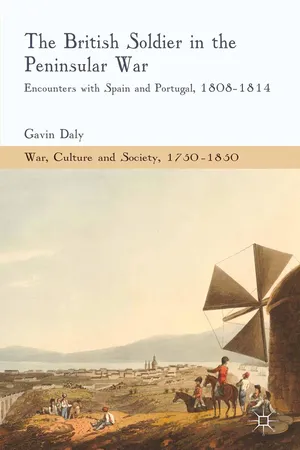
Combining military and cultural history, the book explores British soldiers' travels and cross-cultural encounters in Spain and Portugal, 1808-1814. It is the story of how soldiers interacted with the local environment and culture, of their attitudes and behaviour towards the inhabitants, and how they wrote about all this in letters and memoirs.
Information
1
To the Peninsula
In the spring of 1808, Private William Lawrence of the 40th Regiment was stationed in the south of Ireland. He was one of 9,000 British soldiers assembling in Cork, earmarked for an expedition to the Spanish Americas under the command of Lieutenant-General Sir Arthur Wellesley.1 Undeterred by the disastrous British military expeditions to the River Plate in 1806–1807, the British government was determined to strike another blow against the Spanish Empire. Indeed, many of the British soldiers gathering in Cork in 1808 had been part of those earlier expeditions to Argentina, Lawrence included. Born into a relatively humble background – the son of a Dorset farmer, reduced to labouring – Lawrence had enlisted in the 40th in 1806 at only 15 years of age, having absconded from a builder’s apprenticeship. In October 1806, he departed Portsmouth with 3,000 other soldiers under the command of Sir Samuel Auchmuty, bound for the River Plate. Lawrence was to spend nine months in Argentina, fighting the Spanish at the Battles of Montevideo and Buenos Aires, before departing for home in September 1807, arriving in the Cove of Cork in time for Christmas.2
But in June 1808 the British government’s plans for its regiments in Cork suddenly changed. Wellesley’s force was now destined to set sail on 13 July, not for the Spanish New World but for the Iberian Peninsula. As Lawrence noted in his memoirs: ‘the nation we had recently been fighting in Montevideo, Buenos Aires and Colonia, was now calling for our assistance to drive the French out of their country.’3 The old foe had become a new ally in the war against Napoleon. How had this come to pass?
The outbreak of the war
In some senses, it all began on a raft on the Niemen River, near Tilsit in East Prussia. There, on 25 June 1807, two Emperors – Napoleon and Tsar Alexander I – met to begin peace talks. The following day they were joined by the Prussian king, whose army Napoleon had crushed at Jena (14 October 1806) and whose capital, Berlin, was currently under French occupation. The subsequent Treaties of Tilsit brought a formal end to the war between Napoleon and his two eastern adversaries, and changed the balance of power in Europe.4 From Napoleon’s perspective, Russia was now neutralized, and Prussia dismembered and humiliated – all on top of Austria’s defeat in 1805. This left Britain the sole remaining Great Power at war with France. Now the undisputed master of Europe, Napoleon’s gaze almost immediately shifted from Tilsit to resolving a long-standing problem closer to home: south of the Pyrenees. Beginning in November 1807 with Portugal, and then with Spain early the following year, the French invaded and occupied large parts of the Iberian Peninsula, with Napoleon’s elder brother Joseph named the new king of Spain. In the breathtaking space of a little over six months, Napoleon turned the Iberian Peninsula upside down.
Portugal was the first to fall. From the time of the French Revolutionary Wars, Portugal was caught between neutrality and allying with either France or Britain.5 The stakes were raised when Napoleon introduced his Continental Blockade in November 1806: all French ports and those of their European allies were closed to British shipping. Then, on 12 August 1807, Portugal received a Franco-Spanish ultimatum: it was to end its neutrality and declare war on Britain; arrest all the British residing in Portugal and seize their goods; and close the ports to British shipping – or risk war. France and Spain then secretly signed the Treaty of Fontainebleau (1 October 1807), a plan for the annexation and subdivision of Portugal between the two. Portugal fell in just two weeks. The French invasion began in mid-November 1807, when 25,000 soldiers under General Junot crossed the Portuguese-Spanish border. On 29 November, as the French army raced across Portugal, the Portuguese regent – Prince John of the House of Braganza – and the royal court sailed out of the Tagus bound for Rio de Janeiro, under the British naval escort of Sir Sidney Smith. The Braganzas were not to return until 1821, leaving their three million Portuguese subjects to their fate. The very next day Junot’s soldiers entered Lisbon and the tricolour flew from St George’s Castle.
With Portugal occupied, Napoleon turned his attention to the greater prize: the Spanish kingdom. Spain was five times the territorial size of Portugal, and its population was more than three times larger, with around ten million inhabitants.6 Initially at war with Revolutionary France between 1793 and 1795, Spain had been allied with France since 1796 and was increasingly under its thumb. The Bourbon family itself was a house divided, with tensions between the father, Charles IV, the son, Ferdinand, and the Queen and her favourite, Godoy, the prime minister. In the winter and spring of 1808, a combination of stealth, intrigue and French military might allowed Napoleon to snatch the Spanish throne. Under the guise of reinforcing the French army in Portugal, more French troops crossed the Pyrenees. On 16 February 1808, Napoleon revealed his hand, French troops seizing the northern Spanish frontier fortresses. Amidst the escalating crisis, the Spanish King, Charles IV, abdicated on 19 March, his son assuming the throne as Ferdinand VII. French troops continued to pour over the Pyrenees and Marshal Murat entered Madrid. The Spanish royal family was duly summoned by Napoleon to Bayonne, where Ferdinand, under intense pressure, abdicated on 6 May. He was then consigned to Talleyrand’s chateau at Valençay, remaining there for the duration of the war. Four days after Ferdinand’s abdication, Napoleon offered the vacant throne to his brother, Joseph.7
By May, Napoleon had 100,000 troops in Spain, yet the French rapidly lost control of the situation on the ground. On 2 May 1808, the inhabitants of Madrid rose up against the French occupation. The uprising of the Dos de Mayo was brutally crushed by Murat’s troops, with around 500 Spanish killed in street fighting and by French firing squads.8 But the French could not quell what was to come. On 20 May, the abdication of Ferdinand was made public for the first time, sparking off a wave of revolts and the formation of insurrectionary provincial juntas throughout most of Spain.9 The northern province of Asturias was amongst the first regions to revolt, an insurrectionary junta boldly declaring war on France on 25 May. The revolt then jumped the border to Portugal, beginning in the north and quickly spreading.10 Oporto assumed the mantle of unifying a national liberation movement, rising on 18 June and forming a ‘Supreme Junta of the Kingdom’ under the city’s bishop. The Asturias, Oporto and other juntas across the Peninsula almost immediately looked to Britain for help.
Old allies and enemies
Britain had very different international relations with the two Iberian nations that reached out for help in the summer of 1808. Both were vitally important to British geo-political, economic and military concerns in Continental Europe and the colonial world. But Portugal was an old ally and Spain an old enemy.11
When it came to Portugal, Britain enjoyed long-standing commercial and military ties that stretched all the way back to the Middle Ages, with the English exporting woollen cloth and importing Portuguese wine. In 1703, the Methuen Treaties, which remained in force until the Peninsular War, shored up the wine–wool nexus between these two commercial and maritime powers, and guaranteed English access to Portuguese ports.12 On the back of this commercial alliance, powerful and privileged English merchant communities – known as the ‘Factory’ – were established in both Lisbon and Oporto. During the French Revolutionary-Napoleonic Wars, Britain was determined to maintain this ‘Old Alliance’, safeguard its commercial interests and ensure that neither Portugal, nor its empire, nor its navy – small but valuable as a supplementary force – should fall into the hands of France or Spain.13
In contrast to the tradition of Anglo-Portuguese goodwill stood Anglo-Spanish suspicion, hostility and conflict. Spain was second only to France as Britain’s historical nemesis. True, by the time of the Peninsular War, the days of the Armada and of formidable Spanish armies were long gone. Nevertheless, Spain remained a considerable commercial, maritime and imperial rival, and a revitalized Spain in the late eighteenth century played a role in helping to defeat and humiliate Britain during the American War of Independence. In particular, the Spanish Empire in the Americas continued to be a source of both interest and anxiety for British policy makers and political thinkers, an anxiety only heightened by Napoleon’s seizure of the Spanish throne.14 ‘For both Britain and the United States,’ argues Eliga Gould, ‘Spain accordingly remained a potent and hostile antithesis, limiting the ability of either nation to control its imperial project on its own terms.’ 15
Of the five major international wars of the eighteenth century involving Britain, beginning with the War of the Spanish Succession (1701– 1713) and ending with the French Revolutionary Wars (1792–1802), Britain was at war with Spain in all five conflicts. Indeed, from a Spanish perspective, ‘War with England, whether hot or cold, was the most constant factor in Spanish foreign affairs between 1713 and 1808.’16 And, whilst Spain as a single power no longer posed a direct threat to the British mainland, it could be a very different matter when Spain was aligned with France, helped by the so-called Family Pact, whereby successive Bourbons on the French and Spanish thrones (1733, 1743 and 1761) pledged to come to each other’s aid – which invariably meant going to war against Britain.17 This meant the prospect of combined Franco-Spanish fleets and shipbuilding capacities, such as the case in 1779 when a Franco-Spanish Armada threatened to land on the English coast.18 Integral to this entrenched hostile international relationship, Britain and Spain clashed over economic and territorial interests, trading colonial possessions back and forth across the eighteenth century. There was Florida (1763 and 1783), the Falkland Islands crisis (1770– 1771), and the 1790 Nootka Sound crisis over trade and fishing rights in the Pacific Northwest.19 And nothing was more contested and sensitive than Gibraltar, a British possession since 1713: a ‘British fortress in the heart of Spain,’ as the Duke of Richmond called it in 1777, not long before the Spanish subjected it to a four-year-long siege (1779–1783).20
During the French Revolutionary and Napoleonic Wars, then, it was more or less business as usual. By 1796, the old foes were at it again: Britain seized Trinidad (February 1797) and the Royal Navy defeated the Spanish Mediterranean fleet at Cape St Vincent (14 February 1797). Following the Peace of Amiens (March 1802–May 1803), hostilities with Spain resumed in December 1804, culminating in Nelson’s victory at Trafalgar (21 October 1805) over a combined Franco-Spanish fleet. British interests then shifted to the Spanish New World. Between June 1806 and June 1808, numerous plans were devised and military expeditions launched, but it all ended in abject failure and humiliation with General Whitelocke’s River Plate campaign of June–July 1807, with British forces departing under a truce.21 Still, British interest in expeditions to South America remained undiminished, with plans to send off another force in 1808. Such was Britain’s relationship with Spain on the eve of the Spanish uprisings against Napoleon – a state of war. But Spain was about to be imagined anew.
The call of Iberian patriotism and chivalry
It was not so much the news of the Madrid uprising that stirred the hearts and minds of the British public in 1808, but rather the arrival in England of two Spanish noblemen, Viscount Matarosa and Don Diego de la Vega. They arrived in Falmouth on 6 June 1808 on board the Stag, a Jersey privateer, having boarded the vessel in the Bay of Biscay, after pulling alongside in an open boat and reportedly offering 500 guineas in return for passage to England. Once in Falmouth, they were whisked away to London, arriving at Admiralty House early on Wednesday morning, 8 June. Why all the haste? The two noblemen were representatives from the Assembly of the Spanish province of Asturias, and they came bearing news that ‘the whole of the province of the Asturias had risen in open resistance.’ Further, they were actively courting Great Britain to aid in their war against Napoleon. The Spanish cause had literally set foot in Britain.22
The arrival of the Asturian deputies was greeted in London with extraordinary enthusiasm, the British public gripped with ‘Spanish fever’.23 From 22 June, deputations from other Spanish insurrectionary juntas began to arrive in London.24 The press eagerly reported every new development and proclamation coming out of the Peninsula, with news of the Portuguese uprisings reaching the public on 4 July.25 The Times felt obliged to get a man on the ground, so dispatched a correspondent to Spain. Henry Crabb Robinson duly arrived on 31 July 1808 in Corunna, from where he wrote dispatches until 26 January 1809.26 Reflecting the British public mood, Robinson confessed to being ‘zealous in the cause of Spanish independence’.27
Tories and Opposition Whigs alike initially rallied to the cause. On 15 June, it was Richard Sheridan, intoxicated with both Spanish patriotism and wine, who first voiced the call of Spain in the House of Commons, ‘convinced that since the first burst of the French Revolution, there never existed so happy an opportunity for Great Britain to strike a bold blow for the rescue of the world’.28 The Foreign Secretary, George Canning, then followed, informing the House that anybody who was an enemy of the Napoleonic state was automatically a friend and ally of Britain.29 Britain’s leading Hispanophiles, the Whigs Lord and Lady Holland, threw their weight behind the cause of Spanish liberty. Holland House enhanced its reputation ...
Table of contents
- Cover
- Title Page
- Copyright
- Contents
- Acknowledgements
- List of Abbreviations
- Introduction
- 1. To the Peninsula
- 2. First Contact: Lisbon
- 3. Landscape and Climate
- 4. Billets and Hospitality
- 5. Searching for Civilization
- 6. The Religious World
- 7. ‘Dark-Eyed Beauties’
- Conclusion: Crossing to Civilization
- Notes
- Bibliography
- Index
Trusted by 375,005 students
Access to over 1.5 million titles for a fair monthly price.
Study more efficiently using our study tools.
Frequently asked questions
Yes, you can cancel anytime from the Subscription tab in your account settings on the Perlego website. Your subscription will stay active until the end of your current billing period. Learn how to cancel your subscription
No, books cannot be downloaded as external files, such as PDFs, for use outside of Perlego. However, you can download books within the Perlego app for offline reading on mobile or tablet. Learn how to download books offline
Perlego offers two plans: Essential and Complete
- Essential is ideal for learners and professionals who enjoy exploring a wide range of subjects. Access the Essential Library with 800,000+ trusted titles and best-sellers across business, personal growth, and the humanities. Includes unlimited reading time and Standard Read Aloud voice.
- Complete: Perfect for advanced learners and researchers needing full, unrestricted access. Unlock 1.5M+ books across hundreds of subjects, including academic and specialized titles. The Complete Plan also includes advanced features like Premium Read Aloud and Research Assistant.
We are an online textbook subscription service, where you can get access to an entire online library for less than the price of a single book per month. With over 1.5 million books across 990+ topics, we’ve got you covered! Learn about our mission
Look out for the read-aloud symbol on your next book to see if you can listen to it. The read-aloud tool reads text aloud for you, highlighting the text as it is being read. You can pause it, speed it up and slow it down. Learn more about Read Aloud
Yes! You can use the Perlego app on both iOS and Android devices to read anytime, anywhere — even offline. Perfect for commutes or when you’re on the go.
Please note we cannot support devices running on iOS 13 and Android 7 or earlier. Learn more about using the app
Please note we cannot support devices running on iOS 13 and Android 7 or earlier. Learn more about using the app
Yes, you can access The British Soldier in the Peninsular War by G. Daly in PDF and/or ePUB format, as well as other popular books in History & British History. We have over 1.5 million books available in our catalogue for you to explore.