- English
- ePUB (mobile friendly)
- Available on iOS & Android
eBook - ePub
Desire Between Women in Caribbean Literature
About this book
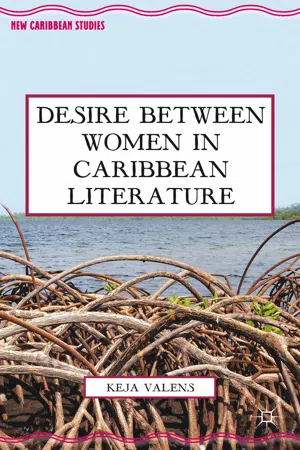
Relations between women - like the branches and roots of the mangrove - twist around, across, and within others as they pervade Caribbean letters. Desire between Women in Caribbean Literature elucidates the place of desire between women in Caribbean letters, compelling readers to rethink how to read the structures and practices of sexuality.
Information
CHAPTER 1
José Martí’s Foundational Failure
According to José Martí, Amistad funesta (Fatal Friendship, 1885), later re-titled Lucía Jerez, was to have been “the Hispanoamerican novel that was desired” (109), a story where “higher ventures” lifted mere lovers’ tales to “better ends” (110). Yet, faced with the problem of containing desire between women, the romance in Amistad funesta/Lucía Jerez fails.1 The unrealized hope for Martí’s only novel anticipates Doris Sommer’s conception of national romances where “books fueled a desire for domestic happiness that runs over into dreams of national prosperity; and nation-building projects invested private passions with public purpose” (7). Sommer’s work defines one of the major trends in Latin American literature and Martí is one of the most venerated authors in Latin America and the Caribbean, but Martí’s preface to Amistad funesta/Lucía Jerez is staged as an apology, an admission of defeat. Either this novel or the novel erodes the foundation faster than it can be shored up.
Amistad funesta/Lucía Jerez opens as the story of Lucía and Juan Jerez, cousins engaged to be married. Lucía’s female cousins, the sublimely moribund Ana and the pretty, if petty, Adela, share her life of needlepoint, balls, and waiting for Juan. Juan embodies Martí’s ideal man, a “genuine poet” dedicated above all else to social good and purity (119). Lucía’s strong, independent character would seem to make her a perfect candidate for the role of revolutionary love-companion to Juan.2 However, rather than complementing one another, Juan’s idealism and Lucía’s ardor are irreconcilable in the marriage plot. Juan is ill equipped for Lucía’s powerful passions, which are excited at every turn, not least by the beautiful but poor Sol del Valle. Lucía’s desires rage increasingly out of control, and then explode.
Most analyses of Amistad funesta/Lucía Jerez, when they do not tend to questions of poetics and genre, focus on the character of Lucía as emblematic of Martí’s views of women or the character of Juan as emblematic of Martí’s views of the ideal man, and see the disaster at its end as related to these, or as the reflection of a moment of personal and political despair in the author’s life.3 However, I argue that the foundational failure in Amistad funesta/Lucía Jerez stems less from the individual qualities of its characters or author than from irreparable fissures in the heterosexual model that grounds marriage, the national romance, and perhaps even the genre of the novel. When the terms homosexual and heterosexual were just entering into Caribbean discourse (through, in part, Martí’s own chronicles on such other writers as Wilde and Whitman), the binary that adherence to that model would encode into the foundational narrative of the postcolonial nation was already showing its inability to adequately account for desire and sexuality in the Caribbean.
In Foundational Fictions, Sommer analyzes Latin American literary nation-making where “a variety of novel national ideals are all ostensibly grounded in ‘natural’ heterosexual love and in the marriages that provided a figure for apparently nonviolent consolidation during the internecine conflicts at midcentury” (6). Among these books, Sommer includes the Argentinean José Mármol’s Amalia (1844), and Columbian Jorge Isaac’s María (1867), both mentioned in Amistad funesta/Lucía Jerez, and drawing on his articles praising these and other similar novels, Sommer refers to Martí as a “notable propagandist for nation-building novels” (10). However, Amistad funesta/Lucía Jerez directs our attention to the fissures in the model that Sommer signals but that the national romances that she analyzes overcome or overlook: the only “ostensible” grounding in heterosexual love, the quotation marks that must surround any claim to the naturalness of heterosexuality, and the violence that underlies any national consolidation in and through the traditional heterosexual romance.
“The Hispanoamerican novel that was desired”: Prefacing Amistad funesta/Lucía Jerez
Born in 1853, Martí lived in Cuba until the age of 18, when he was deported for his pro-independence writings.4 Martí eventually settled in New York, where he supported himself writing chronicles for newspapers and journals throughout Latin America and the United States, composed poetry, and developed the arguments for, including the organization of, a Cuban revolution.5 Martí’s work has been widely read in the Spanish-speaking world since its publication, but only small portions of it—and not Amistad funesta/Lucía Jerez—have been translated into English.6 The reasons for this are many and include the Anglophone world’s disinterest in non-European literary production and political writing, the decrease of translations into English, and the reaction in the United States to all things Cuban. But it is strangely fitting that the man whose most famous essay (which has been translated into English) is entitled “Nuestra América” (1891) be read and studied predominantly in Latin America (OC 6:15–23). “Nuestra América” folds together Latin America and the Caribbean in its urgent call for a united front of “natural” Americans to launch armed rebellion against colonial rule, resist US expansionism, and found republics where all classes and races unite and defend local and regional righteousness. Martí was an avid reader of European and American writing, often translating it into Spanish for publication in Latin American newspapers and magazines, but he was a vocal critic of the United States as well as of European colonialism.
Martí’s chronicles and essays served as the political and intellectual foundation not only of many Caribbean and Latin American independence movements but also of modernismo. Rejecting the rationalism of European Enlightenment, realism, and naturalism in favor of irrational and imaginative literary production, modernismo reflects and produces late-nineteenth-century Latin American and Caribbean experience. Modernismo celebrated the development in Latin America and the Caribbean of “modern” forms of government (independent democracies), social organization (more egalitarian, or with an elitism based on something other than ancestry), and literary and artistic expression (affective, symbolic, and metaphoric).7 Martí’s poetry, emblematic of modernismo as much as that of Rubén Darío, is collected in the volumes Ismaelillo (1882) and Versos Sencillos (1891). Martí also wrote plays, edited a children’s magazine, and published a great number of translations. Martí returned to Cuba in 1895 to take up arms against Spain. He was killed a few weeks later. (Cuba’s war of independence ended in 1898 when the United States took control of Cuba.)
Although he was widely respected for his intellectual and artistic achievements and was part of a vibrant Cuban exile community in New York, Martí suffered from over two decades of failed attempts at Cuban independence as well as from more personal difficulties. Deeply in love with his island, in the first decade of his exile, Martí tried twice to return to Cuba but both times was accused of conspiring against the colonial regime and forced to leave. Martí’s second return to Cuba, in 1878, was made with his wife, the Cuban-born Carmen Zayas-Bazán, whom he met while both were in exile in Guatemala. In 1878, in Havana, José Francisco Martí y Zayas-Bazán was born. When Martí left Cuba shortly thereafter, Zayas-Bazán and José Francisco remained on the island. Zayas-Bazán and José Francisco came to New York several times to be with Martí and also met him in Venezuela while he was living there for a time, but financial difficulty as well as their differing opinions about Martí’s primary loyalty to the Cuban cause plagued the marriage, and Zayas-Bazán and José Francisco rarely stayed long in New York. Zayas-Bazán returned to Cuba for a last time in 1891 and the couple did not see each other again. Many of the poems collected in Ismaelillo as well as the children’s magazine that he edited, La Edad de Oro, attest to the tremendous pain Martí felt at being separated from his family. Martí left many of his personal affects to Carmita Miyares, who had been his companion in New York.
Amistad funesta originally appeared between May 15 and September 15, 1885, in nine serial installments in El Latino Americano, a New York Spanish-language newspaper. El Latino Americano was distributed throughout Latin America and also in Europe and engaged a reading public acutely involved with Latin American and Caribbean independence movements.8 The newspaper, however, addressed itself primarily to women readers and purveyed messages of moral conformity and conservatism.9 Martí signed Amistad funesta with the pseudonym Adelaida Ral.10 A dedicatory poem to Martí’s friend and compatriot Adelaida Baralt, not included in the original publication, gives an oblique explanation of his unusual use of female pseudonym: Baralt had apparently been commissioned by the magazine to write the story and, knowing that Martí was in need of money, passed the assignment along to him.11 But as much as it acknowledges the circumstances of the commission, the use of the pseudonym distances Martí from the genre and content of the novel, literally preventing readers from knowing that he wrote it. Martí might best be read, through Sylvia Molloy, as posing as Adelaida Ral, presenting himself (and his story) as something that he equally affirms he (and it) is not—“feminine,” performative, full of artifice and feigning, nothing serious.12
When, years after the original publication, Martí planned to reissue Amistad funesta with a new title, under his real name, and with the addition of a prologue, he indicated that the novel was a work to be read over differently.13 In the planned prologue, Martí claims, speaking of himself in the third person, that “the genre of the novel does not please him, however, because there is much to pretend in it, and the pleasures of artistic creation do not compensate for the pain of traveling in a prolonged fiction; with dialogues that have never been heard, between people who have never lived” (109). This is not just a critique of fiction, but of the artificial and super-ficial associated with the “feminization of the novel” that Michael Danahy observes at the end of the nineteenth century. The serious novel Martí would have liked to write would be not only manly but by, for, and about only men, a book that would “raise readers’ spirits with feats of knights and heroes” (110). Editorial requirements that the novel have “much love, some death, many girls, no sinful passion; and nothing that would not be most pleasing to fathers and priests” make it not only feminine but heterosexual (110). Women and heterosexuality are, by convention, associated with artifice and artificial market or religious impositions. The hero who flowed naturally from Martí’s pen had a “better destiny,” ready for “higher enterprises, great feats” (110). But put into a novel, guided by editors, “his career was cut short by certain prudent observations,” and Juan became a “mere ladies’ man” (110). The opposition Martí establishes between men and women and between heroes and husbands, rather than generic conventions, precludes Juan’s, or any man’s, being a ladies’ man without being merely that.
Sommer crystallizes common knowledge when she observes that heterosexual romance works so well to consolidate nations in other stories because it offers a story of opposites attracting, of different sides of a family or a conflict, of different temperaments and concerns, a coming together in harmonious union that will spawn a new race of integrated citizens. It can be less successful, however, in accounting for the attraction of similarity, the favor of insular self-sufficiency, or the mangled interweaving and cordoning of species and genera, genders and genres that occurs along the Caribbean shores.
In Amistad funesta/Lucía Jerez and throughout Martí’s work, correspondences occur not between men and women but between men and between women. It is the friendship of men, not the love of women, that can impel the poet-warrior and to which Martí would like to exhort his readers. In an 1875 article, Martí lamented:
our intelligent youth go around as if avoiding that which unites them, and cautious of one another: they are like isolated plants, those who daily praise the serendipities of friendship. They do not seek each other out, they do not like each other, they do not love each other: they do not want to know how many sweet things are enclosed in this community of those born to move, to look to the sky, to sing and to dream. Friendship is as beautiful as love: it is love itself, devoid of the enchanting fickleness of woman.
(OC 6:307)
In Emerson, Wilde, and Whitman, Martí finds fellow poets, rhetoricians, and nation-builders who base their poetics and their politics in an ideal of male friendship (OC 13:15–30; OC 15:362–367). But reading Whitman, Martí confronts the erotic desire that holds together this world of men. In his 1887 article, “El poeta Walt Whitman,” Martí notes that
Since [Whitman’s] books and lectures earn him barely enough to buy bread, “loving friends” care for him in a little house nestled away in a pleasant country corner from which he rides out in an old-fashioned carriage drawn by the horses, he loves, to see the “athletic young men” at their virile pastimes, to the camerados [sic] who are not afraid to rub elbows with this iconoclast who wants to establish “the institution of the dear love of comrades.”
(The America of José Martí: 242, emphasis in original)14
The proliferation of quotation marks around every reference to friendship and to masculine attractiveness is striking, especially in comparison to their omission in Martí’s citations of Whitman elsewhere in the same article.15 Martí signals a problem of interpretation surrounding male friendship, or an attempt to contain, set off, and distance certain aspects of it. A few pages later, Martí asserts:
fools, with the affected modesty of prurient schoolboys, have thought to see a return to those vile desires of Virgil for Cebetes and of Horace for Gyges and Lyciscus in those most ardent images of the human language with which Whitman celebrates the love between friends in “Calamus.”
(The America of José Martí: 250, translation modified)
“El poeta Walt Whitman” makes clear that Martí’s ideal of friendships between men was not an ideal of homosexuality, but it also reveals Martí’s concern about the ways that it was equally not an ideal of heterosexuality. As Sylvia Molloy observes, “what calls attention … is not that the issue of homosexuality is avoided but, precisely, that it is brought up” (“Too Wilde”: 195–196).16 Furthermore, Martí’s attention to male friendship and desire in the works of both Whitman and Wilde as well as in Greece and the Latin American youth of his day suggests that Martí was well aware that desire between men is not only the terrain of “fools, with the affected modesty of prurient schoolboys” but rather circulates, in various forms, throughout American populism (Whitman), British elitism (Wilde), and Cuban anticolonialism (OC 13:137).
Martí avoids desire between men in Amistad funesta/Lucía Jerez by containing Juan Jerez’s male friendships to the “high feats” of politics and religion, but he cannot insert Juan into the role of hero in a national romance. The problem with the novel and with this novel becomes the problem of containing women and their desires. Embodied in a way that Martí’s male friendships never are and unchecked by a strong heterosexual romance, Lucía’s correspondences with women develop into full-fledged love affairs. Attached to a homogeneity that cannot accommodate women, let alone the mangled mixings of men and women, Indians and criollos, that the new Cuban nation will have to hold, Amistad funesta/Lucía Jerez remains caught in a hetero–homo divide that it also cannot sustain.
Feeble and Faulty Heterosexuality
In the opening scene of Amistad funesta/Lucía J...
Table of contents
- Cover
- Title Page
- Copyright
- Contents
- Acknowledgments
- Introduction: The Epistemology of the Mangrove
- 1. José Martí’s Foundational Failure
- 2. Lost Idyll: Mayotte Capécia’s Je suis martiniquaise
- 3. Replaced Origins: Maryse Condé’s Moi, Tituba sorcière … Noire de Salem
- 4. Plotting Desire between Girls: Jamaica Kincaid’s At the Bottom of the River
- 5. Sexual Alternatives in Patricia Powell’s Me Dying Trial
- 6. The Love of Neighbors: Rosario Ferré’s Eccentric Neighborhoods/Vecindarios excéntricos
- Conclusion
- Notes
- Bibliography
- Index
Trusted by 375,005 students
Access to over 1.5 million titles for a fair monthly price.
Study more efficiently using our study tools.
Frequently asked questions
Yes, you can cancel anytime from the Subscription tab in your account settings on the Perlego website. Your subscription will stay active until the end of your current billing period. Learn how to cancel your subscription
No, books cannot be downloaded as external files, such as PDFs, for use outside of Perlego. However, you can download books within the Perlego app for offline reading on mobile or tablet. Learn how to download books offline
Perlego offers two plans: Essential and Complete
- Essential is ideal for learners and professionals who enjoy exploring a wide range of subjects. Access the Essential Library with 800,000+ trusted titles and best-sellers across business, personal growth, and the humanities. Includes unlimited reading time and Standard Read Aloud voice.
- Complete: Perfect for advanced learners and researchers needing full, unrestricted access. Unlock 1.5M+ books across hundreds of subjects, including academic and specialized titles. The Complete Plan also includes advanced features like Premium Read Aloud and Research Assistant.
We are an online textbook subscription service, where you can get access to an entire online library for less than the price of a single book per month. With over 1.5 million books across 990+ topics, we’ve got you covered! Learn about our mission
Look out for the read-aloud symbol on your next book to see if you can listen to it. The read-aloud tool reads text aloud for you, highlighting the text as it is being read. You can pause it, speed it up and slow it down. Learn more about Read Aloud
Yes! You can use the Perlego app on both iOS and Android devices to read anytime, anywhere — even offline. Perfect for commutes or when you’re on the go.
Please note we cannot support devices running on iOS 13 and Android 7 or earlier. Learn more about using the app
Please note we cannot support devices running on iOS 13 and Android 7 or earlier. Learn more about using the app
Yes, you can access Desire Between Women in Caribbean Literature by K. Valens in PDF and/or ePUB format, as well as other popular books in Literature & Literature General. We have over 1.5 million books available in our catalogue for you to explore.