- English
- ePUB (mobile friendly)
- Available on iOS & Android
eBook - ePub
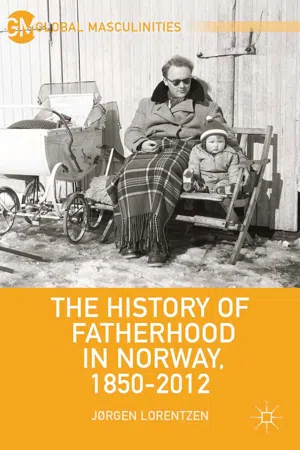
The History of Fatherhood in Norway, 1850–2012
About this book
The first study of its kind, this book traces 150 years of the history of fatherhood in Scandinavia and shows how Scandinavian gender equality policy has important implications for the rest of the world. Among other interesting findings, Lorentzen reveals that the modern-day rise in equality fathering can be traced back to the 19th century.
Information
Part I 1850–1927
THE PATRIARCHAL FATHER AT THE HEARTH
In her autobiographic novel Eleven Years (1934) the Norwegian author Sigrid Undset (1882–1949) describes her childhood up to the age of 11. The end of the novel coincides with the death of the father, Ingvald Undset, in 1893. In this novel, Undset describes a father who, despite being absorbed in his work as an archaeologist, nonetheless, devotes both time and attention to his daughter. Ingvald Unset is convinced that his daughter will continue his life’s work, digging into Europe’s history to tell the story of past generations and their lives. The fact that women had only recently gained access to the universities does not seem to put any limits on his plans for his daughter. Neither does his relationship with her seem in any way controlling or contrived; rather he simply shows his enthusiasm and love through play and the telling of stories. Ingvald could sit for hours with Sigrid on his lap telling her stories about the peoples of Europe, and he introduced her to the classics very early; “Daddy described the ancient times so vividly, that he seemed almost to make them come alive in his own world” (Undset 210). Thus, Undset’s father laid the ground for her love of storytelling, which would later reveal itself in her numerous novels and earn her the Nobel Prize for Literature in 1928.
Ingvald’s presence clearly had an influence on other areas of his daughter’s life. Writing about herself in the third person, Undset says: “She wanted to be independent as quickly as she could. Now that her father was dead, there was nobody on whom she wanted to be dependant. Not even her mother, for longer than she absolutely needed—that much she knew that right away” (283). Ingvald’s insistence on freedom and openness in relation to his daughter Sigrid, was important in establishing a strong sense of independence and need for freedom in her. It was her father who liberated his daughter from the usual cultural expectations of a woman, that of being feminine and motherly.
Sigrid Undset’s autobiographical novel gives us a fascinating glimpse into this father–daughter relationship. But in addition to this, fortunately, a large number of Ingvald Undset’s own letters are still in existence, covering the time of her birth and the early years of her life. These letters confirm Ingvald’s close involvement with his daughter, while at the same time indicating the clear division of roles between mother and father, between men and women, in a middle-class family in the 1800s. The mother’s first task was to be at home and to look after the house and the children, while the father was expected to provide an income for the family. This meant, among other things, that Ingvald Undset was away in Europe for long periods as an archaeologist and therefore missed much of Sigrid’s first year. As we shall see, this duality between presence and absence is in many ways the fate of the father and the position of men in the new middle-class institution of the family. This was true in part of the preindustrial society too, but became more systematic in modern society. However, we shall see that this model was not as systematically implemented as we might think. Both men and women often broke with this “two-sphere” model, in which the woman was associated only with the home, and the man with work and absence from home. First, the traditional peasant lifestyle, where the family lived and worked together on a farmstead, continued to exist well into the 1900s. Second, there was soon a requirement for women’s participation in the public sphere. Third, men spent more time at home than one might expect in a simple model of two separate spheres. I shall come back to this a little later.
Ingvald Undset (1853–1893) was an archaeologist and married Anne Marie Nicoline Charlotte Gyth in 1881 in Kalundborg, Denmark. Sigrid was born on the May 20, 1882, the first of three girls. A few months before Sigrid’s birth, Ingvald suffered a bad attack of malaria in Rome, which would eventually lead to his premature death. But, only months after her birth he had to travel south again to carry out research for a book on the early Iron Age in Southern and Central Europe, a follow up to his doctoral thesis on the early Iron Age in Northern Europe (1881). During that summer, he wrote several warm letters to friends and family, telling them about the fantastic daughter he now has, and on July 5, 1882, he wrote the following letter to a colleague at the Norwegian National Archives, in which discusses the fact that he will soon be travelling to Italy:
It will be miserable to have to decamp now, and rather sad to travel alone, now that I have established a home, in which I leave behind my dear wife and our dear little child. You will, being a happy father yourself, understand this, I am sure;—and you would understand, even more, how gloomy and sad I am in this particular moment, at the thought of this long separation, if you could see our little Sigrid—she was baptised with this name in church last Sunday—, and what an extraordinary child she is. You’re probably smiling, since all fathers believe this of their children, but in this case it is not my opinion alone, but the vox populi! Long black hair, prominently marked eyebrows, an unusually well formed body, intelligent staring eyes, a fierce, energetic temper, and then in contrast a beautiful smile and an exceptionally eloquent and adorable grunt and growl, are what make this child a rare treasure, and I shall find it very hard leaving her behind with her mother for a whole year; since I shan’t come back up north before next St Hans Day.
This letter tells us a great deal about Ingvald’s intimate relationship with his family; he has no difficulties expressing his sorrow at having to leave them, and he is also uninhibited in sharing his delight in his daughter. It is also worth noting what he chooses to mention while describing her. There are very few typically feminine characteristics here; he does not portray her as sweet, small, and innocent. Quite the opposite; Sigrid is a determined and intelligent child with strongly marked features. He knows the child in the minutest detail, and is unrestrained in his love for her.
In every single of his extant letters, written after settling down and having his first child in 1882, he talks about his daughters, and always with the greatest tenderness and love, whether to his own parents, friends, or colleagues. He interests himself in the pregnancies, births, and the raising and welfare of his daughters, both when he is at home with them and when he is travelling in Europe. The intimate relationship Ingvald builds with his children does not, of course, only bring him happiness and joy, since such intimacy also means opening oneself up to potential sorrow and longing. This is clear during the last part of his life, when he realizes he is going to die, leaving the girls forever. But even when he goes to Italy some months after Sigrid’s birth, sadness and longing are evident. In a letter to his friend, Henrik Mathiesen (1847–1927), on November 13, 1882, Ingvald describes his journey and his work, but then continues:
It is wonderful to be able to dive into ones studies with one’s whole heart, into work that absorbs one’s interest completely,—but it shan’t surprise you when I tell you that I have many a melancholic moment, in which my thoughts wander North, flying to my loved ones left behind in Denmark, to my dear wife and our little Sigrid. Travelling alone is not quite the same once you have a wife and children;—one is only human, after all, and we have our weak and weary moments where softer sentiments get the upper-hand,—and then, when one is so very alone, in a hotel among only strangers, one easily becomes faint-hearted and dispirited. But, then there is nothing to do but to man myself up. And at least I have received nothing but good news from them at home; they are well.
Ingvald wrote a large number of letters to his friend that summer about the fabulous Sigrid, and how much he hated having to leave his family. The duality was perpetually there for Ingvald. The intimacy of the relationship came in conflict with the functional side of his role as a father; he had to travel, but in many ways had no desire to. The letter bears witness to the fact that men were comfortable to share these intimate and difficult feelings with male friends, and even with professional colleagues. The letter also tells us something about “manliness,” as a defense mechanism. By “manning himself up,” Ingvald could push his feelings of sadness to one side and concentrate on his public duties. Yet, being manly, it seems, also included an emotional engagement with children and family. Ingvald Undset offers us the opportunity to glimpse into that reality. Further, his letters show us that this intimate relationship has a public face. He reveals his feelings, writes about them to everybody, acknowledging his love for, and dependency on, his family, without this representing any threat to his manliness. Quite the opposite, the intimacy is an important part of his manliness, and as he puts it himself, “his humanity.” Even in the letter he writes to his friend Henrik from Rome, his daughter is credited with giving him the strength to survive his absence. Having written about his melancholy, and seeing the need to “man himself up,” he immediately sets to describing the fantastic Sigrid, telling his friend what a marvel of strength and intelligence she is, and how she is beyond compare. It seems that he gains a kind of strength to carry on with his letter and to bear this period of absence by thinking about this miraculous child, with whom he will spend most of his time after his return from his European studies.
The letters from Ingvald Undset evidence a dual position or situation in his fatherhood. On the one hand, the letters are a wonderful example of a father’s love, and of a father’s overwhelming enthusiasm in the way he talks about his own child. On the other hand, they point to a society in which the father could (and often had to) leave his children and family for long periods of time. The father’s relationship with the children and family must be seen, therefore, as having its basis in two relationships, which for the purposes of this book I term as the father’s intimate relationship and the father’s functional role. The father is a daddy and husband when he is close to the family, but he is also the provider for, as well as the head of, the family.
It is doubtful that individual fathers in the nineteenth century were conscious of any such division between these two positions. Quite the opposite, there is reason to believe that most fathers reflected little on their own positions. This is witnessed by the lack of contemporary material on the subject of men as fathers. Where we now see articles on a weekly basis in the Norwegian and Scandinavian press discussing fathers—their battle for access to their children, etc.—we find very few nineteenth-century sources discussing any diverging opinions or confusion over the father’s role. Of course, the public sphere was quite different at that time; there were far fewer media outlets in which people could express themselves, and the life of the individual was rarely a subject for public debate. Where we do, however, see fathers feature in the literature of the 1800s and around the turn of the century is in the contemporary discourse surrounding those who ran away from their responsibilities after making women pregnant, or over how severe fathers should be in the disciplining of their children (Melchior 1859, Arnesen 1882, Aas 1899, Knoff 1921). The focus of these texts was on fathers (or prospective fathers) who refused to take their functional role seriously, or whose fathering was deemed inappropriate, and where the society became legally involved with a view to keeping social order intact. For most fathers, their functional role and intimate role probably flowed into each other—it was through earning their role as a father in society (through work) that they also gained access to the intimate relationship (that of marriage and having children). We have to remember that the percentage of unmarried men remained relatively high throughout the 1800s. In Norway, one out of five men between the ages of 30 and 50 were unmarried, and therefore had no chance of having any family (Backer 1965).
My own research on the discourse of fatherhood in Norway from 1850 onward substantiates the assertion that the home was also significant for men and fathers, just as it was for Ingvald Undset. I found a total of 116 books that were relevant during the period 1850–1920. Most often, they were titles referring to the family, marriage, and the raising of children. Typical titles from this period included: Barndomshjemmet, eller Hjertet i dets bedste Dannelsestid (The Child’s Home; Or The Ideal Time to Tutor the Heart) by Abbott (1875); Om Opdragelse. Hjem og skole. Et Ord til fædre og mødre (On Child Raising. Home and School. A Word to Fathers and Mothers) by Aas (1899); Ægteskab og Familielive: Hvorledes bereder vi os et lykkelig Hjem?(Marriage and Family Life: How Do We Make a Happy Home?) by Halvorsen (1907); Ved Hjemmets Arne: Nogle Ord til unge og gamle Ægtefolk (By the Hearth: Some Words to Married Couples, Young and Old) by Funcke (1908); and Hjem, helbred og lykke: En veileder til lykkelige hjem (Home, Health and Happiness: A Guide to a Happy Home) by Nelson (1908). There are some more titles referring specifically to fathers; for example, En Faders Ord til sin Datter paa hendes Bryllupsdag (A Father’s Word to His Daughter on Her Wedding Day) by Olsen (1878); Nils Voget’s book from 1910: Fra Far til Datter: Smaa søndagsbreve (From Father to Daughter: Little Sunday Letters); and Cecilie Bååth-Holmberg’s book from 1914: Far og Søn: Et hjem’s historie (Father and Son: The Story of a Home).
Advice books, moral guides, religious publications, personal reminiscences about families and parents, and journals of the time, generally focus on the duties and tasks parents share jointly, and where a gender perspective is given to child raising, the focus is on the mother. I have not, in fact, come across a single book written directly and exclusively about the duties and tasks of fathers.
It may seem paradoxical and contradictory to suggest that fathers were important in the home and occupied a central position there, when not a single nonfiction book from the period is exclusively devoted to the domestic role of fathers. I will, however, attempt to show that where contemporary texts discuss the home, family, and marriage, the father is almost as important as the mother, even though his tasks and the significance of his role are different. One reason why we see an increased number of books written about the mother is perhaps that the importance of the mother for the children was considerably strengthened over the course of the nineteenth century, and that the transition from a woman’s role as fellow breadwinner on the farm to the more clear-cut role as wife and mother in the bourgeois family was deemed an important subject for discussion, definition, and development around the turn of the twentieth century. There is some disparity here between the findings of American and British researchers, who pinpoint a more dramatic change in the second half of the 1800s onward, and their Norwegian counterparts who observe a comparative slowness in the domestification of the woman’s role, and place the breakthrough of a more specific housewife role well into the 1900s (Avdem 1985, Blom and Sogner 1999)
The position of men as the head of the family changed little, but their role as superior patriarch changed gradually toward a more clearly defined provider for the family, and this trend continued to strengthen as the twentieth century rolled in. In this book, I shall try to say something both about fathers and intimacy, and the father’s role in society. As mentioned in my introduction, I characterize these two positions as the father in the family and for the family. These are not concepts that would have been used to define the father’s role in earlier times, but an analytical divide I have established from the material I have studied in order to better organize the understanding of the father’s position in society and the family. Fathers had an important function both within and outside the family. Men both represented and were participants in the public sphere, both in their paid work (rising from the turn of century) and social and political activities in society. This, in contrast to women who were primarily attached to the home and had their function in the family, either as mothers and wives in their own families, or as unmarried women and participants/workers in other families. It is important, of course, to remember that there were exceptions to the rule: many women had a significant public role even in the 1800s, either as midwives, nurses, or in caring for and teaching of children etc., or as telegraph workers, typists, and factory workers toward the end of the century. Despite this, however, the main role of women, in particular, married women, was in the family.
However, the role and function of men in the public sphere cannot be separated from the family in this first period. To have a family was in itself important if a man was to achieve respect in society. Added to which, the procurement of work and an income was not in itself a goal for man, but the means to his being able to have a family and to be able to provide for it (Häggman 1994, Tosh 1999). But before I go further into the debate on the father in and for the family, it is necessary to give a closer account of the effect the split between the private and public spheres has had on our understanding of the family in society.
SEPARATE SPHERES
The theory of separate spheres—the idea that men and women occupied a public sphere and a private sphere, respectively—has had enormous influence on the understanding of the position of women and the relationship between the sexes in the nineteenth and twentieth centuries. This theory has, indeed, formed a basis for the way historians have framed their arguments and for their analysis of gender relations from nineteenth century onward. The idea, however, has been reassessed in more recent women’s studies—not least in Norwegian studies on the history of women—and it has been shown that not only were women participating more in public life than was initially sup...
Table of contents
- Cover
- Title
- Introduction
- Part I 1850–1927
- Part II 1927–1970
- Part III 1970–2012
- Afterword
- References
- Index
Trusted by 375,005 students
Access to over 1.5 million titles for a fair monthly price.
Study more efficiently using our study tools.
Frequently asked questions
Yes, you can cancel anytime from the Subscription tab in your account settings on the Perlego website. Your subscription will stay active until the end of your current billing period. Learn how to cancel your subscription
No, books cannot be downloaded as external files, such as PDFs, for use outside of Perlego. However, you can download books within the Perlego app for offline reading on mobile or tablet. Learn how to download books offline
Perlego offers two plans: Essential and Complete
- Essential is ideal for learners and professionals who enjoy exploring a wide range of subjects. Access the Essential Library with 800,000+ trusted titles and best-sellers across business, personal growth, and the humanities. Includes unlimited reading time and Standard Read Aloud voice.
- Complete: Perfect for advanced learners and researchers needing full, unrestricted access. Unlock 1.5M+ books across hundreds of subjects, including academic and specialized titles. The Complete Plan also includes advanced features like Premium Read Aloud and Research Assistant.
We are an online textbook subscription service, where you can get access to an entire online library for less than the price of a single book per month. With over 1.5 million books across 990+ topics, we’ve got you covered! Learn about our mission
Look out for the read-aloud symbol on your next book to see if you can listen to it. The read-aloud tool reads text aloud for you, highlighting the text as it is being read. You can pause it, speed it up and slow it down. Learn more about Read Aloud
Yes! You can use the Perlego app on both iOS and Android devices to read anytime, anywhere — even offline. Perfect for commutes or when you’re on the go.
Please note we cannot support devices running on iOS 13 and Android 7 or earlier. Learn more about using the app
Please note we cannot support devices running on iOS 13 and Android 7 or earlier. Learn more about using the app
Yes, you can access The History of Fatherhood in Norway, 1850–2012 by J. Lorentzen in PDF and/or ePUB format, as well as other popular books in Social Sciences & Literary Criticism. We have over 1.5 million books available in our catalogue for you to explore.