- English
- ePUB (mobile friendly)
- Available on iOS & Android
eBook - ePub
About this book
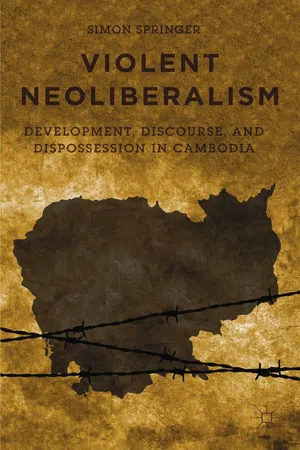
Violent Neoliberalism explores the complex unfolding relationship between neoliberalism and violence. Employing a series of theoretical dialogues on development, discourse and dispossession Cambodia, this study sheds significant empirical light on the vicious implications of free market ideology and practice.
Information
Part I
Development
Chapter One
Violent Politics: Authority, Terror, and the New Devaraja
Placing reflections on the cultural phenomena of the Devaraja and free market capitalism next to each other provides an interesting point of departure in thinking about how contemporary Cambodian politics are organized. For Ian W. Mabbet (1969, 223), “it is important to realize that in a society with a monistic religion where divinity is immanent, godship is not necessarily unique . . . it is a familiar everyday thing that people take for granted,” while David Graeber (2011, 44) reminds us that “Smith’s famous invisible hand was, as he says in his Theory of Moral Sentiments, the agent of Divine Providence. It was literally the hand of God.” There is something very distinctive about Cambodia’s encounter with neoliberalism given the cultural acceptance of divinity on earth that I wish to explore in this chapter, and yet at the same time, I don’t necessarily think that the reverence that elites have for capitalism, and their use of authoritarian means to support societal acceptance and veneration are entirely unique.
With the adoption of even greater neoliberal reforms in the wake of the Asian Crisis, for the most part, this has simply meant that public monopoly became private monopoly while the authoritarian structure of the Southeast Asian state has remained intact (Robison et al. 2005), albeit under new governments in many instances, notably Thailand, Indonesia, and Malaysia. This constitutes a paradox, as neoliberal ideology presents itself as being in favor of democracy (Harvey 2005). It would seem that in such transitional contexts, foreign pressures seeking the privatization of national economies and the opening of borders to trade and capital movements are far more prevalent than is support for democratization, accountability, and the economic assistance needed to ease the impacts of poverty on populations (Tetreault 2003). Some analysts of the neoliberal persuasion might attribute lamentations over this predicament as a condition of critical scholars proverbially wanting their cake and eating it too. In the neoliberal view, free markets constitute the necessary basis for freedoms in other arenas, enabling a system in which economic and social power is dispersed and able to accommodate numerous interests, and it is thus assumed that the most ideal way to encourage democratic reform is simply to develop markets (Robison 2002). However, an alternative interpretation exists, positing that the best way to promote markets—particularly those that would be open to “western” capital—is to develop democracy as this would, in theory, dislodge the politico-business oligarchies and what is viewed as patron favoritism advanced by an entrenched central authority. Thus, while the sequencing may be debated among neoliberals, it is a moot point, as the ultimate goal is a “neoliberal democracy.”
Democracy, however, is one of the most abused and debased words in the English language (Lummis 1996), so we should ask if it has any meaning beyond mere rhetoric in a neoliberal context. Indeed, “democracy” proposes no more of a solution to neoliberals than authoritarianism if it produces regimes where populist governments might engage in policies of redistribution or nationalist adventures that obstruct the globalization of markets. Thus, the democracy-promotion policies of the international financial institutions (IFIs) have sought to construct “low-intensity democracies,” where elections do not subject rulers to populist and other pressures that might derail free market objectives (Robison 2004). In Stephen Gill’s (1995) view, “disciplinary neoliberalism” is the order of the day to ensure that through a variety of regulatory, surveillance, and policing mechanisms, neoliberal reforms are instituted and “locked in,” in spite of what the population base might desire. Alternatively, the disciplinary power of neoliberalism can be viewed as conterminous to circulating discourse, wherein neoliberal ideals are articulated, internalized, and borne out through the citational chains of the discourses it promotes as governmentality (Springer 2012). Either way, neoliberalism entails an erosion of democratic control and accountability, as through a variety of legal and constitutional devices, the economic model is insulated from popular scrutiny and demands (Overbeek 2000). This situation is precisely what transpired in Cambodia under the United Nations Transitional Authority in the early 1990s, when a “liberal democracy,” and hence a free market economy, was a mandated outcome of the country’s new constitution that was to be ratified following the peace process (Peou 2007; Springer 2010).
At the same time, privatized means and decision makers who are not accountable to the general citizenry increasingly determine the provision of public goods and services. These constrictions of welfare provision serve to intensify the politicization of citizenship and immigration issues, as citizens and “Others” come into conflict over who is inside and who is outside of what remaining protection and welfare the state provides (Peterson 2003; Sparke 2006a). Such renewed opportunities for exclusion from the sovereign order, and hence human rights, is precisely why neoliberalism can be viewed as a state of exception (Ong 2006), (re)producing conditions of “bare life” where the poor, homeless, and marginalized are relegated to the status of homo sacer, a life included in the juridical order solely in the form of its exclusion, or in other words, a life that has the capacity to be killed, but not sacrificed (Agamben 1998). Although failing to account for hierarchies of wealth, status, and class within the global south, whereby “local” economic and political elites constitute the sovereign rather than the exception, Giorgio Agamben’s (1998, 180) understanding that “today’s democratico-capitalist project of eliminating the poor classes through development not only reproduces within itself the people that is excluded but also transforms the entire population of the Third World into bare life” is nonetheless well taken.
In this chapter I set out to contest the taken-for-granted character of neoliberalization through a critical interrogation that reveals the ways in which it has been taken up in Southeast Asia, and particularly within the context of Cambodia, how it might be considered as a form of war against both democracy and the poor. In assessing how such a critical reading of the ways in which neoliberalism has metastasized within the Southeast Asian context, I also examine how the new global discourse of a “war on terror,” spearheaded by American foreign policy concerns, has similarly had deleterious consequences for the consolidation of democracy, and what America’s recent pivot back to Southeast Asia in terms of its geostrategic interests might mean for the region. My concern is that this new discursive framing of “terror” and its coupling with security will be a boon for authoritarianism insofar as it gives license to certain forms of silencing and state retribution in the face of public dissent and greater demands for democratic accountability.
Authoritarianism and the War on Democracy
Democracy is typically associated with some modicum of accountability. This is axiomatic when we consider democracy in its most direct or radical forms, wherein groups and individuals use direct action to assert their own accountability to themselves and their communities in the hope of procuring better solutions for the issues they face. Even in those models where direct democracy is foregone in favor of more representational versions, accountability sits at the heart of the concept as the notions of “demos” (people) and “kratia” (power) together imply a sense of responsibility, wherein empowerment of the people means that any decisions that are made must be justified to the wider community. Yet when it comes to the promotion of such values at a global level, which most frequently come coupled with a neoliberal logic, we find that those parties responsible for the dissemination of both democracy and neoliberal ideas are scarcely responsible or accountable for their actions. Indeed, accountability appears to be anathema to the IFIs as the internal structures of these organizations bear little resemblance to democratic forms. Nicola Bullard (2002) reminds us that the International Monetary Fund (IMF) is completely unused to outside scrutiny and responds to most criticisms with defensive arrogance. She further contends that the IMF views transparency as simply making information accessible, while accountability means more statistical information is made available, but democracy itself does not appear to have a place in their internal lexicon (Bullard 2002). Outwardly, however, democracy is front and center in IFI discourse, as it is readily touted as an imperative human value in their public criticisms of the apparent lack thereof in countries where its reform policies have inevitably resulted in social discord and accordingly, an equally predictable violent and authoritarian retort. This of course begs the question, if the IFIs are themselves not democratic, accountable, or transparent institutions, is their authority to make judgments on issues concerning democracy really tenable?
Given the lack of introspection the IFIs display, it is not surprising that “the idea that authoritarian states could play a positive development role became attractive within the West at a time when growth rates lagged behind some Asian rates . . . Within Western business circles many looked approvingly at the state’s role in sweeping aside ‘distributional coalitions’ (labor, welfare, and environmental groups) and instituting low tax regimes” (Rodan et al. 2001, 14). Thus, although the relationship between liberalization and democratization is far from straightforward, (neo)liberalization lends itself well to opportunities for elite groups with strong commercial interest to influence political development away from democracy (Jönsson 2002). As Gérard Duménil and Dominique Lévy (2004) argue, in a context of demands for greater reform coming from the global north, in order for global south ruling classes to preserve their privileges they must confront two options: (i) the establishment of a new social compromise of their own (to align larger segments of the population with the prosperity of the wealthiest), a condition antithetical to neoliberalism; or (ii) a shift toward an increasingly authoritarian regime, a position that neoliberalism can easily accommodate. As an illustration of such assimilation, James Crotty and Gary Dymski (1999) point to political repression as a commonplace feature of neoliberalism, where the destruction of independent, democratic, and sometimes militant unions has played and continues to play a crucial role in the reform processes imposed by the IMF in the aftermath of the Asian Crisis. Furthermore, in the Southeast Asian setting, the avoidance of overt capital–labor conflict is due at least in part to industry’s heavy reliance on female labor in the context of long-standing gender-based oppression (Gills 2002).
The neoliberal model provokes greater inequalities, decreases the share of labor, and increases the share of corporate (especially foreign) wealth in national incomes (Cox 2002; Rapley 2004). Consequently, foreign aid, whether by selectivity or conditionality, simply hastens the introduction of policies responsible for the maldistribution of national income by promoting and ensuring the adoption of neoliberal reforms. Donors are biased in favor of rewarding pro-market and trade-oriented policies on the part of aid-receiving countries, thus clearly introducing ideological and political elements about the socioeconomic order into a seemingly technocratic discussion about the prerequisites of governance (Hout 2004). Whereas an idealist approach is content to view foreign aid as a disinterested policy, divorced from the interests of a capitalist class and thus geared exclusively toward humanitarian concerns, the historical-structural context demonstrates otherwise, as the social component of foreign aid has little, if any, effect in compensating for the loss of income shares and for the slashing of social allocations in national budgets (Petras and Veltmeyer 2002). The fact that throughout East Asia brutal authoritarian regimes such as Indonesia under Soeharto and South Korea under Syngman Rhee “were encouraged, so long as they promoted political stability, were anticommunist, and protected the development of economic systems that were broadly capitalist,” confirms that contra the rhetoric of “Western” modernization, it was the threat to capitalism, not democracy, that was the principal driver of foreign policy in the region (Rodan and Hewison 2004, 386). In Cambodia, like his East Asian counterparts, Hun Sen was not required to act democratically as the country emerged from years of isolation under the Khmer Rouge and then as a Vietnamese client state; all that mattered was that his government remained committed to further neoliberalization.
This condition became evident immediately following the United Nations Transitional Authority in Cambodia (UNTAC) mission (February 1992 to December 1993), when Hun Sen and his Cambodian People’s Party (CPP) lost the 1993 elections to Prince Norodom Ranariddh of the FUNCINPEC party, a French acronym for National United Front for an Independent, Neutral, Peaceful, and Co-operative Cambodia (Peou 2007; Springer 2010). The international community was effectively stunned as not only Hun Sen appeared to be the likely victor given the deep patron-client networks he maintained, but also because he had been proving himself committed to a neoliberal cause for several years prior, astutely aware that as the Soviet Union collapsed he would need to shift his communist allegiance to a capitalist orientation should he wish to retain control of the country. With Hun Sen as the favored choice, this unexpected turn of events was ultimately of little consequence, as a blind eye was turned when the CPP, still in control of the military (a major failing of UNTAC to be sure), refused to accept FUNCINPEC’s electoral victory. Threatening secession of all the land to the east of the Mekong River and the resumption of civil war, Hun Sen was allowed to force his way into a co-prime ministerial position (Peou 2000). The official explanation for UNTAC’s acceptance of an outcome inconsistent with the election results is that it was not in a position to confront the CPP militarily (Boutros-Ghali 1995). A skeptical view suggests that Cambodia was preordained as the United Nation’s successful peacekeeping model, and to avoid having the whole operation blow up in its face, the United Nations agreed to preside over the creation of an inauspicious coalition between the CPP and FUNCINPEC (Roberts 2001). Even more critical would be to posit that if the mockery Cambodian elites made of democracy and peace was so easily disregarded, then the final aspect of Cambodia’s triple transition from war to peace, authoritarianism to democracy, and command economy to free market was clearly given precedence over the other two. In line with the fundamentalist orthodoxy that ensures that democracy is only extended to the realm of the political, as a preordained economic system remains insulated from popular concern (Abrahamsen 2000), the architects of UNTAC made certain that neoliberalism, an ideology derived from a very different context in the post-Keynesian west, was a mandated requirement of Cambodia’s posttransitional government. From this perspective, it is possible to see UNTAC as concerned not with democracy per se, but rather with conferring legitimacy on a regime that had recently emerged from Vietnamese tutelage.
Such trampling of democratic norms, although publicly described as regrettable, is nonetheless given implicit support as long as such subversions run parallel to the greater project of neoliberal reform. The periodic lamentations of the international donor community represent a convenient political tool, as they encourage us to focus our view inward on the democratic shortcomings within countries rather than on the larger structural conditions. Yet this is a priori an Orientalizing gaze (Said 2003), as we are never encouraged to pull the lens back to examine how donors themselves place economics before and separate from politics. Rather than recognizing the politically constructed character of all economic relations, neoliberal economics posits a distinct separation between the economy and politics, as though states and markets are diametrically opposed principles of social organization (Robison 2004). To interpret neoliberalism as nothing more than an economic reform agenda overlooks a critical element of its strength. It is also a political doctrine that prescribes a preferred social and political order, whereby the de-politicization of policymaking that neoliberalism envisages is a specific conception of how power should operate, and who should be exercising it (Rodan and Hewison 2004). This helps to explain why many Cambodian scholars, still preoccupied with the country’s communist past, have been slow to recognize the neoliberalization of the contemporary Cambodian state. Moreover, such a partitioning misreads (or more accurately ignores) how power is actually operationalized in a capitalist system. Accordingly, the Cambodian government is frequently accused of cronyism in reference to the cozy relationships between politicians and the agents of capital (Dixon 2002). Yet, we can rightly ask when in any capitalist system have the agents of capital not been intimately connected with politicians? Indeed, it is this very hallmark of capitalism whose character is obfuscated by the orthodox neoliberal view.
In the Indonesian context, Richard Robison (2002, 109) indicates that recent investor perspectives on the country are informed by an underlying sense of nostalgia for “the good old days” of Soeharto when things were certain, where investors are not primarily concerned with whether there is democracy or not, or even whether there is corruption or not, but instead require “a strong government, democratic or authoritarian, that provides predictability and keeps in check coalitions that might contest the terms under which they operate.” Accordingly, regime stability becomes the primary concern from a capitalist perspective because it often provides for a secure marketplace, which clearly does not always or necessarily correspond with democracy or the will of the populace. Catarina Kinnvall (2002) corroborates this point, suggesting that the global capitalist market is not necessarily always hostile toward authoritarianism or supportive of democracy, but instead actually benefits from the presence of a “strong state.” Yet pace the “strong state” thesis, neoliberalism requires precisely the opposite conditions to function, and not because of a mistaken belief that neoliberalization sees the state wither in the face of increased market power. Geographers have long recognized both a “roll-back” and a “roll-out” component of neoliberalization, which involves as much, if not more intensive, re-regulation as it does deregulation (Peck 2001; Peck and Tickell 2002). Such a reading allows for a more nuanced account of the “actually existing” neoliberalized sate (Brenner and Theodore 2002), which is—at least in the case of Cambodia—symptomatic of a “weak state.”
Strong states have appropriate capacity and can legitimize themselves without recourse to explicit violence by listening to and addressing citizens’ demands, that is, through the very practice of democracy (Welsh 2002). In contrast, as a weak state with a policy orientation that lacks interest in meeting the needs of the populace, the Royal Government of Cambodia (RGC) predictably takes an authoritarian stance, resorting to violence to regain its footing when citizens begin to make their demands known. In Joel S. Migdal’s (1988) rendering, there are two facets to a weak state. The first concerns “state autonomy,” or the relative distribution of power between state and society, particularly those dominant interests in the private sector of the economy. The second, drawing on the Weberian dichotomy of patrimonial and rational-bureaucratic polities, relates to “state capacity.” From this, Jane Hutchison (2001, 56) contends that “[o]n this basis, a weak state is one in which relatively little distinction is made between the personal interests and official duties of decision-makers in the executive, legislature, and/or bureaucracy and, therefore, is one in which the policy-making process is constantly stymied by particularistic demands.” Thus, if we accept the Marxian political economy critique that neoliberalism is an elite-driven project, as it so clearly seems to be (see McMichael 2000; Overbeek 2000; Carroll and Carson, 2006), neoliberalism appears more appropriate to the conditions that underline a weak state. As the desires of the capitalist class coincide with and come to dominate neoliberal policy orientations, “particularistic demands” become the insignia of the neoliberalized state. Moreover, in contrast to the notion that authoritarian regimes constitute strong states, Jomo (2003) argues that they are actually indicative of weak states, in the sense that they have an inability to secure legitimacy among the population, requiring authoritarian regimes that resort to repressive measures. The lack of consultation...
Table of contents
- Cover
- Title
- Introduction—Sic Transit Gloria Mundi: There’s Something Rotten in the State of Cambodia
- Part I Development
- Part II Discourse
- Part III Dispossession
- Conclusion—Memento Mori: The Mortality of Neoliberalism
- Notes
- Bibliography
- Index
Trusted by 375,005 students
Access to over 1.5 million titles for a fair monthly price.
Study more efficiently using our study tools.
Frequently asked questions
Yes, you can cancel anytime from the Subscription tab in your account settings on the Perlego website. Your subscription will stay active until the end of your current billing period. Learn how to cancel your subscription
No, books cannot be downloaded as external files, such as PDFs, for use outside of Perlego. However, you can download books within the Perlego app for offline reading on mobile or tablet. Learn how to download books offline
Perlego offers two plans: Essential and Complete
- Essential is ideal for learners and professionals who enjoy exploring a wide range of subjects. Access the Essential Library with 800,000+ trusted titles and best-sellers across business, personal growth, and the humanities. Includes unlimited reading time and Standard Read Aloud voice.
- Complete: Perfect for advanced learners and researchers needing full, unrestricted access. Unlock 1.5M+ books across hundreds of subjects, including academic and specialized titles. The Complete Plan also includes advanced features like Premium Read Aloud and Research Assistant.
We are an online textbook subscription service, where you can get access to an entire online library for less than the price of a single book per month. With over 1.5 million books across 990+ topics, we’ve got you covered! Learn about our mission
Look out for the read-aloud symbol on your next book to see if you can listen to it. The read-aloud tool reads text aloud for you, highlighting the text as it is being read. You can pause it, speed it up and slow it down. Learn more about Read Aloud
Yes! You can use the Perlego app on both iOS and Android devices to read anytime, anywhere — even offline. Perfect for commutes or when you’re on the go.
Please note we cannot support devices running on iOS 13 and Android 7 or earlier. Learn more about using the app
Please note we cannot support devices running on iOS 13 and Android 7 or earlier. Learn more about using the app
Yes, you can access Violent Neoliberalism by S. Springer in PDF and/or ePUB format, as well as other popular books in Social Sciences & International Relations. We have over 1.5 million books available in our catalogue for you to explore.