eBook - ePub
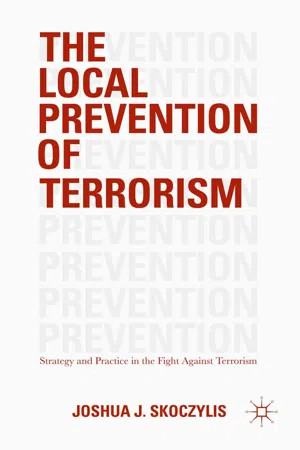
The Local Prevention of Terrorism
Strategy and Practice in the Fight Against Terrorism
- English
- ePUB (mobile friendly)
- Available on iOS & Android
eBook - ePub
The Local Prevention of Terrorism
Strategy and Practice in the Fight Against Terrorism
About this book
This book explores the success and failures of the Prevent strategy, which was developed by the UK Government to help stop people becoming terrorists or supporting terrorism. It provides a holistic overview of the policy's formation, delivery and impact on Muslim communities.
Information
1
Introduction
CONTEST, which stands for COuNter-TErrorism STrategy (Omand, 2010, p. 86), is, as the name suggests, the UK government’s principal strategy to counter terrorism, with the purpose of reducing ‘the risks to the United Kingdom ... from terrorism, so that people can go about their lives freely and with confidence’ (HM Government, 2011a, p. 6). This strategy has four principal workstreams: Pursue, Prevent, Protect and Prepare, also referred to as the four Ps. This book focuses primarily on Prevent, a policy which aims to ‘stop people from becoming terrorist or supporting terrorism,’(HM Government, 2011a, p. 10) and argues that the innovative inclusion of Prevent within the already established institutional framework has caused tensions between government agencies and departments on both national and local levels. The book is structured around two key elements: (1) a policy analysis of the formulation of Prevent, which explores the potential conflicts and tensions between Prevent and Pursue – a police and security led workstream – which is discussed partially in Chapter 2 and 3 and all of Chapter 5; and (2) a study of the policy’s local implementation, which is discussed in Chapter 6 and 7. Throughout, the chapters consider the relationship between the national policy and its local delivery as well as the impact Prevent has had on Muslim communities in the UK.
This chapter provides a brief overview of CONTEST, particularly Prevent and Pursue, and discusses changes that occurred in the three years leading up to 2015. This will be followed by an introduction to some of the key literature and the conceptual ideas that have emerged and underpin the Prevent policy. Gaps within the research literature are identified, setting the context for the book. Subsequent sections specify the purpose of the book and define its originality, and introduce the research design and data collection methods. The concluding section outlines the book chapters and their content.
The background
This book focuses mainly on Prevent and Pursue. Both of these workstreams fall under the umbrella of CONTEST. The four Ps, mentioned above, provide the government with a comprehensive domestic counter-terrorism strategy which goes beyond the police and the security services. CONTEST, which has been around since early 2003, combines aspects of criminal justice, prevention, protection of the public, and preparation for the aftermath of possible terror attacks. Despite the evolution of each of the workstreams, CONTEST remains structured around these four Ps. Since its initial publication in 2006, it has become more transparent, and since then two comprehensive and declassified versions have been published (HM Government, 2011a). Sir David Omand, the original architect of CONTEST, noted that
in the light of a realistic view of the nature and seriousness of the major risks facing the public we should look at what it would take to reduce those risks to the level at which we would all feel sufficiently confident to get out and get on with our normal lives taking reasonable precautions for our collective safety but not such as to inhibit our sense of freedom and self-confidence. (Omand, 2010, p. 86)
Within CONTEST there is an emphasis on anticipatory risks and the proactive countering of terrorism (Walker 2005), as the risk of mass casualties are deemed unacceptable (Suskind, 2006). To achieve its aims, multi-agency partnerships have been developed. These partnerships, and the recognition by successive governments that they needed to be seen to uphold human rights and the freedoms and liberty granted by the law, are key to CONTEST’s success. ‘This strategy gives us a more effective, better focused and more flexible response to the changing terrorist threat we face’ (HM Government, 2011a Foreword). The remaining sections in this chapter focus on Prevent, and more detail about CONTEST, Prevent and Pursue can be found in Chapter 3. Unless stated otherwise, any further references to CONTEST and Prevent refer to its 2011 versions.
Prevent was first introduced by the New Labour government in 2003, as part of CONTEST (Communities and Local Government Select Committee, 2010; Gregory, 2009), and it remained secret until its publication in 2006. The 2005 London bombings brought about a shift, challenging the then common perception that terrorists, embodied by the archetypical images of Al Qaeda and Osama Bin Laden, were foreigners; this was because the perpetrators of the attacks all came from British communities in the North East of England.
In old times, anyone fitting a stereotype – be it national, ethnic, racial or cultural – could be marked out as a potential foe. ... Yet whilst foreigners remain a threat, the menacing figures in the contemporary stage of terrorism are often our neighbours from within. (Walker 2008, p. 276)
The New Labour government acknowledges that Prevent had been underdeveloped, and that more needed to be done to address the evolution of the threat as well as the government’s understanding of it. The realisation that jihadi extremism was no longer just an international problem but also existed within UK communities meant that more efforts were put into developing Prevent (HM Government 2009). As the title suggests, Prevent was about preventing individuals and communities from supporting and/or engaging in extremism and terrorism. It derived from the notion that the socio-economic issues that give rise to anti-social behaviour and criminality are similar to those leading to extremism and terrorism (Omand, 2010, p. 92).
The New Labour government believed that engaging local Muslim communities and increasing their resilience against extremist ideologies was key to successfully countering extremism and terrorism. Collaboration between the police and local authorities, as well as working with at-risk communities, the voluntary and private sectors, was seen as central to successfully challenging extremist ideologies, increasing levels of trust, and fostering cooperation between affected communities and authorities:
Strong and empowered communities are better equipped to effectively reject the ideology of violent extremism, isolate apologists for terrorism and provide support for vulnerable institutions and individuals. (HM Government 2009, p. 83)
Under New Labour, Prevent focused primarily on community cohesion projects in Muslim communities – a claim that the government and successive CONTEST documents refute.
Although Prevent has changed over time, its aims remain focused on groups of people who are vulnerable to persuasion to provide tacit or even active support to terrorist groups (HM Government, 2011b). Often, however, these individuals may not break the law, and to this extent legislation and police action can be ineffective (Communities and Local Government Select Committee 2010). Under the New Labour government, the Department of Communities and Local Government (DCLG) took a lead role within Prevent. This is reflected in the core aims and objectives listed in the 2009 version of CONTEST. These were:
(1)to challenge the ideology behind violent extremism and to support mainstream voices;
(2)to disrupt those who promote violent extremism and to support people living in the communities where they may operate;
(3)to support individuals who are vulnerable to recruitment, or have already been recruited by violent extremisms;
(4)to increase the resilience of communities to violent extremism;
(5)to address grievances which ideologies are exploiting;
(6)to develop supporting intelligence, analysis and information;
(7)to improve strategic communication (HM Government 2009, p. 14).
The integration of Prevent into CONTEST has led to allegations of spying, and some have argued that Prevent was attempting to securitise community cohesion and social policy (Communities and Local Government Select Committee 2010). Prevent also includes a more hard-edge programme called Channel – a programme which focused on individuals identified as ‘at risk’ of engaging in extremism – and programmes within prisons; Channel has moved centre stage under the Prevent review. Some critics argued that Prevent was too broadly focused, giving the impression that the government only included cohesion projects to securitise integration (HM Government, 2011b, p. 30). Much of the Prevent work has been carried out by local authorities across the UK. Over time, local councils have developed local Prevent policies which are based and modelled on the national Prevent policy; local councils were given broad autonomy, something that many national policymakers and politicians criticised. This will be discussed in more detail in Chapter 4 and 5.
Until 2011, the Prevent policy focused principally on broad secondary prevention. However, it also included specific programs such as Channel, and tertiary prevention in prisons. Over the last five years, local authorities delivering Prevent have been accused of mainly targeting and spying on Muslim communities, misusing Prevent funds, funding groups and individuals perceived to be extremist and paying for spuriously related local authority projects (Communities and Local Government Select Committee 2012).
The Coalition Government published its Prevent review in 2011. The review heralded significant changes, shifting its focus from community cohesion to challenging extremist ideology (although generally not through community cohesion projects), and identifying those at risk of radicalisation (HM Government, 2011b). Although local authorities were still at the heart of delivering Prevent, funding and guidance was now tightly controlled by the Home Office’s OSCT rather than the DCLG. Tackling extremism not linked to jihadi ideologies, and addressing real and perceived grievances, were no longer key elements of the new Prevent policy. The new aims and objectives demonstrate this. These were:
(1)responding to the ideological challenges of terrorism and the threats we face from those who promote it;
(2)preventing people from being drawn into terrorism, and ensuring that they are given appropriate advice and support; and
(3)working with sectors and institutions where there are risks of radicalisation which we need to address. (Adapted from HM Government, 2011b, p. 7)
The revised policy focuses on working with national and local government agencies as well as the voluntary and private sector. Aside from the organisations already engaged in Prevent, such as the police, the government aimed to involve healthcare and educational professionals, to increase cooperation, and identify and share information about individuals perceived to be involved in/or at risk of radicalisation (HM Government, 2011b). Essentially, the policy moved from broad secondary prevention to a more narrowly focused prevention approach. Prevent shifted towards a program of net-widening and surveillance, although aspects of this had already been present (Zedner, 2009). As Power observed: ‘the management of uncertainty is inherently paradoxical, an effort to know the unknowable’ (Power, 2004, p. 59). This quest for knowledge and the gathering of as much information as possible, focusing on Muslim communities and individuals with perceived links to jihadi extremism, has become ingrained within Prevent’s purpose.
Pursue, on the other hand, aimed to stop terrorist attacks through detection and by investigating threats ‘at the earliest possible stage, disrupting terrorists activities before it can endanger the public and, whenever possible prosecute those responsible’ (HM Government, 2011b, p. 45). Essentially, Pursue is the criminal justice response to terrorism, although intelligence gathering by the police and the security services also plays a large role. The book argues that counter-terrorism operations and government executive measures can influence public perceptions, and can either undermine or strengthen the trust in government authorities, in particular the police (Weisburd et al., 2010). Negative media and political discourses and their portrayal of counter-terrorism policing such as stop-and-searches, dawn raids and arrests appear to have influenced public perceptions – particularly those of Muslim communities – affecting the level of trust that these communities and the individuals within them placed in the police/authorities, and negatively affecting their willingness to engage with them (Sunshine & Tyler, 2003).
Local police forces carry out work both on Prevent and Pursue. More specialised units, such as the regional Counter-Terrorism Units, have taken on the traditional role of counter-terrorism policing, while local police forces have taken on Prevent and community engagement. At times there have been tensions between the Pursue and Prevent workstreams. These tensions centre on information-sharing and on the value given to community cohesion work in the area of counter-terrorism. These tensions will be discussed in more detail in later chapters.
The book and its purpose
This book argues that Prevent is innovative but embodies inherent policy and organisational tensions that are difficult to resolve. These tensions have a direct impact on community perceptions and hence on the success of Prevent within Muslim communities. The book is structured around the two key elements, namely a policy analysis of the formation of Prevent, and a study of its local implementation and impact. These two key elements are further broken down and organised around the following four research objectives:
(a)an analysis and critique of the ideas that inform the Prevent policy (see Chapter 2 and 3);
(b)an analysis and critique of the conflicts and tensions that arose within the Prevent policy on a national level, as well as its implications on local delivery (see Chapter 4);
(c)an analysis and critique of the tensions and conflicts that arose between the organisations involved in the local implementation of Prevent, such as the police and the local authorities, and a consideration of the implications on the delivery process (see Chapter 5); and
(d)an analysis and critique of how counter-terrorism policing and prevention have affected local Muslim communities, and how they have shaped community perceptions and willingness to engage with authorities in counter-terrorism policing and the Prevent agenda, while considering their wider implications on both Prevent and Pursue (see Chapter 6).
Each of these objectives is individually addressed in the chapters that follow, providing a policy analysis and study of its implementations in the case study area.
The success of CONTEST and Prevent must also be measured against these declared aims, although evaluation is a contested issue. The following chapters will ask questions such as: How does this policy ensure that the freedoms outlined in the policy document are upheld? What safeguards are undertaken to ensure that it does not become a programme of surveillance akin to that in a police state? It will also examine how the freedoms of Muslim communities are protected, and what impact the perceived lack of protection has on their level of engagement in both Prevent and Pursue.
To answer these questions and identify the tensions, the book takes a holistic approach, examining the ‘three stages’ of the policy process in the conte...
Table of contents
- Cover
- Title
- 1 Introduction
- 2 Concepts and Tensions Affecting Prevent
- 3 Is CONTEST Innovative? Counter-Terrorism and Prevent
- 4 The National Implementation of Prevent
- 5 Prevent and Its Local Professional Delivery
- 6 Local Communities and Prevent
- 7 Conclusion
- Appendix
- Bibliography
- Index
Trusted by 375,005 students
Access to over 1.5 million titles for a fair monthly price.
Study more efficiently using our study tools.
Frequently asked questions
Yes, you can cancel anytime from the Subscription tab in your account settings on the Perlego website. Your subscription will stay active until the end of your current billing period. Learn how to cancel your subscription
No, books cannot be downloaded as external files, such as PDFs, for use outside of Perlego. However, you can download books within the Perlego app for offline reading on mobile or tablet. Learn how to download books offline
Perlego offers two plans: Essential and Complete
- Essential is ideal for learners and professionals who enjoy exploring a wide range of subjects. Access the Essential Library with 800,000+ trusted titles and best-sellers across business, personal growth, and the humanities. Includes unlimited reading time and Standard Read Aloud voice.
- Complete: Perfect for advanced learners and researchers needing full, unrestricted access. Unlock 1.5M+ books across hundreds of subjects, including academic and specialized titles. The Complete Plan also includes advanced features like Premium Read Aloud and Research Assistant.
We are an online textbook subscription service, where you can get access to an entire online library for less than the price of a single book per month. With over 1.5 million books across 990+ topics, we’ve got you covered! Learn about our mission
Look out for the read-aloud symbol on your next book to see if you can listen to it. The read-aloud tool reads text aloud for you, highlighting the text as it is being read. You can pause it, speed it up and slow it down. Learn more about Read Aloud
Yes! You can use the Perlego app on both iOS and Android devices to read anytime, anywhere — even offline. Perfect for commutes or when you’re on the go.
Please note we cannot support devices running on iOS 13 and Android 7 or earlier. Learn more about using the app
Please note we cannot support devices running on iOS 13 and Android 7 or earlier. Learn more about using the app
Yes, you can access The Local Prevention of Terrorism by Joshua J. Skoczylis in PDF and/or ePUB format, as well as other popular books in Social Sciences & Terrorism. We have over 1.5 million books available in our catalogue for you to explore.