- English
- ePUB (mobile friendly)
- Available on iOS & Android
eBook - ePub
About this book
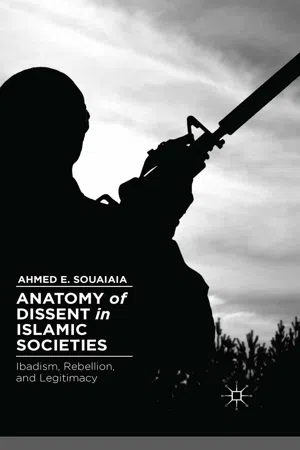
Anatomy of Dissent in Islam is an interdisciplinary study of political and legal dissent in Islamic civilization from the seventh century on. (7th century). Using Ibadism as a case study, this work explores the events and teachings that shaped legitimacy and rebellion, orthodoxy and sectarianism, and law and culture in Islamic societies.
Information
C H A P T E R 1
INTRODUCTION
THE SO-CALLED ARAB SPRING—A NONVIOLENT PROTEST MOVEMENT THAT led to the overthrow of the Tunisian and Egyptian presidents—reached Syria on March 15, 2011. Young men and women descended on public squares in major Syrian cities demanding a political order that treats them with dignity. Within weeks, the peaceful protests turned into an armed uprising.
This rapid escalation was due in part to the success of the military campaign that Qatar, France, and NATO had led that year to overthrow Libyan leader Muammar Qaddafi. The rulers of the Gulf States loathed the Syrian regime, which was known for its alliance with anti-West countries and armed groups like HAMAS, Hezbollah, and the Islamic Jihad. Seeing an opportunity in the protest movement in Syria, they reckoned that by escalating the crisis in Syria they might be able both to overthrow Bashar al-Assad and to direct the flood of the Arab Spring away from their own countries. To train and arm the Syrian rebels, the Gulf State leaders formed an alliance with Turkey, a country with a thirst for energy and a need for direct access to oil and natural gas from the Gulf region. Within months, Syria became the land of jihad, attracting thousands of fighters from all over the world.
Although this phenomenon to some extent resembles events such as the anti-USSR Afghan resistance in the 1980s, the Islamist fighters in Syria have drawn special attention from Islamicists, commentators, and politicians. In the past, Islamicists and Middle East experts have generically labeled conservative religious movements “Islamists.” But the Arab Spring has made it clear that we need a deeper understanding that can differentiate among the many widely differing Islamist groups and movements. Some scholars have coined the label “neo-Kharijism” to distinguish the Salafis (Syrians and non-Syrians), who fight to establish a puritan Islamist order, from the Syrian rebels, who fight for the ouster of the Ba`ath regime.
The characterization of Jihadi Salafists as Kharajites is conceptually significant. Even more notable, however, is the fact that these scholars have referenced a movement from the seventh century CE (Kharajites) to explain a phenomenon of the twenty-first century (Salafism). The suggestion that some modern religious groups may have roots in the distant past underscores the need for comprehensive, informed scholarship on the development and evolution of Islamic societies. It is increasingly clear that one cannot explain what is happening now in the Arab countries without looking for historical factors that go back more than a thousand years. Meaningful appreciation of today’s transformative events is contingent upon understanding the rich legacy of the past and on grasping the intricacies of contemporaneity that shape societies. For those seeking to understand the forces that shape modern Islamic societies, in this work I explore the interplay between historical forces and current events in the Middle East.
Given its demographic weight and economic potential, the Islamic world has emerged as both a challenge and an opportunity for world leaders today. In January of 2009, for the first time in US history an American president addressed the Muslim world directly, when President Barack Obama proclaimed in his inaugural speech a new era based on “mutual respect and mutual interests.” In Egypt six months later, he again spoke directly to the Muslim world and outlined a new road map for American-Islamic relations. We should not expect a singular reaction to this overture from the Muslim world, however, since it is not a monolithic or homogeneous entity, but a mosaic of ethnicities, cultures, ideologies, political systems, and identities.
There have been many attempts to create a sense of unity among the 1.5 billion Muslims around the world. The Organization of the Islamic Conference (OIC) includes fifty-seven countries whose population is majority Muslim. The Arab League was created to give a single voice to twenty-two nations where Arabic is the primary language of the majority of the citizens; because the majority of these people are Muslim, the Arab League acts as a proxy for Islam as well. Self-proclaimed global associations of Muslim scholars, such as the International Union of Muslim Scholars, claim ultimate authority regarding critical issues facing the Ummah. Institutions such as al-Azhar, Najaf, and Qom provide training to religious scholars in order to maintain continuity and uniformity in religious teachings and practices. And while sectarian divisions keep the Muslim world pluralistic, they also provide relative systematization within each of the major Islamic sects: Sunni, Shi`i, and Ibāḍī.
In spite of the unifying efforts of such institutions of learning and leadership, the Muslim world remains politically unstable. A short list of examples includes two failed states (Somalia and pre-2003 Afghanistan), several civil wars (Algeria, Sudan, and Yemen), many border disputes, military occupations, and invasions (Sahara, Morocco, Chad, United Arab Emirates, Iran, Kuwait, Iraq, Afghanistan, etc.), and widespread civil unrest and political repression (Egypt, Tunisia, Libya, Syria, Lebanon, Jordan, Bangladesh, Indonesia, Turkmenistan, Mauritania, etc.). The West generally categorizes the Islamic world according to its leaders’ temperament or personalities: the “moderate” and “extremist” axes. The lack of stable institutions and absence of systematic transfer of power in the Islamic world will likely remain one of the most significant challenges for world leaders for at least the next several centuries.
While each regime claims fidelity to “authentic” Islamic guidelines, Arab and Muslim states have adopted diverse forms of government. Saudi Arabia identifies its power structure with the Umayyad dynasty of the eighth century. Iran’s regime embraces the vice regency of the jurisprudent (walī-faqīh) paradigm, linking their model to a modified interpretation of Ja`farī jurisprudence of the ninth century. Jordan and Morocco rely on their kings’ alleged blood relations to the Prophet Muhammad to assert an authority that transcends constitutional allowances. Many religious movements—from the grassroots-focused Muslim Brethren to the militaristic al-Qaeda—justify their quest for power by their desire to revive an authentic Islamic model of governance. Civil wars have been justified on religious grounds, religious personalities have inspired and guided revolutions, and declarative religious claims have both fostered and destroyed stability. As we survey this modern multiplicity of ideas and practices, the Prophet Muhammad’s accomplishment in creating a unified Islamic order looms as an extraordinary achievement.
To find the roots of the existing paradigms and principles of Islamic political theories, we must examine the complex historical evolution of Islamic civilization. If there is a single settled principle that I have acquired from reading just some of the vast literature on this subject, it is that in law and politics, there are no absolutes, only circumstances. Rather than seeking to determine the truth of statements and judgments, legal scholarship should instead focus on understanding their context. In Islamic civilization, certainly, the religious discourse has affected historical events. But by examining little-known contributions of the Ibāḍī heritage to the development of Islamic traditions of dissent, this work demonstrates that circumstance and reason are key factors in shaping not only legal and political matters but also ethical and theological truths.
Perhaps the single most significant event in the history of Islamic civilization was the first civil war, which resulted in the slaying of the third caliph, `Uthmān Ibn `Affān. As he took refuge in his home while the rebels reinforced the siege around him, `Uthmān declared, “if I were to be killed in this uprising, Muslims will never be ruled by a single authority and their unity will be destroyed forever.” These prophetic words marked the end of the era of a single regime that ruled by consensus and the ushering in of an era of fragmentation, pluralism, and dissent.1
This first civil war was a profoundly transformative moment. Ever since the end of the rule of `Uthmān, Muslims have employed violence to eliminate internal adversaries. Yet despite the fact that many of the sectarian disputes, political contestations, and religious controversies of today have their roots in this time,2 too little research and critical study has focused on the seventh and eighth centuries and the outcome of these cataclysmic events.
The Ibāḍīs have received the least attention, though they were one of the main groups involved in the civil war. Reconstructing the history of early Islamic societies by focusing only on Sunni and Shi`i Islam to the exclusion of the Ibāḍīs is like attempting to erect a tripod on two legs. This study is one of the first attempts at providing a fuller picture of the place of dissent and rebellion in Islamic civilization by interpreting Sunni and Shi`i records in the context of Ibāḍī materials, especially those that modern scholars have yet to examine.
This work starts by examining the events of the formative period (seventh century) and concludes with events of the modern era. I approach these topics with a singular focus: theoretical and applied dissent in Islamic societies. However, explaining dissent cannot happen in a vacuum. Islamicists must examine dissent within a background and foreground that features related concepts and contexts.
“Dissent,” as understood for this work, covers both political and legal dissent. While legal dissent has given rise to schools of jurisprudence, in Islamic civilization political dissent has often resulted in sectarianism by way of rebellion. While this work will not address Islamic revolutions such as the Abbasid and other revolutions, since revolution is theoretically a stage of rebellion, it will seek nonetheless to explore and elucidate the concepts of dissent, consent, rebellion, revolution, and legitimacy within the context of Islamic sectarian and jurisprudential literature.
Given this framework, I have worked under the assumption that Islamic teachings and practices have left an imprint on the notions of dissent and consent. It is therefore essential to provide a sufficient historical background of the early Muslim community and key figures. This does not mean that I assume my audience is uninformed, but because readers will not necessarily share my perspective on Islamic history, this background information will provide some clues about my own assumptions, biases, and understanding of the issues as a student and an author. For these reasons, I include in this introduction and at the start of each chapter brief historical accounts of key events and institutions, as I understand them, which are necessary to the development of ideas about the topics of this work.
I do not expect readers to believe that because this is a work of scholarship, the author is objective at all times and in all places. While it is my aim and my wish to be objective when reporting facts, my opinions are, nonetheless, present throughout this work. With that said, I will now begin by situating key figures, places, and events in a historical context and timeline.
* * *
His lasting impact on both the short- and long-term development of Arab and Muslim societies makes it clear that Muhammad must have been an inspiring leader, a shrewd politician, and a skilled commander. Despite a humble background and unprivileged upbringing, his accomplishments have inspired and his ideals have transformed millions of people. Muhammad combined the mysticism of a monk, the realism of a king, and the transformative power of a revolutionary. Perhaps even more impressive was his ability to manage dissent among tribes known for their egalitarian values and feudal lifestyle. Indeed, he seems to have been so successful that by the end of his life, he had almost muted dissent altogether. His accomplishments were due both to a personal disposition to find compromises where none seemed possible and to his extraordinary claim to access divine wisdom.
Born in Mecca around 570 CE, Muhammad came from an ordinary—or even disadvantaged—background. His father passed away before his birth, and as was the practice then, Muhammad was sent to the countryside to be suckled by a Bedouin woman. When he was six his mother died and he was adopted by his uncle Abū Ṭālib, to be raised with seven of his cousins. At first a sheepherder, he became a trader and gained recognition for his honesty and deal-making abilities. That reputation earned him the trust and affection of a woman named Khadījah, who employed him to manage her trade business and the substantial fortune that she had inherited from three deceased husbands. When Muhammad was about twenty-five years old, Khadījah—then forty years-old—asked him to marry her. They had two sons and several daughters and remained together until Khadījah passed away at the age of sixty-five. Though both sons died at a very young age, his youngest daughter stayed with him until he migrated to Madīnah. That much is known about his personal life: so ordinary that it hardly made its imprint on the history books.3
The legacy of Muhammad that is preserved in oral and written Arabic traditions begins when he was forty—his age when he claimed to have had an encounter with an extraordinary being, subsequently identified in Islamic literature as the archangel Gabriel. While Muhammad was meditating in a cave overlooking the city of Mecca, this being emerged out of thin air before him and uttered the word: “Recite!” Distraught, Muhammad reportedly replied, “Recite what?” (mā anā bi-qāri’?). The uninvited visitor then recited for him two beautifully composed sentences. Muslim exegetes later recorded these words as part of the Qur’ān and the first several verses of a Muṣḥaf (book) containing nearly 6665 verses in total.
Weeks after this first frightening manifestation,4 Muhammad relived the experience. This time, the communicated verses instructed him to leave his isolation and declare publicly that he was the Messenger of God (Rasūl allāh). He announced that God had sent him a message of righteousness and justice rooted in the belief in the one God worshipped by the People of the Book, the Jews and the Christians (ahl al-kitāb). For ten years, Muhammad continued to periodically receive these revelations (waḥy) and confront his people with new teachings that challenged their way of life, their social practices, and their belief systems. The majority of his followers at this point were former slaves that he or his friends emancipated, servants, and poor Bedouins, with only a handful of more renowned and affluent people from the tribe of Quraysh.
While this new movement that equated the slave with the master in humanity and dignity irritated the leaders of Quraysh, it also incited the curiosity of the leaders of Madīnah. As Quraysh, the powerful supertribe of Mecca, prepared to crush Muhammad’s movement, the city of Yathrib (later renamed to Madīnah) sent a delegation of leaders twice in two years to convince him to migrate to Yathrib and help them bring peace to a community depleted by war, murder, and revenge. On the second visit, they reached a compromise, and he agreed to relocate to their city on the condition that they accept him as the Messenger of God and their political leader. On July 16, 622 CE, Muhammad, his friend Abū Bakr, and a guide set out for Madīnah under the cover of darkness. Having instructed his followers to leave weeks before, Muhammad was the last to leave Mecca, with the exception of his son-in-law Ali, who stayed as a decoy.
When he reached the city of Yathrib, Muhammad told his hosts that his camel was instructed to choose the place where he would spend his first night. Because the feuding leaders of Yathrib all wanted Muhammad to stay in their houses, for Muhammad himself to choose one leader’s house over another’s would inevitabily anger someone. This subterfuge of leaving the decision to a camel exemplifies Muhammad’s exceptional skill at mediating conflicting demands and reconciling competing interests. In fact, the camel walked a few yards and then rested in an empty lot. The Prophet explained that there they would together build both his home and the house of God. A hut was hurriedly erected for him to use as his private home, and next to it they began to build the larger space that would come to be known as the Mosque of the Prophet, the first in the City of the Prophet (Madīnat al-nabiyy; later shortened to al-madīnah).
According to Muslim biographers and Ḥadīth scholars, the Prophet Muhammad continued for another decade or so to receive periodic revelations, which he taught to his followers and instructed seven of his scribes to write down. He counseled that memorizing the Qur’ān by heart is the ultimate act of piety, and many people undertook...
Table of contents
- Cover
- Title
- 1. Introduction
- 2. Governance in Arab and Islamic Societies
- 3. Origins and Transformation of Ibadism
- 4. Islamic Law and Jurisprudence Reconsidered
- 5. Statelessness and Leaderlessness
- 6. Conclusions
- Notes
- Bibliography
- Index
Trusted by 375,005 students
Access to over 1.5 million titles for a fair monthly price.
Study more efficiently using our study tools.
Frequently asked questions
Yes, you can cancel anytime from the Subscription tab in your account settings on the Perlego website. Your subscription will stay active until the end of your current billing period. Learn how to cancel your subscription
No, books cannot be downloaded as external files, such as PDFs, for use outside of Perlego. However, you can download books within the Perlego app for offline reading on mobile or tablet. Learn how to download books offline
We are an online textbook subscription service, where you can get access to an entire online library for less than the price of a single book per month. With over 1.5 million books across 990+ topics, we’ve got you covered! Learn about our mission
Look out for the read-aloud symbol on your next book to see if you can listen to it. The read-aloud tool reads text aloud for you, highlighting the text as it is being read. You can pause it, speed it up and slow it down. Learn more about Read Aloud
Yes! You can use the Perlego app on both iOS and Android devices to read anytime, anywhere — even offline. Perfect for commutes or when you’re on the go.
Please note we cannot support devices running on iOS 13 and Android 7 or earlier. Learn more about using the app
Please note we cannot support devices running on iOS 13 and Android 7 or earlier. Learn more about using the app
Yes, you can access Anatomy of Dissent in Islamic Societies by A. Souaiaia in PDF and/or ePUB format, as well as other popular books in Social Sciences & Middle Eastern History. We have over 1.5 million books available in our catalogue for you to explore.