- English
- ePUB (mobile friendly)
- Available on iOS & Android
eBook - ePub
About this book
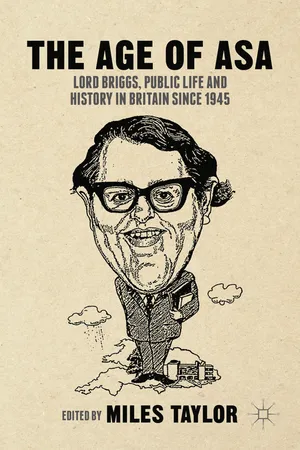
Asa Briggs has been a prominent figure in post-war cultural life - as a pioneering historian, a far-sighted educational reformer, and a sensitive chronicler of the way in which broadcasting and communication more generally have shaped modern society. He has also been a devoted servant of the public good, involved in many inquiries, boards and trusts. Yet few accounts of public life in Britain since the Second World War include a discussion or appreciation of his influential role. This collection of essays provides the first critical assessment of Asa Briggs' career, using fresh research and new perspectives to analyse his contribution and impact on scholarship, the expansion of higher education at home and overseas, and his support and leadership for the arts and media more generally.
The online bibliography of Asa Briggs' publications which accompanies the book is available on the The Institute of Historical Research website here.
Information
Part I
History
1
The Interconnectedness of Things: Asa Briggs and Social History
Rohan McWilliam
Threaded through the footnotes of Richard Hoggart’s pioneering The Uses of Literacy are a number of references to his colleague at the University of Leeds, Asa Briggs.1 Hoggart finds support from Briggs for his belief that working-class life in the small towns of Yorkshire ‘can more easily have dignity … than in the big cities’. This is because street life possesses, as Briggs reminded Hoggart, a ‘hierarchy of specialisation’, defined by people who are known for different skills, whether a man, ‘good with his hands’, who can help out a neighbour or a woman who puts her talent for fine needlework to good use on special occasions. These crafts or talents not only provided satisfaction but were gifts to the group, distinct from professional or individualistic services. Yet Briggs’ input also suggested this was not a world to be idealised. A common part of life was the family row, which could not be concealed from the neighbourhood because the walls were so thin.2 If we want to understand Briggs as a social historian, it is best to start with him as a social observer, noting the contours of everyday life, comparing the experiences of his Keighley childhood with other parts of Yorkshire. Briggs insists he has ‘learnt as much from landscape and townscape as from books’.3 On another occasion, he urges ‘[t]here is no substitute for knowing a city: reading about it is second best’.4 His scholarship is notable for its concern with the texture of life but also with the way everyday life is structured. Briggs acknowledges that the ‘the co-existence of smoking chimneys and heather among the bracken in the hills’ in Keighley helped determine his interest in 19th-century Britain.5
Few have done more to shape the development of social history as a discipline than Asa Briggs.6 He is often credited with helping launch the fields of labour history, urban history, leisure history and the history of mass communications, amongst other subdisciplines. However, the significance of his work and those who are comparable to him (such as Harold Perkin and Brian Harrison) remains surprisingly undiscussed in the literature on trends in modern history. This has left a hole in our understanding of historiography, which this chapter seeks to begin to fill.7
The absence can be explained. The conventional narrative of the rise of social history in Britain places a lot of emphasis on those who were associated in the 1940s with the Communist Party Historians Group (such as Eric Hobsbawm and E. P. Thompson) as well as the wider group of figures who would go on to found Past and Present. Much of this literature was formed by an engagement with Marxism or, at least, some form of theory. In contrast, Briggs’ work has tended to eschew elaborate discussions of either theory or methodology. Briggs has never been a Marxist (though he has written and broadcasted on Marx) and his work carries its politics lightly; he sits in the House of Lords as a cross-bencher.8 We can infer a left-leaning inclination from some of the topics he has written about (he is also clear that he regards Clement Attlee as Britain’s best post-war prime minister).9 But, if we can observe traces of political commitment, there is nothing approaching the passionate polemics of E. P. Thompson or the panoramic portraits of capitalism to be found in Hobsbawm’s histories.
This absence of theorising or discussion of methodology is deceptive because Briggs’ histories in fact offer a profound way of understanding the past of British society and elsewhere. Moreover, his writings and career make him one of the architects of the post-1945 social democratic settlement. It was the work of intellectuals such as Briggs that helped establish the common sense’ of post-war politics and social policy, where the inequalities of British society had to be ameliorated through redistribution and a healthy public sector. We need to explore the meanings of Briggs’ work and to place it in its historical context. In this article, I deliberately contrast Briggs’ views with those of subsequent scholars who have covered similar territory. This is partly to locate Briggs’ scholarship in its historical moment but also to show its enduring influence in the establishment of problems and paradigms, even if later historians have chosen to do things differently.
What was the academic subject of history like before Briggs’ generation began to change things in the 1950s and 1960s? History as an academic subject in British universities was dominated by political, diplomatic and constitutional history but also, increasingly, by economic history. In addition, university history degrees often ended their coverage with the early 19th century. The rise of social history therefore represented a challenge to the way history was being written at the time.
To some extent, social history had always existed, but it frequently took the form of antiquarian narratives that were strong on colour and a feeling for the customs and manners of the people, but which were unstructured and unsystematic. Things began to change between the wars, which saw the development of serious academic work in the field. The Annales school made the running after 1929 in France, whereas in Britain social history was a subset of economic history. There were figures such as Eileen Power (an influence on Briggs) and M. M. Postan, whose medieval histories blended social and economic aspects; so too did R. H. Tawney’s work on the 16th century.10 Dorothy George wrote extensively about 18th-century social life and the study of demography also expanded.11 G. M. Trevelyan’s best-selling social history of England, published in 1944 and dedicated to Eileen Power, showed how the subject could have broad popular appeal.12
The experience of the depression and then the disorienting impact of the Second World War generated new interest in the ways societies have behaved historically. The opening up of higher education after the war and the increasing attractions of Marxism to some scholars ensured that history could no longer be simply concerned with the politics of the elite. The decision by the University of Oxford (at the instigation of G. D. H. Cole, himself a social historian) to make Briggs a Reader in Recent Social and Economic History in 1950 therefore illustrated the way that the discipline was changing. Briggs was able to develop 19th-century British history as a field. If we emphasise here Briggs’ role as a pioneer of social history, it should also be acknowledged that he was working with the grain of his time; there were many others (such as Keith Thomas and Peter Laslett) who expanded the scope of academic history in the 1950s and 1960s.
What distinguished the post-war generation was a desire to shift away from anything that appeared impressionistic, painterly or antiquarian. In its place came the emphasis on a scientific approach (hence the original subtitle of Past and Present, ‘a journal of scientific history’) or, at least, the attempt to engage with the social sciences. Social history was affected by the rise of sociology and anthropology as academic disciplines in the post-war period; sociologists such as Michael Young were examining the ways communities behaved whilst anthropology became a key influence for figures such as Keith Thomas.13 Measuring change in precise terms became the stock-in-trade of the social historian, which meant that parliamentary papers, census data, surveys and other new forms of evidence were pressed into service. Marxists and non-Marxists, studying Britain (and elsewhere) in the period after about 1780, were focused on the significance of class, capitalism, hierarchy and inequality. Thus, social historians became associated with putting peasants, working-class and other subaltern groups back into the historical record. This was only ever one dimension of the way in which they approached the past; figures such as F. M. L. Thompson demonstrated how it was possible to write a social history of the aristocracy.14 The next generation (from the 1980s onwards) was less emphatic about class but more concerned with the categories of race, gender, national identity and selfhood when studying society.
The rise of social history was not uncontroversial. Some political historians resisted it and claimed it was less important than matters of state and diplomacy. This meant that social history (at least in its early years) had a slightly oppositional dimension. In what sense was Briggs part of this new wave? Briggs’ work was of its time in reflecting deeply on changes in social structure; on the other hand, it never had the obsession with quantification that became a characteristic of social history in its early years. Social history tended to flourish initially on the fringes of mainstream academic life and particularly in adult education. Briggs significantly played a major role in the Workers’ Educational Association from the 1950s onwards, serving as vice-president and then president. When Briggs was at the University of Leeds, he developed strong connections with figures in the extramural department such as J. F. C. Harrison. Briggs was therefore well connected with these intellectual currents, which challenged the curricula of many university history departments.
The interconnectedness of things is the central Briggsian insight. To say that Briggs ignores theory does not mean that his are works of naïve empiricism. On the contrary, they are examples of ideas-driven history. In Isaiah Berlin’s terms, Briggs has been a fox and not a hedgehog.15 Briggs’ work abounds with reflections on the way modern society has been shaped. He explains that, for him, ‘social history is concerned both with structures and with processes of change, but the best way of exploring these things is to focus on experience’.16 If there is no explicit theory of history, there is a strong sense that the relationship between economy and society is an important driver of change. Not for nothing did he do an undergraduate degree in economics as well as in history. He has therefore been concerned fundamentally with the relationship between social groups, pushing forward understandings of class and social reform that modern historians now take for granted. Briggs’ gaze as a social historian runs from the welfare state to apparently trivial pieces of ephemera such as Staffordshire figurines. He understands the role of institutions in shaping modern life, from the BBC to Marks and Spencer. At the same time, there is a recognition of the ambiguities and complexities of social change that mean he cannot be pigeon-holed in a simple way. We catch a cautious but sensible methodology when he describes his approach to local history: ‘Avoid generalizations until you were sure that could make them. Stick to particularities’.17 This is precisely why he is an important thinker. It is characteristic of him that, despite helping to launch a number of subdisciplines of history, he has always disliked the way these tended to take institutio...
Table of contents
- Cover
- Title Page
- Copyright
- Contents
- Foreword by David Cannadine
- Acknowledgements
- Notes on Contributors
- Introduction: Asa Briggs and Public Life in Britain since 1945
- Part I: History
- Part II: Broadcasting
- Part III: Universities
- Select Bibliography
- Index
Trusted by 375,005 students
Access to over 1.5 million titles for a fair monthly price.
Study more efficiently using our study tools.
Frequently asked questions
Yes, you can cancel anytime from the Subscription tab in your account settings on the Perlego website. Your subscription will stay active until the end of your current billing period. Learn how to cancel your subscription
No, books cannot be downloaded as external files, such as PDFs, for use outside of Perlego. However, you can download books within the Perlego app for offline reading on mobile or tablet. Learn how to download books offline
We are an online textbook subscription service, where you can get access to an entire online library for less than the price of a single book per month. With over 1.5 million books across 990+ topics, we’ve got you covered! Learn about our mission
Look out for the read-aloud symbol on your next book to see if you can listen to it. The read-aloud tool reads text aloud for you, highlighting the text as it is being read. You can pause it, speed it up and slow it down. Learn more about Read Aloud
Yes! You can use the Perlego app on both iOS and Android devices to read anytime, anywhere — even offline. Perfect for commutes or when you’re on the go.
Please note we cannot support devices running on iOS 13 and Android 7 or earlier. Learn more about using the app
Please note we cannot support devices running on iOS 13 and Android 7 or earlier. Learn more about using the app
Yes, you can access The Age of Asa by M. Taylor in PDF and/or ePUB format, as well as other popular books in History & British History. We have over 1.5 million books available in our catalogue for you to explore.