- English
- ePUB (mobile friendly)
- Available on iOS & Android
eBook - ePub
About this book
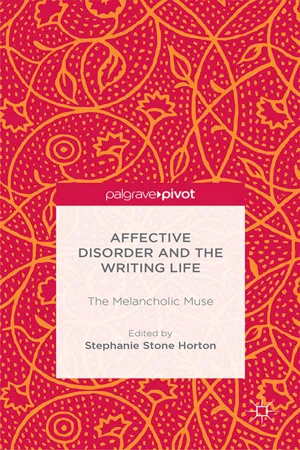
Affective Disorder and the Writing Life interrogates the mythos of the 'mad writer' through lived experience, literary analysis, writerly reflection and contemporary neuroscience. It explores how affective disorders colour, drive and sometimes silence the writing mind – and how affective difference has always informed the literary imagination.
Information
Part I
“Could It Be Madness, This?” Affective Difference and the Work of Composition
1
“What Ceremony of Words Can Patch the Havoc?”: Composition and Madness
Stephanie Stone Horton
Abstract: In a 15-year longitudinal study little known outside of psychiatry, fully 80 per cent of a writers’ group at the Iowa Writers’ Workshop reported living with, or experiencing an incidence of, an affective disorder – as opposed to 30 per cent of non-writer controls. Springing from this study, this survey breaks ground by examining the persistent linkage of affective disorders (depression and bipolar disorder) and writing creativity, from the Phaedrus to today’s stunning PET and SPECT scans of depressed, manic, and non-affectively disordered brains. The essay also calls for new research alliances between composition studies and neuroscience – research into states such as writer’s block, hypergraphia, and the exuberant pressured speech of mania. The year 2013 marks the fiftieth anniversary of Sylvia Plath’s suicide; her work provides fertile ground for this exploration of affective madness and invention.
Keywords: Affective disorders; creativity; depression; bipolar disorder; writer’s block; hypergraphia; neuroscience; Sylvia Plath
Horton, Stephanie Stone, ed. Affective Disorder and the Writing Life: The Melancholic Muse. Basingstoke: Palgrave Macmillan, 2014. DOI: 10.1057/9781137381668.
Cutting through
To be a poet is a condition, not a profession.
Robert Greaves
Of all that is written I love only what a man has written with his blood.
Nietzsche
First day of a graduate class, and we must create a metaphor for our own writing. A free write-and-share, a little harmless fun.
A 30-year-old memory flows in, unstoppable. An Oklahoma sky so blue it hurts. Red blood on gray pavement. I put pen to paper, and the chorus – a familiar presence – sidles up, taking my elbow.
“What on earth – you can’t write that!” it whispers.
The room is quiet, save for scribbling. My knot-heart turns to stone. Now that I think of it, this metaphor is bizarre; I have no idea where it is trying to go. I try to think of another, but this unwanted child of the mind crowds out all others. The chorus weighs in again, oracular:
This metaphor has nothing to do with writing! It’s gratuitous. These people are going to think you’re a freak.
The minutes tick by. I cast a furtive glance at the writer on my left (“For me, writing is like cooking”) and the notebook on my right (“For me, writing is like gardening”). Both knowledgeable, ethos appropriate to audience. My throat closes. Once again, I try – hard – to commit even a single word to paper, to capture sky and wind and horror. Now the chorus gets personal:
You just want attention, don’t you? You’re pathologically morbid. You’re already an outsider here; this little trick will cement it.
Out of time and ideas, I force metaphor to paper:
For me, writing is like opening a vein. Mind you, I’ve never actually opened a vein. But that’s how it feels when I try to write. I’m not a cutter, but I know they find relief in the cutting through of things, in the warm living flow.
When I was 19, I saw a girl die in a motorcycle accident. A station wagon ran a stop sign and broadsided the bike and its two riders, who flew over the car like rag dolls. One tried to get up despite an ankle snapped 90 degrees. The other landed on her head, and was utterly still.
A passing nurse began CPR. A halo of dark red blood fanned on the pavement around the girl’s helmet. I couldn’t help her, but I couldn’t leave her, either. The frantic lifesavers began to sound far away.
That’s when I noticed it, from a place beside myself. Her blood was clotting, there on the street. All of it. Hundreds of little clumps forming on the smooth gray pavement. The girl was dead, but the blood language was alive – a consciousness of its own, a last beautiful grasping at life.
I don’t like to bleed. That’s why it’s hard for me to write. I want to stay whole and safe and keep my words in. Once spilled, my words take on a life of their own.
I read first, and for a long moment, there was silence. “Well”, said the gardener. “I hate to follow that.”
My writing was not rejected – far from it. The blessing of strangers allows me to exhale. Yet physiologically, I remain poised for imminent conflict, adrenals surging with cortisol, stone heart pounding. I feel devastated. Listening to the other students read, I slowly begin to calm, and realize I had cut through to something vital. This long-ago scene helped me understand the pain behind my writing – the lifeblood, the broken body, the communion with audience, the cutting through that is the job of every writer.
Much of the time, however, I can’t cut through.
On writing and depression
[We] must understand [madness] not as reason diseased, or as reason lost or alienated, but quite simply as reason dazzled.
Foucault, Madness and Civilization (108)
I owe a supreme, metaphysical lucidity to my depression ... . Sometimes, I have the arrogant feeling of being witness to the meaninglessness of Being ... . My pain is the hidden side of my philosophy, its mute sister.
Julia Kristeva, Black Sun: Depression and Melancholia (4)
This chapter, the one you’re reading, is way past deadline – a casual deadline, but a deadline still. My mentor, a scholar of great energy and wit, a veritable publishing machine – is through with me. Friends claim that no evidence exists for this, but I know it at the deepest levels. My amygdalae – deep-brain, almond-shaped structures, the diminutive portrait artists of the human brain, our readers of human faces – have registered a furrow in her brow, instantly obliterating a thousand smiles. With a predictability verging on the comic, my ornate and lengthy Scroll of Professional Failures unfurls – but not before I manage one moment of clarity: These despairing thoughts, these visions of failure, these distortions of memory, are madness – the depressive phase of manic–depression.
I live and write with manic–depression (I prefer this older, more descriptive term, rather than the vague “bipolar”). Yet I am a walking binary, deconstructed daily by this disease of perception. Manic–depression occurs in roughly 2.6 per cent of the American population. Nine per cent of American adults experience major unipolar depression in a given year, and half of those meet criteria for severe depression (CDC 2013). According to the World Health Organization, depression is the leading cause of disability worldwide, affecting 350 million people (WHO 2012). Ten per cent of American undergraduates seek treatment for it during any given year and seven per cent take antidepressants (ACHA 2012). It is naive to think affective difference has nothing to do with writing. Yet until very recently, the phenomenon has received only spotty attention from rhetoric and composition studies.
Long-term studies show that the affective disorders (depression and manic–depressive illness) are far overrepresented in writers. One compilation, “Suicide Rates in Writers and Artists” (Jamison 1989), yields startling data:
Expected rate of suicide in the general population: less than one per cent. Expected rate of suicide, all writers: seven per cent (Andreasen 1987) Rate of suicide in poets: 18 per cent. (Ludwig 1992, working from 30 years of biographical studies from 1000 eminent individuals, including poets). Poets had highest rate of depression of all professions. (Jamison 89)
The suicide rate for female poets is highest of all; one psychiatric researcher has dubbed this “the Sylvia Plath effect” (Kaufman 37). Theories and etiologies of depressive disorder abound, but one study suggests that depressed women may be more likely to use rumination – a profoundly isolating activity – as a form of emotional regulation (272). I am a writer who ruminates. I mull over and over my mentor’s brow; actual discourse with her is, as Robert Lowell described manic–depression, “seeing too much and feeling it/with one skin layer missing” (Goodwin and Jamison 341). In my pain, I’ve often wondered: Why do these disorders exist? Why haven’t they cycled out of the gene pool? And why do they carry strong links to artistic endeavor? Jonah Lehrer, writing in The New York Times, suggests that the Pleistocene hunter–gatherer didn’t have much time for self-loathing; he or she probably didn’t undergo paroxysms of shame over a dumb comment in a faculty meeting. Lehrer theorizes that rumination seems to be intertwined with an obsessive cognitive style that may facilitate the production of art. Inch by inch, it extends a taproot, a deeper vision.
Depression and bipolar illness are among the most painful of human maladies, saboteurs of the delicate machinery of sleep, emotion, cognition, and perception. The semantic shift from “melancholy” to “depression” wove its way into collective discourse around 1912, the brainchild of Johns Hopkins psychiatrist Louis Meyer, the same fellow who gave us “mental hygiene”. Meyer invented “depression” to supplant the rich, millennia-old melancholy – the melan (black) chole (bile) of Hippocrates, Arteus, and Galen. In the bloodless language of psychiatry, depression involves, among other things, a dysregulation of the limbic/hypothalamic/pituitary axis; it is a neurochemical symphony far out of tune. The novelist William Styron, in Darkness Visible: A Memoir of Madness, decried the gross linguistic inadequacy of the word “depression” (47). What Styron described was agony beyond agony, of “slowed-down responses, near paralysis, psychic energy throttled back to zero” (47). Styron describes suicidal depression as “a fiercely overheated room with no exits ... the rational mind begins to seek oblivion” (47).
Melancholy has compelled as far back as Aristotle, who famously asked:
Why is it that all men who are outstanding in philosophy, poetry or the arts are melancholic? The same is true of Ajax and Bellerophontes ... and many other heroes suffered in the same way as these. In later times also there have been Empedocles, Plato, Socrates and many other well-known men. The same is true of most of those who have handled poetry. (Problemata)
Writers (Byron 1853) have been drawn to the associative fluidity and creative zeal associated with some states of hypomania and mania; presumably, they do not bargain for the murky, death-obsessed, neurological hell of severe depression, that dark anarchy of the psyche, in which a writer’s “breath is agitation, and their lives/A storm whereon they ride” (136).
In a longitudinal study spanning 15 years, psychiatric researcher Nancy Andreasen followed 30 writers at the Iowa Writers’ Workshop, publishing data in The American Journal of Psychiatry (1987). Andreasen had hypothesized a link between schizophrenia and creative writing, but 15 years of data revealed not a single case of schizophrenia among the writers. What did capture the researchers’ attention: 80 per cent of the Iowa writers reported living with, or a lifetime incidence of, an affective disorder (mainly bipolar illness), while affective disorders were indicated in only 30 per cent of controls (non-writers matched for age, sex, and educational level, hailing from careers like insurance and banking). Even the first-degree relatives of the Iowa writers were, in Andreasen’s words, “riddled with creativity and mental illness”, with these traits only “randomly scattered” among relatives of controls (1292). Two of the Iowa writers committed suicide during the term of study; statistics show that nearly one in five persons with bipolar disorder will end life in suicide, so painful is the malady (Jamison 41). Throughout the 15-year study (Andreasen and Glick 1988), the Iowa writers “consistently reported they were unable to write during periods of depression”; they also described writing produced in mania as “disjointed and often of poor quality” (212). Severe depression and mania – intensely painful and debilitating – do not lend themselves to writing; mild depression and hypomania (mild mania) seem to hold the key. For the Iowa writers, affective disorders are both “a hereditary taint, and a hereditary gift” (Andreasen 1282).
Increasingly, neuroscience research is focusing on language and writing:
1Depressed subjects showed “clear deficits” in memory, global verbal learning ability, recall of positive memories, ideational flexibility, and the ability to recall the “gist” of a story (Turnera et al. 2012).
2Original, creative responses to a word-association test increase threefold in mania, whereas the number of predictable responses falls by a third (Pons et al.).
3Depression increases rumination, memory of negative stimuli, cognitive distortions, cognitive biases, inferior memory strategies, attention deficits, and decreases in executive functioning (Moffit et al. 1994, Thomas et al. 2007, Murrough et al. 2011). The writing of depressed eminent writers contains “significantly more cognitive distortions” than the writing of eminent non-depressed writers (Thomas et al. 2007).
4Depression increases use of the first person, intransitive verbs, and passive voice (Stirman and Pennebaker 2001).
5Bipolar writers refer to death more often, and to other people less often, than depressed and control writers (Forgeard 2008).
Engaging with rhetorics of neuroscience would open new discourse into writing. Rosemarie Garland-Thompson, writing in disability studies, calls disabled bodies “extraordinary bodies”. I propose we think in terms of “extraordinary brains”, extraordinary in part because of pathology. James Kaufman found that writers who had reached a pinnacle of achievement, such as the Pulitzer or Nobel Prize, were more likely to suffer from mental illness than other writers (2001).
Academics rarely “come out” with an affective disorder. Katie Rose Guest Pryal has identified rhetorical strategies employed by mood memoirs (for instance, Lauren Slater’s Prozac Diary); these restorative strategies include “laying claim”, or listing famous or accomplished people with the disorder. The impulse is understandable: We lose rhetorical agency when we identify as mentally ill; our ethos incurs damage from which it will never fully recover. For Emily Martin, the performative act of diagnosis creates a circular trap; we are forever assigned to “the subject position of the irrational” (128). I compare disclosure to the purchase of a new Jaguar; the moment it rolls off the lot, its value decreases by half, with the promise of much maintenance ahead. Yet, a metastudy conducted at the Tufts University School of Medicine examined 81 studies and articles on people with bipolar disorde...
Table of contents
- Cover
- Title
- Part I Could It Be Madness, This? Affective Difference and the Work of Composition
- Part II Their Lives a Storm Whereon They Ride: Affective (Dis)order and the Literary Imagination
- Index
Trusted by 375,005 students
Access to over 1.5 million titles for a fair monthly price.
Study more efficiently using our study tools.
Frequently asked questions
Yes, you can cancel anytime from the Subscription tab in your account settings on the Perlego website. Your subscription will stay active until the end of your current billing period. Learn how to cancel your subscription
No, books cannot be downloaded as external files, such as PDFs, for use outside of Perlego. However, you can download books within the Perlego app for offline reading on mobile or tablet. Learn how to download books offline
Perlego offers two plans: Essential and Complete
- Essential is ideal for learners and professionals who enjoy exploring a wide range of subjects. Access the Essential Library with 800,000+ trusted titles and best-sellers across business, personal growth, and the humanities. Includes unlimited reading time and Standard Read Aloud voice.
- Complete: Perfect for advanced learners and researchers needing full, unrestricted access. Unlock 1.5M+ books across hundreds of subjects, including academic and specialized titles. The Complete Plan also includes advanced features like Premium Read Aloud and Research Assistant.
We are an online textbook subscription service, where you can get access to an entire online library for less than the price of a single book per month. With over 1.5 million books across 990+ topics, we’ve got you covered! Learn about our mission
Look out for the read-aloud symbol on your next book to see if you can listen to it. The read-aloud tool reads text aloud for you, highlighting the text as it is being read. You can pause it, speed it up and slow it down. Learn more about Read Aloud
Yes! You can use the Perlego app on both iOS and Android devices to read anytime, anywhere — even offline. Perfect for commutes or when you’re on the go.
Please note we cannot support devices running on iOS 13 and Android 7 or earlier. Learn more about using the app
Please note we cannot support devices running on iOS 13 and Android 7 or earlier. Learn more about using the app
Yes, you can access Affective Disorder and the Writing Life by S. Stone Horton in PDF and/or ePUB format, as well as other popular books in Literature & Literature General. We have over 1.5 million books available in our catalogue for you to explore.