eBook - ePub
China’s Renewable Energy Revolution
- English
- ePUB (mobile friendly)
- Available on iOS & Android
eBook - ePub
China’s Renewable Energy Revolution
About this book
The authors suggest that China's renewable energy system, the largest in the world, will quickly supersede the black energy system that has powered the country's rapid rise as workshop of the world and for reasons that have more to do with fixing environmental pollution and enhancing energy security than with curbing carbon emissions.
Information
1
Introduction
Abstract: China’s renewable energy revolution is a work in progress where the building of the world’s largest manufacturing system is based on the world’s largest energy system created, as in the case of previous industrial powers, from reliance on fossil fuels. But China is reaching the limits of such a system, in terms of environmental pollution and energy/resource security, and so is embarked on a serious and sustained creation of a complementary system based on power generation from water, wind and sun, plus some continuing adherence to nuclear power. China’s investments in its green energy system dwarf those of other countries. China’s renewable energy revolution may be framed as the world’s first case of a country breaking free of carbon lock-in by building its own renewable energy industries – ‘building energy security through manufacturing’.
Keywords: 12th Five Year Plan; carbon emissions; carbon lock-in; China; coal; energy security through manufacturing; environmental pollution; fossil fuels; renewable energy
Mathews, John A. and Hao Tan. China’s Renewable Energy Revolution. Basingstoke: Palgrave Macmillan, 2015. DOI: 10.1057/9781137546258.0008.
The world has yet to come to grips with the scale of China’s commitments to renewable energies. It is not widely appreciated that China has built a renewable energy system powered by water, wind and sun (WWS) which is larger than the renewable systems built by the United States, Germany, India and Spain combined. While the scale of China’s commitment to building coal-fired power stations is widely recognized and deplored, the fact that these fossil fuel capacity investments are approaching their peak, and look set to decline in the near future, is less widely recognized. Even less well appreciated are the reasons guiding China’s vast commitments to renewable energy sources – reasons that have much more to do with cleaning smog-choked skies and water, building new industrial capacities, and enhancing energy security than with reducing carbon emissions (important as this latter goal might be). Meanwhile the global impact of China’s commitment to renewables, in terms of driving down costs not just for itself but for everyone else, is still barely appreciated.
In this monograph we tackle these issues, in what might be called the political economy of China’s energy revolution. We spell out in a succinct and up to date fashion the basic facts and trends, focusing on China’s vast additions to its renewable energy capacity and generation of renewable electrical energy as complement to its equally vast additions to its black, coal-fired capacity and generation of thermal power. We provide clear data on the capacity additions, on the electric energy generated, and on the investments being made, all of which dwarf those of other countries, and on how they are demonstrably growing greener at the margin. We look at the macro trends, both in terms of China’s energy system as a whole, and its most important constituent, namely the electric power sector, and at the micro trends at the level of firms and their strategies. We emphasize that China demonstrably views its ‘Big Push’ to renewables not just as an environmental strategy but as a developmental and business strategy, with renewables industries such as those producing wind turbines, solar cells, batteries, LEDs or electric vehicles as pillars of the economy and as export platforms for the future.1
The thesis that we defend in this study is that China is employing industrial strategies to great effect in building and expanding a number of industries related to renewable energy, energy efficiency and resource efficiency, and is indeed a major case for the demonstration of the efficacy of such strategies.2 Through its implementation of these industrial strategies China is achieving or approaching world leadership in green sectors. Our goal is to demonstrate that China’s strategies are working and are having positive impact both in China – reducing catastrophic levels of pollution and enhancing energy and resource security – and globally, through dramatic reductions in costs and prices and the framing of an alternative model of low-carbon development that works. At the same time we recognize that the pollution from China’s build-up of a coal-fired manufacturing industrial system is having shockingly deleterious impact in China itself and globally, through carbon emissions that add to those already created by the industrialized countries. We recognize that it is an open question whether China’s greening strategies are going to be able to drive the creation of new cleantech sectors before the older carbon-intensive sectors create irreversible damage.
We draw implications from this analysis of both macro and micro trends, and situate China’s energy strategies in their global and historical context. China’s strategies may be viewed as comparable to the coal-based strategies that took Britain to world economic leadership in the 19th century, and the oil-based strategies that took the US to world leadership in the 20th century. China’s 21st century strategies which are focused on the scaling-up of renewable sources of electric power have implications for the modernization and urbanization of China, in terms of the smart grid, high-speed rail and of the diffusion of electrified energy access on the part of more than a billion people – an unprecedented expansion of industrial strength, combined with an unprecedented strategy for enhancing energy security based on manufacturing rather than access to fossil fuel resources.
Since nations’ energy systems have a strong influence on the kind of industrial choices open to the country, we emphasize in this study that China’s focus on renewables is opening up many more industrial options. As costs of generating electric power fall, utilizing renewable sources like water, wind and sun, so the prospects for industrial activities such as solar-powered desalination become more attractive. Outside China, the impact of plunging prices for oil and coal is clearly visible – from choices being made by minerals producers in Chile’s Atacama desert (see a Case Study in Chapter 6) to expand production utilizing renewable power sources, to those made by food producers who can now utilize solar-powered greenhouses to produce their own clean water and clean environment for growing a variety of foods at vast scale.
China’s black and green energy economy
Before embarking on our analysis of the greening of China’s economy and energy system, it is necessary to acknowledge the size of its black economy and the scale of the pollution that currently afflicts the country. Just as China has telescoped into three and a half decades developmental processes that took decades if not centuries to unfold in earlier countries, so its pollution problems have also accelerated and fed on each other in a way that creates a toxic soup. The video sensation ‘Under the Dome’ by Chinese investigative reporter Chai Jing, vividly captures the scale of China’s pollution problems, bringing home their immediate and human impact.3 Chai Jing emphasizes that China’s smog is a result of a concatenation of pollution problems coming on top of each other – pollution from coal burning in heavy industry, pollution from dirty road vehicles, particularly diesel trucks that flout their environmental permits, pollution from gasoline vaporization which adds further polycyclic aromatic hydrocarbons (all carcinogenic) to the toxic mix, as well as other sources.
‘Under the Dome’ carries a powerful message, urging Chinese citizens – particularly younger people to whom the video is directed – to tackle the problems at source, by insisting that the present laws (all of which could contain the pollution if enforced) be applied and acted on. One of the most telling quotes in her film is the petrol station owner who blocks an impromptu inspection of fuel dispensing equipment (which is clearly unguarded) by telling the Environment Ministry inspectors that they ‘have the responsibility but not the authority’. Chai Jing is calling for citizens in China to uphold that authority – in a social movement that could emulate the effect just over half a century ago of Rachel Carson’s Silent Spring in the then heavily polluted USA.4
To gain a feel for the scale and significance of China’s ongoing energy revolution, we shall examine first its contrasting ‘black’ (fossil fuelled) and ‘green’ characteristics.5 The electric power generation system, which consumes half the country’s coal and has been responsible for much of the carbon and soot pollution that has wracked China, provides a sharp contrast between the black and green aspects of China’s energy system. The black features are captured in the story of the rise of China’s power output and coal consumption in recent years, as shown in Figure 1.1.
The two headline points to make from Figure 1.1 are that (1) China’s rate of energy production grew rapidly during the first decade of the century, based largely on coal, while (2) this dependence on coal, with all its pollution implications, appears now to be peaking. The year 2001 was the inflection point – which coincides with China’s entry to the World Trade Organization (WTO). This signalled to the world that China was ‘open for business’ and manufacturing started to migrate to China in a big way – calling for drastic expansion of the energy system. In the time-honoured way, replicating the actions of the West in the 19th century and Japan in the 20th century, what was expanded initially was the coal-burning system.6 Now there appears to be a second inflection point at 2014, signalling that China is reining in its heavy coal dependence.
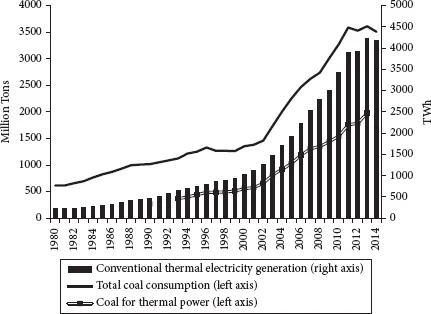
FIGURE 1.1 Chinese thermal power generation and rising coal consumption up to 2014
Sources of primary data: The data for the total coal consumption (up to 20...
Table of contents
- Cover
- Title
- 1 Introduction
- 2 Major Trends in Chinas Energy Revolution
- 3 Chinas Energy Producing and Using Industries Industrial Dynamics
- 4 Transformation of the Electric Power Sector Creating a 21st Century Infrastructure
- 5 Chinas Energy Firms: New Dragon Multinationals
- 6 Global Impact of Chinas Energy Revolution
- 7 Concluding Remarks
- Appendix: Energy and Power Units and Measures
- Bibliography
- Index
Trusted by 375,005 students
Access to over 1.5 million titles for a fair monthly price.
Study more efficiently using our study tools.
Frequently asked questions
Yes, you can cancel anytime from the Subscription tab in your account settings on the Perlego website. Your subscription will stay active until the end of your current billing period. Learn how to cancel your subscription
No, books cannot be downloaded as external files, such as PDFs, for use outside of Perlego. However, you can download books within the Perlego app for offline reading on mobile or tablet. Learn how to download books offline
Perlego offers two plans: Essential and Complete
- Essential is ideal for learners and professionals who enjoy exploring a wide range of subjects. Access the Essential Library with 800,000+ trusted titles and best-sellers across business, personal growth, and the humanities. Includes unlimited reading time and Standard Read Aloud voice.
- Complete: Perfect for advanced learners and researchers needing full, unrestricted access. Unlock 1.5M+ books across hundreds of subjects, including academic and specialized titles. The Complete Plan also includes advanced features like Premium Read Aloud and Research Assistant.
We are an online textbook subscription service, where you can get access to an entire online library for less than the price of a single book per month. With over 1.5 million books across 990+ topics, we’ve got you covered! Learn about our mission
Look out for the read-aloud symbol on your next book to see if you can listen to it. The read-aloud tool reads text aloud for you, highlighting the text as it is being read. You can pause it, speed it up and slow it down. Learn more about Read Aloud
Yes! You can use the Perlego app on both iOS and Android devices to read anytime, anywhere — even offline. Perfect for commutes or when you’re on the go.
Please note we cannot support devices running on iOS 13 and Android 7 or earlier. Learn more about using the app
Please note we cannot support devices running on iOS 13 and Android 7 or earlier. Learn more about using the app
Yes, you can access China’s Renewable Energy Revolution by John A. Mathews,Hao Tan,Kenneth A. Loparo,O''Faircheallaigh in PDF and/or ePUB format, as well as other popular books in Biological Sciences & Energy Industry. We have over 1.5 million books available in our catalogue for you to explore.