- English
- ePUB (mobile friendly)
- Available on iOS & Android
eBook - ePub
About this book
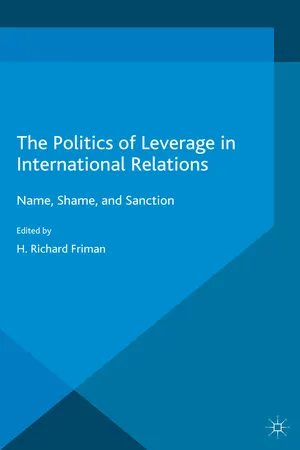
This unique volume unpacks the concept and practice of naming and shaming by examining how governments, NGOs and international organisations attempt to change the behaviour of targeted actors through public exposure of violations of normative standards and legal commitments.
Information
1
Introduction: Unpacking the Mobilization of Shame
H. Richard Friman
On 21 August 2013, the Syrian government of Bashar al-Assad launched chemical weapons against opposition forces operating out of key Damascus suburbs, killing an estimated 1,429 people “including at least 426 children” (US Assessment 2013). The Obama administration condemned the attack as a clear violation of international norms and a crime against humanity by the al-Assad regime. The administration’s efforts to mobilize a coordinated international military response quickly stalled. The UN Security Council remained paralyzed by Russian and Chinese support for the al-Assad regime. Traditional US allies also failed to step forward. Most notably, the British parliament rejected Prime Minister David Cameron’s motion to join with the United States. Opposition reflected the legacy of the recent wars in Iraq and Afghanistan as well as questions over US claims over who was actually responsible for the chemical weapons attack (Watt and Hopkins 2013).
In the absence of broader support, President Barack Obama ramped up the US military presence in the region and repeatedly noted his intent to act unilaterally if necessary. But on the heels of the British decision, he soon stunned critics and supporters alike by announcing on 31 August that the administration would be seeking congressional authorization for a military response. In the Rose Garden announcement of this decision, the president sought to sway opposition members in Congress and the reluctance of the American public for new military commitments in the Middle East. He stressed that the actions of the al-Assad regime posed a critical challenge to the “fundamental international rules” of the “international system” and broader global community as well as to the security of the United States and its allies (Transcript 2013).
As Congress deliberated, scholars and pundits pointed to alternatives other than US military action, including more extensive military support for the Syrian rebels, economic sanctions, and “shaming” the Syrian regime and its supporters. In Op-Ed pieces published by The New York Times on 4 September, Oona Hathaway and Scott Shapiro (2013) called on the president “to use his rhetorical power to shame and pressure Russia and China.” Thomas Friedman (2013) called on the administration to “arm and shame” by expanding military support to the rebels while “using every diplomatic tool we have” to shame individual members of the al-Assad regime. In a ringing appeal, Friedman wrote, “Do not underestimate how much of a deterrent it can be for the world community to put the mark of Cain on their foreheads so they know that they can never again travel” except to other pariah states.1
Ten days later, the escalating crisis over how the world community would respond to the chemical weapons attack began to ebb, though with little indication that nonmilitary threats were responsible for the change. Russian leverage of an offhand comment by Secretary of State John Kerry on how the al-Assad regime might forestall military action resulted in a negotiated agreement on 14 September to destroy Syrian chemical weapons (Gordon 2013). UN chemical weapons inspectors turned to identifying and removing stockpiles as the Syrian civil war continued to rage.
These events from the fall of 2013 call attention to the prominence of normative appeals in international politics. More importantly from the standpoint of this book, these events illustrate the prominence of expectations that public exposure of the actions of a noncompliant government can mobilize domestic and international support, alter the targeted government’s behavior, pressure its supporters, and serve as a deterrent to the actions of others. From campaigns against genocide to efforts against money laundering, governments, nongovernmental organizations, and international organizations have attempted to change the behavior of targeted actors through the public exposure of violations of normative standards and legal commitments. Yet, the prominence of these efforts and their uneven track records of success underscore the need to look more closely at what naming and shaming entails and the conditions that shape its effectiveness.
The most prominent International Relations approaches to naming and shaming focus on the public exposure of governmental abuses of human rights. Scholars such as Margaret Keck and Kathryn Sikkink (1998) emphasize how advocacy groups engage in the “mobilization of shame,” using public exposure of noncompliance with human rights norms to mobilize support from state and nonstate actors against the offending government, pressuring it to change. Such public exposure of noncompliance ideally leads policymakers in the targeted governments to feel ashamed of their behavior. Or, if not ashamed, they become cognizant that their state’s standing in the international community is at risk (Keck and Sikkink 1998; Risse and Ropp 2013). Where such social pressure does not suffice, advocacy networks utilize the “mobilization of shame” to attract support from states capable of wielding material influence through economic and military pressure on the targeted government. The more sensitive the target is to the exercise of “moral leverage” and the more it is vulnerable to sticks and carrots generated by “material leverage,” the more effective the advocacy network will be in bringing about change (Keck and Sikkink 1998, 23–24, 28–29).
This mobilization-of-shame approach details how transnational advocacy networks (TANs) seek to mobilize support through public exposure of human rights abuses in attempts to influence the behavior of targeted governments. However, the approach is less helpful in accounting for the different ways in which state and nonstate actors wield public exposure as an instrument of leverage, let alone combine it with material sanction, the contextual factors that shape these combinations, and the conditions that generate effective pressure. These issues are the central focus of this book. What are the actual instruments of naming, shaming, and sanction? How, when, and why are particular instruments used by state and nonstate actors? When are targets more receptive to these instruments, and how is this receptivity shaped by characteristics of the senders, targets, and broader audiences? Through engaging these questions, the contributors to this book seek to add to the scholarly understanding of naming and shaming and its effectiveness as an international policy strategy to alter state behavior.2
Name and shame in the popular lexicon
Part of the difficulty in unpacking naming and shaming lies in pinning down what exactly the concept means. A Google search of “name and shame” in January 2014 revealed 2.1 million hits, 521,000 for “naming and shaming,” and 2.4 million for “shaming” alone.3 Slate contributor Mark Peters (2013) argues that the contemporary usage of the word “shaming” has exploded in the Internet age in ways that have broadened its meaning to the point of irrelevance. Rather than the calling of attention to “legitimately horrible behavior,” Peters notes how shaming has been used to describe the public criticism of “every single thing in the world that makes us feel bad,” as well as public humiliation intended for comedic effect.
This was not always the case. Gary Martin (n.d.) traces the origins of the phrase “name and shame” in the popular lexicon to the late 1800s and defines it as “the publication of the identity of a person or group that is culpable in some anti-social act in order to shame them into remorse.”4 Generating remorse on the part of the offender was not the only intent. Public humiliation was also intended to serve a deterrent role. In colonial America, authorities “shamed” persons for penal law violations, identifying and humiliating offenders by displaying them in wooden restraints for “public ridicule,” branding them, and using other measures (e.g., Massaro 1991, 1881–1882). Joerg Wettlaufer (n.d.) traces at least a 600-year history “of shaming and humiliating rituals in [European] penal law and folklore.” Sara Forsdyke lists public humiliation among the prominent means of social control in Ancient Greece, with offenders facing “public display in the stocks” or made to wear transparent clothing, “being paraded [while bound] through the streets of the city,” and being subjected to head shaving and other punishments (2008, 12–14 quote, 22).5
Several centuries later, interest in public exposure and humiliation as means of social control experienced a resurgence, though with less physically punitive measures. In the United States during the 1990s, faced with prison overcrowding and recidivism, authorities began to embrace alternatives to incarceration, such as offenders wearing sign boards in public noting their violation or through the use of large billboards or newspaper listings with the offenders’ names and pictures on public display (Massaro 1991, 1882–1883). Martin (n.d.) argues that “naming and shaming” and the modern-day usage of the term also escalated in the United Kingdom during the 1990s, popularized by the British government and by Rupert Murdoch’s media enterprise during high-profile campaigns against youth crime and pedophilia (see also Copley 1996; Hodge 2000). In the aftermath of the 2008 global financial crisis, increased attention turned to the potential impact of shaming on white-collar crime.6
The extent to which shaming practices serve a useful criminal justice function, however, remains contested, as do the best methods of application. In particular, John Braithwaite (1989) distinguishes between shaming through stigmatization and “reintegrative shaming.” The former relies on condemnation of the act as well as the individual, while the latter focuses on the act rather than the individual and offers opportunities for the targeted actor to rejoin the community.7 This distinction informs the discussions of academics and practitioners over the merits of punitive steps against offenders as opposed to paths of restorative and transitional justice (e.g., Hannem-Kish 2004; Sakiyama, et al. 2011).
Social pressure and international politics
Public exposure and condemnation of the actions of governments also has a long history in international politics. Keck and Sikkink (1998, 39) note such practices in the transnational abolitionist movement against slavery as one of several “historical precursors” to the mobilization of shame in modern-day human rights campaigns. Other scholars look to an earlier period, to the actions of “transnational moral entrepreneurs” in condemning government complicity in piracy during the seventeenth century and the Atlantic slave trade in the eighteenth and nineteenth centuries (e.g., Andreas and Nadelmann 2006; Nadelmann 1990; Sandholtz and Stiles 2009).
Human rights scholarship has largely embraced the argument that state and nonstate actors can be thought of as members of society who are able to effectively mobilize social pressure—as distinct from, though often interwoven with, threats of economic and military sanction— against noncompliant others. Yet, from the modern inception of the field of International Relations in the early twentieth century, claims regarding the nature and impact of social sanction in international politics have been contested. This section turns to scholars from the three of the field’s formative theoretical traditions to begin to conceptually unpack naming and shaming, and conditions under which it is likely to be effective.
Idealism and the mobilization of shame
Ann Marie Clark (2009; 2013) points to Alfred Zimmern’s 1936 classic The League of Nations and the Rule of Law, 1918–1935 as offering one of the earliest scholarly references to “the mobilization of shame.” Zimmern (1936a, 459–460) describes the League’s role in opening the “inner workings of international politics” to public scrutiny, particularly in the League Assembly committees. Here, Zimmern argues “high sounding professions of faith and vaguely idealistic declarations of policy” made by defenders of the status quo can be challenged by reformers “fortified in their intentions by close study of the relevant facts.” By exposing gaps between rhetoric and reality, Zimmern writes,
the pertinacious defenders of good causes, with the public opinion of the world at their back, can succeed, on occasion, in provoking the “mobilization of shame” which is the real sanction of the League, whether in regard to peace or war or to less dramatic issues such as the welfare of young people or the traffic in drugs.
(1936a, 460)8
Zimmern has been identified by some scholars as a primary example of the flawed idealist/utopian approach in International Relations (overview in Griffiths 1999). Most notably, E. H. Carr (1942, 51–52) uses Zimmern to point to the approach’s naive faith in the power of public opinion as central to the original conception of the League, and its failure. Belief in “the utopian doctrine of the efficacy of rational public opinion” enabled the organization’s founders to sidestep a more detailed engagement with the more “ticklish problem of material sanctions” in the event of future noncompliance by League members (Carr 1942, 45–46). Zimmern’s claim about the League’s real power of sanction, Carr argues, echoes the words of Britain’s Lord Robert Cecil speaking at the first meeting of the League Assembly: “it is quite true that by far the most powerful weapons at the command of the League of Nations is not the economic weapon or the material weapon or any other weapon of material force. By far the strongest weapon we have is the weapon of public opinion” (quoted in Carr 1942, 47). As described by Lord Arthur Balfour, failure to participate in the collective vision of the League would be met with the threat of public condemnation (Zimmern 1936a, 399).
Yet, even though emphasizing the importance of public opinion to the vision of the League, Zimmern acknowledges that it has proved to be more of a challenge than a unifying force or source of effective social sanction. He writes that while people were concerned about international affairs in the aftermath of the world war, public opinion was uneducated in the “details” and “principles” of foreign policy (1936a, 28 emphasis in original). Mobilized by the spread of democracy, publics were both demanding and suspicious of government. But influenced and divided by nationalism, publics lacked any sense of shared international vision (Zimmern 1936a, 291–292, 482–483). Thus, while League Assembly committee discussions were open to the public, deliberations were carried out and viewed back home through a nationalist lens. As a result, public pressures undermined, rather facilitated, cooperation between government representatives (Zimmern 1936a, 291–292).9
Despite his detailed overview of the history of the League, Zimmern (1936a, 286–446) also reveals few, if any, instances where public exposure of government actions, in issues of war and peace or other issues addressed by the League, actually changed noncompliant government behavior. Pulled from multiple directions, the League appeared unable to wield social sanction, let alone combine public condemnation of noncompliance with coordinated economic or military sanction. By the early 1920s, Zimmern concludes, the “Old Diplomacy” of power-driven, elite-dominated, and often secretive conduct of international politics “began to reassert itself” (1936a, 481). In the absence of credible threats of public condemnation, the real sanction of the League was anything but.
Realists and social sanction
If idealist scholars were skeptical of the nature and impact of the power of social sanction in international politics, realist scholars were even more so. Carr’s suspicions of claims concerning world public opinion have already been noted.10 In his classic work Politics among Nations, Hans Morgenthau (1948, 170–173) offers an extensive discussion of social rules in international politics. He explores “ethics, mores, and law” as three dimensions of the “intricate maze” of social rules that “limit the struggle for power in the domestic societies of Western civilization” and asks to what extent similar “normative orders” exist and influence international society. The answer is not encouraging.
Morgenthau (1948, 184) argues that ethical limitations on the conduct of international politics have deteriorated since the days of cosmopolitan, aristocratic international society of seventeenth- and eighteenth-century Europe. Foreign affairs have become the product of “democratic selection and responsibility” (Morgenthau 1948, 187). Instead of “clearly identifiable men, who can be held personally accountable for their acts,” international politics is in the hands of multiple individuals with different understandings of “what is morally required in international affairs, or with no such conceptions at all” (Morgenthau 1948, 189).11
Morgenthau (1948, 189) argues further that international society itself has been “destroyed” by nationalism. Ethical standards rooted in “Christian, cosmopolitan, and humanitarian elements” have been replaced by a m...
Table of contents
- Cover
- Title Page
- Copyright
- Contents
- List of Tables
- List of Figures
- Acknowledgments
- Notes on Contributors
- 1. Introduction: Unpacking the Mobilization of Shame
- Part I: Revisiting Human Rights Naming and Shaming
- Part II: Naming and Shaming Beyond Human Rights
- References
- Index
Trusted by 375,005 students
Access to over 1.5 million titles for a fair monthly price.
Study more efficiently using our study tools.
Frequently asked questions
Yes, you can cancel anytime from the Subscription tab in your account settings on the Perlego website. Your subscription will stay active until the end of your current billing period. Learn how to cancel your subscription
No, books cannot be downloaded as external files, such as PDFs, for use outside of Perlego. However, you can download books within the Perlego app for offline reading on mobile or tablet. Learn how to download books offline
Perlego offers two plans: Essential and Complete
- Essential is ideal for learners and professionals who enjoy exploring a wide range of subjects. Access the Essential Library with 800,000+ trusted titles and best-sellers across business, personal growth, and the humanities. Includes unlimited reading time and Standard Read Aloud voice.
- Complete: Perfect for advanced learners and researchers needing full, unrestricted access. Unlock 1.5M+ books across hundreds of subjects, including academic and specialized titles. The Complete Plan also includes advanced features like Premium Read Aloud and Research Assistant.
We are an online textbook subscription service, where you can get access to an entire online library for less than the price of a single book per month. With over 1.5 million books across 990+ topics, we’ve got you covered! Learn about our mission
Look out for the read-aloud symbol on your next book to see if you can listen to it. The read-aloud tool reads text aloud for you, highlighting the text as it is being read. You can pause it, speed it up and slow it down. Learn more about Read Aloud
Yes! You can use the Perlego app on both iOS and Android devices to read anytime, anywhere — even offline. Perfect for commutes or when you’re on the go.
Please note we cannot support devices running on iOS 13 and Android 7 or earlier. Learn more about using the app
Please note we cannot support devices running on iOS 13 and Android 7 or earlier. Learn more about using the app
Yes, you can access The Politics of Leverage in International Relations by H. Friman in PDF and/or ePUB format, as well as other popular books in Social Sciences & Civil Rights in Law. We have over 1.5 million books available in our catalogue for you to explore.