- English
- ePUB (mobile friendly)
- Available on iOS & Android
eBook - ePub
About this book
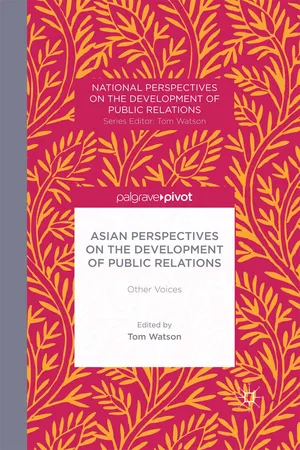
The National Perspectives on the Development of Public Relations: Other Voices series is the first to offer an authentic world-wide view of the history of public relations. It will feature six books, five of which will cover continental and regional groups. This first book in the series focuses on Asia and Australasia.
Information
1
Australasia
Abstract: Public relations (PR) in Australia has strong governmental roots from the 19th century, and it expanded along this route until the end of World War II when influences from the US and then globalization led to expansion in practice, PR organizations and education. The vast distances in Australia between colonies and, later, states of the federation, reinforced state and national governments’ roles in applying public information-style communication to reach the widespread population. This development was not in imitation of British models but of the need to inform, convince and persuade the widely spread population Some scholars trace the development of New Zealand’s public relations industry to the wartime and post-war efforts of military personnel. However, the use of strategies and tactics that are now recognized as part of a PR ‘toolkit’ occurred much earlier. They can be traced back to indigenous Mäori culture and to the promotional techniques used in the mid-19th century to attract settlers to the new colony. Post-war, public relations has developed along Anglo-American lines with an emphasis on media relations and corporate communications.
Keywords: Australia; colonial promotion; government communications; New Zealand; post-war expansion; public relations; tyranny of distance
Watson, Tom. Asian Perspectives on the Development of Public Relations: Other Voices. Basingstoke: Palgrave Macmillan, 2014. DOI: 10.1057/9781137398154.0005.
1a. Australia
Mark Sheehan
It is now widely accepted that public relations activities existed in Australia well before the term became popular or discussed. The institutionalized communication activities of governments were ongoing from the early 19th century. The most significant challenges for white settlement of Australia were the vast size of the continent and its sparsely spread population. These factors combined to create unique conditions that shaped and influenced the early colonies and ultimately the nation of Australia. Compounding these challenges was, in the words of Australian historian Geoffrey Blainey (1982), ‘the tyranny of distance’ which was the most powerful brake on Australia’s population growth. Early Australia was the British Empire’s furthest colony. A lack of population meant that on a large continent many initiatives to build the new society fell to government – whereas in other new nations, particularly the United States, it was the private individual and corporations who saw potential and exploited it. So a cooperative approach of citizen and state came about in Australia more so, it could be argued, than in other growing 19th-century societies. Blainey (1962), who acknowledged the role of public relations in the gold rushes of the 1850s, also stated that by the late 1880s the colonies had begun to shape the ‘modern semi-independent government corporation that now rules so much of Australia’s economic and social life’ (1982, p. 254). When reflecting on historical analyses of PR, Macnamara noted that ‘public relations is extensively used by governments’ (2012, p. 167). It can be argued further that the responsibility for government to communicate to its constituents in a democracy is far greater than for a private citizen or corporation.
Colonial period
Within 30 years of the settlement of New South Wales (NSW) as a penal colony in 1788, the social, political and commercial conditions had developed that allowed many elements of proto-PR strategies and actions (Watson, 2013) to develop. The early establishment of newspapers, that provided news reports and editorial opinion, allowed for discussion of issues and gave opportunity for citizens to publicize and promote causes. This was underpinned by an early basic schooling system in which children of the colony – settler, convict, aboriginal and colonist – were given opportunities to read and write, and be instructed on religious practices (Clark, 1962, p. 258). An example was the aboriginal Walter Arthur who wrote and edited the first indigenous newspaper, Flinders Island Chronicle, and went on to petition Queen Victoria successfully about the mismanagement of the Flinders Island native settlement (Reynolds, 1991). Arthur’s familiarity with activism and lobbying, as with so many PR practitioners over the next 180 years, stemmed from his education and role in early journalism.
Proto-PR activities were strongly evidenced in the colonial governments as they encouraged immigration and tourism from England. By the end of the 19th century, the colonies were exploiting the new medium of moving pictures to encourage immigration. Smyth claimed that ‘the first government film making in the world’ (1998, p. 238) occurred in Queensland for distribution at the Greater British Exhibition in London in 1899. From the 1840s to the early years of the new century the colonies also sought self-government which required sophisticated and coordinated effort in persuasive communication in Australia and in London. For example, the citizens of the island state of Tasmania appointed a lobbyist, John Jackson, to represent their claim for self-government in London. Jackson’s activities included the publication and distribution of pamphlets extolling the benefits of self-government for London and the colony; at the same time ensuring that the response and coverage of his London publicity, lobbying and relationship activities were recorded in the colony’s press (Sheehan, 2014). Lobbying was practised over subsequent decades in the early colonies and as those colonies federated into the Commonwealth of Australia in 1901 it was ‘no coincidence that the very choice of Canberra as the site of Australia’s Federal parliament was a much lobbied decision’ (Sheehan, 2012, p. 6).
20th century
The first two decades of the 20th century saw the rise of publicity officers and departments in federal and state governments and their agencies. Yet there seems to be little recorded activity of PR in Australian private industry at this time. Gleeson (2012) identifies the first government publicity officer as being appointed by the NSW government in March 1914. Turnbull (2010) notes that at this time PR activities were all government-based and refers to the appointment of a federal government publicity officer in 1918. By that time the NSW Premier’s Department had increased its PR activity and established a Publicity and Research branch. These developments were more than information dissemination and show governments’ understanding of persuasive communication was beyond press agentry to an awareness of the strategic value of communication with diverse publics.
World War I witnessed an expansion in PR activities in support of war loan subscriptions and recruitment drives. Australia remained the only nation with a volunteer army fighting in the war. By 1916 the numbers of recruits had reduced so much that Prime Minister Hughes sought a mandate for conscription from voters. The 1916 conscription referendum failed and Hughes attempted again in 1917. This time the prime minister seconded Claude McKay, a former journalist and writer, to work on the campaign’s promotion; he broadened the use of persuasive tactics. Mackay had been the successful Publicity Director for War Loans. He set up recruiting committees, held public meetings and produced a handbook for the conduct of these committees and meetings. The handbook, The Speaker’s Companion, contained template speeches and featured one section called Sister Susie’s Creed. The creed exhorted women to die an old maid rather than ‘flirt with men who did not enlist’ (Carlyon, 2006, p. 525). The campaign employed the services of Australia’s most famous expatriate, the international opera singer Dame Nellie Melba, who delivered carefully crafted messages directed at the women of Australia. Hughes had identified women as highly persuasive with their ability to urge doubtful enlisters and shame the shirker (Sheehan, 2007).
These meetings often took place on the back of other patriotic events and to that extent caught the public unaware. Carlyon notes that ‘theatres, cinemas, town halls, sporting events and even beaches’ (2006, p. 525) became fora to encourage the nation to ‘keep Australia’s promise to Britain’ for more recruits. Again the referendum failed, by a larger majority than the first. Despite the support of the press and most national institutions, Hughes was unable to persuade the Australian people.
Throughout the 1920s and 1930s the dominance of PR practice by governments continued, and significant development occurred in the not-for-profit sector with charities using these techniques. A prominent example were the communication and lobbying activities of the returned servicemen’s organization Legacy which advocated a Shrine of Remembrance as the city of Melbourne’s tribute to the fallen of World War I (Sheehan, 2007). Gleeson (2012) has identified George Fitzpatrick as Australia’s first PR consultant. In 1929, Fitzpatrick described himself with this role in a statement which advocated PR’s role far beyond publicity as ‘creation of public opinion was entrusted to highly-skilled specialists, who never appear in public. The(y) created public opinion by means of the power of the Press, letters, large advertising space, cartoons, letter writing campaigns, lobbying’ (Gleeson, 2012, p. 5). Fitzpatrick set up a consultancy business in Sydney in 1933 and developed a lobbying business in the national capital Canberra shortly after. In 1930 the NSW government publicity officer was among the highest paid public service positions; the Tasmanian government re-established a publicity office in 1935 and the Queensland government also established a publicity office in the same year.
Critical at this time was the creation in 1926 in the UK of the Empire Marketing Board (EMB) under the Colonial Secretary Leo Amery. The EMB, under the directorship of the British PR pioneer (Sir) Stephen Tallents, sought to promote empire goods to UK consumers (Anthony, 2012). Richard Casey, later a prominent cabinet minister, who arrived in London at this time was mentored and befriended by Amery (Hudson, 1986). This close relationship would have brought Casey into Tallents’ sphere of operation and allowed him to observe the PR work of Tallents and the EMB. Casey, a founder of the Liberal Party of Australia, the dominant political party of power from the late 1940s to the early 1970s, formed a ‘lifelong attitude of “devotion” to public relations in terms of what it could achieve for individuals and organisations’ (Sheehan, 2014, p. 38). It can be argued that Casey’s influence was a contributing factor to government’s recognition of the benefits of PR.
World War II and the arrival of General Douglas MacArthur and his PR entourage in late March 1942 have been attributed by some authors as the start of public relations in Australia (Tymson and Sherman, 1987; Zawawi, 2000). However as this chapter illustrates, PR as both the term and practice was already in wide use. The nation’s Army and Air Force had adopted the term and practices by 1941 (Herington, 1954; Long, 1953). It would be the nucleus of servicemen, often designated as Public Relations Officers (PRO), who would create and build a more widely recognized PR profession in post-war Australia.
After 1945 it was mostly government that endorsed the benefits of PR for post-war recovery and national growth. This link can be substantiated when the employer organizations of the founding presidents of the Public Relations Institute of Australia (PRIA) from the early 1950s are examined. The organizations were chiefly government departments and agencies: Trans Australia Airlines (the government-owned airline), Department of Civil Aviation, Rural Bank, Department of Lands, Australian Road Safety Council, and State Electricity Commission of Victoria (Flower, 2002). Turnbull has noted that even by the late 1960s ‘most of the PR practitioners were concentrated in government departments and agencies and consultancies although there was a growing number employed by business’ (2010 p. 20) and Dwyer, editor of Australia’s first PR-specific publication, also acknowledged that ‘before private enterprise began to make anything like extensive use of public relations technique in Australia, PR was already well established in a number of government departments and statutory corporations’ (1961, p. 52).
Growth
By the mid-1950s corporate Australia had caught up. The oil refining industry and banks had established internal public relations departments and information bureaux, respectively. The bureaux specifically undertook public relations activities (Flower, 2007; Sheehan, 2014).
Although Fitzpatrick had established a consultancy in the early 1930s, it was in post-war era this became the area of professional growth. It may have appealed to corporations because, rather than setting up a department or employing a PRO, a consultancy was a low-risk way to engage PR services.
Foremost among the new consultancies was Eric White Associates (EWA). In 1944, Eric White was employed as the Director of Public Relations of the conservative Federal Liberal Party (Potts, 1976). White stayed in the role until 1947 when he set up EWA (Dwyer, 1961). The Liberal Party remained in power for 23 years until 1972. Much of EWA’s growth was linked to its government clients who over this period displayed a greater understanding and appreciation of PR (Sheehan, 2009). By the late 1950s EWA was operating in all state capitals and was soon represented in New Zealand and Asia. A decade later, his overwhelming commercial success in creating ‘the biggest (public relations firms) in the world outside the United States’ (Sydney Morning Herald, 1989) allowed White to launch it on the Stock Exchange in 1964. A former CEO of EWA claimed the company ‘taught so many people the rudiments of public relations’ that a leading Australian business magazine dubbed it ‘the university of public relations’ in Australia (Golding, 2004, p. 207).
In 1957, one of Australia’s leading newspapers The Argus had closed after 111 years. ‘Public relations particularly benefitted. Many Argus people moved into this rapidly expanding, developing industry and were a major force in laying the foundations of “PR” as it is today’ (Usher, 2007, p. 8). In that year there were 30 consultancies in Melbourne alone. One former Argus journalist went on to found Australia’s other major PR consultancy, International Public Relations (IPR). ‘If EWA created the modern consultancy industry, it was further shaped in 1964 when the EWA recruit Laurie Kerr, left EWA to set up IPR’ (Turnbull, 2010, p. 19). The Australian Financial Review (27 July 1961) wrote that Australian business was spending more than £3 million on PR and that ‘a much greater amount [was] spent on internal consultants employed inside industry’. Kerr told a meeting of business leaders in 1965 that public ...
Table of contents
- Cover
- Title
- Introduction
- 1 Australasia: Australia and New Zealand
- 2 China
- 3 India
- 4 Indonesia
- 5 Japan
- 6 Malaysia
- 7 The Philippines
- 8 Singapore
- 9 Taiwan
- 10 Thailand
- 11 Vietnam
- Index
Trusted by 375,005 students
Access to over 1.5 million titles for a fair monthly price.
Study more efficiently using our study tools.
Frequently asked questions
Yes, you can cancel anytime from the Subscription tab in your account settings on the Perlego website. Your subscription will stay active until the end of your current billing period. Learn how to cancel your subscription
No, books cannot be downloaded as external files, such as PDFs, for use outside of Perlego. However, you can download books within the Perlego app for offline reading on mobile or tablet. Learn how to download books offline
Perlego offers two plans: Essential and Complete
- Essential is ideal for learners and professionals who enjoy exploring a wide range of subjects. Access the Essential Library with 800,000+ trusted titles and best-sellers across business, personal growth, and the humanities. Includes unlimited reading time and Standard Read Aloud voice.
- Complete: Perfect for advanced learners and researchers needing full, unrestricted access. Unlock 1.5M+ books across hundreds of subjects, including academic and specialized titles. The Complete Plan also includes advanced features like Premium Read Aloud and Research Assistant.
We are an online textbook subscription service, where you can get access to an entire online library for less than the price of a single book per month. With over 1.5 million books across 990+ topics, we’ve got you covered! Learn about our mission
Look out for the read-aloud symbol on your next book to see if you can listen to it. The read-aloud tool reads text aloud for you, highlighting the text as it is being read. You can pause it, speed it up and slow it down. Learn more about Read Aloud
Yes! You can use the Perlego app on both iOS and Android devices to read anytime, anywhere — even offline. Perfect for commutes or when you’re on the go.
Please note we cannot support devices running on iOS 13 and Android 7 or earlier. Learn more about using the app
Please note we cannot support devices running on iOS 13 and Android 7 or earlier. Learn more about using the app
Yes, you can access Asian Perspectives on the Development of Public Relations by T. Watson in PDF and/or ePUB format, as well as other popular books in Business & Business Communication. We have over 1.5 million books available in our catalogue for you to explore.