- English
- ePUB (mobile friendly)
- Available on iOS & Android
eBook - ePub
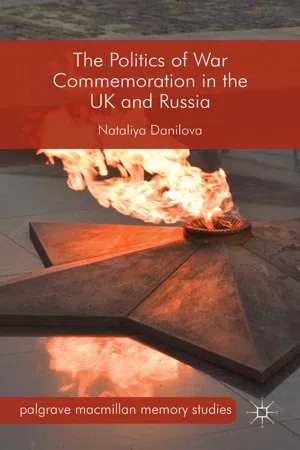
The Politics of War Commemoration in the UK and Russia
About this book
This book analyses contemporary war commemoration in Britain and Russia. Focusing on the political aspects of remembrance, it explores the instrumentalisation of memory for managing civil-military relations and garnering public support for conflicts. It explains the nexus between remembrance, militarisation and nationalism in modern societies.
Information
1
Memory Politics and the Afterlives of Fallen Soldiers
1.1 Fallen soldiers: from the age of nationalism and beyond
A popular approach in the analysis of war commemoration associates commemorative practices with the expression of nationalism. War commemoration is perceived as an instrument that forges national identifications, unites societies and acts as an essential component in ‘the symbolic repertoire of the nation-states’ (Ashplant et al., 2000, p. 7). This approach draws its inspiration from a classic study by Maurice Halbwachs on Collective Memory (1992 [1950]). According to Halbwachs, collective memory is a social construct and ‘a social fact’ that comes into existence by the power of social groups. Halbwachs considers collective memories as ‘a part of a totality of thoughts common to a group, a group with whom we have a relation at this moment, or with whom we have had a relation on the preceding day or days’ (1992, p. 52). From his perspective, family, religious association and social class make the most important contribution to collective memory. Scholars of nationalism extrapolate his conclusions to the level of nation-states. Exploring the origin of Western nationalism, Benedict Anderson begins his book on Imagined Communities with a reflection on the Cenotaph and the Tomb of the Unknown Soldier in London, describing these memorials as the most ‘arresting emblems of the modern culture of nationalism’, which have been ‘sacrilege of a strange, contemporary kind! Yet void as these tombs are of identifiable mortal remains or immortal souls, they are nonetheless saturated with ghostly national imaginings’ (Anderson, 1983, p. 9, emphasis in original). As Anderson illustrates, nations function as ‘imagined communities’ because they are sustained by the power of shared ‘imaginings’, symbols and ceremonies.
Halbwachs’ pioneering study advocates a non-linear development of collective memory. He suggests that ‘our sense of reality [is] inseparable from our present life’ (1992, p. 49) and therefore the current interests of social groups shape society’s vision of the past. This presentist approach inspired one of the most famous studies of ‘invented traditions’ by Eric Hobsbawm. According to Hobsbawm, the ‘invented tradition’ is ‘a set of practices, normally governed by overtly or tacitly accepted rules and of a ritual or symbolic nature, which seek to inculcate certain values and norms of behaviours by repetition, which automatically implies continuity with the past’ (1983a, p. 1). Hobsbawm explains the present-orientated essence of collective memory by society’s desire for the historical continuity. In this regard, Hobsbawm, like Durkheim, believes that commemorations ‘awake certain ideas and feelings, to link the present to the past, the individual to the collectivity’ (Durkheim, 2001, p. 282). They revitalise shared feelings and commitments by reconciling societies with profound social transformations, while also constructing a new source of legitimacy for a nation-state (Hobsbawm, 1983b, p. 263). Hobsbawm’s findings are critical for the problematisation of war commemoration in modern societies because they suggest that a turbulence of political and societal changes can be resolved through the ‘invention’ of the new rituals and symbols. These rituals can potentially be used to re-legitimise the political (and military) inspirations of governments and reconcile societies with controversial political outcomes of modern conflicts.
The nationalistic nature of war commemoration is thoroughly investigated by George Mosse in his book Fallen Soldiers: Reshaping the Memory of the World Wars (1990). Mosse developed an interest in war memories from his research on the political symbolism of the Third Reich in The Nationalisation of the Masses (1975). He came to the conclusion that ‘festivals commemorating the noble dead’ were one of the most successful instruments to ‘nationalise the masses’ in Germany (Mosse, 1975, p. 76). He explains the success of these festivals by their ability to blend together history and the idea of the nation, where citizens form strong emotional associations with the ‘glorious dead’. In The Fallen Soldiers (1990), he explores the power of war commemoration to form national myths and sentiments. In particular, he investigates the Myth of the War Experience, which emerged in Western societies out of ashes of the First World War. This myth ‘was designed to mark war and to legitimize the war experience; it was meant to displace the reality of war’ (1990, p. 7). He convincingly demonstrates that the memory of the First World War ‘was refashioned into a sacred experience which provided the nation with a new depth of religious feeling, putting at its disposal ever-present saints and martyrs, places of worship, and a heritage to emulate’ (1990, p. 7). According to him, the cult of the war dead is central to the Myth of the War Experience; it evokes nationalistic feelings through war memorials, military cemeteries and ceremonies of remembrance.
Mosse outlines three key characteristics of this cult. First, he discusses ‘the triumph of youth’ of fallen soldiers (1990, pp. 72–4). In this instance, death on the battlefield is seen as a passage in male socialisation, a transition from the boyhood of a soldier to the manhood of a fallen soldier. Second, the cult of the war dead implies ‘an analogy of sacrifice in war to the Passion and resurrection of Christ’ (1990, p. 74). As he explains, ‘suffering purifies’ and death transforms fallen soldiers into ‘saints of the nation’ (1990, p. 76). Here, the figure of a fallen soldier embodies both the national hero and the martyr figure. Finally, Mosse insists that the most important function of the cult of the war dead is its ability to fashion a new solidarity within societies by continuing ‘a patriotic mission [which] not only seemed to transcend death itself, but also inspired life before death’ (1990, p. 78). Mosse argues that the remembrance of fallen soldiers can rejuvenate the nation through engagement with the spirits of the war dead. After the First World War, numerous memorials and military cemeteries symbolised that ‘the fallen did not fulfil their mission as individuals but as a community of comrades’ (Mosse, 1990, p. 79). Here, Mosse puts a particular stress on the collective and ‘democratic’ essence of First World War commemoration, which smoothed over the differences between the identities of fallen soldiers.
The interpretation of war commemoration as a vehicle for nationalism favours the idea of ‘a unitary and coherent version of the past’ (Misztal, 2003, p. 127). This version of the past prefers either a linear historical narrative as in Mosse’s study or expresses itself through a non-linear, presentist’ concept of the national timeline, as suggested by Hobsbawm. However, as Schwarz argues, the vision of a national past cannot be ‘literally constructed; but it can only be selectively exploited’ (Schwarz, 1982, p. 396). In other words, the state and political elites cannot just ‘invent’ the past, they can also exploit and re-design popular narratives by constructing a highly selective account of national history. These exploits, as Zerubavel explains in his study of the Israeli national memory, can be activated through the complex commemoration in which ‘each act of commemoration reproduces a commemorative narrative’, and these narratives intersect each other by reinforcing the broader national master narrative (Zerubavel, 1995, p. 6). According to this view, commemoration can express itself through a series of time-loops, revolving around not one but many key events in national history. The task in this instance is to extract these keystones and to study ‘the history of commemoration as well as its relation to other significant events in the group’s past’ (Zerubavel, 1995, p. 7). This discussion suggests that societies hardly ever remember the experience of one war without drawing parallels with other wars. Paraphrasing Maja Zehfuss’ point, the experience of any war can ‘haunt’ societies ‘even if in fundamentally different ways’ (Zehfuss, 2007, p. 13). Therefore, the study of the politics of war commemoration should seek to explore not only the memory of a particular conflict but also to identify the ‘templates’ or ‘the horizons of representations through which later conflicts are understood’ (Ashplant et al., 2000, p. 34; see also Hoskins and O’Loughlin, 2010, pp. 91–6).
Recognition of the complex temporality of national commemoration brings forth another aspect of this process. According to Pierre Nora, from the 1980s, commemoration in Western societies is no longer associated with the nation-state, but is driven by the interests of social groups (Nora, 1996). Nora describes a transition from a nationalistic to a particularistic type of commemoration where ‘the state is divorced from the nation and eventually the old couple is supplanted by a new one: state and society’ (Nora, 1996, p. 5). Nora’s point about the decline of the nation-state is popular among scholars of modern Western societies, who write about the declining power of the nation-state to mobilise the population under the banners of nationalism (Giddens, 1991; Appadurai, 1996; Bauman, 1997, 2001). However, as Billig suggests, it may be premature to proclaim the death of the nation-state as well as to deny its power to create nationalistic commemoration: ‘Maybe, nations are already past their heyday and their decline has already been set in motion, but this does not mean that nationhood can yet be written off’ (Billig, 1995, pp. 176–7). Olick comes to the same conclusion in his analysis of the politics of regret in modern democracies. He suggests that the process of commemoration might illustrate ‘not a replacement of state dominancy by society’, as Nora thought, ‘but the proliferation of alternatives alongside the original’ (Olick, 2007, p. 189; see also Olick, 1999). These alternatives can potentially diminish the influence of nationalistic rituals and symbols, but this does not mean that governments cannot claim their superiority in framing the past or have stopped trying (Billig, 1995, p. 177). Moreover, by ‘exploiting’ and re-using the templates of the World War commemorations from the ‘age of nationalism’, governments might seek to overcome the fragmentation of national identity.
The example of the USA demonstrates the vitality of commemoration as a vehicle for state-driven nationalism. In September 2001, the attacks on the World Trade Center in New York and the Pentagon in Washington DC produced not only ‘the opening to trauma time and the recognition of the contingency of political community’, but also led to ‘the reaffirmation of solidarity and nationhood’ (Edkins, 2003, p. 19). This solidarity emerged in the context where ‘the time of memory and commemoration evolved … alongside the time of revenge’ (Simpson, 2006, p. 4; see also Sturken, 2007, p. 7). This feeling of revenge reconstituted the country’s ‘imagined wholeness’ and national unity (Butler, 2003, p. 41). As a result, ‘after September 11, 2001, Americans no longer had to project themselves into distant past in order to claim its virtues. Instead, they could imagine that the cycles of history had been renewed and that a new national drama awaited them’ (Hoogland-Noon, 2004, p. 352). Fundamentally, the commemoration of the victims of 9/11 revitalised the idea of the nation by demanding unity and support for subsequent military interventions.
Thus, tragedies and wars of the twenty-first century can successfully reinvigorate the nationalistic meaning of commemoration by offering a sense of historical continuity and a powerful illusion of national unity in times of trouble. However, this approach alone cannot capture the complexity of war commemoration in contemporary societies. Both its strength and its limitation come from its focus on the nation-state. This focus helps us to understand the reasons for new commemorative symbols and traditions, but it fails to problematise the interests of other groups involved in the process of commemoration.
1.2 War trauma and communities in grief
To understand the alternative side of war commemoration, we need to shift the focus of our attention from the interests of the state to the desires of survivors and bereaved communities. The intellectual background of this approach comes from ‘cognitive psychology, psychoanalysis, trauma studies and oral history’s quest to retrieve the memories of groups whose histories had previously been neglected’ (Radstone, 2005, p. 137). Drawing upon these studies, war commemoration in this context tells us a story of suffering, grief and reconciliation of social groups touched by war.
In a similar fashion to Mosse’s analysis of the cult of the war dead, the cultural historian Jay Winter investigates war memorials in Britain, France and Germany after the First World War. Unlike Mosse, Winter is less interested in the nationalising appeal of war memorials. His primary concern is to study ‘how multiple forms of associational life which have as their focus the commemoration of the dead assist those they had left behind’ (1995, p. 6). In this instance, Winter approaches the commemoration of the dead as ‘a communal enterprise’ and a ‘place of individual and collective mourning’ (1995, p. 79), whereby ‘the marks of the spot where communities were reunited, where the dead were symbolically brought home, and where the separations of war, both temporary and eternal, were expressed, ritualised and in time, accepted’ (1995, p. 98). In sum, Winter not only prioritises the interests of communities over the interests of the nation-state, he also sees commemoration as a therapeutic activity which heals war trauma and brings about reconciliation.
Within this approach, the effect of war memorials is associated with the needs of survivors and bereaved communities. According to Winter, these communities are closely connected by ‘experiential ties’ of ‘fictive kinship’ (1999, p. 40). This kinship springs from a common experience of trauma and loss. This concept of experiential and, in essence, traumatic kinship is grounded in Freud’s analysis of mourning and melancholia: ‘mourning is regularly the reaction to the loss of a loved person, or to the loss of some abstraction which has taken the place of one, such as one’s country, liberty, an ideal, and so on’ (Freud, 2001 [1917], p. 243). The proponents of this approach apply psychoanalytical analogies by transferring the impact of an individual trauma to the trauma of communities and nations (McNally, 2003; see also Merridale, 2000; Etkind, 2009). This extrapolation implies that ‘all “bad events” – and particularly those which involved violence – have a pathological effect on the sufferer’s psyche’ (Bourke, 2012, p. 25). However, as Bell reminds us, ‘even if psychoanalysis can provide a satisfactory account of individual behaviour, it is often not clear how useful it is as a concept for analysing collectives’ (2006, p. 8). Psychoanalytical associations when transferred to the level of collectives tend to universalise the impact of trauma. This indiscriminate approach to trauma advances ‘an undifferentiated “victim” culture’ (Bell, 2006, p. 9; see also Bourke, 2005). This culture allows for the representation of soldiers of defeating and winning sides, civilian survivors of war, families of deceased soldiers and wider society as victims of war while also assuming ‘a universal human response to grief’ along with a universal desire for closure and reconciliation (Ashplant et al., 2000, p. 33). This victim-centred reframing of war commemoration corresponds with broader debates on the individualisation and pluralisation of identities in modern Western societies (Giddens, 1991; Beck, 1992; Bauman, 1997, 2001). This focus on the identities of soldiers overshadows the broader context of war commemoration and brings us to the limitations of this approach.
First and foremost, the analysis of commemoration ‘exclusively in terms of the psychological and emotional dynamics of individual remembering’ downplays the importance of the context and, we can add, the differences between war experiences (Kansteiner, 2002, p. 185). Moreover, it constructs the vision of a decontextualised commemoration that treats ‘war’ as a continuum of violence and tragedy. This decontextualisation is appreciative of the identities of soldiers and their individual losses, but it lacks the potential to question the necessity of soldiers’ sacrifice. As Wagner-Pacifici and Schwartz conclude in their analysis of the Vietnam War memorialisation, in the context of controversial war, ‘to the original dilemma of how to honour the participant without reference to the cause, there is a corresponding reciprocal problem of how to ignore the cause without denying the participant’ (Wagner-Pacifici and Schwartz, 1991, p. 404). Their research does not offer the answer to this question, but following their line of enquiry, we might ask: when it is important to ignore and ‘forget’ the cause of wars while remembering the fallen soldiers? If this separation of the cause from the participant results from the aims of a controversial war, does it mean that our ‘forgetfulness’ of ambivalent causes of wars can open the door to state- or military-driven narratives, whilst at the same time closing the door for public deliberation of controversial wars? After all, by the late 1980s, the commemoration of the Vietnam War overcame its moral dilemmas by demonstrating that ‘the identities and heroic sacrifices of fallen soldiers [can be] remembered, but the broader political context of the conflict (on which American society lacks moral consensus) [can be] quietly ignored’ (Ducharme and Fine, 1995, p. 1311). As a result, the decontextualised commemoration recognised the sacrifices of the American soldiers in Vietnam, but it also assisted in the re-militarisation of society (Bacevich, 2005).
The second problematic aspect of this approach follows from its predisposition to ignore the political context of wars. This disregard for the context not only pushes the ‘state out of the frame of consideration’ (Ashplant et al., 2000, p. 9), but also downplays the importance of the political aspects of this process. As Joanna Bourke warns us, ‘the victim culture has had a politically neutering effect’ on modern societies (Bourke, 2005, cited in Bell, 2006, p. 9). In accepting the view that soldiers can be seen as individuals and victims of war, it is very difficult to discuss issues of political responsibility and ethical commitments with regards to wars. Undoubtedly, this conceptual framework is sensitive to the feelings of survivors and bereaved families, but this sensitivity comes at the cost of treating these groups as politically passive subjects. It positions them as recipients of society’s compassion rather than the active social actors. Jenny Edkins, in her seminal book Trauma and the Memory of Politics, points out that ‘in contemporary culture victimhood offers sympathy and pity in return for the surrender of any political voice’ (2003, p. 9). Survivors and bereaved families are often faced with a dilemma: to accept sympathy without political participation or challenge the existing memory narratives by claiming a political voice. As Edkins suggests, the ‘trauma time’ has a potential to bring politics into memory narratives by disrupting ‘the linear time of the state’ (2003, p. xiv). Although, as we demonstrated above, state-driven commemoration does not necessarily express itself through a linear timeline, ‘trauma time’ can nevertheless expose relations of power. From this perspective, representations of traumatic events construct an ‘intimate bond between personhood and community and, most importantly, they expose the part played by relations of power’ (Edkins, 2003, p. 4). Adopting this thesis to war commemoration, we suggest that this process is constituted by evolving power relations, activated through discourses and practices of commemoration. The analysis of this relational politics of war commemoration defines the main purpose of our investigation. Edkins’ approach brings politics back to the analysis of war commemoration, but this approach appears to be relatively ‘blind’ towards changes in modern warfare, the role of the armed forces, and the interaction between the military, the state and civilian society. The following section fills this gap.
1.3 The era of the posts-: war, military and society
Accepting the idea that war commemoration is a deeply contextual phenomenon, this section engages with debates about a series of transformative shifts in civil–military relations. In the literature these relationships are considered through a series of transitions from the era of a total war or a heroic warfare to a post-heroic warfare, from a period of the modern militaries, based on conscription, to the postmodern armed forces and, finally, from acceptance of a high number of military casualties to a sensitive public attitude towards the loss of lives in modern conflicts. Drawing on these debates, we develop a set of research hypotheses and research questions about the nature of contemporary war commemoration.
In the introduction to a pivotal volume, The Politics of War Commemoration, the authors discuss the politics of naming modern conflicts noting that in many modern societies the definition of war is subject to controversy (Ashplant et al., 2000, pp. 54–5). Although there is significant literature on the changing nature of warfare, which is assumed to have happened between the late twentieth and early twenty-...
Table of contents
- Cover
- Title
- Copyright
- Contents
- List of Figures and Tables
- Preface
- Acknowledgements
- List of Abbreviations
- 1 Memory Politics and the Afterlives of Fallen Soldiers
- 2 Media Commemoration in Britain
- 3 The Story of War Memorials
- 4 Remembrance in Modern Britain: Support the Armed Forces!
- 5 Media Commemoration in Russia
- 6 War Memorials in Russia
- 7 Remembering War: Celebrating Russianness
- 8 From Remembrance to Militarisation
- Bibliography
- Index
Trusted by 375,005 students
Access to over 1.5 million titles for a fair monthly price.
Study more efficiently using our study tools.
Frequently asked questions
Yes, you can cancel anytime from the Subscription tab in your account settings on the Perlego website. Your subscription will stay active until the end of your current billing period. Learn how to cancel your subscription
No, books cannot be downloaded as external files, such as PDFs, for use outside of Perlego. However, you can download books within the Perlego app for offline reading on mobile or tablet. Learn how to download books offline
Perlego offers two plans: Essential and Complete
- Essential is ideal for learners and professionals who enjoy exploring a wide range of subjects. Access the Essential Library with 800,000+ trusted titles and best-sellers across business, personal growth, and the humanities. Includes unlimited reading time and Standard Read Aloud voice.
- Complete: Perfect for advanced learners and researchers needing full, unrestricted access. Unlock 1.5M+ books across hundreds of subjects, including academic and specialized titles. The Complete Plan also includes advanced features like Premium Read Aloud and Research Assistant.
We are an online textbook subscription service, where you can get access to an entire online library for less than the price of a single book per month. With over 1.5 million books across 990+ topics, we’ve got you covered! Learn about our mission
Look out for the read-aloud symbol on your next book to see if you can listen to it. The read-aloud tool reads text aloud for you, highlighting the text as it is being read. You can pause it, speed it up and slow it down. Learn more about Read Aloud
Yes! You can use the Perlego app on both iOS and Android devices to read anytime, anywhere — even offline. Perfect for commutes or when you’re on the go.
Please note we cannot support devices running on iOS 13 and Android 7 or earlier. Learn more about using the app
Please note we cannot support devices running on iOS 13 and Android 7 or earlier. Learn more about using the app
Yes, you can access The Politics of War Commemoration in the UK and Russia by Nataliya Danilova in PDF and/or ePUB format, as well as other popular books in History & Historiography. We have over 1.5 million books available in our catalogue for you to explore.