eBook - ePub
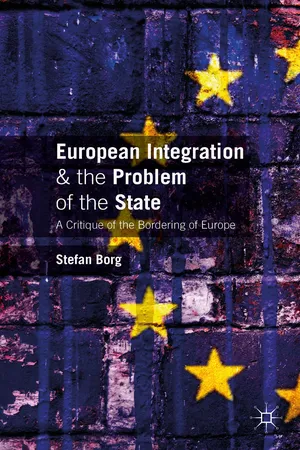
European Integration and the Problem of the State
A Critique of the Bordering of Europe
- English
- ePUB (mobile friendly)
- Available on iOS & Android
eBook - ePub
About this book
This study argues that the practices of European integration reproduce, rather than transcend, the practices of modern statecraft. Therefore, the project of European integration is plagued by similar ethico-political dilemmas as the modern state, and is ultimately animated by a similar desire to either expel or interiorize difference.
Information
1
The Question of a European Union ‘Beyond the State’
Countless academics, intellectuals, journalists, and politicians of all ideological stripes have celebrated European integration as something novel, innovative, and progressive. In its ‘Fourth Lesson about the European Union,’ the EU’s website rehearses this familiar refrain: ‘The European Union is more than just a confederation of countries, but it is not a federal state. It is, in fact, a new type of structure that does not fall into any traditional legal category.’1 What is more, this ‘new type of structure’ that the reader learns about in their Fourth Lesson about the EU has been widely celebrated from almost all quarters and ideological persuasions. Cosmopolitan theorist David Held laments that the EU suffers from ‘something of an identity crisis’ despite ‘all its extraordinary innovation and progress.’2 If the EU could somehow find a remedy to its ‘identity crisis’ and ‘find its true self,’ the reader may infer, the future prospects for global life would rapidly start to look much brighter. Neo-Gramscian Robert W. Cox, contrasting the EU to bête-noire US hyperpuissance, approvingly claims that the EU, by a skillful blend of realpolitik and moral preference, ‘tend[s] to envisage a world political order … as the search for consensus and the elaboration of international law.’3 And, at the dawn of the US-led invasion of Iraq in February 2003, Jürgen Habermas and Jacques Derrida jointly called for the development of a European common foreign policy, a pan-European identity, and argued that the EU ‘offers itself as a form of “governance beyond the nation-state”, which could set a precedent in the postnational constellation.’4
This book will examine whether the EU really could be said to represent something so novel, progressive, and exemplary as its innumerable supporters would have it. I will do so not in order to be able to issue a plea for the abandonment of the project of European integration, which undoubtedly has had much positive impact on the European continent, but rather in order to underpin a call for a more self-critical ethos among scholars, politicians, and public intellectuals with an interest in European integration. In order to start doing so, I will in this chapter – drawing on a variety of literatures in critical political and social theory – present a framework for thinking critically about European integration. Inspired by Roxanne Doty’s work, I will present an understanding of statecraft as desire.5 It will then in the chapters that follow be possible to read various discourses on European integration against such an understanding of statecraft in order to address the question of the EU’s alleged novelty, and start addressing the ethics of European integration discourse. My main contention here is that the question of European integration should be posited as a question of performative statecraft, rather than measured against any kind of purportedly finalized and self-same entity referred to as ‘a state.’ Before any proclamations that the EU is an entity that has moved ‘beyond the state’ can be made, a different understanding of ‘the state’ than those currently on offer in European Integration Studies (EIS) is called for. Next, I will ask why it matters if the crafting of the EU reproduces the desire-driven practices of modern statecraft. In response to this question, I will make clear that statecraft rests on a constitutive violence. Thus, the gestures made towards a greater degree of ethical awareness by some of the representatives of the EU will largely remain futile, insofar as in the crafting of the EU the constitutive violence of the modern state is reproduced.
The chapter unfolds as follows. In the first section, I review some of the literature on the question of the EU and the problem of the state, which clarifies the overall contribution to the existing scholarship made by this book. In the second section, drawing primarily on Ernesto Laclau and Chantal Mouffe’s Hegemony and Socialist Strategy, and some writings by Michel Foucault, I argue for a general shift from ‘state’ to ‘statecraft,’ which is analytically needed in order to think critically of European integration. In the third section, inspired by Doty’s work, and drawing on a variety of other poststructuralist writings, I put forward an understanding of ‘the state’ as an effect of a plethora of practices of identification/bordering (i.e. statecraft), animated by a desire for order, stability, and foundation. In the final section, I seek to make explicit the problem with ‘the state,’ in order to clarify why ‘the state’ cannot be considered as an adequate solution to the problem of violence in the Western tradition, which harks back to the understanding of ethics as outlined in the introductory chapter of this book.
The EU and the problem of the state
Discourses promoting European integration gained prominence during the Second World War and would in the 1950s emerge as an institutionalized response and proposed solution to the tremendously bloody history of the European continent.6 The ‘Europe’ of the early European movement and the theorists of European integration, the so-called neo-functionalists, started out as a negative signifier. What ‘Europe’ sought to negate was the traditional construal of the nation state, which was understood to be intimately associated with nationalism, militarism, and ultimately a normative order which made the two world wars possible.7 One may, like John Erik Fossum, point to a ‘cosmopolitan opening’ away from the nation state, in the world where European integration first began.8 To many, the signifier ‘Europe’ assumed the form of a promise of a way of organizing political life beyond the state, hence to radically break with the violent past of European political life. Ernst B. Haas, arguably the first major theorist of European integration, entitled his magnum opus Beyond the State, a title largely indicative of this analytical bent that rested upon a normative anti-statism.9 Assumed in much of this discourse was that the violence associated with the two world wars and the Holocaust constituted a radical break with an ‘authentic’ European identity that European integration would recover, safeguard, and rest upon.10
Haas’s neofunctionalism, which is the subject of Chapter 2, fell out of favor as European integration stalled in the mid-1960s, while the normative anti-statism that imbued neofunctionalism was largely lost in the desire to put EIS on a scientific footing. In the lore of EIS, a theoretical position that became known as intergovernmentalism emerged as the main contender to neofunctionalism. Intergovernmentalism was most closely associated with the writings of Stanley Hoffmann, who in a much-cited article in 1966 argued that the nation state was still firmly in control of the process of European integration.11 The nation state, he argued, was not simply withering away as some of the neofunctionalists thought (and hoped), and the process of integration was not primarily driven by supranational institutions but instead by the national interests of the major member states. The intergovernmentalist position would later on be merged with US mainstream liberal political science by Andrew Moravcsik, whose The Choice for Europe proposed a ‘liberal intergovernmentalist’ framework to explain European integration, and rapidly established itself as one of the most influential works in EIS in the late 1990s.12 In fact, it was common in the early 2000s to portray EIS as being divided between neofunctionalists and intergovernmentalists. But even the hardline intergovernmentalist Moravcsik did believe that the EU represented something rather different from an international organization.
Scholars viewing the EU purely as an international organization have in fact always been rare. Ever since the heyday of the European Coal and Steel Community in the 1950s, most observers have conceptualized the EU and its predecessors as an entity somewhere ‘in between’ an international organization and a federal state, often invoking a rather problematic teleological narration of political organization.13 An example of this way of approaching the EU is to be found in the writings of Simon Hix, who has been particularly influential in Comparative Politics, asserting that the EU is not a full-blown Weberian state but should still be theorized as an entity in its own right, mainly by using theories developed for and from national political systems.14 Hix thereby sought to bypass a question that has haunted EIS ever since its inception: the question of what the EU is. In 1985 former President of the European Commission Jacques Delors famously referred to the EU as an ‘Unidentified Political Object.’15 Fanciful images about everything from blind men touching different parts of an elephant to geese flying in formation had to be resorted to in order to capture the alleged exceptionality of the EU.16 Alberta Sbragia summed up this received wisdom: ‘the European Community is a political entity that does not fit into any accepted category of governance.’17 And although there are many different takes on what the EU is, there is, as Stefano Bartolini more recently wrote, almost perfect agreement that the EU is not a state. Rather, the EU is widely believed to be different from any other political arrangement.18 So if the EU represents an exceptional way of organizing political life, wherein lies this exceptionality? In other words, how does it supposedly differ from the modern state? In the following I will discuss some major interventions in this long-standing debate. My discussion here will focus on the analytical strands of this scholarship. It should be noticed that there is also a more normative body of work concerning the post-nationality of the EU, some of which will be discussed in Chapter 3.19
In an influential statement, John G. Ruggie argued that modernity is more than anything characterized by a specific way of organizing territory: ‘the distinctive feature of the modern system of rule is that it has differentiated its subject collectively into territorially defined, fixed, and mutually exclusive enclaves of political domination.’20 He further argued that European integration demonstrates a break in the modern form of organizing political space into ‘disjoint, mutually exclusive, and fixed’ territories, of which the modern sovereign state is the institutional manifestation that is the hallmark of modernity.21 Due to the ‘social defects’ of having territory organized into separate and mutually exclusive containers (‘states’), the ‘unbundling of territoriality’ has historically been a way of rectifying this. Ruggie put forward the idea that the European Community has taken the process of unbundling of territoriality further than anything hitherto seen; i.e. to break with the modern way of organizing political life. The European Community, Ruggie believed, ‘may constitute nothing less than the emergence of the first truly postmodern international political form,’22 precisely since the EU ‘may constitute the first “multiperspectival polity” to emerge since the advent of the modern era.’23 This is so, argued Ruggie, since the policy of the EC, as well as within the member states, is no longer conducted from one single point but from 12 points:24 ‘the constitutive processes whereby each of the twelve defines its own identity … increasingly endogenize the existence of the other eleven.’ This ‘reimagining,’ however, Ruggie conjectured without offering any specific reasons, is unlikely to result in a federal state ‘which would merely replicate on a larger scale the typical modern political form.’25 Although Ruggie’s discussion of statehood focused on territory, his argument for the exceptionality of the EU was rather about sovereignty. Within the EU, sovereignty is dispersed, unlike in the modern state, so that the single viewpoint of the state is being replaced by several viewpoints. Hence, sovereignty in the EU is, according to Ruggie, de-centralized. This argument, powerful as it may be, as will be made clear below, relies on a traditional, ontologizing top-down understanding of the state, which fails to capture the already dispersed character of ‘the sovereign state.’
A few years later, James Caporaso argued that the EU might be compared to different forms of state. He set out three forms of state; the Westphalian, the regulatory, and the post-modern state, and compared the EU to each of those forms. Rather than postulating a fixed constellation of institutional arrangements as characteristic of a state, a state form is understood as ‘clusters of institutions embedded within distinctive historical periods.’26 Caporaso argued that each state form captures some tendencies of what is going on in the EU. He noted that ‘the Westphalian model encourages us to see regional integration centering on the EU as a re-enactment of the traditional processes of state-building from the seventeenth to the twentieth centuries,’ but argued that this is not a promising avenue since (1) the EU ‘falls short’ of the Westphalian model; and (2) ‘activities [of the EU] go off in directions not captured by the Westphalian state.’27 Although Caporaso pointed towards a historically sensitive processual understanding of the state, the processes that he considered were macrohistorical in nature. The state, as I will argue below, needs to be decentered more fully and treated as an effect of practices at the micro level, rather than at the macro level.
In a more recent statement, Jan Zielonka has asserted that the EU resembles a ‘neo-medieval empire.’28 Noticing the teleological orientation of much of the scholarship in EIS, he contends that the EU is most commonly conceptualized as being on its way to becoming a ‘Westphalian federation’ akin to the modern state. However, the EU will, according to Zielonka, not resemble the 19th century British empire or the 20th century American empire but rather a political constellation from the Middle Ages; a ‘neo-medieval empire.’ He further argued that ‘most of the literature applies statist analogies and terms when writing about the EU.’29 According to Zielonka,
the ...
Table of contents
- Cover
- Title Page
- Copyright
- Contents
- List of Map
- Acknowledgments
- Introduction
- 1. The Question of a European Union ‘Beyond the State’
- 2. On the Limited Imagination of Neofunctionalism
- 3. Political Theory Meets European Integration Studies
- 4. In Search of a Foundation for Europe
- 5. Solana’s Struggle
- 6. Euro-Crafting at Border Zones
- Conclusion
- Notes
- Index
Trusted by 375,005 students
Access to over 1.5 million titles for a fair monthly price.
Study more efficiently using our study tools.
Frequently asked questions
Yes, you can cancel anytime from the Subscription tab in your account settings on the Perlego website. Your subscription will stay active until the end of your current billing period. Learn how to cancel your subscription
No, books cannot be downloaded as external files, such as PDFs, for use outside of Perlego. However, you can download books within the Perlego app for offline reading on mobile or tablet. Learn how to download books offline
Perlego offers two plans: Essential and Complete
- Essential is ideal for learners and professionals who enjoy exploring a wide range of subjects. Access the Essential Library with 800,000+ trusted titles and best-sellers across business, personal growth, and the humanities. Includes unlimited reading time and Standard Read Aloud voice.
- Complete: Perfect for advanced learners and researchers needing full, unrestricted access. Unlock 1.5M+ books across hundreds of subjects, including academic and specialized titles. The Complete Plan also includes advanced features like Premium Read Aloud and Research Assistant.
We are an online textbook subscription service, where you can get access to an entire online library for less than the price of a single book per month. With over 1.5 million books across 990+ topics, we’ve got you covered! Learn about our mission
Look out for the read-aloud symbol on your next book to see if you can listen to it. The read-aloud tool reads text aloud for you, highlighting the text as it is being read. You can pause it, speed it up and slow it down. Learn more about Read Aloud
Yes! You can use the Perlego app on both iOS and Android devices to read anytime, anywhere — even offline. Perfect for commutes or when you’re on the go.
Please note we cannot support devices running on iOS 13 and Android 7 or earlier. Learn more about using the app
Please note we cannot support devices running on iOS 13 and Android 7 or earlier. Learn more about using the app
Yes, you can access European Integration and the Problem of the State by Stefan Borg in PDF and/or ePUB format, as well as other popular books in Politics & International Relations & Comparative Politics. We have over 1.5 million books available in our catalogue for you to explore.