- English
- ePUB (mobile friendly)
- Available on iOS & Android
eBook - ePub
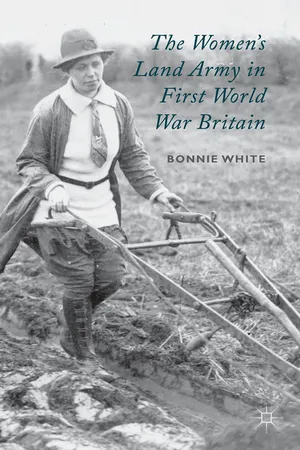
The Women's Land Army in First World War Britain
About this book
Between 1917 and 1919 women enlisted in the Women's Land Army, a national organisation with the task of increasing domestic food production. Behind the scenes organisers laboured to not only recruit an army of women workers, but to also dispel public fears that Britain's Land Girls would be defeminized and devalued by their wartime experiences.
Information
1
Answering the Call: The Formation of the Women’s Land Army
In the summer of 1915 British women took to the streets of London demanding the right to serve. This ‘Call to the Women’ of Britain was part of a larger campaign that encouraged women to support the war effort by entering the labour force and relieving men for military service. At the beginning of the war women flocked to factories and urban centres hoping to capitalise on the wartime market, but in the winter of 1916 there were rumours of food shortages in the capital and all groups involved in women’s farm labour agreed that a concerted effort was needed to bring more women to the land. While these volunteer organisations did much to encourage enlistment, offer training, and put women to work on British farms, they did not have the support of the Asquith government and lacked central organisation. To coordinate and effectively employ women in agriculture, Lord Selborne, who had been working independently to organise women’s farm labour since 1915, established the Women’s Branch in December 1916 before retiring from his post as minister of food with the Board of Agriculture. The Women’s Land Army was created in 1917 to serve as a central organisation for women’s farm labour and was intended to act as an umbrella for those volunteer organisations already in place. The lack of central coordination, the volunteer nature of early farm and horticulture organisations, the absence of government support, and the divergent tactics employed by the various groups involved undermined the success of these organisations and presented a number of obstacles and challenges for the organisers of the Women’s Land Army (WLA) after 1917. While the WLA was successful in bringing women to the land and establishing a viable source of labour, its overall efforts were impeded by organisational mismanagement and the unwillingness of central government to abandon its commitment to laissez-faire policies regarding agriculture.
On the eve of the First World War the British government spent an average of £269 million for the purchase of food, tobacco, and drink from overseas markets.1 Although Britain relied extensively on imports to feed the population, in 1914 the weather was good and the harvest fruitful, labour was not yet in short supply, and it was estimated that home supplies of grain would last for five months.2 Agriculture anticipated no immediate problems since the war was supposed to be over by Christmas and British imports would remain largely unaffected. This lack of intervention in the early days of the war was partly because initial concerns were not about supply, but rather prices, which reflected the inflationary nature of war finance, the high cost of imports, and rising shipping costs.3
While the government under Herbert Asquith was accused of neglecting agriculture, by the end of 1914 the state was directly responsible for buying and shipping the bulk of Britain’s imported foodstuffs and was considering the regulation of prices and the distribution of food items. In December 1916 Asquith appointed a Food Controller (Lord Devonport was the first but was not actually appointed until David Lloyd George became Prime Minister) to control food prices, and later civilian rationing. In the same month he also established the Food Production Department to increase home food production. The result of these changes was the control of imports and production, and the sale of much of the nation’s food supply. From the perspective of the populace, these changes had the benefit of slowing the rate of inflation on food prices, and they eventually led to the stabilisation of bread prices between 1917 and 1919.4
In the first two years of the war, however, a number of merchant ships had been requisitioned to provide essential supplies to Britain’s troops on the continent, which decreased the number of ships available for civilian food imports.5 Volunteerism in the early days and weeks of the war led to a shortage of dockhands to manage Britain’s imports, leading to congestion and delays in British ports. In addition, the submarine campaign against Germany meant that shipping had to be diverted to ports away from the English Channel,6 many of which were not initially equipped to handle the new loads. There was also concern that the U-Boat campaign would intensify as the war progressed, a problem that was compounded by the fact that the Royal Navy was slow to adopt convoy practices until there was no other recourse in 1917.7 Shipping losses meant higher prices at home, which had already provoked consumer discontent. In order to make up for losses in shipping and imports, Britain’s farming community had to increase home food production. The only practical way to increase production was to abandon the livestock regime in favour of cereals and grains. Even under ideal conditions this would have been a tricky undertaking given the nature of British farming. Large landowning estates were in decline, although this did not diminish the role of this group in local politics and recruiting, which they did enthusiastically.8 Changing from livestock to cereals would have required massive intervention and the implementation of restrictive government controls to manage Britain’s farms, which Asquith’s Liberal government opposed.
Ultimately, the war’s impact on agriculture can be divided into two stages: indirect and direct. In the first stage, August 1914 until May 1916, few changes were made to the agricultural sector and Britain’s farmers continued to operate within a laissez-faire framework. Farmers were left to produce what they thought they should and the impact of the war on farming remained indirect. In the second stage – mid 1916 until the end of the war – the rise in demand for farm products clashed with the expansion of the armed forces under the new conscription laws, resulting in a decline in agricultural production. The inability of the farmers to meet quotas forced the government to change its agricultural policies.9 The formation of the Women’s Land Army was one of the changes introduced by the Lloyd George government in January 1917 as part of a larger policy to manage the nation’s food supply.
In the meantime, the government encouraged farmers to manage the food situation locally. Upon the outbreak of war the government made several proposals to farmers through the medium of press releases by the Agricultural Consultative Committee. The policy favoured by the Committee was released on 18 August 1914, when it encouraged farmers to increase the production of staple crops by breaking up grasslands.10 There were no incentives offered to the farmers; instead the Committee was content to offer suggestions that it hoped the farmers would implement. The Committee’s suggestion to the farmers was part of the broader ‘business as usual’ approach adopted by the Asquith government at the beginning of the war. Under this plan, Britain would participate in the European war through limited military, industrial, and financial means, and with minimal disruption to the domestic life of the nation.11
During the war farmers’ unions played a central role in organising and protecting members’ rights, but their efforts were initially unsuccessful.12 Many farmers, whether owner-occupiers or tenant farmers, were reluctant to plough up their fields because they wanted government assurance that prices and demands for their crops could be secured; the issue of price guarantees was an important part of pre-war discussions between the government and the National Farmers’ Union (NFU). The union also worried about the requisite labour for such an undertaking. Due to the decline in agricultural production in the second half of the nineteenth century the number of agricultural labourers had declined from 3 million in 1870 to 2.3 million in 1911.13 Farmers sought improved wages for their labourers in the hopes of preventing further loss of manpower to manufacturing and other industries where wages were higher, an issue that the Land Army would also be forced to deal with during recruiting.14 This was especially important for those farmers who had limited access to machinery. Ploughing up pastures was a risky undertaking that the farmers, smallholders in particular, were not willing to consider without guarantees. In October 1914 the NFU’s organising secretary reported that the Union had ‘absolutely failed to get a guarantee’ of government support in return for increasing the acreage of grain.15
While the Asquith government dithered about the implications of government intervention into the domestic food supply, Lord Selborne, President of the Board of Agriculture, was given the responsibility of managing the nation’s food supply. In early 1915 he established the Milner Committee, comprised of three councils for England, Ireland, and Scotland, to consider the NFU’s position. The unanimous finding of the English Committee in December 1915 was that a ‘plough-up policy’ was the only way for England to substantially increase the gross production of food for the 1916 harvest. The committee recommended offering farmers a minimum price for wheat over the next several years, but only if the farmers were successful in increasing the percentage of arable land by ploughing up their fields to plant staple crops. However, the Irish Committee rejected the idea of guaranteeing prices for any longer than one year, and the Scottish Committee was opposed to fixed prices for cereals, believing that the 1916 harvest would be bountiful and price guarantees would be unnecessary.16 The findings of the Milner Committee eventually formed the basis of the food policy adopted for 1917–18, which included the formation of the Women’s Land Army in England, Wales, and Scotland. Until then, however, intervention was rejected.17
Nevertheless, Selborne continued to stress the need for increased government action and encouraged the NFU to maintain pressure for government guarantees. Selborne also suggested that farmers offer a token of goodwill by voluntarily planting more potatoes and wheat, which some farmers did by abandoning their normal crop rotations. This was only a temporary solution as the land soon became weedy and infertile and instead of improving the productivity of the country, the move resulted in financial losses and a drop in agricultural production.18
Despite Selborne’s protests his scheme received little support from the War Committee. Supporters of laissez-faire policies, including Reginald McKenna, Chancellor of the Exchequer, and Arthur Balfour, First Lord of the Admiralty, blocked all recommendations of regulation. Of primary concern was the scope of Selborne’s scheme. Both McKenna and Balfour were apprehensive about the intended timeline for the proposal – was this to be a permanent policy or would it be terminated with the cessation of hostilities in Europe? Selborne’s plan was to guarantee prices for an indeterminate amount of time, which was unacceptable to all but David Lloyd George, who supported government intervention in terms of price guarantees. The War Committee was also worried that the scheme would require a considerable commitment of personnel, rail lines for the transportation of equipment, horses and supplies, and funds to convert grazing land into arable land. Due to the war the rail lines and the treasury were already over-extended.19 Despite disapproval from the War Committee, Selborne’s programme was intended to reduce maritime shipping needs and negate foreign exchange demands by growing food at home, thereby protecting Britain’s food supply from the vulnerability of a wartime market and, later, the German submarine campaign.20
Lord Selborne was unhappy with the results of the Milner Committee and felt that the Asquith government was too preoccupied with issues in Ireland, as well as with labour and munitions shortages, to give adequate attention to agriculture. While Selborne resigned from government in 1916 over Ireland,21 he was committed to government intervention in agriculture, and in the meantime continued to work toward agricultural reforms. In July 1915 Selborne wrote a letter to Asquith imploring him to develop a plan to increase agricultural production at home, which he believed would have to include a plan for the use of alternative labour supplies, and he emphasised that even if the plan were not implemented immediately it would be ready once the food situation became less certain. Asquith’s cabinet was not convinced that there would be a food shortage and the Prime Minister refuted the charge that immediate action was critical to ensure that home food supplies were secured.22
In September 1915 Asquith conveyed to Selborne that the food question was important, but not vital. While the nation had to produce as much food as possible, the pressing matter was the foreign exchange for the purpose of purchase.23 In response, Selborne developed a plan to stimulate home food production in spite of not having the full support of the Asquith government for futher interference in agriculture. His initial plans involved the establishment of regional committees to coordinate food efforts, a propaganda campaign to appeal to the farmers’ patriotism, and to enlist the help of volunteer organisations that were already dedicated to bringing women workers to the land. In 1915 Selborne set out to establish War Agricultural Committees under the Board of Agriculture to assess local farming needs.24 Most immediately, farmers needed more labour if the plough campaign was to be considered. Selborne understood that asking farmers to increase crop production by ploughing up older fields, largely without the assistance of machinery, with a dwindling labour supply, a shortage of horses, and no government price guarantees, was neither appealing nor likely. David Lloyd George, who had called for a Food Controller to oversee domestic production, believed by November that the food situation was more pressing than previously thought. He was also supportive of a plan to supplement the agricultural labour force with women workers. Selborne’s efforts to affect change with regard to domestic production, and Lloyd Geroge’s support, matured after the Royal Commission on the Wheat Supply, headed by Lord Crawford, Selborne’s eventual successor at the Board of Agriculture, reported that the food situation was uncertain, due in part to shipping losses, but also due to the uncertainty of domestic outputs.25
Selborne believed that the War Agricultural Committees (WAC) were a critical first step in increasing home food production, but these committees varied in their activity and efficiency. The cause of inconsistency was that the WACs were not uniformly introduced across the country, meaning that the structure of each committee reflected county, not local, needs and interests. Each county was required to appoint a WAC, but the County Councils determined the structure of the committee. Therefore, the WAC could consist of an existing committee or sub-committee of the County Council with co-opted members, or it could be a newly formed committee constituted for the express purpose of meeting food needs in wartime. While each committee was to be fully representative of all agricultural interests in the county, including landowners, farmers, and labourers, as well as educational authorities and unions, the interests of all groups were not necessarily represented equally.26 The WAC was to appoint a local committee for each Rural District in the county and for each Urban Distri...
Table of contents
- Cover
- Tilte
- Copyright
- Contents
- List of Illustrations
- Acknowledgments
- List of Abbreviations
- Introduction
- 1 Answering the Call: The Formation of the Women’s Land Army
- 2 Female Preparedness, Male Authority: Organisers and the Board of Agriculture
- 3 Gender, Service, Patriotism: Promoting the Land Army in Wartime Britain
- 4 ‘The Lasses Are Massing’: The Land Army in England and Wales
- 5 ‘Respectable Women’: The Land Army in Scotland
- 6 Back to the Land: The Land Army after 1918
- Conclusion
- Notes
- Select Bibliography
- Index
Trusted by 375,005 students
Access to over 1.5 million titles for a fair monthly price.
Study more efficiently using our study tools.
Frequently asked questions
Yes, you can cancel anytime from the Subscription tab in your account settings on the Perlego website. Your subscription will stay active until the end of your current billing period. Learn how to cancel your subscription
No, books cannot be downloaded as external files, such as PDFs, for use outside of Perlego. However, you can download books within the Perlego app for offline reading on mobile or tablet. Learn how to download books offline
Perlego offers two plans: Essential and Complete
- Essential is ideal for learners and professionals who enjoy exploring a wide range of subjects. Access the Essential Library with 800,000+ trusted titles and best-sellers across business, personal growth, and the humanities. Includes unlimited reading time and Standard Read Aloud voice.
- Complete: Perfect for advanced learners and researchers needing full, unrestricted access. Unlock 1.5M+ books across hundreds of subjects, including academic and specialized titles. The Complete Plan also includes advanced features like Premium Read Aloud and Research Assistant.
We are an online textbook subscription service, where you can get access to an entire online library for less than the price of a single book per month. With over 1.5 million books across 990+ topics, we’ve got you covered! Learn about our mission
Look out for the read-aloud symbol on your next book to see if you can listen to it. The read-aloud tool reads text aloud for you, highlighting the text as it is being read. You can pause it, speed it up and slow it down. Learn more about Read Aloud
Yes! You can use the Perlego app on both iOS and Android devices to read anytime, anywhere — even offline. Perfect for commutes or when you’re on the go.
Please note we cannot support devices running on iOS 13 and Android 7 or earlier. Learn more about using the app
Please note we cannot support devices running on iOS 13 and Android 7 or earlier. Learn more about using the app
Yes, you can access The Women's Land Army in First World War Britain by B. White in PDF and/or ePUB format, as well as other popular books in History & British History. We have over 1.5 million books available in our catalogue for you to explore.