Lexical Facility
eBook - ePub

Lexical Facility

Size, Recognition Speed and Consistency as Dimensions of Second Language Vocabulary Knowledge

  1. English
  2. ePUB (mobile friendly)
  3. Available on iOS & Android
eBook - ePub

Lexical Facility

Size, Recognition Speed and Consistency as Dimensions of Second Language Vocabulary Knowledge

About this book

Coins the term lexical facility to analyse second language performer differences

Establishes a consistent framework to measure size and retrieval speed of vocabulary

Creates a new method of analysis to measure second language performance

Frequently asked questions

Yes, you can cancel anytime from the Subscription tab in your account settings on the Perlego website. Your subscription will stay active until the end of your current billing period. Learn how to cancel your subscription.
No, books cannot be downloaded as external files, such as PDFs, for use outside of Perlego. However, you can download books within the Perlego app for offline reading on mobile or tablet. Learn more here.
Perlego offers two plans: Essential and Complete
  • Essential is ideal for learners and professionals who enjoy exploring a wide range of subjects. Access the Essential Library with 800,000+ trusted titles and best-sellers across business, personal growth, and the humanities. Includes unlimited reading time and Standard Read Aloud voice.
  • Complete: Perfect for advanced learners and researchers needing full, unrestricted access. Unlock 1.4M+ books across hundreds of subjects, including academic and specialized titles. The Complete Plan also includes advanced features like Premium Read Aloud and Research Assistant.
Both plans are available with monthly, semester, or annual billing cycles.
We are an online textbook subscription service, where you can get access to an entire online library for less than the price of a single book per month. With over 1 million books across 1000+ topics, we’ve got you covered! Learn more here.
Look out for the read-aloud symbol on your next book to see if you can listen to it. The read-aloud tool reads text aloud for you, highlighting the text as it is being read. You can pause it, speed it up and slow it down. Learn more here.
Yes! You can use the Perlego app on both iOS or Android devices to read anytime, anywhere — even offline. Perfect for commutes or when you’re on the go.
Please note we cannot support devices running on iOS 13 and Android 7 or earlier. Learn more about using the app.
Yes, you can access Lexical Facility by Michael Harrington in PDF and/or ePUB format, as well as other popular books in Langues et linguistique & Linguistique. We have over one million books available in our catalogue for you to explore.

Information

Part 1
Part 1
Introduction
Part 1 (Chaps. 1, 2, 3, 4, and 5) introduces the theoretical and methodological foundations of the lexical facility account. Chapter 1 introduces the vocabulary size research program, including the frequency-based tests of vocabulary knowledge that are used to estimate second language (L2) vocabulary size in the individual user, which in turn has been related to differences in L2 performance. Chapter 2 then presents different types of vocabulary size tests, including the Vocabulary Levels Test (Nation 2013) and the Yes/No Test (Meara and Buxton 1987). Test assumptions and uses in testing and instruction are described and key findings surveyed. Research on the development of speed and consistency in L2 word recognition skill is examined in Chap. 3. The aims and methods of this research paradigm are then described, as are key research findings. These two independent lines of research provide the foundation for the lexical facility proposal introduced in Chap. 4, which sets out the rationale for combining the two dimensions and discusses the key issues related to this undertaking. Chapter 5 describes the Timed Yes/No Test, which is used in the studies in Part 2 that provide evidence for the lexical facility account.

References

Meara, P., & Buxton, B. (1987). An alternative to multiple choice vocabulary tests. Language Testing, 4(2), 142–145.
Nation, I. S. P. (2013). Learning vocabulary in another language (2nd ed.). Cambridge: Cambridge University Press
Ā© The Author(s) 2018
Michael HarringtonLexical Facilityhttps://doi.org/10.1057/978-1-137-37262-8_1
Begin Abstract

1. Size as a Dimension of L2 Vocabulary Skill

Michael Harrington1
(1)
University of Queensland, Brisbane, QLD, Australia
End Abstract
Aims
  • Introduce the vocabulary size research literature.
  • Describe how vocabulary size is counted.
  • Describe the use of word frequency statistics to estimate vocabulary size.
  • Relate vocabulary size measures to second language (L2) performance.

1.1 Introduction

This chapter introduces the field of what will be called vocabulary size research, an approach based on the simple assumption that the overall number of words a user knows—the breadth of an individual’s vocabulary stock—provides an index of vocabulary knowledge. The focus on vocabulary breadth means that little attention is given to what specific words are known or the extent (or depth ) to which any given word is used. Rather, researchers in the area are interested in estimating the vocabulary size needed to perform particular tasks in a target language. These tasks can range from reading authentic texts (Hazenberg and Hulstijn 1996) to coping with unscripted spoken language (Nation 2006). Size estimates are used to propose vocabulary thresholds for second language (L2) instruction, and more generally to provide a quantitative picture of an individual’s L2 vocabulary knowledge (Laufer 2001; Laufer and Ravenhorts-Kalovski 2010). The focus here, and in the book in general, is on the size of recognition vocabulary and the role it plays in L2 use. The main focus is on the recognition of written language.
Recognition vocabulary is acquired before productive vocabulary and serves as the foundation for the learning of more complex language structures. The store of recognition vocabulary knowledge builds up over the course of an individual’s experience with the language. This knowledge ranges from the most minimal, as in the case of knowing only that a word exists, to an in-depth understanding of its meaning and uses. A sparkplug may be a thingamajig found in a car or, according to Wikipedia, ā€˜a device for delivering electric current from an ignition system to the combustion chamber of a spark-ignition engine to ignite the compressed fuel/air mixture by an electric spark, while containing combustion pressure within the engine’. Recognition vocabulary knowledge emerges from both intentional learning and implicit experience, and even the most casual experience can contribute to the stock of recognition vocabulary knowledge. Repeated exposure to a word also has a direct effect on how efficiently it is recognized.
The notion that knowing more words allows a language user to do more in the language hardly seems controversial. However, many apparently commonsensical assumptions in language learning are often difficult to specify in useful detail or to apply in practice (Lightbown and Spada 2013). Even when evidence lends support to the basic idea, specific findings introduce qualifications that often diminish the scope and power of the original insight. This chapter introduces and surveys the vocabulary size research literature to see how the ā€˜greater size = better performance’ assumption manifests itself. The methodology used for estimating vocabulary size is first described, and then findings from key studies are presented.
Size is a quantitative property and therefore requires some unit of measurement. In the vocabulary size approach, it is the single word. Size estimates reflect vocabulary breadth and have been related to L2 performance in two ways. Researchers have sought to establish the minimum size thresholds needed to perform specific tasks, such as reading an academic text (Schmitt et al. 2011), or related size to performance outcomes in specific settings, as in placement testing (Meara and Jones 1988).

1.2 Estimating Vocabulary Size

The measurement of recognition vocabulary is a far more complex task than might first appear. The first difficulty involves defining what to count as a word. Criteria must also be established for deciding how a given word is recognized for counting. Finally, a practical means must be devised for obtaining a sufficient sample of the individual’s language from which to make a valid size estimate. All three factors present challenges for the researcher.

What to Count

The vocabulary size approach quantifies vocabulary knowledge as a collection of single words. Characterizing vocabulary knowledge as a collection of individual words accords with how vocabulary knowledge is popularly viewed. Single words are the means by which children learn to spell and are the basis for dictionaries, spelling bees, and crossword puzzles. They also have a privileged place in vocabulary learning and teaching, where word lists are a staple feature of any language textbook. And, of course, multiword units (collocations , formulaic speech ) are ultimately made up of single words. Learning these forms involves either associating a combination of known words to a new meaning or learning a new unit in which some or all of the words are unknown (Wray 2008). In either case, the single word represents a basic building block.
Single words are different from other kinds of language knowledge in how they are acquired and represented in the brain. The L2 learner learns a word (sound–meaning pair) consciously and that is stored as part of the declarative memory system, a system open to reflection and explicit modification. But this knowledge is only part of the lexicon, which consists of these words in combination with the mostly implicit grammatical properties that constrain how the words are used. These properties reside in procedural memory , a system of implicit, unconscious knowledge. Paradis (2009) makes a distinction between vocabulary and the lexicon to capture this difference. Vocabulary is the totality of sound–meaning associations and is typical of L2 learner knowledge, particularly in the early stages. The lexicon characterizes the system of explicit and implicit knowledge that the first language (L1) user develops as a matter of course in development, and which is developed to varying degrees in more advanced L2 users. In Paradis’s terms, the lexical facility account relates strictly to vocabulary knowledge, its measurement, and its relationship to L2 proficiency and performance.
Last, the pivotal role the single word plays in online processing also reflects its importance. The word serves as the intersecting node for a range of sentence and discourse processes that unfold in the process of reading (Andrews 2008). It is where the rubber meets the road, as it were, in text comprehension.
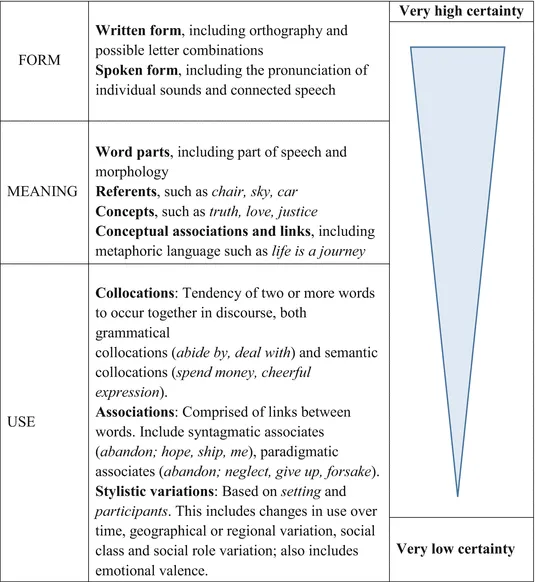
The focus on the recognition of single words means that the vocabulary size approach captures only a small part of L2 vocabulary knowledge, a multidimensional notion comprising knowledge of form, meaning, and usage. Each word is part of a complex web of relationships with other words, and this complex network is used to realize the wide range of expressive, communicative, and instrumental functions encountered in everyday use. Figure 1.1 depicts the basic elements of word knowledge in a three-part model adapted from Nation (2013); see also Richards (1976).
A373450_1_En_1_Fig1_HTML.gif
Fig. 1.1
Elements of vocabulary knowledge tapped by vocabulary size tests
The vocabulary size account reduces vocabulary knowledge to the single dimension of the number of individual words a user knows, or more precisely, recognizes. It is about the user’s ability to relate a form to a basic meaning, whether by identifying the meaning from among a set of alternatives, as in the Vocabulary Levels Test (VLT), or merely recognizing a word when it is presented alone, as in the Yes/No Test. This passive ā€˜rec...

Table of contents

  1. Cover
  2. Frontmatter
  3. 1. Part 1
  4. 2. Part 2
  5. Backmatter