- English
- ePUB (mobile friendly)
- Available on iOS & Android
eBook - ePub
About this book
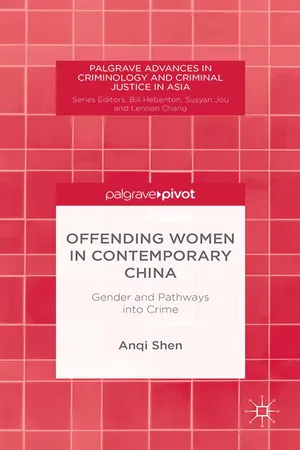
Through an empirical inquiry into three categories of offending women, Offending Women in Contemporary China: Gender and Pathways into Crime explores the socioeconomic conditions that facilitate womens' pathways into crime, and examines the interplay between gender, class, rapid social changes and female law-breaking in neoliberal China.
Information
1
Offending Women in Contemporary China: An Introduction
Abstract: The primary aim of this book is to examine the criminogenic factors of female criminality and the social contexts that facilitate women’s participation in criminal offending in post-Mao China. A further aim is to explore how these factors are gendered. In an attempt to better understand women’s offending, this chapter firstly looks into the historical, cultural, and social contexts of Chinese women on the whole, and secondly, it investigates the impact of the radical socioeconomic changes following the 1978 reforms on Chinese women in general and on female offenders in particular.
Shen, Anqi. Offending Women in Contemporary China: Gender and Pathways into Crime. Basingstoke: Palgrave Macmillan, 2015. DOI: 10.1057/9781137441447.0004.
Feminist studies on pathways to law-breaking look at the trajectories that lead women (and men) to offend (see Chesney-Lind, 2012; Daly, 1998; Sharpe, 2012). Harding (1987) argues that women’s and men’s experiences, desires, and interests differ within every class, race, and culture. Therefore, pathways are gendered. Gendered pathways emphasise biographical elements, life course trajectories, and development sequences (Daly, 1998, 2010). In fact, in feminist criminology, it is not only the gender issue, but also the gendered lives of women (Daly, 1998) that are brought into consideration. Gelsthorpe (1989) makes it clear that feminists should not solely focus on gender as the primary category of analysis, but the historical, cultural, and material diversity of women’s offending must be examined, and victimisation should be taken into consideration, too.
The emphasis of this book, as its title suggests, is gender and the gendered pathways into crime in the context of contemporary China. It aims to examine the criminogenic factors of female criminality and the social context that facilitate women’s participation in criminal offending. A further aim is to explore how criminogenic factors are gendered.
As in other countries (Heidensohn, 1996; Smart, 2012 [1977]), Chinese women are less significantly involved in crime compared with their male counterparts (Cong, 2001; Wang, 2004). As a result, scholarly research into women and crime was neglected in China until the late twentieth century. From the 1990s, research into female criminality has developed quite rapidly (Shen & Winlow, 2013). However, this development has a number of limitations. Firstly, there is a general absence of systematic official crime data in China (Jiang, 2014; Liang & Lu, 2006; Zhang et al., 2007). Reliable information about females’ involvement in crime is largely unavailable (Shen & Winlow, 2013). Secondly, criminological research in China generally lacks methodological foundations that are supported by scientific approaches (L. Zhang, 2014). In the area of female criminality, Wan (2012) argues that little has been done to develop theoretical arguments to explain patterns and trends. Thirdly, no emphasis is placed on evidence-based approaches, and research into criminal matters often involves general discussions or speculations without solid empirical analysis of ‘hard’ data (Zhou & Cong, 2001). As regards women and crime, ‘there is clear refusal to engage with the reality of female offending in a reasonably objective manner’ (Shen & Winlow, 2013: 2). The writing of one author (Yang, 2012: 55) provides a good example for this claim:
The (offending) women are incredibly benighted, shameless, and embraced with unlimited greed, who stretch out their black claws, open their mouths with sharp teeth, suck our society’s blood, create one after another sin and crime, damage their own families and cause disasters to the society ... For them, beautiful appearance is drowned in sin and crime, and beauty has turned to ugliness.
This account suggests two common perceptions of female offenders in China. First, taking a simplistic approach, offending woman are examined separately from a social context and blamed for harming others and the society as a whole; and second, offending women are condemned as ‘doubly deviant’ (Lloyd, 1995). In popular, academic, and official discourses in China, female offenders, as in other cultural contexts, are not only blamed for the offence itself, but also deemed guilty of the traditional moral code of femininity (Snider, 2003; Jewkes, 2011a). Literature in the Chinese language frequently focuses on the internal life of the individual offending women, but has paid little attention to the objective world and its effects, as Shen and Winlow (2013: 3) remarked: [I]n many respects, the developing discourse addressing female offending in China has failed to move beyond basic utilitarian calculus and its emphasis on inappropriate and antisocial decision-making.’ It is therefore argued that before Chinese criminologists begin to address issues of gender and crime with a reasonable degree of rigor and objectivity, there are clear reasons for utilising a rich body of western literature on gender inequality and on criminogenic effects of neoliberalism to make sense of female law-breaking in contemporary China (ibid.).
There are, however, contextual variations which must be taken into account while applying western theories to interpret social phenomenon in different geographical contexts. As regards female criminality in China, two factors are worth noting. Firstly, women’s emancipation and empowerment there develops at a different pace from that in the West, and its impact on female law-breaking and research into women and crime also differs. For example, in the 1960s and 1970s, the feminist movement was growing throughout the western industrial societies such as Britain and the United States. In criminology, liberal feminist writers (e.g., Simon, 1975; Adler, 1975) identified a change in the pattern of female criminality. Adler (1975) argues that women’s increased participation in the labour force opened up new opportunities for them to participate in ‘masculine’ activities, including crime. Therefore, an increase in female crime was being associated with women’s liberalisation. Although the liberal feminist theses did not receive wide support (see, e.g., Figueira-McDonough, 1984; Smart, 1979; Steffensmeir, 1980), it has made significant contributions to the development of feminist criminology by bringing in new approaches to the discipline. By contrast, during the same period, women’s empowerment in China was overshadowed by the radical political struggles. Rofel (2007) questions whether there has been any feminist movement in China as is understood in the West. In fact, Mao’s radical liberation for women, whilst equating women to men, did not seem to have any visible impact on female law-breaking or on scholarly research into women and crime. Therefore, this gives rise to the development of new concepts and theories to encapsulate unique socio-political and cultural conditions in China.
Secondly, differences in legal definitions of crimes are well-acknowledged in comparative criminology (Pakes, 2010), and crime is socially constructed. In contemporary western developed societies, gendered crimes usually involve girls and young women and often refer to ‘running away’, street life, criminal groups, teenage violence, and so forth (Daly, 1998; Sharpe, 2012). Those however are not the major concerns in China. Due to cultural variations and social changes, societies’ perceptions of similar forms of female law-breaking may vary considerably. Even within the same society, there are inevitable cultural shifts concerning offending women. Furthermore, in the West, racism, poverty, abuse of alcohol and drugs, ‘street women’, homelessness, and teenage pregnancy are recognised as the gendered harms and are often considered as causes of female law-breaking (see Chesney-Lind, 2012; Daly, 1992; Sharpe, 2012). Some of the causes are shared in China, but the others are more localised and culturally embedded in the western social settings. Therefore, we must accept that in the transitional period of post-Mao China, there are unique problems for Chinese women in general and for offending women in particular.
Hence, on the one hand, it is salient to recognise that western feminist criminology which is construed from a particular ethnocentric position may not embrace the experiences of, and the problems and challenges facing, women in broader ethnic and geographical contexts, nor may it represent the diversity of women and their involvement in crime. In a study on sex and prostitution in China, Elaine Jeffreys (1997) observes that western experience with urban crime is often projected to China, whilst the localised specifications are ignored. She argues that interpreting crime in China based on English-language accounts concerning similar problems results in false assumptions. Thus, Curran (2014) argues the need for culturally specific theories for China.
On the other hand, China is no longer an isolated nation. It joined the rest of the world firstly when Deng Xiaoping initiated neoliberal practice in 1978 and then has further integrated into the mainstream capitalist system after joining the WTO in 2001. Whilst it has benefited from capitalism’s free market, it has also inherited the system’s problems. Thus, while the world is diverse and cultures are varied, social experiences and social reality can still be truly encapsulated by focusing on objective empirical reality shaped by the spread ideas about how economies should be organised (Winlow, 2013). In this empirical study, I seek to explore some of the realities about women and crime in neoliberal China.
Taking a deconstructionist approach (Carrington, 2008), my analysis starts with the examination of the traditional cultural context of Chinese women on the whole and the impact of the radical socioeconomic changes in reform China on individuals, particularly women, in an attempt to better understand offending women’s life experiences (Connell, 1987).
Cultural context of Chinese women
Historically, China is a patriarchal society. Throughout its long history, Confucian’s ideology about women has had a profound, long-lasting impact. The Confucian norm places women in a subordinated social position in terms of ‘san-cong’ and ‘si-de’. To be considered good, a woman must obey first her father before she marries, then her husband while she is married, and finally her son when she is widowed – ‘three obediences’ (san-cong); and she must also submit four wifely virtues (si-de): fidelity, physical charm, propriety in speech, and ability to do household work. Under these terms, as Jackson (2006) argues, it was considered absolutely essential for women to fully submit to heteronormativity, and fidelity was vital, and the traditional female virtue also required self-sacrifice on the part of women for the sake of their families (Rofel, 1999). The aim of defining and enforcing female virtues was to regulate women and make them good servants to men, who dominated the family and the society. Lu Xun (1881–1936) – an influential contemporary writer in China – made it clear that Confucian virtue and morality for women restricted them and brutally ruined their lives (Mitter, 2008).
Traditionally, women, and children, were assumed to have inferior status in the domestic sphere. Whilst sons were considered to carry on the family bloodlines and therefore valued, daughters were born as ‘outsiders’, who, in the traditional marriage system, would marry out, ‘as the water poured away’ – an old Chinese saying. As I discuss in Chapter 5, such gender preference has survived the profound social changes, especially in remote, rural areas.
In the pre-revolution era prior to 1919, women were deprived of formal education entirely. The old saying – ‘innocence is a woman’s virtue’ – justified the blatant gender discrimination against women in education. Uneducated women were consequently excluded from public life. Therefore, men were deemed to be respectable, whilst women were humble (Wang, 1999), and girls and women were anonymous in and outside family life, with no identity and recognition of personal choices (Watson, 1986).
No evidence suggests that female criminality was a particular social concern in traditional China, perhaps largely due to women’s suppressed social position, limited contact with the world outside their family, and the tight control over their mind and behaviour.
Confucianism fell apart in the early days of the Communist regime, and Mao Zedong’s famous saying – ‘women hold up half the sky’ – redefined female identity. After the founding of the People’s Republic of China (PRC) in 1949, gender equality for women is guaranteed at the constitutional level. In practice, Mao’s radical liberation of women created many ‘iron maidens’ in the socialist era. During the Cultural Revolution, female Red Guards were encouraged to take part in violent activities against anti-revolutionists (Zhang & Ye, 1989), and female violence was accepted as part of the normative gender identity. Rofel (2007) argues that Maoist feminism had essentially masculinised women. Therefore, whilst it equated the gender, femininity was suppressed.
Ironically, even at the height of ‘Maoist androgyny’ (Bailey, 2012), Confucian female virtues were preserved by the state. For example, chastity for women was defined as a socialist ideal in political discourses (Honig & Hershatter, 1988; Evans, 1997). As portrayed in the film Hibiscus Town, a woman who was found to be involved in an extra-marital affair was forced to hang a pair of worn shoes around her neck, thus publically humiliated. Therefore, although women’s status changed dramatically in the Maoist era, as Mitter (2008) pointed out, it is wrong to assume that the change has brought Chinese women an uncomplicated gender equality, freedom, and liberation, and Li (1990) even observed that women’s liberation reversed in the reform era.
Radical social changes in reform China and their impact on women
China’s reform era (post-Mao China) started in 1978. Since then, the shift from the planned political economy to the free market economy has led to profound changes in virtually every aspect of social life. Initially, the official slogan ‘to get rich is glorious’ served to instigate the pursuit for personal wealth. Then Deng’s famous saying ‘regardless the kind of cat, black or white, it is a good cat so long as it catches mice’ openly placed an emphasis on economic growth over ideological debates. The cultural impact of this profound political shift is twofold. Firstly, in the market economy, all relations are defined in monetary terms (Dutton, 2005). Money becomes the key, if not sole, indicator for achievements and success. In this context, individuals are encouraged to make money by all possible means. Gradually, it has created a general desire to ‘get rich’ in the society, and the pursuit of wealth becomes the only driving force in Chinese social life (Yan, 2011). Secondly, in the marketised society, the ‘getting rich’ mentality and the ‘casino mentality’ (Sharma, 2000) are so dominant that they have replaced the traditional Chinese value of respecting virtue and placing less value on profit (Biddulph & Cook, 1999). Consequently, where a society has failed to maintain a set of norms, it is likely to result in anomie – a situated condition of discontent and social disorder (Merton, 1938). Rapid social changes also cause enormous strain – disjunction between the common social goal and the means to achieve it (Merton, 1968) – and generally this Mertonian strain is experienced by women (Conklin, 2012) when they are subjected to the gendered social control and limited legitimate opportunities.
The economic reforms are accompanied by the breathtaking rates of urbanisation in post-Mao China. Following the rural reforms, thousands of rural migrants flow into cities to look for jobs, and many of them are women (Harvey, 2005). Due to the rigid urban-rural differentiation institutionalised in Maoist China, rural migrants do not enjoy the same social status as urban citizens (Ren, 2013; Rofel, 2007). In cities, plentiful jobs with low rates of pay await migrant women who have no qualifications, skills, and social networks. They tend to find jobs in labour-intensive industries (Chang, 2008), in domestic services (Rofel, 2007), and in the sex industry (Liu, 2012; Zheng, 2014). Often, female migrants are subjected to the super-exploitation of labour power (Harvey, 2005), and their marginalised social status renders them vulnerable and may lead to them being associated with crime (Bakken, 2005).
Yan (2009) contends that capitalism in alliance with the strong state may have attributed to the remarkable economic growth in China but at the same time has also made it an ever polarised society. In post-Mao China, the traditional urban-rural inequality has transformed into disparities in income among different classes (H. Wang, 2003), with a small number of the super-rich at the top and millions of migrant workers and the rural population, especially those in western inland mountainous provinces such as Yunnan and Guizhou, at the bottom and living in impoverished conditions (Jones, 2007; Mitter, 2008; Naughton, 2007). Vowing a ‘war against poverty’, Chinese Premier Li Keqiang admitted that ‘while economic growth has been stunning over the past 30 years, it has also been uneven’ (The Diplomat, 2014). Among people living below the poverty line, women make up the majority (Chen, 1999). Such ‘feminisation of poverty’ was true a decade ago and remains real even today (Jie & Kanji, 2003; Wang et al., 2006).
In addition to social inequality, the negative effects of the economic reforms include the collapse of the collective structure established in the Maoist era. The Chinese leadership initially believed that it was possible ‘to cross the river by gripping the stones’ but later found when the ‘market water’ got deeper and faster, at times it lost control. When the market rules started to dictate the social arrangements, the collective structure could not survive. As a result, job security and social protection are no longer provided by the state-owned enterprises for their workforces, and limited welfare and benefits are offered by the private sectors to their employees (Harvey, 2005). At the same time, the reforms carried out in the state-owned enterprises have created a large number of laid-off workers, among whom many are women (Jie & Kanji, 2003; Wang et al., 2006). Without an adequate social welfare system, they have to rely on themselves to survive.
To deal with the problem, the Party-state places increasing emphasis on individual capabilities and obligations, and it is hoped that through spurring growth opportunities are created that enable individuals to construct an autonomous self and look after the welfare of the...
Table of contents
- Cover
- Title
- 1 Offending Women in Contemporary China: An Introduction
- 2 Researching Chinese Female Offenders: The Methodology
- 3 Female Members of Black-Society Style Criminal Organisations
- 4 Female Offenders Who Organised Others for Prostitution
- 5 Female Child Traffickers
- 6 Conclusion
- Bibliography
- Index
Trusted by 375,005 students
Access to over 1.5 million titles for a fair monthly price.
Study more efficiently using our study tools.
Frequently asked questions
Yes, you can cancel anytime from the Subscription tab in your account settings on the Perlego website. Your subscription will stay active until the end of your current billing period. Learn how to cancel your subscription
No, books cannot be downloaded as external files, such as PDFs, for use outside of Perlego. However, you can download books within the Perlego app for offline reading on mobile or tablet. Learn how to download books offline
Perlego offers two plans: Essential and Complete
- Essential is ideal for learners and professionals who enjoy exploring a wide range of subjects. Access the Essential Library with 800,000+ trusted titles and best-sellers across business, personal growth, and the humanities. Includes unlimited reading time and Standard Read Aloud voice.
- Complete: Perfect for advanced learners and researchers needing full, unrestricted access. Unlock 1.5M+ books across hundreds of subjects, including academic and specialized titles. The Complete Plan also includes advanced features like Premium Read Aloud and Research Assistant.
We are an online textbook subscription service, where you can get access to an entire online library for less than the price of a single book per month. With over 1.5 million books across 990+ topics, we’ve got you covered! Learn about our mission
Look out for the read-aloud symbol on your next book to see if you can listen to it. The read-aloud tool reads text aloud for you, highlighting the text as it is being read. You can pause it, speed it up and slow it down. Learn more about Read Aloud
Yes! You can use the Perlego app on both iOS and Android devices to read anytime, anywhere — even offline. Perfect for commutes or when you’re on the go.
Please note we cannot support devices running on iOS 13 and Android 7 or earlier. Learn more about using the app
Please note we cannot support devices running on iOS 13 and Android 7 or earlier. Learn more about using the app
Yes, you can access Offending Women in Contemporary China by A. Shen in PDF and/or ePUB format, as well as other popular books in Social Sciences & Criminology. We have over 1.5 million books available in our catalogue for you to explore.