- English
- ePUB (mobile friendly)
- Available on iOS & Android
eBook - ePub
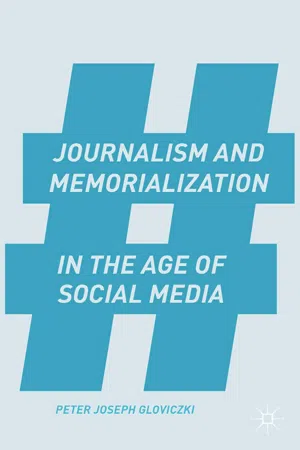
Journalism and Memorialization in the Age of Social Media
About this book
This volume examines journalism and memorialization in the age of social media, with a particular emphasis on communication in times of crisis. Recognizing that individuals are sharing more actively than ever before, this book investigates the implications of this emerging practice for journalism and mass communication.
Information
Chapter 1
Journalism in the Age of Social Media
Nic Harter and Katherine Olson
I first met Nic Harter when he moved in across the hall from me in Ellingson Hall at St. Olaf College in the fall of 2002. We were freshman and both excited about the prospect of starting college. Later that year (or perhaps it was the following year), I remember that he burned a copy of the movie American Beauty onto a DVD, so that my friend Mia and I could watch it together. Nic was always willing to be helpful, and he was ambitious in the best sense. He had a broad smile and seemed to live life with a full heart. Certainly, time provides what the poet Eliot Khalil Wilson has smartly called “the honeyed light of memory,”1 but I firmly believe that Nic was a kind and generous person. In the spring of my freshman year at St. Olaf, I somehow managed to break or at least injure my left foot. Doctors never found a break, but I wouldn’t be surprised if I at least had a stress fracture. Either way, I needed to rest for several months, and so I used a wheelchair to get around from about January until about May of 2003. I became indebted to my college friends, including Nic, who often helped push me from class to class and generally provided assistance with everyday tasks while I was wheelchair bound.2
St. Olaf College is located in Northfield, Minnesota, and the college is atop a hill. For this reason, the college is sometimes colloquially referred to as “the college on the hill.”3 Needless to say, winter in Minnesota can be brutal, with frigid temperatures and wind chills that reach −10 or −20 Fahrenheit. The coldest wind chills I remember experiencing were somewhere between −45 and −50 Fahrenheit. St. Olaf was cold and windy in the winters. Accordingly, on a nice and relatively warm day in March, if the temperature nears 50 or 55 degrees Fahrenheit, it is not uncommon to see people wearing a light jacket, as they proclaim that spring has arrived. It was on just such a spring day that I remember seeing Nic walking toward the student union. He was wearing a t-shirt and had on a pair of shorts. When I asked if he wasn’t a bit cold, he simply said, “It’s a beautiful day.”4 Nic had a wonderful sense of optimism, one that I admired and still remember to this day. The t-shirt in March story is my favorite one about Nic, because I think it captures both his positive outlook and the full spirit with which he seemed to approach life.
Nic Harter died in a scuba-diving accident in the Mississippi River. As I have written in the past, one of our professors noted that he “had the heart of a Northwoodsman.”5 In telling Nic’s story, I hope that others might come to know him as well. When Nic died, St. Olaf had a memorial service for him on campus; it was a gathering in Boe Chapel. I remember that I spoke at that service, that I shared some memories, but I don’t recall exactly what I said. Something about the importance of a sense of place comes to mind as I write these words now, but I can’t recall the precise nature of my remarks. The gathering in the chapel happened and then it was over. After remembering Nic, we went home to our apartments and dorm rooms.
A few years later, another college classmate of mine, Katherine Olson, was murdered after she answered an advertisement on Craigslist. The story of Katherine’s tragic death received extensive media attention, but rather than recount the story of her death, I remember a brief story about her life. Katherine had a fireball of red hair, which matched her vivacious personality. She was extraordinarily outgoing, much like Nic, and I remember her as a kind and gentle person. I must admit that I did not know Katherine, who was affectionately known as “K.O.,” very well. I knew who she was and we had some mutual friends. In retrospect, she is the kind of person that I wish I would have gotten to know better. This sentiment is easy to have after the fact, I suppose, but it is true nonetheless. A college roommate of mine once told me a story about Katherine and he ended the story by remarking, as I did before, about her hair. Even brief interactions with her seemed to move through people in the most memorable way. When Katherine was around, I knew it, and I felt uplifted for and by her presence.6
The stories of Nic and Katherine are the engine that powers this book. While I have always been interested in remembering and forgetting, the stories of Nic and Katherine motivated me to more fully examine memory and its emerging relationship with the media. Carrying their stories forward provides me with a deep sense of motivation to examine media, memory, remembering, and forgetting. I carry with me the sincere hope that their stories might function to motivate others as well. I hope that learning about Nic and Katherine encourages others to seek out those passions that drive their lives and to engage with everyday challenges and opportunities in a full-hearted and eyes-open manner. I hope this book is helpful on that path.
What Online Memorials Mean to Me
An online memorial is a space for remembrance that exists in the networked world. A memorial may be a CaringBridge site, a Facebook memorial group, a Twitter feed, or a YouTube channel, among other possibilities.7 The exact parameters of the space are much less important to me than the use of the space.8 As I have defined in my earlier research, social media memorials are “immediate, interactive and public and they function across a great distance during a time of crisis.”9 I am asserting that users drive online memorials, rather than being driven by them.10
In this sense, I endorse the uses-and-gratifications theoretical framework, especially the central and long-held notion, made famous by researchers Katz and Blumler, among others, that individuals utilize particular media to gratify specific needs.11 I view uses and gratifications as a helpful way to understand media use in the age of social media, because this theory especially recognizes the media audience as active, rather than passive, in their media consumption.12
My understanding of the audience in the age of social media is especially influenced by many scholars, including danah boyd,13 Sherry Turkle, and Shayla Thiel-Stern. Their writings have helped me understand that the media audience is always growing and changing, and with that growth and change comes a fuller, ever evolving notion of online communication in everyday life. I am especially grateful to the work of these three scholars for the way that they have rightly convinced me about the role of the networked world in the lives of its users.14 In my view, it is no longer helpful to think about “the online world” and “the offline world”15 as distinct places. There is simply the world, and for those people who spend considerable time online, it is often a part of how they live, love, remember, and forget.16
Online memorials are fundamentally storytelling spaces, in my view. This aspect of my thinking about online memorials has especially developed in the process of writing this book. In this sense, I humbly stand on the shoulders of many giants in media and communication studies, including George Gerbner.17 I should also thank Dr. Kathy Forde and Charlotte Bishop for encouraging me to articulate and define my terms during a wonderful dinner-table conversation in Columbia, South Carolina. With their encouragement, I am motivated to further define the notion of online memorials as spaces for storytelling.
Online memorials are not only user driven; they are, more important, story driven. For an online memorial to be ongoing and sustained, there must be a story that is broadly accessible to the audience of users. In this sense, I view access in two ways: first, access to the infrastructure of social media communication (an Internet connection, a social media account, a government willing to provide access to the content), and second, both the means and desire to relate to the story that is being told (the means, in this case, primarily meaning the time to engage in posting, and the desire being some shared frame of reference; for example, memorials that remember college students can inspire responses from other college students, even those who did not know the deceased personally).18
As story-driven entities, thorough, fact-based journalism is a vital component of robust online memorial groups. Journalism can provide the foundation for the memorial group’s ongoing remembrance. When the reportage about the story changes, the memorial group’s conversation can change as well. When the reportage about the story concludes, or slows to an occasional trickle, the memorial groups can conclude, too. Although media coverage is not an absolute necessity for a memorial group, I do think that media coverage about an unfolding news event can serve to motivate participation in online memorial groups, especially as individuals become aware of unfolding events via transnational, 24-hour media coverage. While individuals largely use traditional media to find out what happened, they are turning to social media to discuss what happened. A broad, meaningful conversation needs enduring nuts and bolts. Put simply, online memorial groups are story-driven entities, and thorough, fact-based journalism19 can provide a solid foundation on which those entities are constructed.20
The online memorials that most capture my attention are those that embody the qualities I have described. In studying them, I am most interested in studying the aftermath of an event, rather than the tragedy that gave rise to the memorial. Studying the aftermath provides insight into the way that people remember (and forget) the event. This line of research is for me an engaging, even uplifting pursuit. Studying online memorials has taught me about the need to keep going in the face of tragedy—to keep a focus on the future while remaining mindful of the past. For this lesson, I owe a great deal of thanks to those whose posted content I have studied in online memorial groups.21
My Own Participation in Online Memorial Groups
I have been both a participant and a researcher in online memorial groups. One of the first things that drew me to online memorial groups was the fact that individuals sometimes post on memorial walls in the first person. This simple act convinced me that online memorial groups are not only spaces constructed by the living but also spaces full of life. To write about an individual in the first person seems to me one way of indicating that person is still alive in spirit, through the words and actions of her or his loved ones or those affected by her or his stories. The use of first person was profound evidence to me that those remembered in online memorial groups can have a marked influence on the lives of others.
I am deeply thankful to St. Olaf College professor William Sonnega, the director of the media studies program at the college, for nurturing my interest in online memorials. He knew, probably before I fully realized it, the potential in studying online memorial groups, which I first knew as virtual graveyards. Before I participated actively in online memorial groups, and even before I began researching them, I had studied the way that St. Olaf’s student-run weekly newspaper, the Manitou Messenger, covered the deaths of three students, each of whom died in separate circumstances.22 At this early moment, as a college student, I was already interested in the stories that develop and the journalism that emerges in the aftermath of tragedy. My interest at such an early age was motivated by a desire to make sense of the unbelievable, to know the seemingly unknowable.23
Still today, I love asking myself and my students the foundational why questions: why did something happen, and why does it matter? The first of these questions is sometimes unanswerable, but the second question, why does it matter, can be more easily approximated. In studying the aftermath of an event, its lasting legacy can be gradually revealed. The process of sense making can, at least in certain cases, be made somewhat easier through examination of these questions. In this way, I am fascinated by online memorial groups because they can help me understand the foundational why questions.24
I posted in an online memorial group that remembered the life of Katherine Olson, thanking the group’s founder for her work to keep us updated on the story. I believe the group’s founder had posted a link to a news story about Katherine’s case. My posting was brief and kind, as both of these characteristics seemed appropriate for a social media site, where so much communication is brief. I wanted to express myself in a respectful way, even though I did not know K.O. well and had a relatively minimal connection to her life. My desire to participate in the group through this posting also was rooted in the fact that many of my friends and classmates knew K.O. well, much better than I did, and so I felt peripherally connected to her. I share this specific detail—my sense of peripheral connection—because I think it likely influences my own positionality in relation to the online memorial groups that I study: the users who post content likely feel some connection to the unfolding events, but it may well be a more peripheral, rather than a direct, connection.25
Reflecting on my own, somewhat limited, participation in online memorial groups, I also wonder how I would have reacted if online memorial groups had been readily available to me following Nic Harter’s death. Nic died before the true rise and maturation of social media as we know it today, but I may have taken an active role in a Facebook memorial group, for example, that was dedicated to his life. At the same time, I expect that my direct participation in Nic’s memorial (speaking at the gathering in Boe Chapel on the St. Olaf campus) would have likely trumped participation in an online group. Recognizing that participation can take different forms, it has not surprised me to learn that participation in online memorial groups is common among those with no direct personal or geographic connection to an unfolding event. The online community of interested others can itself provide a connection, however peripheral, to the event.26
As a researcher, it is the stories (revealed in users’ posted content) that keep me fascinated by online memorial groups. I have had the pleasure of studying online memorial groups since 2007, both studying memorials for noncelebrity individuals and especially studying the memorial groups that form in the aftermath of major news events. The case of one of the latter groups, the “In Memorial: Virginia Tech” Facebook group, was the focus of my 2012 doctoral dissertation; the case of that group is presented, in a revised and streamlined form, in Chapter 2 of this book. More broadly, it has been my pleasure to present about online memorial groups at academic conferences and in public scholarship settings, including in op-ed pieces. Owing to this multitude of experiences as a researcher, I feel a responsibility to be a public communicator about online memorial groups. I sometimes preface what I do as a researcher by telling people that “when someone passes away, sometimes a group of family and friends will start a memorial group in their honor” or “following a major news event, especially a tragedy, online memorial groups can help people find community.” Each of these characterizations no doubt reflects how I view my research: I see it as ultimately about people and their stories,27 especially as those stories unfold in times of crisis.
It is worth noting that, in studying users’ posted content, I have sometimes come to feel as though I know at least something about these indi...
Table of contents
- Title Page
- Copyright Page
- Dedication
- Contents
- List of Illustrations
- Foreword
- Preface
- Acknowledgments
- 1 Journalism in the Age of Social Media
- 2 The Case of the “In Memorial: Virginia Tech” Facebook Group
- 3 The News Cycle in the Age of Social Media
- 4 Public Memory in the Online World
- 5 Emotion on the Screen
- 6 The Audience after Virginia Tech
- Notes
- Bibliography
Trusted by 375,005 students
Access to over 1.5 million titles for a fair monthly price.
Study more efficiently using our study tools.
Frequently asked questions
Yes, you can cancel anytime from the Subscription tab in your account settings on the Perlego website. Your subscription will stay active until the end of your current billing period. Learn how to cancel your subscription
No, books cannot be downloaded as external files, such as PDFs, for use outside of Perlego. However, you can download books within the Perlego app for offline reading on mobile or tablet. Learn how to download books offline
Perlego offers two plans: Essential and Complete
- Essential is ideal for learners and professionals who enjoy exploring a wide range of subjects. Access the Essential Library with 800,000+ trusted titles and best-sellers across business, personal growth, and the humanities. Includes unlimited reading time and Standard Read Aloud voice.
- Complete: Perfect for advanced learners and researchers needing full, unrestricted access. Unlock 1.5M+ books across hundreds of subjects, including academic and specialized titles. The Complete Plan also includes advanced features like Premium Read Aloud and Research Assistant.
We are an online textbook subscription service, where you can get access to an entire online library for less than the price of a single book per month. With over 1.5 million books across 990+ topics, we’ve got you covered! Learn about our mission
Look out for the read-aloud symbol on your next book to see if you can listen to it. The read-aloud tool reads text aloud for you, highlighting the text as it is being read. You can pause it, speed it up and slow it down. Learn more about Read Aloud
Yes! You can use the Perlego app on both iOS and Android devices to read anytime, anywhere — even offline. Perfect for commutes or when you’re on the go.
Please note we cannot support devices running on iOS 13 and Android 7 or earlier. Learn more about using the app
Please note we cannot support devices running on iOS 13 and Android 7 or earlier. Learn more about using the app
Yes, you can access Journalism and Memorialization in the Age of Social Media by P. Gloviczki in PDF and/or ePUB format, as well as other popular books in Social Sciences & Media Studies. We have over 1.5 million books available in our catalogue for you to explore.