- English
- ePUB (mobile friendly)
- Available on iOS & Android
eBook - ePub
About this book
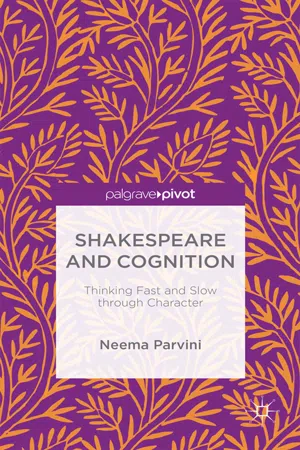
Shakespeare and Cognition challenges orthodox approaches to Shakespeare by using recent psychological findings about human decision-making to analyse the unique characters that populate his plays. It aims to find a way to reconnect readers and watchers of Shakespeare's plays to the fundamental questions that first animated them. Why does Othello succumb so easily to Iago's manipulations? Why does Anne allow herself to be wooed by Richard III, the man who killed her husband and father? Why does Macbeth go from being a seemingly reasonable man to a cold-blooded killer? Why does Hamlet take so long to kill Claudius? This book aims to answer these questions from a fresh perspective.
Information
1
Why Characters Matter in Shakespeare’s Plays
Abstract: This chapter’s aim is twofold: first, to bring us up to speed with the current state of play as regards character analysis in Shakespeare studies, and second to prepare the ground for moving beyond the paradigms set up by cultural historicist theory and traditional historical scholarship by introducing the work of Daniel Kahneman and Amos Tversky.
Parvini, Neema. Shakespeare and Cognition: Thinking Fast and Slow through Character. Basingstoke: Palgrave Macmillan, 2015. DOI: 10.1057/9781137543165.0005.
Some years ago, shortly after completing my PhD, I applied for a part-time teaching post at Cambridge. As part of the process, I had to submit a sample of my work, and so included the reading of the Henry VI plays that now forms a chapter of my book, Shakespeare’s History Plays: Rethinking Historicism. At the interview one member of the panel asked, with exquisite condescension:
‘How would you respond if I were to say that your work has a rather ... Bradleyan quality?’
He leaned forward pointedly. I smiled and said,
‘Well, I’d probably take it as a compliment.’
Suffice it to say that he almost certainly did not intend it as a compliment and, perhaps unsurprisingly, I did not get the job. In any case, my reading of the Henry VI plays does not really owe much to the practice of A.C. Bradley, but it did use characters and their attitudes as a central unit of analysis. I argued that Shakespeare used characters and their individual approaches to politics as test cases through which to analyse the realities of kingship and power. But to my Cambridge interrogator, it would appear that any recourse to character analysis is tantamount to evoking Bradley – it is old fashioned, we don’t do that anymore, and it must therefore be ridiculed and brought to task.
Since then, however, there have been stirrings of a resurrection for character analysis. In 2009, Paul Yachnin and Jessica Slights edited a collection called Shakespeare and Character: Theory, History, Performance, and Theatrical Persons which opens with the bold claim that ‘character has made a comeback’ (1). In 2010, Michael D. Bristol edited a collection of essays called Shakespeare and Moral Agency devoted to the moral reasoning and decision making of Shakespeare’s characters. And the annual publication, Shakespeare Studies, dedicated two special volumes to the topic of Shakespeare and character in both 2006 and 2012. Another volume of essays, Shakespeare’s Sense of Character: On the Page and From the Stage edited by Yu Jin Ko and Michael W. Shurgot, followed in 2012.
For those of us who teach at the undergraduate level, the allure of character analysis is obvious. As Hugh Grady puts it, ‘drama is, fundamentally, about people doing things’ (15), so it follows that we’d want to focus on the people and what they do. Students almost naturally seem inclined towards analysing the motivations of certain characters. Why does Hamlet hesitate? Why is Iago so hell-bent on ruining Othello’s life? Why does Hal reject Falstaff so cruelly? Students, on the whole, are prone to look for psychological explanations in the first instance, which of course entails imagining characters as real people. In his review of Shakespeare and Moral Agency, Colin McGinn has an erudite passage on why this might be the case:
In drama, we are confronted by agents performing actions for reasons. Agents have will, intention, desire, rationality, beliefs, perceptions, emotions, self-conceptions, personalities, and consciousness: all these things affect their decisions and overt acts. ... Shakespeare creates characters in which the full lurid tapestry of defect and deficiency is made vivid. His plays are probing essays in culpability – or better, puzzles and conundrums. We wonder why his characters act as they do, while recognizing their human verisimilitude: Hamlet’s procrastination, Othello’s gullibility, Macbeth’s ambition, Lear’s foolishness, Shylock’s rigidity. We apply the conceptual apparatus of motivation and character to these figures, hoping to make sense of what we witness. (222)
For McGinn it is ‘shocking ... that this needs saying’ (222) and he laments the postmodern theory that brought us to the point where we cannot talk sensibly about character anymore.
One of the legacies of new historicism and cultural materialism has been that the category of character has become almost completely disavowed. As Yachnin and Slights summarise, the chief objections to character analysis have been ‘first theoretical ... on the grounds that subjects are merely the effects of the social, linguistic, and ideological determinations of individual identity’ and ‘second historical’ on the grounds ‘that inwardness as we understand and experience it did not exist in the early modern period’ (3, italics in the original). Alan Sinfield, speaking on behalf of cultural historicists, concurs:
The current historicist objection to character as an interpretive principle holds that early modern people did not have the same kinds of identity and consciousness as ourselves. Medieval and early sixteenth-century drama offers typical figures – allegorized qualities, or characters whose characteristics are continuous with their social roles. That is how those people thought of themselves: they were moved more by social role rather than subjectivity and interiority. ... The second current objection to character criticism flourishes in postmodern and post-structuralist discourses, where it is found to be at odds with ideas about subjectivity and representation. ... It holds that no one really has a consistent inner core of being; any identity is, and should be, decentered – unstable, provisional, occupied only through processes of anxious iteration. Belief in our individual selfhoods is a strategy that we need to survive in our atomized society (though in actuality, market researchers find, we are remarkably similar). ... If postmodern principles and deconstructive mechanisms are (proposed as) universal insights into human identity, it appears not unreasonable to suppose that they are manifest also by Shakespeare. (27, 28)
Sinfield, of course, supports these objections. Citing Louis Althusser’s work on ideology, he says,
the category of ‘character’ has been justly disparaged by historicists and theorists of various persuasions ... Cultural materialists regard ‘character’ as a typical mystification of bourgeois ideology, tending to efface the realities of class, race, gender and sexuality, oppression, cooperation, history, and ideology. They analyze the moments at which character effects break down, disclosing the ideological project of the play. (33)
Regardless of Jonathan Dollimore’s recent protestations about the label (see 2013), this is unmistakably anti-humanist thinking in which characters are the products of ideology just as real people are the products of ideology; there is no selfhood beyond that which is ‘constituted in ideology’ (30).
The responses by those who wish to pursue character analysis have mainly spoken to the theoretical challenge, as I will come on to discuss, but I want to pause briefly to consider the historical claim. This claim is not new. A.C. Bradley’s habit of treating literary constructions as real people was, of course, famously brought to task in the 1930s by formalists such as L.C. Knights (1964). But after that there was a turn towards historical context in the 1940s, and thus came early versions of the historicist argument about character being anachronistic that Yachnin and Slights, and Sinfield, summarise. In 1949, J.I.M. Stewart wrote a book called Character and Motive in Shakespeare: Some Recent Appraisals Examined, which begins by reacting to these historically based arguments:
The discovery that Shakespeare’s drama is not like Ibsen’s, or that as characters Hermia and Helena are only distantly related to Milly Theale and Kate Croy, does not constitute in itself a very sufficient illumination of the plays; nor, when we have grasped that many of the plays are more like fairy tales than the contents of true-life magazines, and thence infer that the characters are more likely to be ‘unpsychological’ are we treading upon very adequately considered ground. (6)
Stewart recognises that realist plays and novels from the nineteenth and twentieth centuries are closer to our modern ‘mode of consciousnesses’ (3) than are Shakespeare’s plays. However, he maintains that despite the fact that Shakespearean characters are ‘essentially symbolical’ (10), they are nonetheless ‘composed into a whole ... which is in the total impression an image of life’ (110). Shakespeare creates an internal reality, which, though often fantastical, gives us recognisably human characters who appear to think, feel and act in a way that is at least analogous to what we see in everyday life. I think Stewart’s real point about Shakespeare not being like Ibsen or Henry James or a glossy magazine is to ask: ‘does it really matter?’ Let us suppose that historicists, such as Francis Barker, who argue that selfhood is a modern, bourgeois concept invented in the late seventeenth century,1 and that the age that gave us Hamlet had no concept of inwardness or psychological interiority are correct (31). Does it change the fact that we, now, have an understanding of such inwardness and can recognise it in a play such as Hamlet? Bruce W. Young’s provocative essay on this topic, ‘Shakespearean Characters and Early Modern Subjectivity: The Case of King Lear’, argues that ‘though the experience of subjectivity has certainly changed over time, subjectivity is a useful notion for understanding human experience in any period’ (37). Young goes on to argue that historicist claims about the period’s notions of subjectivity falsely dichotomise selfhood in a way that ‘would have been foreign to the early modern period’ (38). Historical scruples are beyond the scope of this study, but for the approach that I am proposing, to an extent it does not really matter what the early moderns thought of themselves or, indeed, what we think of ourselves, because dual-process theory accounts for how people think and reason, and not for what they think. It can explain how somebody reaches a given conclusion, but the contents of the conclusion itself are secondary to the process by which it is reached. However, I say only ‘to an extent’, because context is vital in determining how choices are made, and can in fact dictate which biases are more likely to affect the person’s response, but more on this later.
Let us return to the anti-humanist theoretical challenge outlined by Yachnin and Slights, and put forward by Sinfield. It is plain to see that these sorts of arguments have framed the terms of the response from those who still find value in character analysis. Raphael Falco, for example, begins his consideration of whether there is ‘character after theory’ by acknowledging ‘an overt skepticism among postmodern literary critics regarding the existence of a coherent individual subject’ (21). Sara Coodin likewise feels compelled to address the underlying question: ‘Shakespeare scholarship of late has become consumed with how early moderns heard and smelled and saw differently from how we do. But is this necessarily true? There may in fact be something more universal in how we experience emotion’ (66). Michael D. Bristol talks about ‘the shared complexity of our human nature’ (2009, 38). Cultural materialism’s oppositional stance tends to force certain issues which recur time and again. It frames the debate in such a way that seemingly all issues must come down to the core absolute questions of nature versus nurture, bourgeois notions of selfhood versus ideology, universalism versus historical specificity and so on. In short, Sinfield puts those who would want to reclaim character as a valid category for analysis in the position of first having to put forward an essentialist and universal theory of the unified self, which cultural historicists can then attack with ready-made arguments and appropriate citations from Althusser and Foucault. As such, I would like to avoid these arguments, not only because they are a form of conceptual trap that returns the cultural historicist to the relative safety of their traditional stomping grounds of power and ideology, but also because I believe that the focus on the source of people’s or characters’ motivations – that is, whether they are ultimately innate and universal or ideological and historically subject – is misplaced. To embark on character analysis we need not put forward any grand claims – humanist, anti-humanist or otherwise – about the root causes of why people come to behave in the way they do. If one is focusing on the decisions and actions of a particular character in a particular situation, is it necessary always to ask if those decisions are the product of innate biological processes or of ideological conditioning? In my view, such questions are at a level of remove and abstraction from everyday life that prohibits the sensible discussion of characters and their actions in literature, and, indeed, of people and their actions in the real world. Dual-process theory gives us an understanding of the way human beings think in action – it does not put forth a root cause for the way we think, that is, it does not give us the ‘why’ – but rather gives an account, with empirical data, of how people actually make decisions and reason with themselves on a day-to-day basis. In other words, regardless of the reasons, it gives us the ‘how’. Machiavelli’s phrase about how he was concerned with ‘what men do, not what they ought to do’ comes to mind; similarly, the studies from which I am drawing focus on what people actually do.
To lean on the work of Kahneman and Tversky, as I am proposing, is not to posit an ultimate, fixed human nature or to return to pre-theory essentialist humanism. In fact, some insights from research into cognitive biases might actually serve to explain how ideology has been as effective in conditioning individuals as subjects as Althusser and others have argued. For example, the so-called availability cascade, or ‘illusory truth effect’, first outlined by Lynn Hasher, David Goldstein and Thomas Toppino in 1977, finds that ‘frequency is a key attribute of memory’ (112). In short, if a lie is repeated often enough in the media and elsewhere, it self-perpetuates and becomes part of the collective memory as an ‘illusory truth’; in the vernacular we might call these urban myths. This effect can be underlined by other unconscious biases such as the ‘false framing effect’ described by Larry L. Jacoby, Vera Woloshyn and Colleen Kelley, in which familiarity with a particular name alone can lead people more or less systematically to misidentify non-famous names as being famous: vague recognition alone affects our ability to make what they call ‘fame judgements’ (124). Once we learn the illusory truth, we find ways to confirm its truth and perhaps even become staunch defendants of its validity, looking for reasons why the falsehood that we have accepted as truth is after all true. One might think of Juror Three played by Lee J. Cobb in the 1957 film 12 Angry Men: he makes his mind up early on that the defendant is guilty and then, despite growing evidence to the contrary, becomes more and more entrenched in his position, and reaches wildly for any argument to support his conviction. Beliefs, once made, are difficult to unmake, even if the belief is rooted in illusion. None of this is news to the keen readers of Althusser, and it is difficult to imagine Alan Sinfield disagreeing with some of these findings. Many other such experiments find that people are easily led and manipulated and susceptible to over-confidence in their ability to make impartial and rational judgements. We are prone to jump to conclusions; we overrate our ability to assess risk with clarity; we think we understand more than we do by systematically and habitually transmuting information to confirm what we already know; and ‘we tend to exaggerate our ability to forecast the future, which fosters optimistic overconfidence’ (Kahneman, 255). And all of this, if anything, at least provides some interesting empirical data about the human capacity to be influenced and manipulated by others, which must be central to any claim about the efficacy of ideology or power. My point, at this juncture, is that my proposed use of concepts taken from Kahneman and Tversky and others, especially the study of biases and heuristics, is not to take a position on the age-old nature/nurture debate one way or the other. This work can provide interesting insights into that question, but in itself remains neutral and perhaps even ambivalent to it.
However, Kahneman and Tversky do suggest (implicitly) that the way that people process their thoughts is itself universal. I think that this is a fair assumption. There is no reason why an early modern person would not be prone to the same sorts of biases, errors of judgement, hubris and so on, as a twenty-first-century person, and they are easy to spot in Shakespeare, as I will demonstrate later. The emphasis on the ‘how’ rather than the ‘why’ or ‘what’ ensures that these findings cut across cultural specifics. In terms much more familiar to those of us in the discipline of Engl...
Table of contents
- Cover
- Title
- 1 Why Characters Matter in Shakespeares Plays
- 2 Key Concepts: Dual-Process Theory, Heuristics and Biases
- 3 Teach Me How to Flatter You: Persuasion
- 4 Iago, Othello and Trait Ascription Bias
- 5 And Reason Panders Will: Another Look at Hamlets Analysis Paralysis
- Concluding Note
- References
- Index
Trusted by 375,005 students
Access to over 1.5 million titles for a fair monthly price.
Study more efficiently using our study tools.
Frequently asked questions
Yes, you can cancel anytime from the Subscription tab in your account settings on the Perlego website. Your subscription will stay active until the end of your current billing period. Learn how to cancel your subscription
No, books cannot be downloaded as external files, such as PDFs, for use outside of Perlego. However, you can download books within the Perlego app for offline reading on mobile or tablet. Learn how to download books offline
Perlego offers two plans: Essential and Complete
- Essential is ideal for learners and professionals who enjoy exploring a wide range of subjects. Access the Essential Library with 800,000+ trusted titles and best-sellers across business, personal growth, and the humanities. Includes unlimited reading time and Standard Read Aloud voice.
- Complete: Perfect for advanced learners and researchers needing full, unrestricted access. Unlock 1.5M+ books across hundreds of subjects, including academic and specialized titles. The Complete Plan also includes advanced features like Premium Read Aloud and Research Assistant.
We are an online textbook subscription service, where you can get access to an entire online library for less than the price of a single book per month. With over 1.5 million books across 990+ topics, we’ve got you covered! Learn about our mission
Look out for the read-aloud symbol on your next book to see if you can listen to it. The read-aloud tool reads text aloud for you, highlighting the text as it is being read. You can pause it, speed it up and slow it down. Learn more about Read Aloud
Yes! You can use the Perlego app on both iOS and Android devices to read anytime, anywhere — even offline. Perfect for commutes or when you’re on the go.
Please note we cannot support devices running on iOS 13 and Android 7 or earlier. Learn more about using the app
Please note we cannot support devices running on iOS 13 and Android 7 or earlier. Learn more about using the app
Yes, you can access Shakespeare and Cognition by N. Parvini in PDF and/or ePUB format, as well as other popular books in Literature & European Literary Criticism. We have over 1.5 million books available in our catalogue for you to explore.