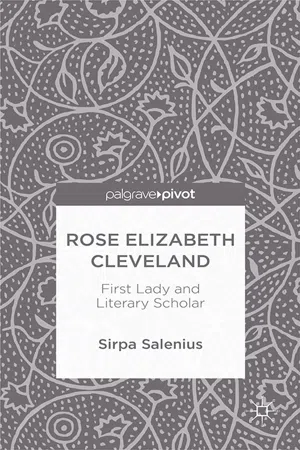
eBook - ePub
Rose Elizabeth Cleveland: First Lady and Literary Scholar
First Lady and Literary Scholar
- English
- ePUB (mobile friendly)
- Available on iOS & Android
eBook - ePub
Rose Elizabeth Cleveland: First Lady and Literary Scholar
First Lady and Literary Scholar
About this book
Rose Elizabeth Cleveland was the First Lady of the United States when she assisted her brother, Grover Cleveland. She was also a literary scholar, novelist, and a poet who published work that empowered women. This book positions Cleveland in the historical context of the early twentieth century, when she helped shape female subjectivity and agency.
Information
1
Literary Lady at the White House
Abstract: Throughout her life, Rose Cleveland challenged traditional gender-specific expectations and steered away from embracing conventional women’s roles, both publicly and privately. She took advantage of the expanding educational opportunities and emerging professions for women who wished to express their full potential. This chapter discusses the early years of Rose Cleveland—her education, occupation as a teacher, and a budding literary career. It also analyzes her first literary works and examines her role as the First Lady of the United States, when she assisted her brother, then bachelor, Grover Cleveland, who was elected President in 1884. In her personal life and professional careers, Rose Cleveland offered subtle critique of social ideologies and gendered expectations; she supported women’s suffrage, and her literary works were geared to empower women.
Salenius, Sirpa. Rose Elizabeth Cleveland: First Lady and Literary Scholar. New York: Palgrave Macmillan, 2014. DOI: 10.1057/9781137452887.0005.
Rose Cleveland first challenged conventional women’s roles publicly when she became the First Lady of the United States. In her Spanish lace, décolleté, and sleeveless dresses that were part of the First Lady’s wardrobe, Rose Cleveland stood as a representative of the progressive women of her time, publicly defying conventionality as one of the most influential women of the nation. She was an educated intellectual who transcended constructions of nineteenth-century normative identities. She took advantage of the expanding educational opportunities and emerging professions that opened up new avenues for women who wished to express their full potential, and articulated a gender-specific role for women primarily outside their home. This chapter will discuss the early years of Rose Cleveland—her education, occupation as a teacher, and budding literary career—and will look at her first appearance in the public sphere.
Rose Elizabeth “Libbie” Cleveland was born on 13 June 1846 in Fayetteville (New York) as the youngest sibling of the Cleveland family that included five girls and four boys. Her parents—father, who was a noted Presbyterian clergyman, Reverend Richard Cleveland, and mother Anne Neal Cleveland—were descendants of the colonial stock but with very modest financial means (Welch 21–22). Their youngest daughter, Rose, developed her remarkable character and her passionate enthusiasm that she expressed in all her endeavors through her love of literature, religious calling, and concern for others. Her unconventional ways found an expression early in life when Cleveland contested conservative models of femininity, preferring, instead, a more active life commonly associated with boys; she had always preferred outdoor activities to domestic chores.
In 1853 the Cleveland family moved to Holland Patent (New York) where Cleveland’s father passed away six months after they had settled down, and her older brother, Grover, took over the responsibility of covering the family’s expenses (Tugwell 7). From Holland Patent, where she would repeatedly return to, her studies took Cleveland to Clinton (New York), where she attended Houghton Seminary. It was one of the most prominent of the many private schools in the area for girls who wished to attend high school in the nineteenth century. Her education consisted of classics, including the study of Greek and Latin. Cleveland excelled in her studies at the school where she was a student from 1864 until her graduation in 1866, when, as a recognition of her noteworthy academic performance, she was selected to read her graduation essay (Petrik 4; Hardy 181). In this way, already as a young girl, Rose Cleveland demonstrated her intelligence and diligence as well as her disregard for gendered expectations.
Patriarchal society, in charge of dictating gender-based norms, traditionally limited the range of women’s choices for education and professions, but the more forward-looking women actively participated in developing new cultural models. Traditionally teaching was considered an acceptable occupation for women, especially those representing the middle classes, whose options for work continued to be limited. Modern women, who campaigned for women’s acceptance in professions conventionally accessible to men only, formed networks of solidarity to surmount social and economic obstacles in their paths toward self-expression. Among them was Cleveland, who from an early age, was used to earning her own living. Desirous to obtain financial autonomy and to employ her education and experience to creating an independent, fulfilling, life for herself, Cleveland started pursuing an academic career. After graduation, she became a teacher of literature and history at the Houghton Seminary for a short time, less than two years, after which she took on teaching responsibilities at the Collegiate Institute at Lafayette (Indiana) for a year. In 1867, she became a teacher of literature (English Criticism), mathematics, and Latin at the Collegiate Institute, which was a preparatory school for college. The Institute stressed equality of sexes, which fit Cleveland’s own social views. From the Collegiate Institute her career took Cleveland to Hamilton College, and from there to a private girls’ school in Muncy, Pennsylvania, where she taught until she fell ill and had to return to her childhood home, the Weeds, located in Holland Patent, near Utica (New York). Once back in her childhood home, she started working at her alma mater to lecture in history. During the years she lived at the Weeds, she was taking care of her mother, until she passed away in 1882 (Encore! 4; Petrik 3–5; Hardy 181).
Cleveland enjoyed economic independence, which was crucial to the emancipation of women, who worked to expand the opportunities available to them for pursuing professional careers. In this way, being financially independent was intertwined with self-expression and professional fulfillment. After her mother’s death, Cleveland prepared a lecture series on medieval history that she presented at Houghton Seminary, the Elmira Female Academy, and Miss Grahm’s [sic] School in New York (Petrik 4–5). Her career advanced rapidly, thus demonstrating Cleveland’s ambition and capacity to shoulder responsibility. She continued teaching and lecturing while expanding the scope of her aspirations to include publications and editorial tasks. Her responsibilities grew as her career progressed: she started to teach the senior and post graduate classes in American history in New York City and became involved in the editorial management of the American Magazine of History, a journal that published her lectures delivered at the school (“Miss Cleveland’s Plans,” The New York Times, 8 May 1887, n.p.). For a woman to become a historian was more uncommon than choosing to teach, for example, literature or music. Cleveland, however, successfully completed the assignments given her in those initial years of her career as a teacher, lecturer, and writer. She exceeded the standard expectations set for teachers working in higher education when she became well-known for her speeches and was sought-after as a speaker (Petrik 5). Her educational background and academic achievements were out-of-the ordinary and stood as a proof of her brilliance and ambitions.
In addition, Cleveland demonstrated her concern for others and interest in female bonding early in her life. Her first community project, “the Joan d’Arc Historical Society,” was a young women’s secret society whose purpose was to raise funds to improve her home town’s cemetery (see Ure). Its members studied history and literature and worked on improvement projects within their community (Tomaino 118). Cleveland demonstrated her interest in social improvement through the activities she engaged in as a member of the Joan d’Arc Historical Society, but it was also apparent in her academic positions, teaching at schools that emphasized egalitarianism between sexes. Her vast intellectual and cultural interests ranged from literature to history to theater and arts. It is unsurprising that also her social life revolved around culture, and many of her friends were theatrical or literary professionals and several of them supported reform and women’s suffrage movements, just like Cleveland herself. Her passion for literature found an outlet when she started to express her talent through her literary activities: she first wrote and translated poems, then published scholarly studies and fiction.
Cleveland’s first literary works were two poems which she contributed to the Independent. They were published in June 1884 and April 1885. She also submitted to the same magazine a third poem, an angry protest, which was never published (see Letter to William Hayes Ward with notice by him, 15 August 1885; it is unclear what her objection concerned; I have been unable to locate these poems). Writing poetry—sentimental, romantic, and “feminine” poems—was considered an acceptable mode for women to express themselves publicly, but it was more difficult for them to publish more forceful expressions of opinions, even in narrative form or verse. The English poet Elizabeth Barrett Browning, whom Cleveland greatly admired, was among the women who published poems that addressed political and ideological concerns; her poems engaged in such contemporary issues as slavery, gender equality, and the Italian Risorgimento or unification movement. In addition to poetry, travel writing and sentimental fiction were genres commonly assigned to female writers because these forms of literary expression enhanced the view of them as emotional and fragile rather than intellectual figures, which corresponded to the period’s expectations concerning womanhood. Cleveland’s works, however, ranged from poetry to religious and historical books and essays, to fictional stories with radical endings, and included writings that were aimed at girls and women with the intention of empowering them. Even her sentimental novel and short story that explored such social institutions as marriage and home, offered alternative views for her female readers. Her writings, indeed, challenged the idealization of domesticity while exploring options for expressing womanhood. In other words, many of her publications questioned patriarchal norms and gender ideologies.
Around the same time as her poems appeared in print, Cleveland was busy preparing some of her first academic publications. In May 1885, she was nearly finished organizing a collection of lectures delivered at Elmira for publication under the title “Sketches of History” (“Miss Cleveland as an Authoress,” The New York Times, 24 May 1885, n.p.). As a prolific, ambitious, and creative writer, Cleveland was successful in finding a publisher for her first book which appeared in the same year that her poems came out in print. According to the New York Times several publishers had shown interest in Cleveland’s manuscript of history sketches, and according to the Boston Daily Globe, the book came out simultaneously in London and New York (“Miss Cleveland’s Book,” 7 July 1885, 1).
In 1885 she, then, published her first literary and historical study, a full-length book titled George Eliot’s Poetry and Other Studies, which she had written prior to her responsibilities at the White House, right before taking up the role as First Lady. The book, which Cleveland dedicated to her countrywomen, received positive reviews and went through 12 editions, thus earning her $25.000 (Petrik 6; Obituary). One reviewer called the author “delightfully emphatic” asserting that her essays “glow with enthusiasm and will leave a vivid impression,” while another found the style “vigorous.” Although the latter review complemented Cleveland for the “freshness in the way of presentation, earnestness of the writer and her evident desire to apply those lessons of history to modern, every-day life in such a way that they may help young and growing people,” the reviewer, in a demeaning attitude, found the book suitable for simple, superficial, obtuse women. The reason the study was suitable for a female audience, according to the reviewer, was because women “are not now interested in such subjects” and hence the author, also a woman, had treated the topics of history and literature “with reflections without going very deeply into the philosophy of the subjects.” The reviewer did, however, acknowledge the public’s enthusiastic “unprecedented” response to the publication of Cleveland’s first book informing that “Nearly three editions were exhausted in this city [Boston] today” (“Miss Cleveland’s Book,” The Washington Post, 26 Jul 1885, 4; “Miss Cleveland’s Book. It Is Dedicated to Her Countrywomen,” Boston Daily Globe, 7 Jul 1885, 1; see also reviews in The Boston Daily Globe, 26 May 1885 and The Washington Post, 31 May 1885). Three editions that were exhausted in one day, in one city, would have been an accomplishment for any author, let alone a nineteenth-century authoress who had written a historical and critical study. Although newspapers had a tendency to exaggerate, it was clear that an enthusiastic reception greeted the publication of the historical sketches, which was a great achievement for Cleveland, a writer, whose first book it was and who had to affront the critical audience’s gender prejudice.
The popularity of Cleveland’s George Eliot’s Poetry and Other Studies lies in the author’s capacity to translate historical events to a general audience in simple language accessible to all. The book starts with Cleveland’s analysis of George Eliot’s poems, which she compared to those of Elizabeth Barrett Browning, who was one of the most celebrated poets of the nineteenth century. In her definition of what poetry should be, Cleveland shared the Romantic poets’ notion concerning the natural flow of emotions. Poetry, she wrote, “must be the natural manner of the poet” (George Eliot 11). This first essay of the collection concentrated on proving why George Eliot’s poems, in Cleveland’s view, were not poetry. She listed elements that she perceived as lacking. For instance, in her view, poetry should appeal to an intelligent mind, to stir emotions, and be an expression of an artistic talent that would be immortalized in the verses: “Let verse have every quality which delights sense, captivates intellect, and stirs the heart, yet lack that ray which, coming from a sun beyond our system, reaches, blends with, vivifies, and assures the intimation of and longing for immortality in man—lacking this, you have no poetry” (Cleveland, George Eliot 14). And according to Cleveland, Eliot as a poet had been unsuccessful in capturing that ray of sun to illuminate her words and rhymes. In addition, Cleveland continued, George Eliot had failed to provide new insight into feelings and experiences of life so as to enhance the lives of readers as a true poet should: “the poet must ever open and widen our horizon,” Cleveland concluded (George Eliot 15). The blatant statement concerning the role of a poet renders evident the fact that starting from her first publications Cleveland’s own goal as well was to widen the horizons of her readers.
Her essay continued with a closer examination of the form, intent, and significance of the genre. What made poems poetry, according to Cleveland’s analysis, was the expression of imagination, beauty, morality, and goodness; poetry should be sensuous and spiritual and should deal with humanity in all its expressions. In this way, true poetry should give something to the reader (Cleveland, George Eliot 16–18). She portrayed the task of poets as a highly challenging activity full of responsibilities towards readers, which placed poets into the male-dominated sphere of intellectuality and rational thinking. Her examples of poets whose words captured the essence of humanity included John Milton, Heinrich Heine, Lord Byron, Algernon Charles Swinburne, and the already mentioned Elizabeth Barrett Browning, whose verse she used to summarize her theories concerning poetic expression:
[...] Inward evermore
To outward, so in life and so in art,
Which still is life. (George Eliot 22)
In conclusion, Cleveland gave credit to Eliot’s writing when she likened it to that of Plato and Shakespeare. She juxtaposed Eliot, Plato, and Shakespeare and with such linking she elevated Eliot’s (a female author’s) writing among the masters of classic philosophical thought and drama who had influenced Cleveland. However, in the final analysis, she insisted on “The Spanish Gypsy,” for example, not being poetry: “George Eliot’s pages are a labyrinth of wonder and beauty; crowded with ethics lofty and pure as Plato’s; with human natures fine and fresh as Shakespeare’s; but a labyrinth in which you lose the guiding cord!” she opined. “I cannot allow her verse to be poetry,” she concluded. “She is the raconteur, not the vates; the scientist, not the seer” (Cleveland, George Eliot 23). What seemed to lack, then, was the inspirational spirit, the spirituality of a prophet, which in Eliot’s poems was substituted with a scientist’s descriptive narration. In other words, while rejecting Eliot as a poet, which would have linked her to a form of literary expression conventionally deemed acceptable for women, Cleveland found her work comparable to Plato’s and defined the authoress a scientist, thus associating her with a sphere commonly assigned to men. In this way, she used a subtle strategy to challenge gender compartmentalization.
The following essay of the collection no longer dealt with poetry or literature, but veered on philosophy. Indeed, it was a philosophical pondering on “Reciprocity.” Cleveland started the chapter by paraphrasing Shakespeare and expressing her view on people’s relations with each other:
All the world’s a stage, and men and women are the actors [...] doubtless you and I occasionally drop the common gait and slip into a grandiose stage-walk; doubtless we assume a rôle we were not born to, and play our little play upon occasions, and shall continue to do so until the final drop of the curtain. But I think that to say all the world is a market, and men and women are the buyers and the sellers, would have in it more of truth if less of poetry. (George Eliot 27)
Hers was a less poetic and more practical metaphor than Shakespeare’s to introduce her approach to illustrating human interaction. Through the image she created of the market scene, social relations became firmly rooted in everyday reality and specifically associated with gender. From Shakespeare she moved on to her own theories concerning the relationship between men and women and continued by explaining why, in her opinion, the metaphor of a market was more appropriate in this context than that of a play with its actors on stage.
According to Cleveland, people were related to each other through continuously giving and taking, which meant that it was impossible for anyone to be truly independent, to rely merely on oneself (George Eliot 28). This idea seems to contradict her own desire for independence, but her point concerned the significance of people’s interaction with each other. In addition, she argued that reciprocity involved manners, attitudes, human exchange, intellectual life, and reciprocity of thought, which, according to Cleveland, was best exemplified by Elizabeth Barrett Browning, whose conversation, “it is said, was pre-eminently tête-à-tête” (George Eliot 35). Once again she referred to the celebrated poetess, using her as an example to demonstrate the validity of her theories and ideals. Since “[m]anners are of the surface,” which made people see other as they presented themselves to outsiders, it was important, she argued, to be honest in the representation, so that it would reflect who we truly were. “What is our thought within us, what is it without? When a high thought comes, do we fling it abroad with liberal soul, or do we fold it away in a napkin that becomes its grave-cloth? If we do t...
Table of contents
- Cover
- Title
- Introduction
- 1 Literary Lady at the White House
- 2 Profession: Writer and Editor
- 3 Same-Gender Relationships in Fiction
- 4 Life with Evangeline Whipple
- Conclusions
- Works Cited
- Index
Trusted by 375,005 students
Access to over 1.5 million titles for a fair monthly price.
Study more efficiently using our study tools.
Frequently asked questions
Yes, you can cancel anytime from the Subscription tab in your account settings on the Perlego website. Your subscription will stay active until the end of your current billing period. Learn how to cancel your subscription
No, books cannot be downloaded as external files, such as PDFs, for use outside of Perlego. However, you can download books within the Perlego app for offline reading on mobile or tablet. Learn how to download books offline
Perlego offers two plans: Essential and Complete
- Essential is ideal for learners and professionals who enjoy exploring a wide range of subjects. Access the Essential Library with 800,000+ trusted titles and best-sellers across business, personal growth, and the humanities. Includes unlimited reading time and Standard Read Aloud voice.
- Complete: Perfect for advanced learners and researchers needing full, unrestricted access. Unlock 1.5M+ books across hundreds of subjects, including academic and specialized titles. The Complete Plan also includes advanced features like Premium Read Aloud and Research Assistant.
We are an online textbook subscription service, where you can get access to an entire online library for less than the price of a single book per month. With over 1.5 million books across 990+ topics, we’ve got you covered! Learn about our mission
Look out for the read-aloud symbol on your next book to see if you can listen to it. The read-aloud tool reads text aloud for you, highlighting the text as it is being read. You can pause it, speed it up and slow it down. Learn more about Read Aloud
Yes! You can use the Perlego app on both iOS and Android devices to read anytime, anywhere — even offline. Perfect for commutes or when you’re on the go.
Please note we cannot support devices running on iOS 13 and Android 7 or earlier. Learn more about using the app
Please note we cannot support devices running on iOS 13 and Android 7 or earlier. Learn more about using the app
Yes, you can access Rose Elizabeth Cleveland: First Lady and Literary Scholar by S. Salenius in PDF and/or ePUB format, as well as other popular books in Politics & International Relations & Literature General. We have over 1.5 million books available in our catalogue for you to explore.